Packaging and packaging waste regulation: PPWR essentials


Disclaimer: New EUDR developments - December 2025
In November 2025, the European Parliament and Council backed key changes to the EU Deforestation Regulation (EUDR), including a 12‑month enforcement delay and simplified obligations based on company size and supply chain role.
Key changes proposed:
- New enforcement timeline: 30 December 2026 for large/medium operators, 30 June 2027 for small/micro operators
- Simplified DDS: One-time declarations for small and micro primary producers
- Narrowed scope: Most downstream actors and non‑SME traders would no longer need to submit DDSs
- New DDS requirement: Estimated annual quantity of regulated products must be included
These updates are not yet legally binding. A final text will be confirmed through trilogue negotiations and formal publication in the EU’s Official Journal. Until then, the current EUDR regulation and deadlines remain in force.
We continue to monitor developments and will update all guidance as the final law is adopted.
- PPWR obligations are assigned by supply chain role: manufacturers must conduct conformity assessments and issue a Declaration of Conformity per packaging type, while importers whose brand appears on the packaging are reclassified as manufacturers under Article 21.
- PPWR applies in phases, with substance restrictions taking effect August 12, 2026, recyclability grades and recycled content targets from 2030, and digital identifier and labeling requirements in 2027 and 2028 respectively.
- Coolset's PPWR playbook walks compliance teams through every workstream, from role identification and packaging portfolio mapping to supplier data collection and Declaration of Conformity preparation.
Packaging touches every product placed on the EU market. With the Packaging and Packaging Waste Regulation (PPWR) applying from August 12, 2026, every company handling packaged goods in the EU needs to understand what the regulation requires, when it applies, and what compliance looks like in practice.
For sustainability managers at mid-market companies, PPWR is not a distant concern. The August 2026 deadline is close, substance testing has can take weeks, and supplier documentation takes time to collect. The companies that wait until Q2 2026 to start will face gaps they cannot close before the deadline.
This guide covers what PPWR is, who it applies to, what it requires, and how to prepare your organization for compliance.
What is the packaging and packaging waste regulation?
The Packaging and Packaging Waste Regulation (PPWR) is Regulation (EU) 2025/40, published in the Official Journal of the European Union on January 22, 2025. It entered into force on February 12, 2025 and will apply from August 12, 2026.
PPWR replaces the Packaging and Packaging Waste Directive (Directive 94/62/EC), which required each EU member state to implement packaging rules through national legislation. Because PPWR is a regulation rather than a directive, it applies directly in all member states without individual national implementation. One set of rules applies across the entire EU market.
The regulation covers all packaging and packaging waste placed on the EU market: consumer sales packaging, grouped packaging, transport and industrial packaging, e-commerce packaging, and packaging used in service and hospitality sectors. If packaging enters the EU market, PPWR applies.
Why PPWR was introduced
Packaging waste is one of the fastest-growing waste streams in the EU. The European Commission introduced PPWR to address that growth by setting binding recyclability requirements, minimum recycled content targets, empty space minimization, and reuse obligations. The regulation is part of the EU's circular economy package, which treats packaging as a resource to be recovered and reused rather than discarded.
PPWR also addresses regulatory fragmentation. Under the previous directive framework, companies operating across multiple EU markets had to navigate different national implementations of the same rules. PPWR eliminates that complexity for businesses operating in two or more member states.
Which companies does PPWR apply to?
PPWR applies to all economic operators placing packaging or packaged products on the EU market. There is no general exemption for small or micro enterprises. The regulation's core requirements, including substance restrictions and the Declaration of Conformity obligation, apply regardless of company size.
Obligations are distributed across three supply chain roles. The manufacturer is the company whose brand name or trademark appears on the packaging. Manufacturers carry the heaviest compliance burden: they must conduct conformity assessments, issue a Declaration of Conformity for each packaging type, and retain technical documentation. The importer is responsible for verifying that manufacturer documentation is complete before placing goods on the EU market. The distributor must make sure that they do not place non-compliant packaging on the market.
A single company can hold different roles for different products. An importer who sells packaged goods under their own brand name becomes the manufacturer for that product under Article 21. For a full breakdown of how roles are assigned and what each role requires, see PPWR supply chain roles explained: manufacturer, importer, distributor, and producer.
Why PPWR matters for your business
Non-compliance with PPWR carries direct commercial consequences. National competent authorities are responsible for enforcement across all EU member states. Authorities can require non-compliant products to be withdrawn from the market, block future sales, and impose financial penalties. Member states set their own penalty levels, but PPWR requires those penalties to be effective and proportionate.
The most immediate consequence is market access. Packaging that does not meet PPWR requirements cannot legally be placed on the EU market from August 12, 2026 onwards. For companies distributing products across EU markets, that means no sales until compliance is confirmed and documented.
Business benefits beyond compliance
Under PPWR, national EPR fees are required to become eco-modulated. Packaging will be measured against sustainability performance standards, including recyclability and recycled content, with better performing packaging resulting in lower EPR fees.
PPWR also creates competitive advantages for companies that prepare early. Packaging that scores well on recyclability is increasingly requested by large retailers and procurement departments that have set packaging sustainability commitments ahead of the regulatory timeline. Achieving recyclability grade A or B under PPWR positions products favorably in these procurement processes.
Reuse systems, required for certain packaging categories from August 2026, create infrastructure that reduces material costs over time once established. Companies with documented recycled content and recyclability data are also better positioned for reporting requirements under CSRD and customer ESG questionnaires.
For a full breakdown of what applies from August 2026 and what comes later, see PPWR compliance deadlines explained: what applies from August 2026 and what comes later.
{{product-tour-injectable}}
Key requirements of PPWR
PPWR sets requirements across five areas: substance restrictions, packaging minimization, recyclability, recycled content, and administrative documentation. Not all requirements take effect on August 12, 2026. The regulation introduces a phased schedule, with design requirements on recyclability and recycled content applying from 2030.
Substance restrictions (August 2026)
From August 12, 2026, food-contact packaging containing PFAS at or above specified concentration limits cannot be placed on the EU market. This applies to all food-contact packaging regardless of material type. There is no grace period and no stock exhaustion allowance for this deadline.
PPWR also maintains restrictions on heavy metals in packaging, including lead, cadmium, mercury, and hexavalent chromium. Concentration limits for heavy metals are set at 100 parts per million total across all four substances, consistent with limits carried over from the previous directive.
Substance test results for PFAS and heavy metals require lab work and can take processing time. Companies placing food-contact packaging on the EU market should initiate testing now if they have not done so.
Packaging minimization and void space (August 2026)
From 1 January 2030, or three years after the Article 24(2) implementing act, grouped, transport and e-commerce packaging must not exceed 50% empty space. Sales packaging does not have a maximum void space threshold, instead operators must reduce empty space to the minimum necessary and prove this.
This requirement applies to packaged products sold online and shipped to consumers. Companies using oversized boxes for standard product shipments will need to redesign packaging formats or document why current volumes are technically necessary.
Recyclability requirements (from 2030)
PPWR introduces a recyclability grading system under Annex II that assigns each packaging unit a grade from A to E based on the percentage of the packaging that can be effectively recycled by weight.

From January 1, 2030, only packaging achieving a minimum recyclability grade of C may be placed on the EU market. Recyclability conformity assessments are not required until 2030, but the grading criteria are defined now, so companies can assess where their packaging stands against future requirements.
For a detailed guide to the grading system by packaging material and category, see PPWR recyclability grades and recycled content targets: what importers need to know.
Recycled content requirements (from 2030)
From January 1, 2030, plastic packaging must contain minimum percentages of post-consumer recyclate (PCR). Targets vary by packaging category and are set to increase further from 2040.
- Contact-sensitive plastic packaging made from PET: 30% recycled content by 2030
- Contact-sensitive plastic packaging made from other plastics: 10% recycled content by 2030
- Non-contact-sensitive plastic packaging: 35% recycled content by 2030
- Plastic packaging for single-use beverage bottles: 30% recycled content by 2030, rising to 65% by 2040
These targets apply to the plastic component of the packaging, not the full packaging unit. Companies using composite packaging (part plastic, part paper or metal) must calculate recycled content of the plastic component.
Declaration of Conformity
A Declaration of Conformity (DoC) is a written declaration by the packaging manufacturer confirming that the packaging meets the requirements of Articles 5 to 12 of Regulation (EU) 2025/40. Manufacturers must prepare one DoC per packaging type and retain it for five years for single-use packaging or ten years for reusable packaging.
The DoC is not filed with an authority. It must be available upon request from national competent authorities, which can request documentation with short notice under PPWR enforcement powers. Upon request from authorities, the DoC must be presented within ten days. The supporting technical documentation that backs the DoC must be retained alongside it.
For a step-by-step guide to preparing the DoC and obtaining it from suppliers, see PPWR Declaration of Conformity: what it is, when you need it and how to get it from suppliers.
Labeling requirements
Article 12 sets distinct labeling obligations with different scopes and deadlines.
By 12 August 2026 the Commission will adopt a methodology for digital material-composition marking. However, the Commission has signaled that it is not prioritizing this implementing act.
From 12 February 2027, packaging within scope of an extended producer responsibility (EPR) scheme must carry a digital EPR compliance identifier (e.g. by means of a QR code).
From 12 August 2028, or 24 months after the relevant implementing acts, harmonized waste-sorting labels must be applied to packaging to guide consumers and end-users on how to separate and dispose of packaging correctly. The specific symbols and formats have yet to be defined.
From 12 February 2029, or 30 months after the relevant implementing act, reusable packaging must bear a label that indicates it is reusable. Further information regarding the reuse system, collection points and rotation tracking can be provided via QR code or a similar digital carrier.
How to prepare for PPWR
Preparing for PPWR requires action across four workstreams: role identification, packaging portfolio mapping, supplier data collection, and documentation. The sequence matters. Role identification drives which obligations apply to each product, and that drives what data needs to be collected before any documentation can be completed.
Step 1: Determine your PPWR role per product
Start with role identification. For each product, determine whether your company is the manufacturer, importer, or distributor under PPWR. The classification is not based on company type but on what each company does for each product.
If your brand name or trademark appears on the packaging, you are the manufacturer. If you import packaged goods produced by another company and your brand appears on the label, Article 21 reclassifies you as the manufacturer. This has significant documentation implications: as the manufacturer, you are responsible for the full conformity assessment and Declaration of Conformity.
For a practical guide to Article 21 and the conditions under which importers become manufacturers, see PPWR roles explained: when importers become manufacturers under Article 21.
Step 2: Map your packaging portfolio
Build a complete inventory of every packaging format used across your product range. Categorize each by material type (plastic, glass, metal, paper, wood, composite), packaging function (consumer, grouped, transport, e-commerce), whether it is food-contact packaging (PFAS restrictions apply), and who manufactures the packaging (internal or external supplier).
Flag packaging types that are likely to require immediate action: food-contact packaging for PFAS testing, e-commerce packaging for empty space assessment, and any packaging that is currently non-recyclable or uses no recycled content (to understand future exposure from 2030 requirements).
Step 3: Collect supplier documentation
For each packaging type where your company is the manufacturer, you need technical documentation from your packaging supplier. Request the following from each supplier:
- Material composition per packaging type
- Substance test results for PFAS limits and heavy metal concentrations
- Recyclability assessment data (recyclability grade under Annex II methodology)
- Technical documentation per Annex VII module requirements
- Current recycled content percentage by material
Many packaging suppliers are working through multiple PPWR documentation requests simultaneously. Send structured requests with clear templates and explicit deadlines. Unformatted or vague requests consistently produce slower and less complete responses.
Step 4: Complete conformity assessment and issue the DoC
Once supplier data is collected, assess each packaging type against the applicable requirements. For substance restrictions applying from August 2026, the assessment must be complete before that date. All these results should be documented in the technical documentation. Sign the Declaration of Conformity and retain it alongside the supporting technical file.
The DoC is signed once per packaging type and remains valid until the packaging changes. It is not an annual filing. If packaging design, material composition, or supplier changes, the DoC must be updated and the conformity process repeated.
Step 5: Plan for 2027 and 2028 requirements
Digital identifiers (2027) and harmonized labeling (2028) involve packaging design changes. These processes require thorough long-term planning to adjust manufacturing and procurements cycles appropriately. Starting the planning and supplier briefings for these requirements in 2026 is realistic. Starting in 2027 is not.
Common challenges and how to address them
Supplier readiness is the most common bottleneck. Many suppliers, particularly those based outside the EU, are unfamiliar with PPWR documentation requirements. Providing structured request templates, a brief explanation of the regulation, and clear deadlines consistently produces better results than general inquiries.
PFAS testing capacity is constrained across the EU. Accredited laboratories are processing a significant volume of test requests ahead of the August 2026 deadline. Companies that start testing in early 2026 may face waiting times that push results past the compliance date.
Internal role clarity is another challenge. In mid-market companies, PPWR responsibilities often sit across legal, procurement, sustainability, and logistics teams with no single owner. Designating a clear owner per compliance workstream before data collection begins prevents gaps from emerging between teams.
{{custom-cta}}
PPWR timeline and deadlines
PPWR applies in a phased schedule. Most immediate obligations take effect on August 12, 2026. Design and content requirements apply from 2030, with further targets from 2040.
- January 22, 2025: PPWR published in the EU Official Journal as Regulation (EU) 2025/40
- February 12, 2025: PPWR entered into force
- August 12, 2026: substance restrictions (PFAS for food-contact packaging, heavy metals), reuse system requirements take effect, recyclability basis
- 12 February 2027: EPR digital compliance identifier required to signal EPR compliance; does not include composition/recyclability data
- 12 August 2028: harmonized waste-sorting labels required
- 12 February 2029: reusable packaging labeling required
- January 1, 2030: minimum recyclability grade C required for all packaging; recycled content targets for plastic packaging take effect; Annex V restrictions on specific single-use plastic packaging formats apply; empty space and minimization
- 2040: higher recycled content targets apply across all plastic packaging categories
PPWR does not provide a phased schedule for smaller companies. The August 2026 requirements apply to all economic operators regardless of company size. The regulation's core requirements are not size-gated.
For a detailed breakdown of each deadline and what it requires in practice, see PPWR compliance deadlines explained: what applies from August 2026 and what comes later.
For a broader view of how PPWR sits alongside EUDR, CSRD, CBAM, and other EU supply chain regulations, see which EU regulations affect your supply chain? EUDR, CSRD, PPWR, CBAM and more.
How Coolset helps with PPWR compliance
Coolset's PPWR compliance platform is built for companies managing packaging compliance across multiple product lines and supplier relationships.
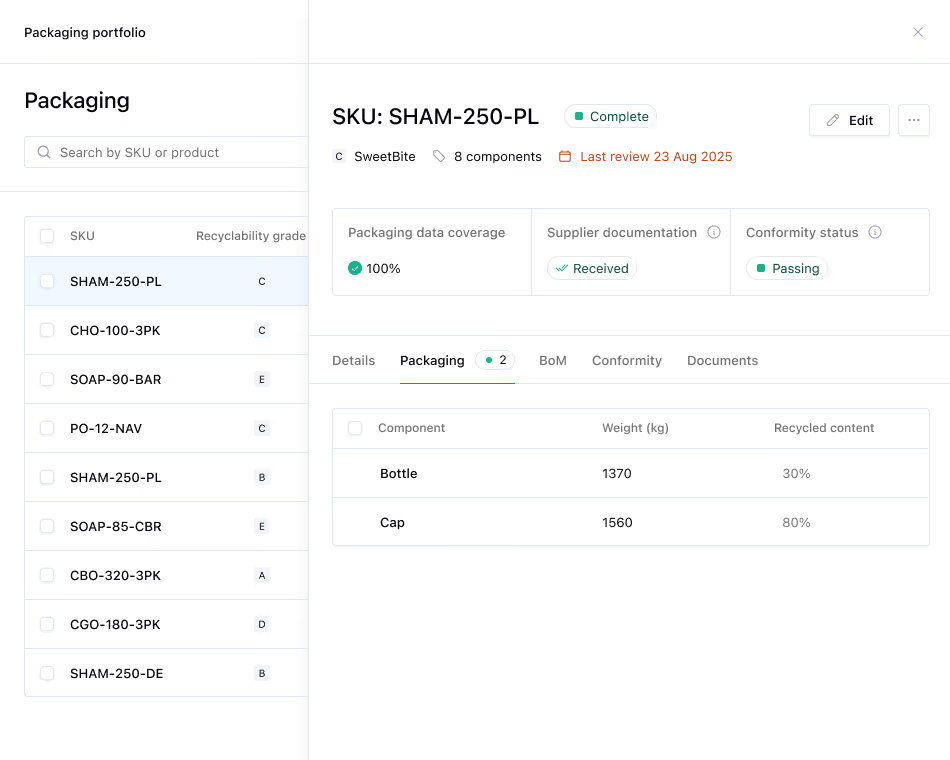
The platform automates supplier data collection. Structured requests go out to packaging suppliers through the platform, and responses are tracked centrally. Compliance teams can see which packaging types have complete documentation and which have outstanding gaps, without chasing suppliers individually via email.
Coolset provides Declaration of Conformity templates aligned with Regulation (EU) 2025/40, pre-populated with company and product information. Once supplier documentation is received, the DoC can be completed and stored in the same system, with five-year or ten-year retention requirements tracked automatically.
A compliance dashboard shows the status of each packaging type against PPWR requirements, with deadline tracking and a clear view of where gaps remain. This is particularly useful for mid-market companies managing tens or hundreds of packaging SKUs across multiple markets.
To evaluate what to look for when choosing a PPWR compliance tool, see how to evaluate PPWR compliance software: 9 questions to ask before you buy.
Frequently asked questions about PPWR
What is the packaging and packaging waste regulation?
The Packaging and Packaging Waste Regulation (PPWR) is Regulation (EU) 2025/40, a directly applicable EU regulation that governs all packaging and packaging waste placed on the EU market. It replaces the previous Packaging and Packaging Waste Directive and applies uniformly across all EU member states from August 12, 2026 without individual national implementation.
Who does PPWR apply to?
PPWR applies to all companies placing packaging or packaged goods on the EU market: manufacturers, importers, and distributors. There is no general exemption for small or micro enterprises. The role a company holds for each product determines which specific obligations apply.
When does PPWR apply?
Most PPWR requirements apply from August 12, 2026. Later requirements include digital identifiers (2027), harmonized labeling (2028), minimum recyclability grades and recycled content targets for plastics (January 1, 2030), and higher recycled content targets (2040).
What happens if a company does not comply with PPWR?
Non-compliant packaging cannot legally be placed on the EU market. National competent authorities can require product withdrawal and impose financial penalties. PPWR requires member states to set penalties that are effective, proportionate, and discourage non-compliance, though each member state sets its own penalty levels.
What is a Declaration of Conformity under PPWR?
A Declaration of Conformity (DoC) is a written declaration by the packaging manufacturer confirming that the packaging meets Articles 5 to 12 of Regulation (EU) 2025/40. One DoC is required per packaging type. It must be retained for five years (single-use packaging) or ten years (reusable packaging) and made available to national authorities upon request.
Does PPWR apply to companies outside the EU?
PPWR applies based on where packaging enters the EU market, not where a company is incorporated. Non-EU companies selling packaged products into EU member states must comply. In practice, the obligation falls on the importer or authorized representative who places the product on the EU market on behalf of the non-EU manufacturer.
Get PPWR compliant before August 12
.webp)

on mobile screens
to experience this demo.


↘ Check if your documentation meets PPWR requirements
This free compliance checker scans your packaging documentation and maps it against mandatory PPWR data requirements, giving you a clear view of your compliance status. Get actionable insights on documentation gaps before they become compliance issues.

.webp)