PPWR recyclability grades and recycled content targets: what importers need to know


Disclaimer: New EUDR developments - December 2025
In November 2025, the European Parliament and Council backed key changes to the EU Deforestation Regulation (EUDR), including a 12‑month enforcement delay and simplified obligations based on company size and supply chain role.
Key changes proposed:
- New enforcement timeline: 30 December 2026 for large/medium operators, 30 June 2027 for small/micro operators
- Simplified DDS: One-time declarations for small and micro primary producers
- Narrowed scope: Most downstream actors and non‑SME traders would no longer need to submit DDSs
- New DDS requirement: Estimated annual quantity of regulated products must be included
These updates are not yet legally binding. A final text will be confirmed through trilogue negotiations and formal publication in the EU’s Official Journal. Until then, the current EUDR regulation and deadlines remain in force.
We continue to monitor developments and will update all guidance as the final law is adopted.
- Importers are legally on the hook. Under PPWR, EU importers share full legal accountability for packaging compliance. If you sell under your own brand, you must issue the Declaration of Conformity yourself.
- 2030 is closer than it looks. Recyclability grade minimums and recycled content targets (up to 35% for plastics) take effect January 2030. Reformulating materials and rebuilding supply chain documentation takes years.
- Coolset's PPWR module removes the admin burden. It helps manufacturers, importers, and distributors manage compliance documentation and stay audit-ready in one platform.
The EU's Packaging and Packaging Waste Regulation (PPWR), officially Regulation (EU) 2025/40, entered into force in February 2025. It replaces a 30-year-old directive with a directly applicable regulation: no national transposition, no room for member-state interpretation. From 12 August 2026, every piece of packaging sold in the EU must meet design, recyclability and labeling standards. Even though manufacturers play a crucial role for compliance, the final responsibility is on the importer bringing packaging into the EU.
Two of the PPWR's most consequential requirements are recyclability performance grades and mandatory recycled content targets. Understanding both is essential for any importer building a compliance roadmap. For context on the compliance obligations that accompany each role, see the guide to PPWR supply chain roles explained.
What are the obligations for importers under PPWR?
The PPWR applies to all packaging placed on the EU market, including packaging used for imported goods. Importers are classified as economic operators under the regulation and share legal accountability with manufacturers for packaging compliance. Failing to meet requirements can result in enforcement action, product seizures and removal from the EU market.
Under Article 18, importers must verify that their non-EU suppliers have completed a conformity assessment, collect a Declaration of Conformity (DoC) for each packaging type and retain documentation for five to ten years. National and European authorities can request this documentation at any time and importers must respond within ten days.
Under Article 21, importers that place packaged goods on the EU market under their own brand or name are reclassified as manufacturers. This means that they must issue the DoC themselves rather than relying on their supplier.
What are the PPWR recyclability performance grades?
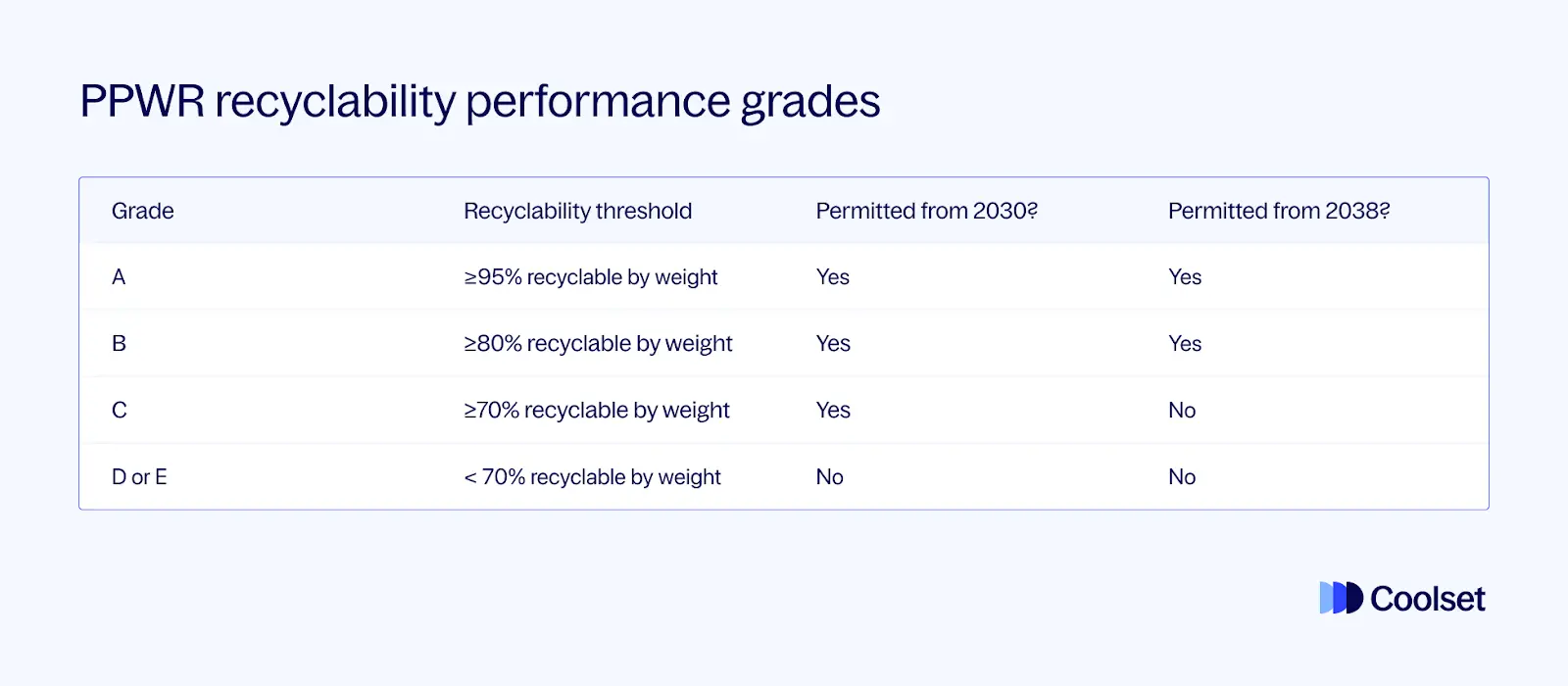
From 1 January 2030, only packaging achieving a minimum recyclability performance grade of C may be placed on the EU market. The grading system is set out in Annex II of Regulation (EU) 2025/40. It measures the proportion of a packaging unit, calculated by weight, that can be effectively recycled. Packaging is assigned one of five grades (A through E):
- Grade A: ≥95% recyclable by weight, permitted in all PPWR timelines
- Grade B: ≥80% recyclable by weight, permitted in all PPWR timelines
- Grade C: ≥70% recyclable by weight, not permitted from 2038
- Grade D or E <70% recyclable by weight, not permitted from 2030
Recyclability can also be impacted if packaging has various components. For example, take a glass jar with a metal lid and a paper label. If the lid and label are easily separated the unit may achieve Grade A. Add a non-recyclable plastic sleeve with no separation mechanism and the grade drops. Multi-material packaging of that kind is where importers will find the most compliance risk. The key is to keep packaging simple and recyclable, so that it can achieve higher grades.
The European Commission will adopt delegated acts by 1 January 2028 setting the formal Design for Recycling (DfR) criteria that underpin grade assessments, per the EUR-Lex summary of the regulation. These criteria will evaluate component separability, sorting and recycling process efficiency and the quality of the output recyclate. The obligations for recyclability obligations will take effect from 1 January 2030 or 24 months after the DfR delegated acts enter into force, whichever is later.
By 2035, the PPWR introduces a further standard: packaging must be recyclable "in practice and at scale." This means it must be processed through real industrial recycling infrastructure across the EU, not just technically recyclable in pilot or lab conditions.
For practical Q&A on the August 2026 recyclability declaration and the 2030 grade system, see the PPWR webinar Q&A.
What recycled content targets apply under the PPWR?
Recycled content targets require manufacturers to incorporate a minimum percentage of recycled material into new plastic packaging, with the specific percentage varying by packaging type. These targets are designed to stimulate demand for recycled plastics and support the transition to a circular economy by ensuring that recycled materials are fed back into the production cycle rather than being displaced by virgin plastics.
Mandatory minimum recycled content thresholds for plastic packaging apply from 1 January 2030, with stricter targets taking effect in 2040. The targets are differentiated by packaging type and polymer category:
Single-use plastic beverage bottles
- 2030: 30% minimum recycled content
- 2040: 65% minimum recycled content
Contact-sensitive PET packaging (excluding beverage bottles)
- 2030: 30% minimum recycled content
- 2040: 65% minimum recycled content
Contact-sensitive plastic, non-PET (excl. beverage bottles)
- 2030: 10% minimum recycled content
- 2040: 35% minimum recycled content
Other plastic packaging
- 2030: 35% minimum recycled content
- 2040: 65% minimum recycled content
.webp)
For non-plastic packaging, material-wide requirements are set:
- Paper and cardboard packaging: 70% recycled content
- Glass packaging: 50% recycled content
- Metal packaging: 25% recycled content
These targets apply to packaging as placed on the EU market. Importers sourcing packaging globally will need documented evidence of recycled content at each supply chain tier, not just declarations from tier-one suppliers.
For many importers, the 10% threshold for contact-sensitive non-PET plastic packaging may look achievable, but the 30% and 35% targets for other categories require meaningful reformulation. Some materials may require switching suppliers or even packaging formats. These big changes are why it is important to start considering how these new rules might affect your business and its products.
How will recyclability grades affect Extended Producer Responsibility fees?
Extended Producer Responsibility (EPR) means that businesses are responsible for packaging after a product has been consumed and is thrown away. This means registering with a national scheme and paying fees that fund collection, sorting and recycling infrastructure. These fees are paid by producers, importers and distributors. Non-EU producers must manage EPR obligations, including fee payments, through an authorised representative appointed in each member state. Depending on the recyclability grade, fees associated with EPR vary. Higher-grade packaging attracts lower EPR fees; lower-grade packaging incurs higher charges. EPR schemes
All EU member states were required to have eco-modulated EPR schemes in place by 2025. From 2030, fee modulation must align with the PPWR grade system. Each member state retains discretion over how it proportions the fees, which means multinational importers should expect variation in EPR cost structures across different markets.
Importers should build a packaging inventory that records the recyclability grade of every packaging type placed on the EU market. This is not just a compliance requirement, it is also a financial planning tool for forecasting EPR costs as the 2030 deadline approaches.
What does PPWR mean for supply chain documentation?
Meeting recyclability grade and recycled content requirements is a documentation challenge as much as a design one. Importers need verifiable records, not just declarations, to substantiate that packaging placed on the EU market meets the applicable thresholds.
The DoC is the central compliance document under the PPWR. It certifies that a specific packaging type meets the sustainability requirements set out in Articles 5 through 12 of Regulation (EU) 2025/40, including recyclability and recycled content. Importers who cannot obtain a compliant DoC from their packaging manufacturer must either switch suppliers or, if they brand-own the packaging, assume manufacturer status under Article 21 and issue the DoC themselves.
{{custom-cta}}
How should importers prepare now?
The PPWR applies from August 2026, with recyclability grade and recycled content thresholds following from 2030. The supply chain engagement required to meet both takes time to build.
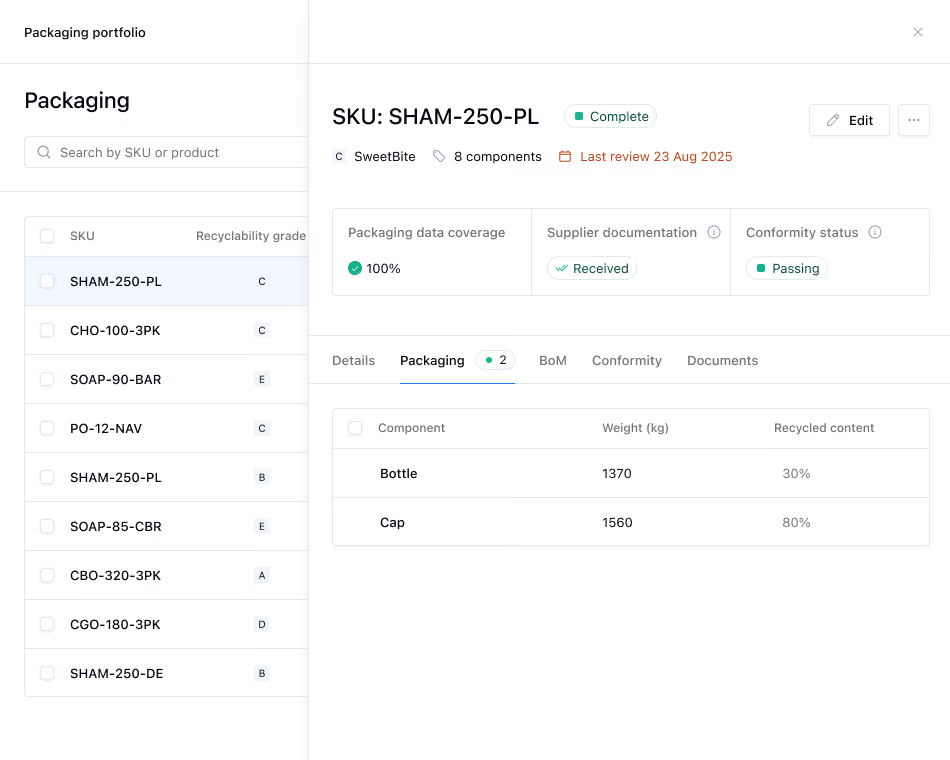
- Audit your packaging portfolio: Identify every packaging type you place on the EU market. Assess material composition and current recyclability performance against the Grade A-to-E scale.
- Engage suppliers early: Request documentation on recycled content percentages, material sourcing and DfR status. If a supplier cannot provide verifiable data, consider switching before 2026.
- Collect DoCs: Under Article 18, you need a DoC per packaging type. If you brand-own the packaging, plan to issue the DoC yourself under Article 21.
- Monitor the 2028 delegated acts: The Commission's delegated acts will finalise the technical grading criteria. Track their publication and reassess your portfolio as soon as they are available.
- Keep your compliance records organised: Market surveillance authorities can request documentation at any time. Records must be retained for five to ten years and made available within ten days.
Platforms like Coolset help compliance teams centralise packaging documentation, track supplier data and manage obligations across multiple regulatory frameworks.
Frequently asked questions
What are the PPWR recyclability performance grades?
The PPWR uses a five-tier system (A to E) to grade packaging recyclability by weight. Grade A requires ≥95% recyclability, Grade B ≥80% and Grade C ≥70%. From 1 January 2030, only Grades A, B and C may be placed on the EU market. From 2038, Grade C will also be phased out.
When do the PPWR recycled content targets take effect?
Mandatory minimum recycled content targets for plastic packaging apply from 1 January 2030 or 24 months after the DfR delegated acts enter into force, whichever is later. Targets for paper, glass and metal packaging also apply from 2030. More stringent plastic targets follow in 2040.
Do PPWR obligations apply to imported goods?
Yes. The PPWR applies to all packaging placed on the EU market regardless of where the goods or packaging were produced. Importers are classified as economic operators and share legal responsibility for packaging compliance with manufacturers.
What happens if packaging does not achieve Grade C or above?
Packaging that falls below Grade C (less than 70% recyclable by weight) cannot be placed on the EU market from 1 January 2030. Non-compliant packaging is subject to enforcement action, including market withdrawal. Grade C will be phased out from 2038.
How is recycled content verified under the PPWR?
Recycled content claims must be substantiated through documented supply chain evidence, with material traceability at each tier. Mass balance approaches are permitted under certain conditions but require recognised third-party certification. Importers must collect and retain supporting documentation from all packaging suppliers.
{{ppwr-document-checker}}
Related: Packaging and packaging waste regulation: PPWR essentials
A guide through documentation, Declaration of Conformity and supplier workflow
.webp)
↘ Check if your documentation meets PPWR requirements
This free compliance checker scans your packaging documentation and maps it against mandatory PPWR data requirements, giving you a clear view of your compliance status. Get actionable insights on documentation gaps before they become compliance issues.

.webp)