PPWR authorised representative: obligations for non-EU companies selling into the EU


Disclaimer: New EUDR developments - December 2025
In November 2025, the European Parliament and Council backed key changes to the EU Deforestation Regulation (EUDR), including a 12‑month enforcement delay and simplified obligations based on company size and supply chain role.
Key changes proposed:
- New enforcement timeline: 30 December 2026 for large/medium operators, 30 June 2027 for small/micro operators
- Simplified DDS: One-time declarations for small and micro primary producers
- Narrowed scope: Most downstream actors and non‑SME traders would no longer need to submit DDSs
- New DDS requirement: Estimated annual quantity of regulated products must be included
These updates are not yet legally binding. A final text will be confirmed through trilogue negotiations and formal publication in the EU’s Official Journal. Until then, the current EUDR regulation and deadlines remain in force.
We continue to monitor developments and will update all guidance as the final law is adopted.
Key takeaways:
- Article 45 of the PPWR requires non-EU companies to appoint an authorised representative in each EU member state where their packaging reaches the direct users, effective 12 August 2026.
- The authorised representative manages EPR registration, packaging data reporting and fee payments on behalf of the non-EU producer.
- A proposed suspension of the AR obligation until 2035 applies only to EU-based producers - non-EU companies are explicitly excluded.
- Coolset's PPWR module helps companies track AR requirements, manage EPR registrations and maintain compliance across member states.
Non-EU companies that sell packaged goods into the EU, directly to end users, face a new obligation under the Packaging and Packaging Waste Regulation (PPWR): appointing an authorised representative in every EU member state where their packaging first reaches the market. This requirement, set out in Article 45 of Regulation (EU) 2025/40, applies from 12 August 2026.
For non-EU manufacturers and e-commerce sellers, the authorised representative acts as the legal bridge between their business and EU extended producer responsibility (EPR) systems. Without one, placing packaging on the EU market is not permitted.
This article explains what a PPWR authorised representative is, who needs one, what the role involves and how to set up the arrangement before the enforcement deadline.
What is a PPWR authorised representative?
A PPWR authorised representative is a natural or legal person established in an EU member state who is appointed by a non-EU producer to fulfil extended producer responsibility obligations on their behalf. The legal basis is Article 45(3) of the PPWR.
The concept is not new in EU product regulation. Authorised representatives exist under REACH, the CE marking framework and medical device regulations. However, the PPWR authorised representative is specific to packaging EPR and carries a distinct set of obligations tied to waste management, registration and reporting.
How it differs from other EU authorised representative roles
- REACH authorised representative: Handles chemical substance registration with ECHA. No overlap with packaging waste obligations.
- CE marking authorised representative: Acts as a contact point for market surveillance authorities regarding product safety and conformity. Under PPWR, the Declaration of Conformity is a separate obligation held by the manufacturer - not the EPR authorised representative.
- PPWR authorised representative: Manages EPR registration, packaging data reporting and fee payments in each member state. This is a waste management role, not a product safety role.
The distinction matters because companies already using authorised representatives for CE or REACH compliance cannot assume the same entity covers PPWR EPR obligations. A separate written mandate is required.
Who needs to appoint an authorised representative?
Under the PPWR, the obligation to appoint an Authorised Representative for Extended Producer Responsibility follows directly from how "producer" is defined in Article 3(1), point (15). Two specific scenarios trigger this requirement.
Scenario 1: You're selling directly to EU end users from outside the EU
Article 3(1), point (15)(c) and (d) makes clear that if you, regardless of where you're established, make packaging or packaged products available for the first time on the territory of a member state, directly to end users, you are the producer in that member state. And as a producer operating there without a physical establishment, you must appoint an AR.
This applies to both non-EU companies and EU companies selling across borders. Some concrete examples:
A US-based supplements brand that ships its bottled products directly to German consumers via its own webshop- A Chinese electronics manufacturer selling packaged devices directly through its own EU-facing e-commerce platform to French buyers
The key trigger is direct-to-end-user supply into a member state where you're not established. Distance selling like webshops, marketplaces, direct fulfilment is explicitly covered by the regulation, regardless of the selling technique used.
Scenario 2: You're an EU company selling cross-border into another member state
This is the scenario many EU businesses overlook. If you are established in one member state but make packaging or packaged products available on the territory of another member state directly to end users, whether transport, service, primary production packaging, or products packaged otherwise, you fall under Article 3(1), point (15)(c) and (d) in that other member state. You are the producer there, and must appoint an AR.
When the importer already fulfills this role
If you are a non-EU company selling your products to an EU-based company, then they are considered the importer, and assume the producer role for EPR purposes. In this case you do not need a separate authorised representative for that member state. The importer is already established in the EU and carries its own obligations under Article 18.
However, if your products enter multiple member states through different channels - some via importers, some via direct sales - you will need authorised representatives for the states where no EU-based importer takes on the producer role.
The proposed suspension for EU-based companies
The European Commission has proposed suspending the authorised representative obligation for EU-based producers until 1 January 2035. This proposal, if adopted, would only apply to producers already established within the EU. Non-EU companies are explicitly excluded from the suspension. For non-EU sellers, the 12 August 2026 deadline stands regardless of whether the suspension is adopted.
{{custom-cta}}
What the authorised representative must do
The authorised representative carries two categories of obligation: core regulatory duties and EPR-specific responsibilities.
Core obligations
- Hold documentation: The authorised representative must keep the EU Declaration of Conformity and technical documentation available for market surveillance authorities on request.
- Provide information to authorities: Upon request from a national market surveillance authority, the representative must supply all information and documentation needed to demonstrate that packaging complies with the PPWR.
- Cooperate on corrective actions: If non-conforming packaging is identified, the authorised representative must cooperate with national authorities on recalls, withdrawals or other corrective measures.
- Serve as the EU contact point: The representative acts as the primary point of contact for regulatory communication between the non-EU producer and EU authorities.
EPR obligations
Extended producer responsibility is the operational core of the authorised representative's role. In each member state covered by the mandate, the representative must:
- Register with the national producer register: Each EU member state maintains a producer register for packaging. The authorised representative registers on behalf of the non-EU company and maintains the registration.
- Register with producer responsibility organisations (PROs): In most member states, producers must join a PRO that organises collection, sorting and recycling of packaging waste. The authorised representative handles this registration and ongoing relationship.
- Submit packaging data reports: PROs and national authorities require periodic reporting on the volumes and types of packaging placed on the market. The representative compiles and submits these reports using data provided by the non-EU company.
- Pay EPR fees: The representative manages fee payments to PROs based on the weight, material type and recyclability grade of packaging placed on the market.
These obligations are country-specific. EPR systems, fee structures and reporting requirements differ across member states. An authorised representative in Germany handles different registration processes and fee calculations than one in France or Spain.
How to appoint an authorised representative
Appointing an authorised representative is a formal legal process. Article 45 requires a written mandate that sets out the scope, duration and terms of the arrangement.
Written mandate requirements
The written mandate is the legal document that authorises the representative to act on the producer's behalf. It must cover:
- Scope: Which member states the mandate covers and which EPR obligations the representative is authorised to handle.
- Duration: The start date and either a fixed end date or the conditions under which the mandate terminates.
- Termination provisions: How either party can end the arrangement, including notice periods and transition requirements to ensure continuity of EPR compliance.
- Data exchange: The non-EU company's obligation to provide accurate packaging data - volumes, materials, weights - on a schedule that allows the representative to meet reporting deadlines.
- Fee responsibility: Who bears the cost of EPR fees, PRO memberships and any administrative charges. The non-EU company typically funds these, but the mandate should be explicit.
The mandate must be documented in writing and available for inspection by national authorities. If an authority requests proof of the arrangement, the authorised representative must be able to produce the mandate.
Choosing an AR provider
Non-EU companies can appoint either an in-house entity or a third-party service provider as their authorised representative.
In-house entity: If your company has an EU subsidiary or office, that entity can serve as the authorised representative. This gives you direct control but requires the entity to have the operational capacity to manage EPR registrations, reporting and fee payments in each relevant member state.
Third-party AR service: Specialist providers offer authorised representative services across multiple EU member states. These providers handle EPR registration, PRO membership, data reporting and fee management as a managed service. When evaluating providers, consider:
- Country coverage: Does the provider operate in all member states where you need representation?
- PRO relationships: Does the provider have established relationships with PROs, or will they need to set up new arrangements?
- Reporting capabilities: Can the provider handle the specific data formats and reporting schedules required by each national system?
- Fee transparency: Are EPR fees passed through at cost, or does the provider mark them up?
- Transition support: If you switch providers, what happens to your existing registrations and reporting history?
The cost of an authorised representative varies based on the number of member states, packaging volumes and complexity of the product portfolio. Budget for both the service fee and the underlying EPR costs, which are calculated per kilogram of packaging by material type.
Liability and enforcement implications
The authorised representative shares legal responsibility for EPR compliance with the non-EU producer. If obligations are not met - whether due to missed registrations, inaccurate reporting or unpaid fees - both the representative and the producer face enforcement action.
What the AR is liable for
The authorised representative is liable for the EPR obligations specified in the written mandate. If the mandate covers EPR registration and reporting in Germany, and the representative fails to register or submits incorrect data, the representative is directly accountable to the German authorities.
However, liability is limited to the scope of the mandate. The authorised representative is not liable for packaging conformity requirements under Articles 5 to 12 - those remain with the manufacturer and importer.
Market surveillance authority powers
National market surveillance authorities can:
- Request documentation from the authorised representative to verify compliance
- Conduct inspections of EPR registrations and reporting records
- Order corrective actions where non-compliance is identified
- Impose administrative penalties for failures in registration, reporting or fee payment
Penalties for operating without an authorised representative
Penalties for non-compliance are determined by individual EU member states, not by the PPWR itself. The regulation requires member states to lay down rules on penalties that are "effective, proportionate and dissuasive." In practice, this means:
- Fines for failing to register with the national producer register
- Fines for placing packaging on the market without an authorised representative where one is required
- Potential market access restrictions - products may be barred from the market if EPR obligations are not met
- Cumulative penalties where non-compliance persists across reporting periods
The amounts vary by member state. Countries with mature EPR systems, such as Germany and France, tend to impose higher fines for registration and reporting failures. Companies selling into multiple member states face enforcement in each jurisdiction independently.
Timeline
The PPWR compliance deadlines are structured in phases, but the authorised representative requirement takes effect at the earliest enforcement date.
- 11 February 2025: PPWR enters into force. The 18-month transition period begins.
- 12 August 2026: General application date. Non-EU companies must have authorised representatives in place. EPR registrations must be active. Market surveillance enforcement begins.
- 1 January 2030: Recyclability grades A-C become mandatory. EPR fees will increasingly reflect recyclability performance, affecting the data the authorised representative must report.
- 1 January 2035: Proposed date from which the suspension of the AR obligation for EU-based producers would expire (if adopted). Non-EU companies are not affected by this suspension.
Preparation steps before August 2026
To meet the 12 August 2026 deadline, non-EU companies should:
- Identify target member states: Map where your packaging first enters the EU market, either through importers, distributors or direct-to-consumer channels.
- Determine where an AR is needed: For each member state, confirm whether an EU-based importer already holds the producer role. Where no importer covers this, an authorised representative is required.
- Select and mandate an AR: Appoint an authorised representative with the right country coverage and operational capacity. Execute the written mandate.
- Provide packaging data: Supply the representative with accurate data on packaging volumes, materials and weights to enable EPR registration and reporting.
- Verify registrations: Confirm that EPR registrations and PRO memberships are active before the enforcement date.
Starting in Q2 2026 leaves limited time. Companies with complex distribution networks across multiple member states should begin the process in Q1 2026 or earlier.
How Coolset helps
Coolset's PPWR module gives non-EU companies and their authorised representatives a centralized system to manage compliance across member states.
- AR requirement tracking: Map which member states require an authorised representative based on your distribution channels and importer arrangements.
- EPR registration management: Track EPR registrations and PRO memberships across member states in one dashboard, with alerts for upcoming deadlines.
- Packaging data collection: Collect and organize packaging volume, material and weight data from your supply chain - the inputs your authorised representative needs for reporting.
- Compliance status dashboard: Monitor which member states are covered, where registrations are pending and where documentation gaps exist.
For companies already using Coolset for EUDR or CSRD compliance, adding PPWR tracking avoids duplicating supplier engagement and data collection across regulatory frameworks.
See how Coolset helps companies manage PPWR obligations across the EU.
Frequently asked questions
What is a PPWR authorised representative?
A PPWR authorised representative is a natural or legal person established in an EU member state, appointed by a non-EU producer to manage extended producer responsibility (EPR) obligations for packaging. The representative handles EPR registration, packaging data reporting and fee payments on behalf of the non-EU company.
Do all non-EU companies need a PPWR authorised representative?
Non-EU companies that place packaging on the EU market need an authorised representative in each member state where they are treated as the producer. If an EU-based importer already assumes the producer role in a given member state, a separate authorised representative may not be required for that country.
When does the authorised representative requirement apply?
The requirement applies from 12 August 2026, when the PPWR's general provisions become enforceable. Non-EU companies must have their authorised representatives appointed and EPR registrations active by that date.
Is the authorised representative the same as a REACH or CE marking representative?
No. The PPWR authorised representative handles packaging EPR obligations - registration, reporting and fee payments for packaging waste. REACH and CE marking representatives cover chemical substance registration and product safety conformity respectively. The roles require separate mandates and may be held by different entities.
What happens if a non-EU company does not appoint an authorised representative?
A non-EU company that fails to appoint an authorised representative where required cannot legally place packaging on the EU market. National authorities can impose fines, restrict market access and take enforcement action. Penalties are set by individual member states and vary in severity.
Can one authorised representative cover multiple EU member states?
In principle, a single entity can serve as an authorised representative in multiple member states, provided it is established or has operations in each one. In practice, most companies appoint a specialist provider with pan-European coverage or use separate representatives per country depending on the complexity of national EPR systems.
Related: PPWR compliance for e-commerce: how to meet empty space rules and marketplace duties in 2026
Practical session on your responsibilities, the packaging data you need, the DoC and how to manage supplier requests

on mobile screens
to experience this demo.


↘ Check if your documentation meets PPWR requirements
This free compliance checker scans your packaging documentation and maps it against mandatory PPWR data requirements, giving you a clear view of your compliance status. Get actionable insights on documentation gaps before they become compliance issues.
PPWR compliance for manufacturers, importers and distributors
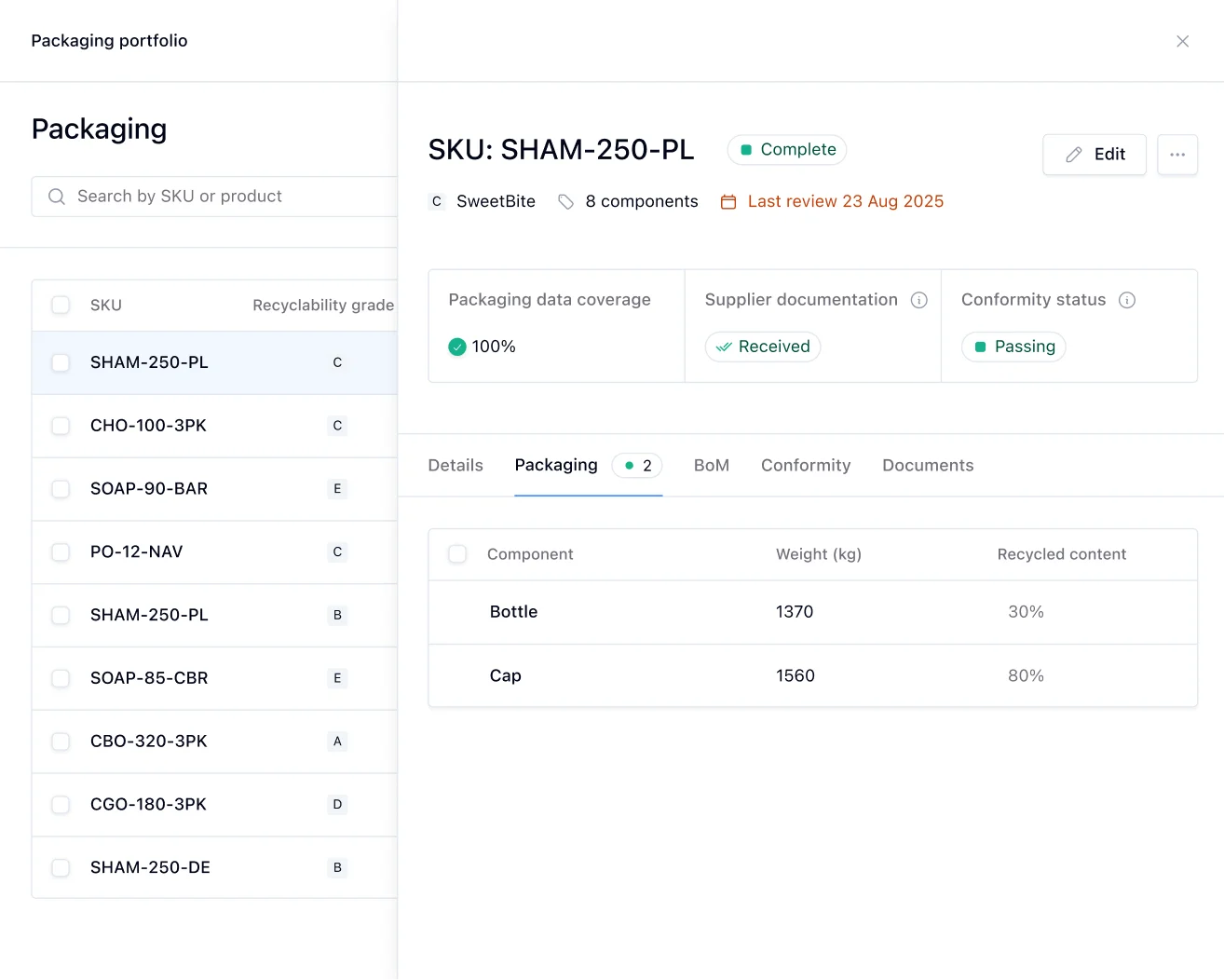
Coolset gives manufacturers, importers and distributors the system to collect proof, track conformity and act on risks - across every SKU, supplier and packaging change.

.webp)