April 30 EUDR simplification 2026: What the Commission's update package means for compliance



Disclaimer: New EUDR developments - December 2025
In November 2025, the European Parliament and Council backed key changes to the EU Deforestation Regulation (EUDR), including a 12‑month enforcement delay and simplified obligations based on company size and supply chain role.
Key changes proposed:
- New enforcement timeline: 30 December 2026 for large/medium operators, 30 June 2027 for small/micro operators
- Simplified DDS: One-time declarations for small and micro primary producers
- Narrowed scope: Most downstream actors and non‑SME traders would no longer need to submit DDSs
- New DDS requirement: Estimated annual quantity of regulated products must be included
These updates are not yet legally binding. A final text will be confirmed through trilogue negotiations and formal publication in the EU’s Official Journal. Until then, the current EUDR regulation and deadlines remain in force.
We continue to monitor developments and will update all guidance as the final law is adopted.
Key takeaways
- The EU Commission published its EUDR simplification package on May 4, 2026: updated guidance, a draft Delegated Act on product scope, and revised IT system rules.
- The December 30, 2026 enforcement deadline is unchanged. The package clarifies obligations – it does not delay enforcement.
- Key changes: only first operators submit a full DDS; annual submissions now allowed; waste and packaging proposed for removal from scope.
The EU Deforestation Regulation has been delayed twice and amended once since it entered into force in 2023. When the December 2025 amendment was adopted, it came with a commitment: the European Commission would conduct a simplification review and publish its findings by 30 April 2026. That review was published on 4 May 2026.
The package is more refinement than reform. The December 2025 amendments already set the main regulatory changes, introducing the downstream operator category and the simplified regime for micro and small primary operators. The May 2026 package largely clarifies how those changes work in practice.
The part most worth paying attention to is the delegated act on product scope. Several HS codes have been added to or removed from Annex I, including the removal of cattle leather products and the addition of a range of palm oil derivatives.
Large and medium operators have until 30 December 2026 to have their due diligence systems in place.
What is in the EU Commission's EUDR simplification package?
The May 2026 package has four components, each addressing a different part of how the regulation operates in practice.
- A simplification review report, assessing the EUDR's administrative burden, particularly for smaller operators
- Updated guidance and a new FAQ edition, clarifying due diligence obligations for downstream operators, re-imports and company groups
- A draft Delegated Act amending Annex I, adjusting which products fall within EUDR scope
- A revised Implementing Regulation on the IT system, adding new functions to support simplified declarations by small primary operators
The Commission confirmed it will not reopen the core EUDR text. The enforcement deadlines remain unchanged: December 30, 2026 for large and medium operators, and June 30, 2027 for small and micro operators on non-timber products.
Product scope: What the delegated act proposes?
The draft Delegated Act amending Annex I makes three types of changes to the list of products covered by the EUDR: exclusions, additions and clarifications. As a delegated act, this document does not require a full legislative vote, but it is not yet binding. Once formally adopted by the Commission, both the European Parliament and the Council have a scrutiny period of typically two months during which either can object.
Products proposed to be removed from the EUDR scope:
- The most significant removal is cattle leather. The current Annex I includes raw hides (HS 4101), tanned hides (HS 4104) and further prepared leather (HS 4107) derived from cattle. All three entries are proposed for deletion, meaning leather goods and leather supply chains would no longer fall under EUDR obligations.
- The delegated act proposes to exclude used and second-hand products across a broad range of rubber and wood categories. Retreaded tyres as a category would be narrowed to cover only tyre treads (HS 4012 90 30) rather than the full retreaded tyre.
- Waste as defined under the EU Waste Framework Directive is also being formally excluded from several entries, including rubber and paper products, bringing the legal text in line with the practical guidance that already existed.
- For paper and pulp, the delegated act proposes to exclude items of correspondence and marketing and information materials from chapters 47 and 48. In practical terms, this means paper-based communications, brochures, catalogues and similar materials fall outside the scope of EUDR obligations, whether they ship alongside a product or are distributed independently.
- Samples used for examination, analysis or testing. This includes samples of negligible value and quantity used to solicit orders, and products undergoing examination, analysis or testing that are completely used up or destroyed in the process, or kept solely for legal or contractual compliance purposes.
Products proposed to be added in scope:
- The largest expansion concerns palm oil derivatives. The current Annex I covers palm oil and its direct fractions in a relatively straightforward way. The delegated act proposes adding a significant number of downstream chemical products that are synthesised using:
- oil palm, including hydrogenated and chemically modified palm oils (HS 1516 20, HS 1518 00)
- crude glycerol from palm processing (HS 1520 00)
- fatty alcohols (HS 2905 16, 2905 17, 2905 19)
- acetic esters (HS 2915 39)
- undecenoic acids (HS 2916 19 10)
- amines and amides (HS 2921 19, HS 2923 90, HS 2924 19)
- soap products (HS 3401 11, HS 3401 20)
- On the coffee side, extracts, essences and concentrates (HS 2101 11 00) are proposed for addition, meaning instant coffee and similar products would now fall within scope.
What is changing but remaining in scope:
- Cattle:
- Live cattle shifts from specific HS subheadings (0102 21 and 0102 29) to the broader "ex 0102" designation.
- A footnote confirms that only specific species will be included in the scope of the regulation (e.g., genus Bos).
- New HS code added in the list of in scope products - ex 0206 21 00.
- Wood:
- Nearly all wood product entries (HS 4401 through 4421) and furniture entries are updated with an "ex" prefix, confirming that only the wood portion of those HS codes derived from relevant commodities is in scope.
- Used and second-hand products are explicitly excluded across the majority of wood entries
What does EUDR simplification mean for downstream operators?
If you are a company that buys EUDR-covered products that have already been placed on the EU market by someone else, you are a downstream operator, and your obligations are significantly narrower than those of the operator who first brought the product into the EU. You do not need to conduct due diligence, submit due diligence statements, or verify that due diligence was properly exercised upstream. What you need is the reference number.
The December 2025 amendment introduced the downstream operator category as one of its most significant changes. Before the amendment, the regulation created the impression that every company in the supply chain needed to conduct full due diligence independently. The amended regulation corrects this by formally distinguishing between the operator who first places a product on the EU market and everyone who handles it further down the chain.
When your supplier is a primary operator, your core obligation is to collect and retain the reference numbers of their due diligence statements or simplified declarations, and keep records of your suppliers and customers. Non-SME downstream operators must also register in the EUDR information system before placing products on the market.
The picture changes if you become aware of new information suggesting a product may not be compliant. In that case you are required to immediately inform competent authorities in the member states where you placed the product on the market, as well as any further downstream operators and traders you have already supplied. For exports, the obligation is to inform the competent authority of the country of production. Non-SME downstream operators must also go a step further and actively verify that due diligence was exercised upstream, and unless that verification confirms negligible risk, they must suspend placing the product on the market.
{{custom-cta}}
What does EUDR simplification mean for micro and small primary operators?
If you are a small producer established in a low-risk country who grows, harvests or raises the commodities you sell directly into the EU market, you are likely a micro or small primary operator, and the regulation treats you differently from larger operators in several ways. The "primary" part of that definition matters: to qualify, you must be the actual producer of the commodities yourself. Intermediaries or traders who buy from farmers and resell, even if they are small companies based in a low-risk country, do not qualify.
The main implications on this new role are:
- Instead of submitting a due diligence statement for every shipment, micro and small primary operators submit a single one-time simplified declaration in the EUDR information system. That declaration covers your operations rather than individual transactions, which significantly reduces the ongoing administrative burden compared to what larger operators face.
- Where standard operators are required to provide precise geolocation coordinates for every plot of land where commodities were produced, micro and small primary operators may use a postal address instead, provided it clearly corresponds to the geographic location of the plots or establishment concerned.
One nuance worth noting for larger companies: the guidance document clarifies that a company exceeding the micro or small thresholds overall can still qualify if it can demonstrate that the parts of its balance sheet, net turnover and average number of employees specifically related to relevant commodities do not exceed the limits of at least two of those three criteria. This is relevant for diversified businesses where EUDR-covered commodities represent only a portion of their overall activity.
What should companies do after the May 2026 simplification package?
The simplification package clarifies the rules. It does not reduce the preparation work that December 30, 2026 compliance requires. Companies that have been waiting for regulatory clarity before acting should start immediately.
Three steps to complete as soon as possible:
- Identify your role: determine whether you are a first operator, downstream operator or trader. The step-by-step EUDR compliance guide includes a role identification framework
- Review your product list against the Annex I changes: check whether any products are newly excluded (waste, packaging) or newly in scope (palm oil soap, instant coffee)
- Update supplier contracts to reflect the first-operator DDS obligation and reference-number collection requirements for downstream operators
An important limitation remains: the country benchmarking (risk classification) system is still unresolved. No country currently holds a low-risk designation, so no sourcing shortcuts apply. Standard due diligence obligations remain in force for all source countries. For background on how benchmarking works, see how EUDR risk benchmarks change your due diligence responsibilities.
{{product-tour-injectable}}
How Coolset helps companies prepare for EUDR compliance
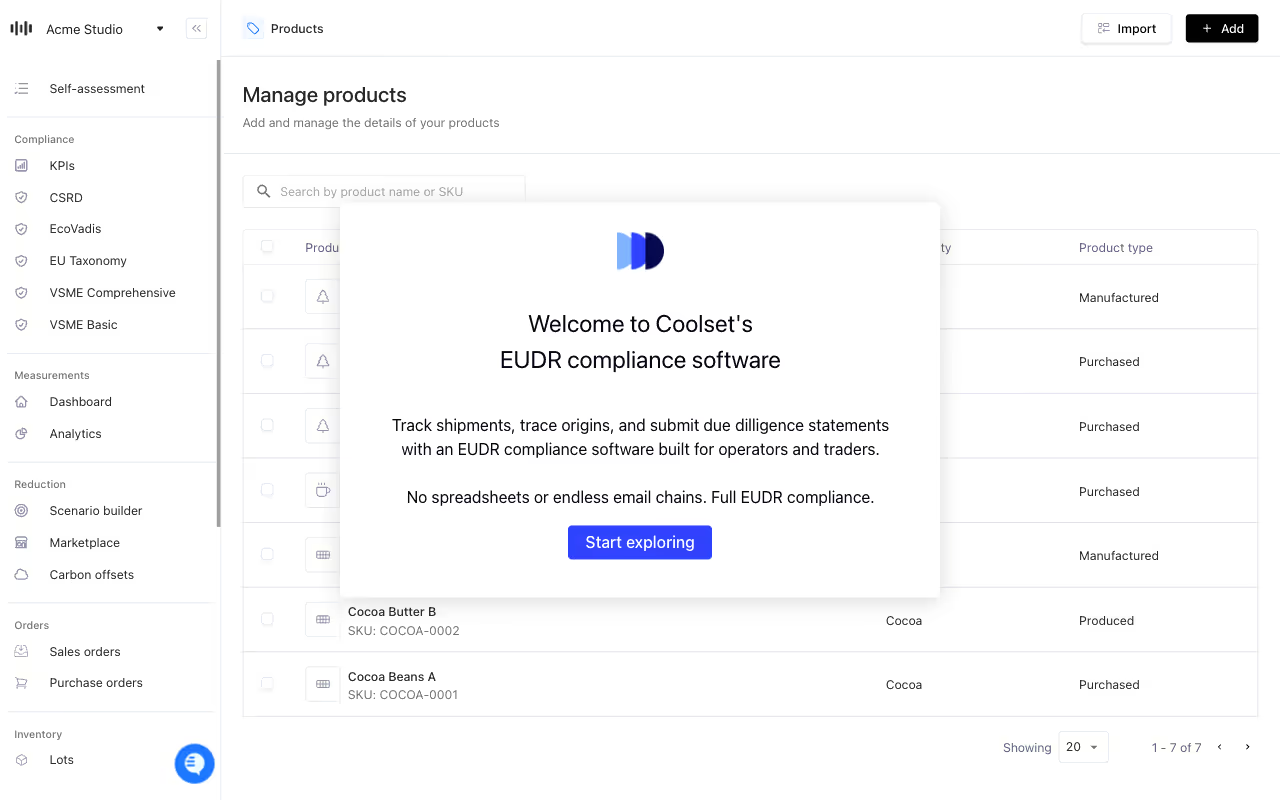
EUDR compliance requires systematic data collection, supplier engagement and audit-ready documentation, especially for first operators submitting DDS in TRACES. Coolset's platform covers the full workflow: supplier data capture, geolocation verification, deforestation risk assessment and TRACES-compatible DDS generation.
Coolset's version-controlled supplier data model makes this straightforward where teams can aggregate across shipments without losing traceability at the individual plot level. For companies operating as downstream operators, the platform supports reference-number collection and validity verification across supplier networks. The EUDR reporting guide for operators explains how each role maps to specific platform workflows.
FAQ
Is there going to be another EUDR delay?
No. The Commission has confirmed that the 30 December 2026 enforcement deadline will not move again. The May 2026 simplification package clarifies how companies must comply within the existing timeline, it is not a further postponement.
I buy EUDR-covered products that are already on the EU market. Do I need to conduct due diligence?
No. If you are a downstream operator, meaning you buy products already covered by a due diligence statement or simplified declaration, you do not need to conduct your own due diligence or submit due diligence statements. Your core obligation is to collect and retain the reference numbers of those statements from your supplier and keep records of your suppliers and customers.
We are a small producer in a low-risk country. Do we qualify as a micro or small primary operator?
Only if you are the actual producer of the commodities yourself. Intermediaries or traders who buy from farmers and resell do not qualify, even if they are small companies based in a low-risk country. If you do qualify, your main simplification is a one-time simplified declaration rather than a due diligence statement per shipment, and you may use a postal address instead of precise geolocation coordinates.
Are the product scope changes in the delegated act already binding?
Not yet. The delegated act is still in draft form. Once formally adopted by the Commission, both the European Parliament and the Council have a scrutiny period of typically two months during which either can object. Companies should treat the changes as highly likely but not yet final.
Our company is larger than a micro or small undertaking overall, but our EUDR-covered commodity activity is small. Can we still qualify for the simplified regime?
Potentially yes. The guidance document clarifies that a company exceeding the micro or small thresholds overall can still qualify if it can demonstrate that the parts of its balance sheet, net turnover and average number of employees specifically related to relevant commodities do not exceed the limits of at least two of those three criteria.
Related: EUDR penalties: what non-compliance actually costs companies in 2026
Related: EUDR downstream operator: what the regulation means for your business in 2026
Related: EUDR Information System: how to register and submit your first DDS in 2026
Related: EUDR Annex I changes: which products are affected by the 2026 delegated act updates
Related: EUDR compliance audit: documentation checklist for December 2026
Related: EUDR compliance roadmap: phased implementation plan for 2026
Our research team walks you through every step - from supplier engagement to submitting in TRACES.


on mobile screens
to experience this demo.


↘ Check if your documentation meets PPWR requirements
This free compliance checker scans your packaging documentation and maps it against mandatory PPWR data requirements, giving you a clear view of your compliance status. Get actionable insights on documentation gaps before they become compliance issues.
Start preparing for EUDR
Get your systems ready for traceability, risk assessment and due diligence.

.webp)