EUDR downstream operator: what the regulation means for your business in 2026



Disclaimer: New EUDR developments - December 2025
In November 2025, the European Parliament and Council backed key changes to the EU Deforestation Regulation (EUDR), including a 12‑month enforcement delay and simplified obligations based on company size and supply chain role.
Key changes proposed:
- New enforcement timeline: 30 December 2026 for large/medium operators, 30 June 2027 for small/micro operators
- Simplified DDS: One-time declarations for small and micro primary producers
- Narrowed scope: Most downstream actors and non‑SME traders would no longer need to submit DDSs
- New DDS requirement: Estimated annual quantity of regulated products must be included
These updates are not yet legally binding. A final text will be confirmed through trilogue negotiations and formal publication in the EU’s Official Journal. Until then, the current EUDR regulation and deadlines remain in force.
We continue to monitor developments and will update all guidance as the final law is adopted.
Key takeaways
- Regulation (EU) 2025/2650 introduces the downstream operator category and postpones EUDR application to 30 December 2026 for large and medium operators and 30 June 2027 for micro and small operators.
- The first downstream operator in the chain must collect and keep DDS reference numbers from their supplier; subsequent downstream operators must retain basic supplier and buyer identity information.
- The category only applies to companies further processing products already covered by a DDS.
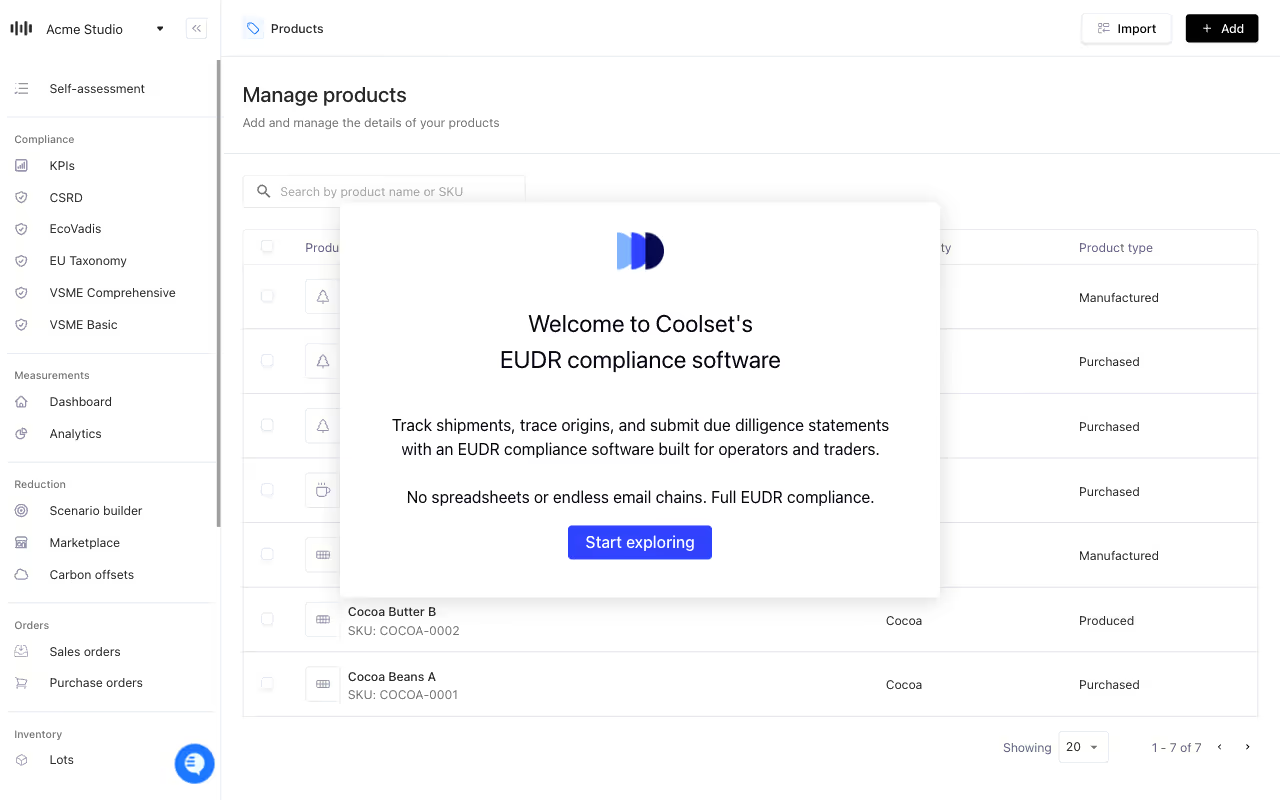
- Coolset's EUDR platform handles classification, reference tracking and information system filings in one workflow.
Regulation (EU) 2025/2650, published in the Official Journal on 23 December 2025, formally introduces the downstream operator category into the EU Deforestation Regulation (EUDR) and postpones the application date to 30 December 2026 for large and medium operators, with micro and small operators following on 30 June 2027.
The amendment carves out a lighter compliance route for companies that buy, transform, or resell EUDR products after an upstream operator has already filed a Due Diligence Statement (DDS). Companies that fit the new definition skip the full due diligence process, but only if they confirm their classification before the application date. The default under the revised Article 2(15) is still operator, with all the obligations that brings.
Why the downstream operator category was created
Under the original EUDR text, every actor placing a relevant product on the EU market faced near-identical due diligence duties, which created duplicate work down the chain. According to the European Parliament's Legislative Train, on 21 October 2025 the Commission tabled 'COM(2025) 652 final', the legislative proposal that became Regulation (EU) 2025/2650.
The explanatory memo is direct about the intent. The proposal text introduces two new definitions providing simplifications for most subjects of obligations and significantly lowers the number of due diligence statements submitted in the Article 33 information system. For both downstream operators and traders, the obligation to ascertain that due diligence was exercised and to submit a due diligence statement is eliminated.
This reclassifies large parts of the manufacturing, retail and distribution sector that previously assumed they were full operators. A chocolate maker buying cocoa from an EU importer, a furniture brand assembling timber components already placed on the market, and a cosmetics company formulating with palm oil derivatives already covered by a DDS each now sit in a different compliance category from the importer at the top of the chain.
The recitals of Regulation (EU) 2025/2650 state plainly that the amendment provides legal clarity in downstream supply chains and reduces reporting requirements and load on the Article 33 information system. The change routes obligations to the actor that can do something about deforestation risk, which is the first placer, and frees up the rest of the chain to carry references rather than rebuild the case.
{{product-tour-injectable}}
How to tell if your company is a downstream or upstream operator
An upstream operator is the first natural or legal person who places a relevant product on the EU market or exports it. Under the revised Article 2(15), the definition of operator was updated to mean any natural or legal person who places relevant products on the EU market or exports them, excluding downstream operators. The seven commodities in scope remain cattle, cocoa, coffee, oil palm, rubber, soya and wood and their derived products.
A downstream operator is something more specific. Article 2(15b) of Regulation EU 2025/2650 defines a downstream operator as any natural or legal person who, in the course of a commercial activity, places on the market or exports relevant products made using relevant products covered by a DDS or simplified declaration. The classic example in the Commission's guidance is a chocolate bar maker using cocoa beans that an upstream operator already imported and declared.
The downstream operator category applies to any natural or legal person regardless of where they are established - there is no geographic restriction in the definition. However, where a non-EU entity is the first to place a relevant product on the EU market, Article 7 of Regulation EU 2023/1115 deems the first EU-established person who then makes those products available to be an operator with full due diligence obligations.
A short classification test:
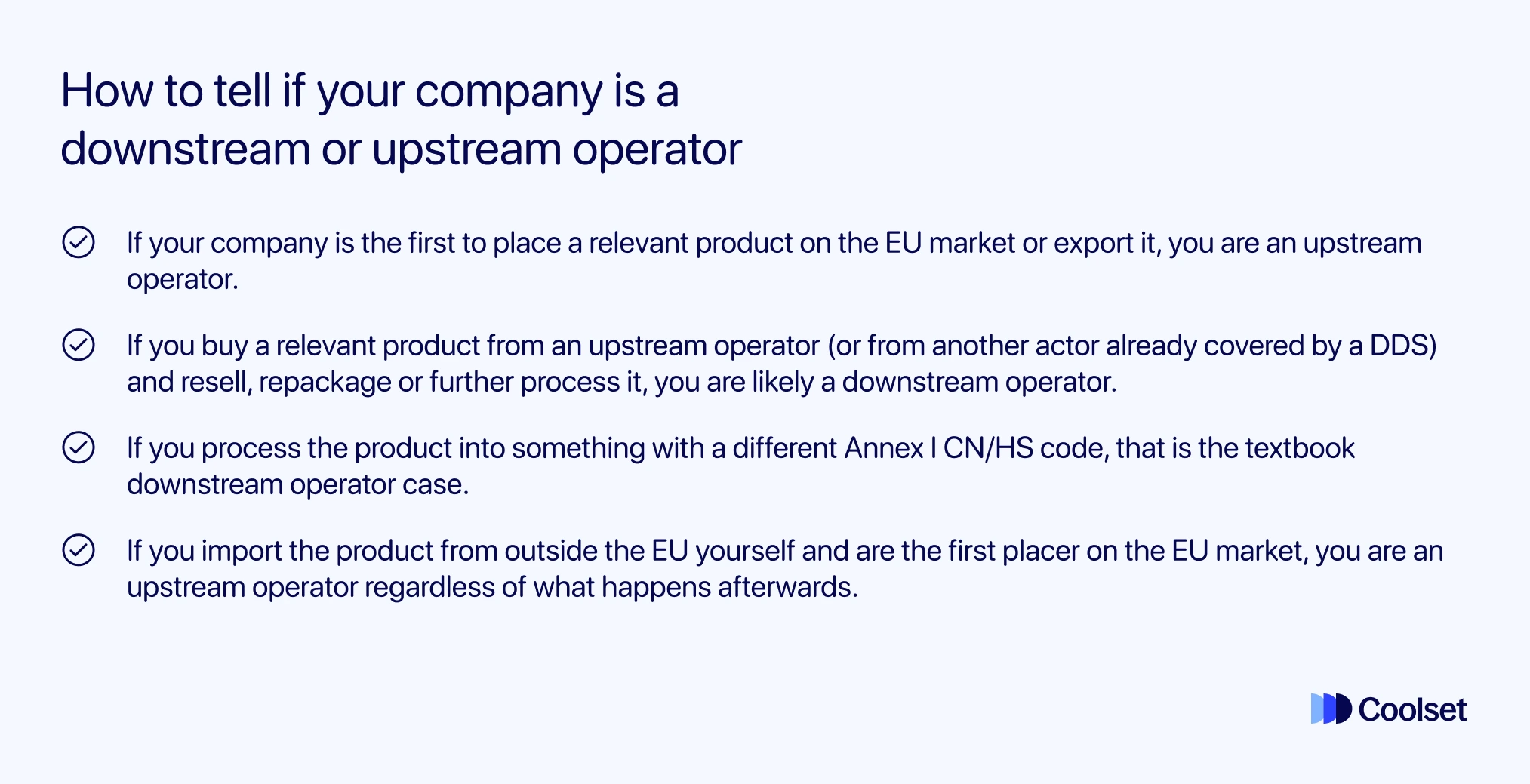
- If your company is the first to place a relevant product on the EU market or export it, you are an upstream operator.
- If you buy a relevant product from an upstream operator (or from another actor already covered by a DDS) and resell, repackage or further process it, you are likely a downstream operator.
- If you process the product into something with a different Annex I CN/HS code, that is the textbook downstream operator case.
- If you import the product from outside the EU yourself and are the first placer on the EU market, you are an upstream operator regardless of what happens afterwards.
Misclassification cuts both ways. Treating yourself as a downstream operator when you are actually the first placer leaves the chain without a DDS at the import point. For the financial detail of penalty exposure, see Coolset's guide to EUDR penalties.
The reduced obligations that apply to downstream operators
Downstream operators do not submit a full Due Diligence Statement verifying compliance. The Commission's explanatory memo confirms that the obligation to ascertain that due diligence was exercised, and to submit a DDS, is eliminated for both downstream operators and traders.
Traceability obligations remain, but vary by position in the chain. Under Recital 6 of Regulation EU 2025/2650, the obligation to collect and keep DDS reference numbers and declaration identifiers from micro or small primary operators applies only to the first downstream operator or trader in the chain - this obligation does not pass to downstream operators further along.
All downstream operators must, however, collect and keep information on their direct suppliers under Article 5(3), and where their direct supplier is an operator, they must collect the DDS reference numbers or declaration identifiers associated with those products.
Registration in the EU information system is still required for non-SME downstream operators. Regulation (EU) 2025/2650 states that non-SME downstream operators and non-SME traders have a significant influence on supply chains and must still register in the information system. The simplification is in the volume of declarations, not in the visibility of the actor.
What the lighter regime looks like in practice:
- If you are the first downstream operator in the chain, collect the DDS reference number or simplified declaration identifier from your upstream operator supplier before or at the point of supply.
- Keep that reference, plus information on direct suppliers and direct customers, for at least five years as required by Article 5(4).
- If you are a downstream operator, but not the first one in the chain, collect information on your direct suppliers and maintain it for 5 years.
- If you are a non-SME downstream operator, register in the Article 33 information system.
- Do not submit a separate DDS verifying compliance for the same product chain.
There is an additional mechanism worth flagging. Under Article 6(3) of Regulation EU 2025/2650, an upstream operator that is a natural person or microenterprise can mandate the next downstream operator or trader in their supply chain to act as their authorised representative. If you sit just below a very small primary supplier in a low-risk country, you may end up handling their declaration in the system on their behalf.
What changes operationally before 30 December 2026
The single operational question between now and the application date is whether your contracts, master data and registrations match the operator category you actually fall into. Application dates set the deadline. Under the Council's formal adoption on 18 December 2025, the EUDR applies to all large and medium operators from 30 December 2026, with micro and small operators receiving a six-month cushion to 30 June 2027. The original EUDR entered into force in June 2023 and was first postponed in December 2024 to 30 December 2025 before this second postponement.
The Commission's Access2Markets notice tells businesses to check what has changed, adapt their systems and adjust commercial arrangements to meet the requirements of Regulation (EU) 2023/1115 as amended. For downstream operators, that translates into rewriting supplier clauses so DDS reference numbers arrive in a structured channel before or at shipment, and adding warranties that the upstream actor has actually filed a DDS for the product as supplied. Product master data and ERP records then need to carry that reference at SKU or batch level, so the link between a physical movement and the upstream declaration is preserved through manufacturing, blending and repackaging. Where a finished product blends inputs from multiple upstream operators, multiple references travel with it.
The Access2Markets notice also states that the additional time is intended to allow improvement of the IT systems all operators must use to submit electronic due diligence statements. For a view of how to choose tooling that handles both operator categories, see Coolset's guide to EUDR compliance solutions.
{{custom-cta}}
Building a downstream operator workflow that scales
The work splits into five concrete steps that compliance, procurement and IT can run in parallel.
- Map every SKU that contains one of the seven EUDR commodities. Tag each SKU with the responsible upstream operator and the country where the product first entered the EU market. The output is a single product-to-operator register.
- Set one intake channel for DDS reference numbers. An API, EDI feed or supplier portal works. PDF attachments and ad hoc emails do not scale and create reconciliation work at year end. For background on the broader discipline, see supply chain due diligence.
- Decide how certification evidence is handled alongside DDS references. FSC, RSPO and Rainforest Alliance certificates are not a substitute for a DDS, but they form part of the supplier file. Coolset has covered this question in EUDR certification schemes.
- Register the legal entity in the EU information system if you are a non-SME downstream operator, in line with the requirement set in Regulation (EU) 2025/2650.
- Document the workflow and assign an accountable owner. The Green Forum guidance on roles and responsibilities sets the expectation that direct supplier and customer information is collected and kept by every downstream operator. The accountable owner needs to be named in writing and connected to a senior decision maker.
For teams tracking what may still change between now and the application date, the April 30 EUDR simplification 2026 update covers the Commission's report obligation and the parallel guidance refresh.
Confirm your role before 30 December 2026
This week, run a classification check on your top EUDR-relevant SKUs. For each line, document whether the company is the first placer on the EU market or buying from an upstream operator with an existing DDS, and record the answer in the product master data. That single document carries through to procurement contract updates, information system registration and the eventual DDS filings, and it is the difference between a manageable December 2026 filing season and a scramble.
Frequently asked questions
When does the EUDR apply for downstream operators?
The EUDR applies to large and medium operators, including downstream operators, from 30 December 2026, and to micro and small operators from 30 June 2027, under Regulation (EU) 2025/2650.
Do downstream operators submit a Due Diligence Statement?
No. The Commission's explanatory memorandum confirms the obligation to ascertain that due diligence was exercised and to submit a DDS is eliminated for downstream operators. They collect and pass on the upstream DDS reference numbers instead.
Do downstream operators still register in the EU information system?
Non-SME downstream operators must still register. Regulation (EU) 2025/2650 states they have a significant influence on supply chains and must remain registered in the Article 33 information system. SMEs benefit from a lighter regime.
What if my company sits in both categories for different products?
A company that imports cocoa beans itself and also buys finished cocoa butter from another EU operator is an upstream operator for the beans and a downstream operator for the butter, since the revised Article 2(15) definition turns on whether the actor is the first placer of the relevant product. The Green Forum guidance applies the same test to each product flow.
Related: EUDR Information System: how to register and submit your first DDS in 2026
Related: EUDR Annex I changes: which products are affected by the 2026 delegated act updates
Related: EUDR compliance audit: documentation checklist for December 2026
Related: EUDR compliance roadmap: phased implementation plan for 2026
Coolset maps your SKUs to the EUDR operator categories under Regulation (EU) 2025/2650, tracks DDS reference numbers from upstream suppliers and prepares your information system filings for the 30 December 2026 application date.


on mobile screens
to experience this demo.


↘ Check if your documentation meets PPWR requirements
This free compliance checker scans your packaging documentation and maps it against mandatory PPWR data requirements, giving you a clear view of your compliance status. Get actionable insights on documentation gaps before they become compliance issues.

.webp)