PPWR technical documentation: what to compile before issuing a Declaration of Conformity


Disclaimer: New EUDR developments - December 2025
In November 2025, the European Parliament and Council backed key changes to the EU Deforestation Regulation (EUDR), including a 12‑month enforcement delay and simplified obligations based on company size and supply chain role.
Key changes proposed:
- New enforcement timeline: 30 December 2026 for large/medium operators, 30 June 2027 for small/micro operators
- Simplified DDS: One-time declarations for small and micro primary producers
- Narrowed scope: Most downstream actors and non‑SME traders would no longer need to submit DDSs
- New DDS requirement: Estimated annual quantity of regulated products must be included
These updates are not yet legally binding. A final text will be confirmed through trilogue negotiations and formal publication in the EU’s Official Journal. Until then, the current EUDR regulation and deadlines remain in force.
We continue to monitor developments and will update all guidance as the final law is adopted.
Key takeaways
- From 12 August 2026, every packaging unit placed on the EU market needs an EU Declaration of Conformity backed by an Annex VII technical file.
- The manufacturer holds the obligation. Under Article 15, a distributor or importer that uses its own name or trademark or modifies packaging is treated as the manufacturer.
- Recycled content, recyclability, substance-of-concern, and Article 10 minimization evidence must sit in the file per packaging unit.
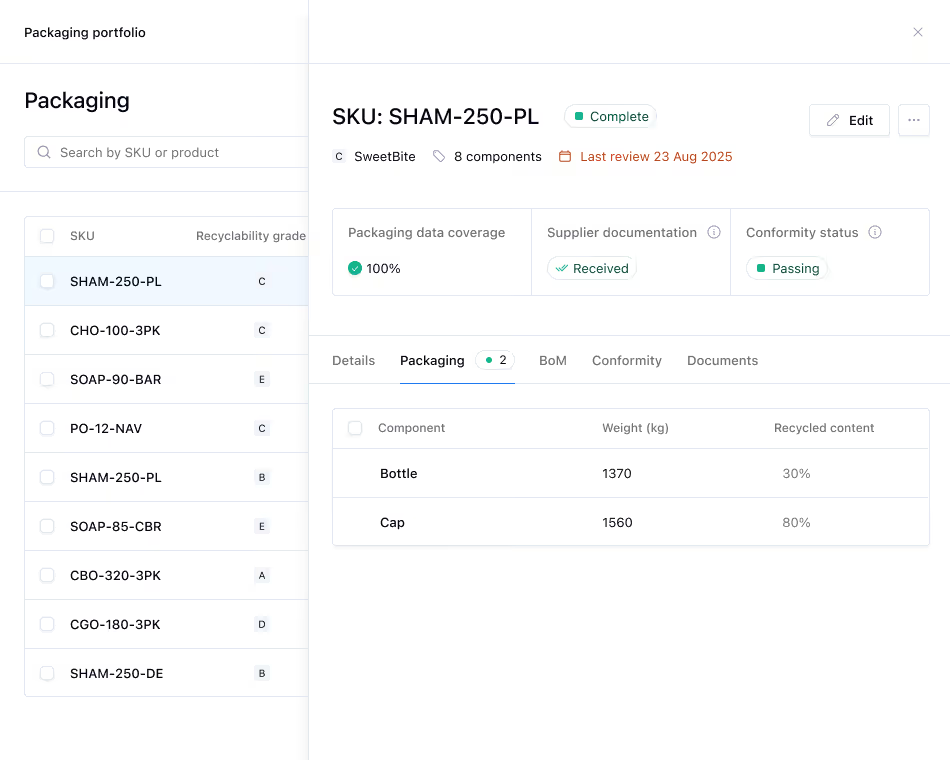
- Coolset helps packaging and compliance teams build audit-ready Annex VII files on the PPWR platform.
From 12 August 2026, the Packaging and Packaging Waste Regulation (PPWR) (Regulation (EU) 2025/40) requires every packaging unit placed on the EU market to be covered by an EU Declaration of Conformity, backed by the technical documentation set out in Annex VII. The Declaration is only valid if that Annex VII file exists at the moment the packaging is made available on the market. For manufacturers and importers, the compliance question is no longer whether the packaging meets Articles 5 to 12. It is whether the file that proves it can be produced on demand for every packaging unit.
What the Declaration of Conformity actually certifies
The Declaration of Conformity is a manufacturer's legal statement that a specific packaging unit complies with the sustainability and labelling requirements in Articles 5 to 12 of PPWR. The Commission's guidance document C(2026)3702 confirms that the manufacturer is the obligated party. That party must carry out the conformity assessment, draft the technical documentation, and sign the EU Declaration before the packaging is made available on the market. A Declaration without the file behind it does not constitute compliance.
The manufacturer role can shift under Article 15. When a distributor or importer places packaging under its own name or trademark, or modifies packaging in a way that could affect compliance, that party is treated as the manufacturer. The Commission's guidance also clarifies that being "established" in the EU means an EU-incorporated legal person, not a branch office. That distinction matters when identifying who inside an EU corporate group can lawfully sign the Declaration.
One narrow exception applies. Where the brand owner is a micro-enterprise under Recommendation 2003/361/EC (as applicable on 11 February 2025) and the supplier is located in the Union, the supplier is treated as the manufacturer for the purposes of Article 15. In every other case, the brand owner or importer holds the file.
The Annex VII file: mandatory contents per packaging unit
The Annex VII file must describe the packaging and evidence conformity with every substantive PPWR requirement that applies to it. Compliance with the substance-of-concern rules in Article 5(4) and 5(5) must be demonstrated in the technical documentation drawn up in accordance with Annex VII, and the same file has to carry the evidence for the other Article 5 to 12 obligations that apply to the unit. That structure lets an assessor trace each claim back to a specific method and dataset.
Substances of concern are the clearest example. The sum of the concentrations of lead, cadmium, mercury, and hexavalent chromium in packaging or packaging components must not exceed 100 mg/kg. Test reports, supplier declarations, or safety data sheets showing compliance with that ceiling belong in the file per component, not as a finished-SKU aggregate.
Food-contact packaging carries a separate PFAS requirement. From 12 August 2026, food-contact packaging shall not be placed on the market if it contains per- and polyfluoroalkyl substances (PFAS) at or above the thresholds specified in Article 5. The Commission's guidance confirms that packaging placed on the market before that date may remain and does not need to be withdrawn. For any food-contact packaging placed on the market on or after that date, the Annex VII file needs a test-based demonstration that the thresholds are met. Assumption is not evidence.
Reusable packaging brings its own layer. For reusable packaging, compliance assessment must take into account the characteristics of reusable packaging and the requirements set out in Article 11. Where operators use documentation prepared under Union food-contact materials law, that material may be reused as part of the Annex VII file. The recitals note that food-contact documentation may, where appropriate, form part of the information and documentation required under this Regulation, which reduces duplication for teams already holding it.
For a wider view of how packaging types map to different obligation sets, see the Coolset explainer on PPWR packaging classification, which sets out the three axes (format, function, and material) that determine which Article 5 to 12 requirements apply to a given unit.
Evidence sources: what to collect from suppliers and testing
Most of the Annex VII file is built from data suppliers control. PPWR obliges suppliers to give the manufacturer all information and documentation needed to demonstrate conformity, including the technical documentation referred to in Annex VII. That duty is the legal lever behind supplier data requests, and it should be reflected in supply contracts and inbound quality checks.
Five categories of evidence carry most Annex VII files:
- Substance-of-concern demonstrations. Test reports, supplier declarations, or safety data sheets showing the sum of lead, cadmium, mercury, and hexavalent chromium is below the 100 mg/kg ceiling, held per component.
- PFAS test data for food-contact packaging. Analytical results against the Article 5 thresholds, dated on or after the 12 August 2026 placing on the market.
- Recycled content and recyclability records. Documentation of the calculations or tests used to demonstrate conformity with the applicable Article 5 to 12 requirement, identifying the method used and the batch or period covered.
- Minimization records under Article 10. A structured performance record showing weight and volume have been reduced to what is needed to maintain packaging function, consistent with the recital that packaging must be designed to minimize volume and weight while maintaining functions.
- Reusable system evidence under Article 11. Documentation of the reuse system, since compliance assessment for reusable packaging must take into account Article 11 requirements.
Composition and weight data recorded in the file should match what is reported to extended producer responsibility (EPR) schemes under Article 44. Where a product carries a Digital Product Passport under the Ecodesign for Sustainable Products Regulation, the same underlying data should feed both records. Coolset's guide to PPWR and the Digital Product Passport covers how to structure one data model to serve both regimes without recording supplier evidence twice.
The recitals add a procedural note for anyone launching new formats. Economic operators should notify the Commission and the competent authority before placing innovative packaging on the market, with information in the technical documentation. The notification is not a substitute for the Annex VII file. It signals that the file exists and covers a format that standard methodologies may not yet address.
How the file changes when packaging or rules change
The Annex VII file has to be updated whenever the packaging or the applicable rules change in a way that affects Articles 5 to 12 compliance, and a new Declaration has to be issued for the changed variant. That duty follows from the manufacturer's obligation under Article 15(1) to ensure the packaging complies with Articles 5 to 12 before it is made available on the market. If the packaging on the market no longer matches the file, the Declaration behind it no longer holds.
Secondary rulemaking under PPWR also affects the file. Under Article 9(6), the Commission and the European standardization bodies are working to establish an EU-wide standard on home compostability. Until that harmonized standard is adopted, EN 13432 on industrial composting can be used as guidance. The Regulation also provides that by 12 August 2030 the Commission will evaluate whether the PFAS paragraph should be amended or repealed to avoid overlap with the Food Contact Materials Regulation, REACH, and the POPs Regulation. Once each standard lands, the compostability and PFAS evidence in the file will need to reference it directly.
Each SKU needs a traceable Declaration reference back to the file version that applied when its packaging was placed on the market. Previous file versions and their validity periods should be archived, not overwritten, because market surveillance can inspect packaging placed on the market in earlier years.
Common gaps that block a defensible Declaration
Recyclability and recycled content are the most frequent evidence gaps. Both are often treated as marketing claims backed by a supplier statement, rather than as file-grade evidence tied to a specific methodology, test date, and traceable data source. When market surveillance asks for the underlying calculation, a corporate sustainability report or a supplier email is not a technical file entry.
Importer evidence is the second recurring gap. Where an EU importer or distributor is treated as the manufacturer under Article 15, the Annex VII inputs are often not contracted for at the point of supply. The party that signs the Declaration carries the enforcement risk, not the overseas producer. The Commission's guidance is direct that the manufacturer must carry out the conformity assessment and draft the technical documentation and the EU Declaration of Conformity.
Minimization under Article 10 is a third gap. Teams often assume that "the packaging is already lightweight" is sufficient. The recitals confirm that packaging must be designed to minimize volume and weight while maintaining functions. Without a documented method, the minimization claim is unauditable.
Substance-of-concern evidence is the fourth. Data is often scattered across procurement folders, safety data sheets, and quality records, but never consolidated per packaging unit. Making it auditable means centralizing it against a stable packaging identifier. For teams building a fuller obligation picture, the Coolset article on PPWR essentials maps how the substance, minimization, and recyclability duties interact across the Regulation.
{{custom-cta}}
Preparing the Annex VII file before 12 August 2026
Assign a named owner for each packaging unit's Annex VII file, and structure the internal record so one file exists per packaging unit rather than per SKU. The Regulation ties the Declaration to the packaging unit, so the file has to match that scope to be produceable on request. For a broader view of common operator questions on Declarations, substances, and EPR, the Coolset PPWR Q&A and the manufacturer obligations webinar Q&A are useful starting references.
Start with the two evidence lines suppliers control: recycled content records and substance-of-concern test data. Those inputs take the longest to secure, so they set the pace for the rest of the file.
Frequently asked questions
When does the Declaration of Conformity requirement start applying?
PPWR applies on a phased basis from 12 August 2026. From that date, every packaging unit placed on the EU market must be covered by an EU Declaration of Conformity backed by the Annex VII technical file. Packaging placed on the market before that date is treated separately, including for the food-contact PFAS restriction.
Who is the obligated party for imported packaging?
The manufacturer is the obligated party. Article 15 also treats a distributor or importer as a manufacturer where that party places the packaging under its own name or trademark, or modifies it in a way that affects compliance. Where the brand owner is a micro-enterprise and the supplier is EU-located, the supplier is treated as the manufacturer.
Do we need one Annex VII file per SKU or per packaging unit?
Per packaging unit. Where one packaging platform covers many SKUs, the file can be organized as a base document plus SKU-specific annexes, provided each SKU has a traceable Declaration reference. Any change to design, materials, supplier, or use that affects Articles 5 to 12 compliance triggers an update and a new Declaration for the changed variant.
Can existing food-contact documentation be reused in the Annex VII file?
Yes, where appropriate. The Regulation's recitals confirm that documentation required under Union food-contact materials law may form part of the information required under PPWR. Reusing that material reduces duplication, but the file still needs to cover any PPWR requirements the food-contact documentation does not address, including recyclability, recycled content, and minimization.
What happens if the technical file is incomplete when market surveillance asks for it?
An incomplete Annex VII file undermines the Declaration itself, since the Declaration is only valid where the underlying file exists. Market surveillance authorities can require corrective action and treat the packaging as non-compliant, independent of whether the underlying sustainability requirement is met. Consolidating evidence per packaging unit in advance is what avoids that exposure.
The Packaging and Packaging Waste Regulation (PPWR) requires an Annex VII file behind every Declaration of Conformity from 12 August 2026. Coolset helps packaging and compliance teams consolidate supplier evidence, recyclability, and substance data per packaging unit.
.png)

on mobile screens
to experience this demo.


↘ Check if your documentation meets PPWR requirements
This free compliance checker scans your packaging documentation and maps it against mandatory PPWR data requirements, giving you a clear view of your compliance status. Get actionable insights on documentation gaps before they become compliance issues.

.webp)