PPWR and Digital Product Passport compliance: choosing the right approach for 2026


Disclaimer: New EUDR developments - December 2025
In November 2025, the European Parliament and Council backed key changes to the EU Deforestation Regulation (EUDR), including a 12‑month enforcement delay and simplified obligations based on company size and supply chain role.
Key changes proposed:
- New enforcement timeline: 30 December 2026 for large/medium operators, 30 June 2027 for small/micro operators
- Simplified DDS: One-time declarations for small and micro primary producers
- Narrowed scope: Most downstream actors and non‑SME traders would no longer need to submit DDSs
- New DDS requirement: Estimated annual quantity of regulated products must be included
These updates are not yet legally binding. A final text will be confirmed through trilogue negotiations and formal publication in the EU’s Official Journal. Until then, the current EUDR regulation and deadlines remain in force.
We continue to monitor developments and will update all guidance as the final law is adopted.
Key takeaways
- PPWR (Regulation (EU) 2025/40) enters general application on 12 August 2026 and requires harmonized labelling plus a declaration of conformity for every unit of packaging on the EU market.
- PPWR packaging data and the ESPR Digital Product Passport describe the same SKUs, so one component-level data model can serve both.
- The compliance load reaches manufacturers, importers, and distributors, so mapping the SKU-by-SKU accountability is the prerequisite decision.
- Coolset helps teams build a single PPWR-ready packaging data model on the PPWR compliance platform.
Regulation (EU) 2025/40, the Packaging and Packaging Waste Regulation (PPWR), entered into force on 11 February 2025 and generally applies from 12 August 2026. From that date, every unit of packaging placed on the EU market must carry a harmonized label identifying its material composition, backed by documentation covering recyclability, recycled content, and packaging minimization. The same SKUs are covered by the Ecodesign for Sustainable Products Regulation (ESPR) through its Digital Product Passport (DPP). Packaging teams that build one data model to serve both regimes avoid running two parallel compliance tracks over the same evidence.
The overlap is not theoretical. PPWR's substance, recyclability, and recycled-content data describe the same fields the DPP is built to carry. One source of truth can feed a PPWR declaration and an ESPR DPP without keying the same supplier evidence twice.
Where PPWR obligations and the DPP data model actually overlap
PPWR's per-unit packaging data and ESPR's per-product Digital Product Passport describe the same physical object from two regulatory angles. PPWR requires that packaging be recyclable and keep substances of concern below specified thresholds. The requirements in PPWR will increase, with a large wave of obligations coming in 2030. The Commission confirms that all packaging on the EU market must be recyclable by 2030 and that plastic packaging must include recycled content with increasing targets for 2030 and 2040. The DPP is being built under the Ecodesign for Sustainable Products Regulation (Regulation (EU) 2024/1781). It will record product composition, environmental impact, and disposal guidance for nearly every physical good placed on the EU market. For a bottle of shampoo or a boxed appliance, the composition and end-of-life data the DPP will surface is largely the same evidence PPWR asks the packaging manufacturer to hold.
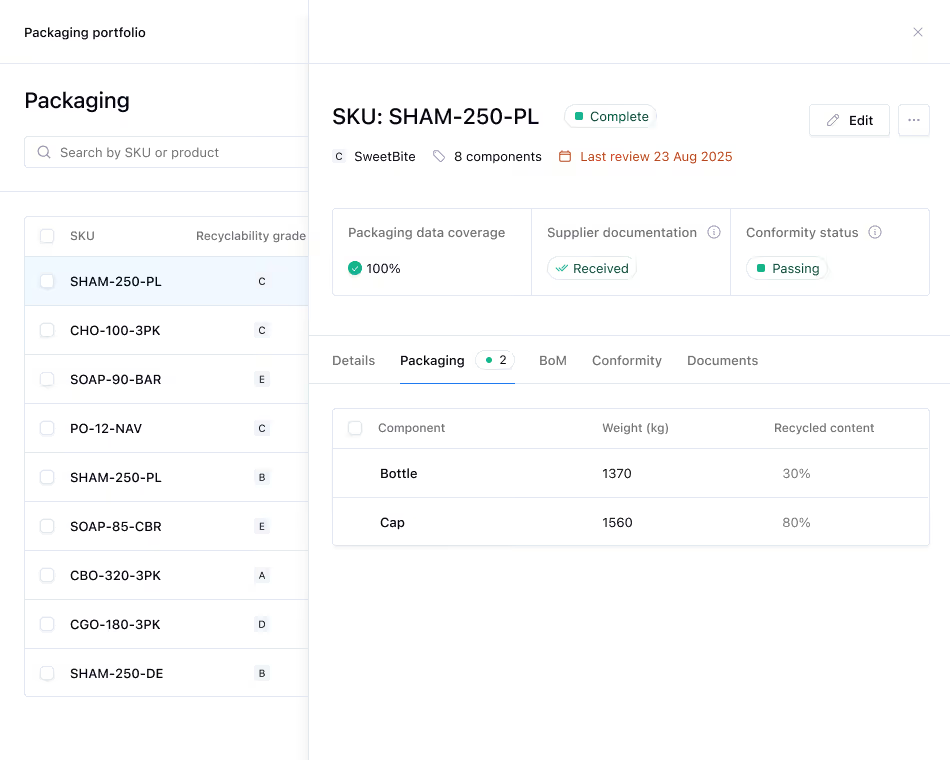
PPWR recyclability and recycled-content evidence must be substantiated at the packaging-component level, not per finished product. A bottle, its closure, its label, and its shipping carton each have their own material composition and their own recyclability assessment. Most teams still hold that data in supplier PDFs and spec sheets, which no data carrier under either regime can read. A single component-level record answers both a PPWR declaration of conformity and any DPP query about the packaging that wraps a priority product.
The Commission also confirms that the DPP will include a unique product identifier, compliance documentation, information on substances of concern, and disposal guidance. PPWR requires the same substance-of-concern and disposal information at the packaging level. Treating them as two disconnected exercises means asking suppliers for the same evidence twice, in two different templates, on two different timelines.
{{product-tour-injectable}}
Two records, one supply chain: how the packaging passport and product passport diverge
PPWR compliance is carried by a packaging-level record and a data carrier on the packaging unit itself, while the ESPR DPP is a product-level record linked to the finished good. They are two separate digital objects with different economic operators responsible, even when the underlying data is identical. Operators can also add a QR code or other standardized digital data carrier on the packaging alongside the label. That carrier resolves to a packaging record.
The DPP resolves to a product record. Under the Commission's DPP framework, specific requirements are set through product-specific delegated acts under the Ecodesign Regulation, and a DPP Registry acts as the EU database supporting the system. The packaging manufacturer holds the PPWR evidence for what wraps the product; the product manufacturer holds the DPP for the product itself. Data has to flow upstream from packaging supplier to brand owner in a machine-readable format, or the brand owner's DPP will be missing the packaging fields the delegated act asks for.
A single QR code cannot simply resolve to "the record" for a SKU. It has to resolve to the correct record, or to a registry entry that separates packaging conformity data from product conformity data. Collapsing the two into one record blurs which economic operator is accountable for which claim. Running them fully independently duplicates supplier requests, audit effort, and the risk of drift between what the packaging record says and what the DPP says about the same material.
Who carries PPWR exposure across the supply chain
PPWR applies to every economic operator along the packaging supply chain, and the party placing packaging on the EU market must hold the evidence that proves compliance. The Council of the EU has described PPWR as covering the full life-cycle of packaging, requiring that all packaging be recyclable and that substances of concern be minimized. The regulation covers all packaging and packaging waste regardless of material or origin and sets requirements for manufacturing, composition, and the reusable or recoverable nature of all packaging placed on the EU market. That scope means the compliance load reaches manufacturers, importers, and distributors, and the accountability map for each SKU is the prerequisite decision before any data or labelling work makes sense.
The Council also notes that the regulation applies 18 months after entry into force, which lines up with the 12 August 2026 general application date. That leaves a narrow window to fix supplier data gaps.
The financial weight of the sector shapes the enforcement stakes. The Council estimates that packaging production and packaging waste management generate a total turnover of EUR 370 billion in the EU. The European Parliament records that EU packaging waste rose from 66 million tonnes in 2009 to 84 million tonnes in 2021. Each European generated 188.7 kg of packaging waste that year, projected to reach 209 kg by 2030 without additional measures. Parliament also records packaging reduction targets of 5% by 2030, 10% by 2035, and 15% by 2040 relative to 2018. Grouped, transport, and e-commerce packaging faces a 50% maximum empty-space ratio. PFAS is banned in food packaging above set thresholds. A deeper walk-through of the operator roles and their evidence duties sits in the PPWR Q&A on declarations of conformity, substances and EPR.
Building one packaging data model instead of two compliance tracks
A single packaging data model is the efficient path because the underlying fields do not change between the PPWR record and the DPP reference. That model needs, at minimum, composition by weight per component, a recyclability assessment, recycled-content share for plastic components, minimization evidence, and reuse-system data where the packaging is part of a reusable format. The PPWR covers all packaging and packaging waste regardless of material or origin and sets requirements for manufacturing, composition, and the reusable or recoverable nature of all packaging placed on the EU market, so the model has to hold every packaging category the organization puts into scope.
Component-level granularity is not optional. A recyclability grade or recycled-content percentage assessed only at finished-unit level cannot answer questions about the label film, the adhesive, or the closure. Supplier onboarding should collect evidence per component and in a structured format, not in the legacy recyclability certificates already on file. The classification decisions underneath (whether an item counts as sales, grouped, or transport packaging, for example) are set out in the PPWR packaging classification breakdown across three axes, and they determine which obligations attach to which record.
A shared packaging data model also serves sustainability reporting beyond product compliance. The same primary component-level data can feed disclosures on resource use and packaging circularity, so the numbers are collected once instead of in three different shapes for three different reporting owners. The PPWR essentials overview covers how these pieces fit together across the wider regulation.
{{custom-cta}}
Sequencing decisions before the August 2026 labelling deadline
To meet the 12 August 2026 general application date, the binding sequence is scope, then data, then declaration. Locking the packaging portfolio in scope tells the organization which SKUs need evidence. Supplier data collection is the slowest step and gates everything downstream. Only once the data is in hand does the data-carrier choice (a QR code or another standardized digital carrier under Article 12) become a real decision. The declaration of conformity can be generated with confidence after that. Running these steps in parallel without a named data owner tends to stall at the supplier-response step.
Packaging tied to ESPR priority product groups will demand data on the DPP's timeline, not PPWR's. The DPP is being implemented under ESPR to require nearly all products sold in the EU to feature a passport, covering origin, materials, environmental impact, and disposal recommendations. Prioritizing SKUs tied to those product groups is the cleaner sequencing choice.
Reusable packaging is a separate operational track, not a data problem. The Council notes that a renewable five-year derogation from re-use targets is available under specific conditions, including exceeding recycling targets by five percentage points. Whether an organization pursues that derogation, integrates deposit-return, or invests in pooled reuse systems is a business decision that has to be made alongside the data-model work, not after it. The specifics of what has to appear on the packaging (sortability, material identity, reuse markings) are covered in the PPWR labelling requirements guide, and the manufacturer duties layer sits in the PPWR webinar Q&A on manufacturer obligations.
Deposit-and-return marking is explicit in the regulation. Article 12 requires packaging in deposit and return systems under Article 50(1) to carry a clear, unambiguous label. The packaging may also bear a harmonized color label set by implementing act. That marking sits on top of the general harmonized material-composition label, not instead of it.
The one decision to make this quarter
Start by assigning one owner for the packaging data model, and confirm for each SKU whether the organization acts as manufacturer, importer, or distributor under PPWR. That accountability map decides which declarations and DPP records the organization must hold, and it is the prerequisite for every downstream supplier, data, and labelling call.
Frequently asked questions
What is Digital Product Passport compliance?
Digital Product Passport compliance means holding the product data ESPR requires for a product group in a machine-readable record linked to the item. The legal basis is Regulation (EU) 2024/1781, and specific requirements are set through product-specific delegated acts and supported by an EU DPP Registry.
What is the PPWR regulation for packaging?
PPWR is Regulation (EU) 2025/40 of 19 December 2024 on packaging and packaging waste. It replaces Directive 94/62/EC, applies to all packaging placed on the EU market regardless of material, and generally applies from 12 August 2026 with staged requirements on recyclability, recycled content, labelling, and reuse.
What is the purpose of a Digital Product Passport?
The Digital Product Passport is intended to make product data available across the value chain so buyers, recyclers, and authorities can access composition, environmental impact, and disposal information for a product. The Commission describes it as covering origin, materials, environmental impact, and disposal recommendations, and enhancing supply chain management and regulatory compliance.
What is the PPWR declaration of conformity for packaging?
The declaration of conformity is the document in which the economic operator responsible for placing packaging on the market states that the packaging meets PPWR's substantive requirements, including recyclability, recycled content, and minimization. It must be available before packaging is placed on the EU market from 12 August 2026 onward.
Does one QR code cover both PPWR and the DPP?
Not automatically. A data carrier can resolve to multiple records, but a PPWR packaging record and an ESPR DPP for the finished product are distinct digital objects with different accountable operators. A single carrier can point to a registry entry that links both, provided the underlying records are kept separate.
The Packaging and Packaging Waste Regulation (PPWR) requires component-level data on composition, recyclability, and recycled content for every SKU on the EU market. Coolset centralizes supplier evidence, generates declarations of conformity, and keeps the same data model ready for Digital Product Passport requirements.
.png)

on mobile screens
to experience this demo.




↘ Check if your documentation meets PPWR requirements
This free compliance checker scans your packaging documentation and maps it against mandatory PPWR data requirements, giving you a clear view of your compliance status. Get actionable insights on documentation gaps before they become compliance issues.

.webp)