PPWR Q&A: your top questions on declarations of conformity, substances and EPR answered


Disclaimer: New EUDR developments - December 2025
In November 2025, the European Parliament and Council backed key changes to the EU Deforestation Regulation (EUDR), including a 12‑month enforcement delay and simplified obligations based on company size and supply chain role.
Key changes proposed:
- New enforcement timeline: 30 December 2026 for large/medium operators, 30 June 2027 for small/micro operators
- Simplified DDS: One-time declarations for small and micro primary producers
- Narrowed scope: Most downstream actors and non‑SME traders would no longer need to submit DDSs
- New DDS requirement: Estimated annual quantity of regulated products must be included
These updates are not yet legally binding. A final text will be confirmed through trilogue negotiations and formal publication in the EU’s Official Journal. Until then, the current EUDR regulation and deadlines remain in force.
We continue to monitor developments and will update all guidance as the final law is adopted.
Key takeaways
- PPWR requires a separate DoC per packaging type. Sales and transport packaging cannot share one; the manufacturer must always issue it.
- PFAS restrictions under Article 5(5) apply only to food-contact packaging. The 100 mg/kg heavy metals limit applies to all packaging types from 12 August 2026.
- Recyclability grades A-C apply from 1 January 2030. Until then, a qualitative EN 13430:2004 assessment in the technical documentation is sufficient.
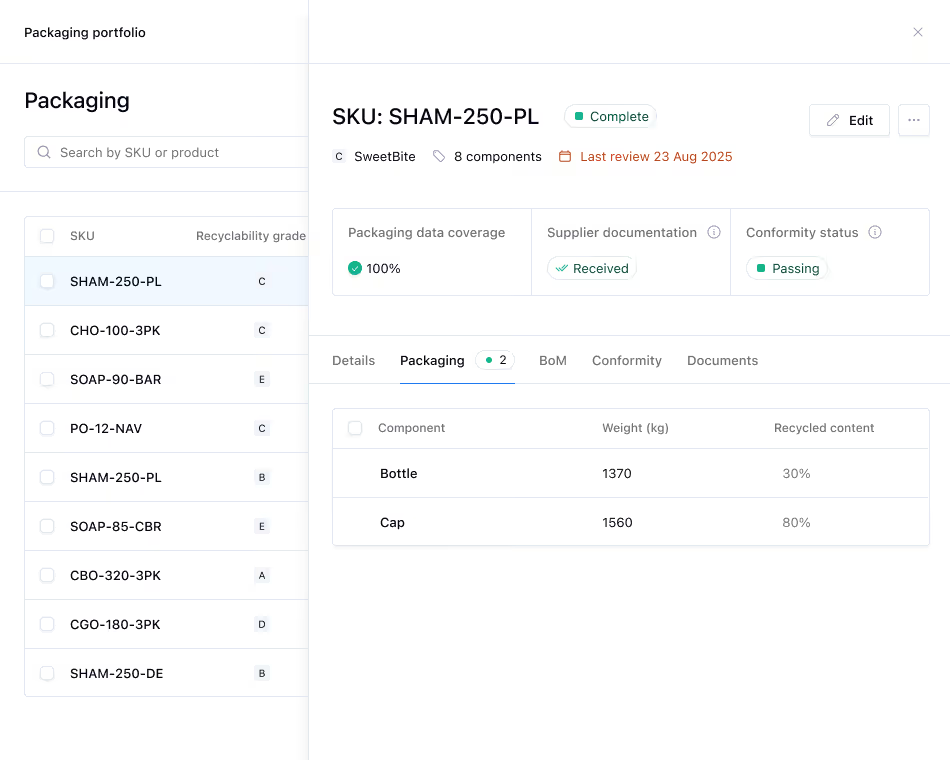
- Coolset's PPWR module helps manage documentation, conformity assessments and audit readiness.
Your packaging supplier just sent you the technical documentation accompanying your packaging. Your legal team is asking whether you need to register for EPR in every country you sell into, and whether you need to provide a Declaration of Conformity (DoC) for all of your packaging. August 12, 2026 is close, and the questions are piling up.
Coolset's research team ran a dedicated Q&A session as part of the PPWR Spring School series, fielding nearly 170 questions from compliance, procurement and sustainability teams preparing for the deadline. What emerged were six recurring themes where the same misunderstandings kept surfacing.
This article addresses the most-asked questions from that session, grounded in Regulation (EU) 2025/40 and the European Commission's guidance published on 30 March 2026. If you are still working through the basics, start with our PPWR compliance deadlines explained article first.
Who can request the PPWR Declaration of Conformity?
The DoC is a written self-declaration by the manufacturer confirming that a specific packaging type meets the requirements of Articles 5 to 12 of Regulation (EU) 2025/40. It is defined in Article 39 with the model structure detailed in Annex VIII.
Two groups can legally request it: market surveillance authorities conducting audits and economic operators in the supply chain. Under Art. 17, the manufacturer carries the sole legal responsibility to draw up the DoC and provide a copy of it, together with all technical information, at the request of relevant national authorities. If you are an importer of packaging, you are obliged to ensure that the manufacturer has carried out the conformity assessment and drawn up the technical documentation before placing the packaging on the market. This means that you as the importer need to request the DoC from the manufacturer as a condition of doing business. The obligations of distributors are limited to the verification of correct compliance documentation; they do not need to request the DoC from the manufacturer or importer.
End consumers have no right to request the DoC, and no practical need for it either.
Can one DoC cover multiple packaging types that share the same structure?
The key question when grouping packaging types under one DoC is always: does the compliance outcome change?
A compliance outcome is the result of the conformity assessment across articles 5-12 of PPWR, such as the substances of concern assessment under Article 5. You are allowed to use one DoC across multiple packaging variants only if those variants share the same material composition, contain the same product, and any differences between them (such as size) do not change the result of the conformity assessment. If any variable affects the compliance result, for example a different ink formulation that changes the heavy metals profile, a separate DoC is required for that variant.
The same logic applies to packaging with artwork variations. If seven different artworks share the same underlying compliance profile, one DoC is sufficient. If one artwork uses a specialist ink that changes the substances of concern assessment, that variant needs its own DoC.
As of 12 August 2026, your products pass the conformity assessment if they do not contain any banned substances above allowed thresholds (PFAS, heavy metals), if they are deemed recyclable and if they are accompanied by all required documentation, such as the DoC. By 1 January 2030, requirements relating to recyclability grade, minimum recycled content targets and empty space minimization for certain packaging types will apply.
Is a separate DoC needed for sales packaging and transport packaging?
Yes. The DoC is issued per packaging type, and a packaging type cannot belong to two different packaging categories. Sales packaging and transport packaging are distinct categories under PPWR and must each have their own DoC.
This has practical implications for portfolio size. A product with primary, secondary and transport packaging components may require three to five separate DoCs depending on the complexity of the packaging stack. Transport packaging is not exempt from PPWR, so pallets, stretch wrap and strapping all require DoCs and the technical documentation to support them.
The conformity criteria also apply differently depending on packaging category. Minimization assesses empty space relative to:
- the selling and presentation function for sales packaging
- the protection function for transport packaging
The basis is the same article (Art. 10 PPWR); the application depends on what the packaging is designed to do.
{{custom-cta}}
Who is the manufacturer under PPWR?
The PPWR defines "manufacturer" in Article 3(1)(13) as a natural or legal person that has packaging or a packaged product designed or manufactured under their own name or trademark, regardless of whether any other trademark is visible on the packaging or packaged product.
In practice, two criteria determine who holds the manufacturer role: brand and design specification. If your brand or trademark appears on the packaging, you are the manufacturer regardless of who physically produced it. If no brand is applied but you specified the dimensions, materials or functional requirements in the design brief, you are the manufacturer.
This matters because the manufacturer must carry out the conformity assessment, prepare the technical documentation under Annex VII Module A, and issue the DoC. The manufacturer cannot refer to or use a supplier's DoC. They either create their own DoC, or hold an existing one as an importer or distributor. A manufacturer may receive technical documentation from a supplier to inform their own assessment, but the obligation to compile, maintain and sign the DoC rests with the manufacturer.
If a Belgian supplier physically produces packaging to a specification your company provided, but no brand is applied, your company is the manufacturer because you designed it. If the downstream buyer applies their brand, that buyer becomes the manufacturer. The rule follows brand first, then design, and it does not follow who pressed the button on the machine.
What substances of concern apply from August 2026 and how do you prove compliance?
PPWR Article 5 restricts two categories of substances in packaging. The first applies to all packaging types: the combined concentration of lead, cadmium, mercury and hexavalent chromium must not exceed 100 mg/kg. This limit was already in place under the Packaging and Packaging Waste Directive 94/62/EC and PPWR carries it forward.
The second restriction applies only to food-contact packaging: from 12 August 2026, PFAS must not be present above three thresholds. Article 5(5) sets limits of 25 ppb for any individual PFAS by targeted analysis, 250 ppb for the sum of targeted PFAS, and 50 ppm for total PFAS including polymeric PFAS.
On evidence: a signed DoC alone is never sufficient. The DoC is proof that technical documentation exists. The technical documentation must contain the actual evidence, meaning test reports or verified supplier declarations that demonstrate compliance with each threshold. A signed statement from a supplier claiming compliance without underlying evidence is not sufficient.
The Commission's March 2026 guidance recommends a stepwise PFAS testing approach. The first step is to test for total fluorine. If total fluorine is below 50 ppm, the packaging is compliant without further testing. If it exceeds that, test to differentiate organic and inorganic fluorine. If total organic fluorine is below 50 ppm, the packaging is compliant. If still above, targeted analysis against the individual substance and sum thresholds is required.
For heavy metals, PPWR does not establish formal risk-tier exemptions by material. The 100 mg/kg limit applies to all packaging types regardless of material. For materials with no known heavy metals exposure, the testing method is flexible. What matters is that the technical documentation contains credible evidence of compliance with the threshold, not that a specific test protocol was followed. A supplier statement supported by documented methodology is acceptable where it can credibly support the compliance claim.
{{product-tour-injectable}}
What recyclability obligations apply from August 2026?
PPWR Article 6(1) requires all packaging placed on the EU market to be recyclable from 12 August 2026. This is a baseline obligation that has existed since the previous Packaging and Packaging Waste Directive.
The recyclability grades, where packaging must meet grade A, B or C to remain on the market, do not apply until 1 January 2030. The Commission's guidance confirms that until the harmonized design-for-recycling requirements under Article 6(2)(a) become applicable, manufacturers must demonstrate recyclability under the existing standard EN 13430:2004, Requirements for packaging recoverable by material recycling. No PPWR conformity assessment for recyclability is required at this stage.
You do not need a formal percentage score or grade classification from August 2026. You do need the technical documentation to include a qualitative description of how the recyclability assessment under Article 6 was carried out, as required by Annex VII of PPWR. Demonstrating that you assessed your packaging against EN 13430:2004 is the expected minimum. Companies already doing this under the Directive continue under the same framework until the PPWR delegated acts are finalized, expected by 1 January 2028.
What happens to existing stock when the August 2026 deadline hits?
Under PPWR, what determines compliance is not when packaging was manufactured but when it was placed on the EU market. "Placing on the market" is defined in Article 3(1)(10) as the first making available of packaging on the Union market, which occurs at the point of transfer of ownership, possession or any other property right.
If ownership transferred from your supplier to you before 12 August 2026, the packaging was placed on the market under the old rules and may continue to be sold without PPWR compliance obligations. If you are the manufacturer and the packaging was produced but not yet placed on the EU-market before the deadline, it cannot be sold after that date because the transfer, and therefore the placing on the market, occurs post-deadline.
There is one critical exception. The Commission's guidance is explicit: PPWR does not foresee a transitional period for the exhaustion of stocks for food-contact packaging. Food-contact packaging placed on the EU market after 12 August 2026 must comply with the PFAS limits under Article 5(5), even if the underlying packaging stock was transferred before that date. The substance restriction follows the date of sale, not the date of manufacture or import.
What obligations are live from August 12, 2026?
Article 5 is just one of several requirements that are live from that date.
- Article 5 - Substances of Concern (SoC). The general obligation to minimize SoC, the four heavy metal concentration limits, and the PFAS limits in food-contact packaging
- Article 6(1) - Recyclability (basic obligation). All packaging must be recyclable.
- Plus reusable packaging criteria, conformity assessment, DoC obligation, EPR registration and accurate environmental claims
Who is the producer for EPR registration purposes?
EPR registration under PPWR is required in every Member State where packaging is first made available on the market by you. The producer definition and the manufacturer definition are distinct roles under PPWR.
To identify whether you are the producer in a given Member State, you must answer three questions.
1. Are you established in that country and distributing packaging domestically? If yes, you are the producer for that market.
2. Are you selling B2B in that market to another company that distributes further? If so, the entity that makes the packaging available to end users carries the EPR obligation, not you.
3. Are you selling directly to end users in any Member State where you are not established? If yes, you are the producer in each of those markets.
%20Template%20-%20Split%20width%20-%201_1%20-%20Visual%20Right.webp)
For cross-border e-commerce, the placing on the market is considered to occur in the Member State of the end user, not the Member State of the seller's registered address. A company established in the Netherlands selling directly to consumers in Germany, France and Belgium carries EPR registration obligations in all three countries. There is no EU-wide single registration; each Member State operates its own national producer registry.
Does the five percent weight threshold exempt packaging from all PPWR obligations?
The five percent weight threshold is not a general compliance exemption. It appears in two specific and limited contexts in PPWR.
The first is in Article 7, which covers recycled content targets for plastic packaging. Plastic packaging components that represent less than five percent of the total packaging weight can be excluded from the recycled content calculation targets. This applies only to plastic components, not to metal, glass or other materials. It does not exempt those components from DoC requirements, technical documentation or the substances of concern assessment.
The second context is composite packaging classification: if a secondary material in composite packaging represents less than five percent by weight of the total packaging, the packaging may be treated as a mono-material for recyclability classification purposes. This becomes relevant from 2030 when the recyclability grade system applies.
In both cases, the threshold is specific and narrow. A label or small accessory making up less than five percent of packaging weight still requires a DoC and remains in scope for the substances of concern obligations under Article 5.
Frequently asked questions
Can an importer use a supplier's DoC instead of creating their own?
No. The DoC must always be issued by the manufacturer. An importer or distributor who is not the manufacturer holds an existing DoC issued by the manufacturer. If your brand is on the packaging or you specified its design, you are the manufacturer and must create the DoC yourself, not refer to a supplier's document.
Is PFAS testing required for all packaging types?
No. PFAS restrictions under Article 5(5) of PPWR apply only to food-contact packaging. Heavy metals limits (100 mg/kg combined for lead, cadmium, mercury and hexavalent chromium) apply to all packaging types regardless of whether they contact food.
Does recyclability need to be proven with a formal grade from August 2026?
No. Recyclability grades A-C under PPWR apply from 1 January 2030. From 12 August 2026, packaging must be demonstrated as recyclable under EN 13430:2004. You need a qualitative assessment in the technical documentation, not a formal grade score or classification.
Does placing packaging on the EU market before August 2026 exempt it from PPWR?
Mostly, but not for food-contact packaging with PFAS violations. Non-food packaging placed on the market before 12 August 2026 may continue to be sold. Food-contact packaging sold after that date must comply with the PFAS limits under Article 5(5), regardless of when it was manufactured or transferred.
Do I need to register for EPR in every EU country where I sell?
Yes, if you are the producer in those markets. You must register in each Member State where you first make packaging available. For direct-to-consumer e-commerce, registration is required in each country of the end user. There is no EU-wide single registration system.
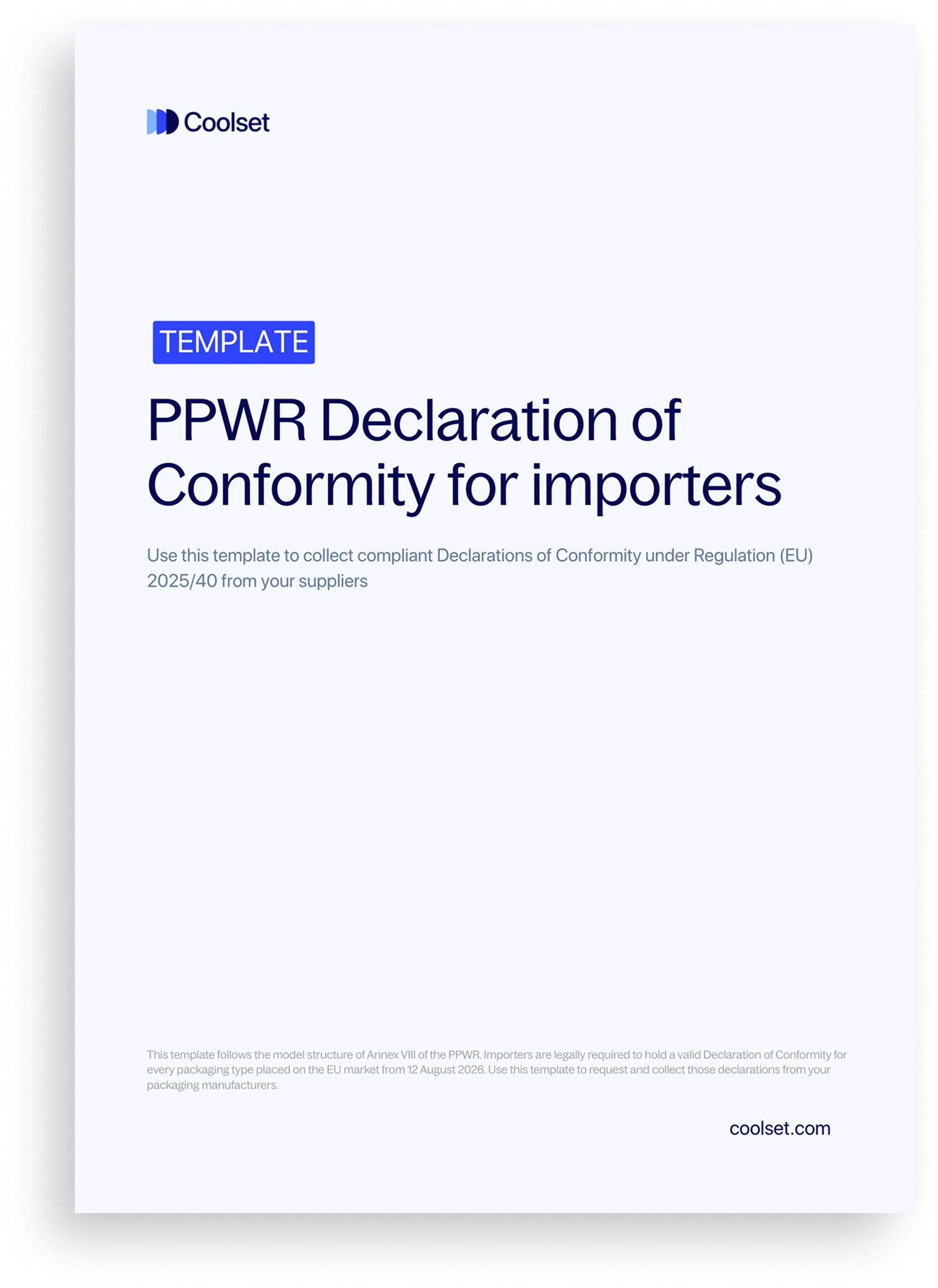
Get a ready-to-use template to request compliant DoCs from packaging suppliers (Annex VIII format).

on mobile screens
to experience this demo.
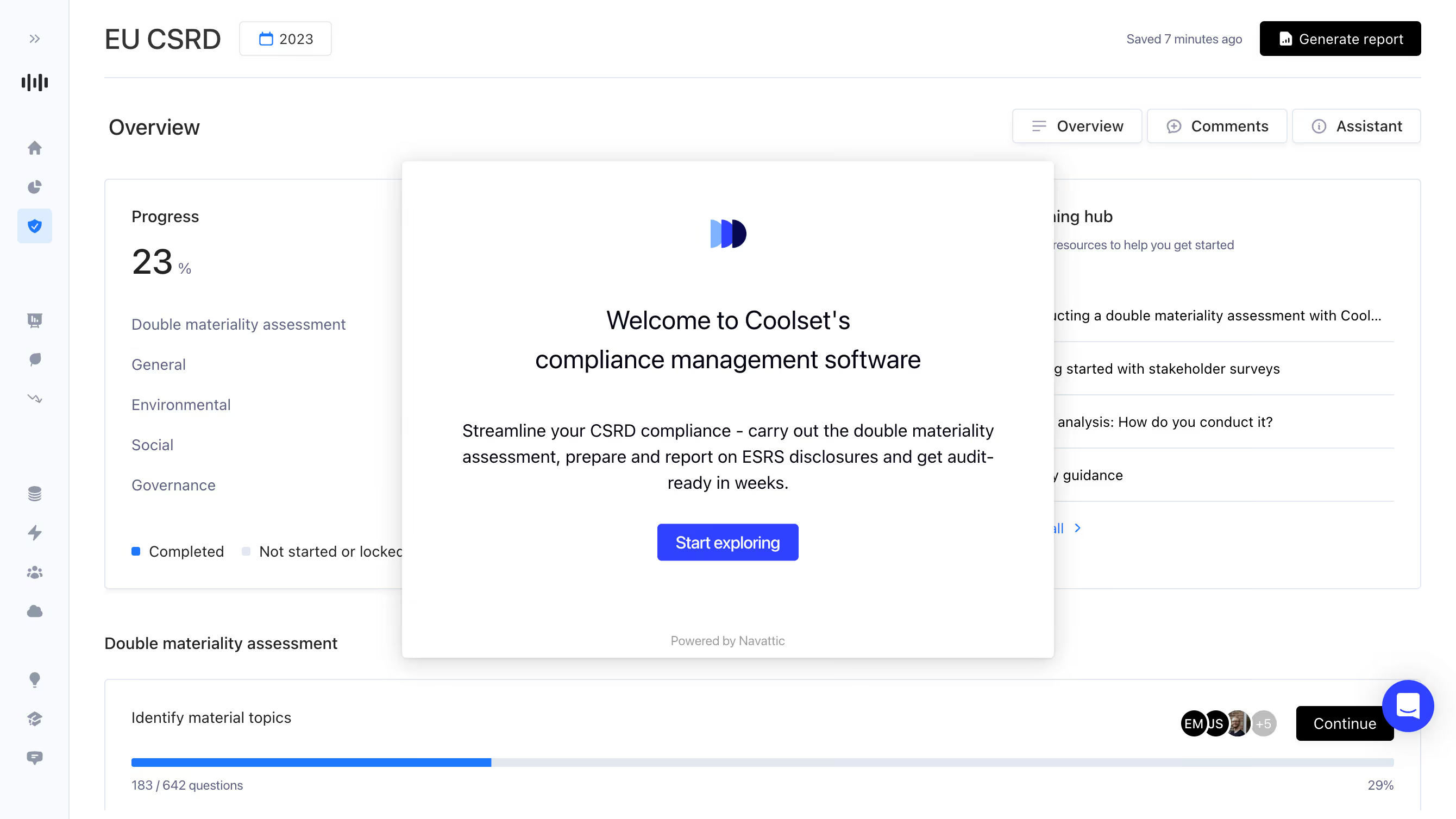


↘ Check if your documentation meets PPWR requirements
This free compliance checker scans your packaging documentation and maps it against mandatory PPWR data requirements, giving you a clear view of your compliance status. Get actionable insights on documentation gaps before they become compliance issues.

.webp)