EUDR legality evidence: a guide to Article 9(1)(h) compliance for suppliers



Disclaimer: New EUDR developments - December 2025
In November 2025, the European Parliament and Council backed key changes to the EU Deforestation Regulation (EUDR), including a 12‑month enforcement delay and simplified obligations based on company size and supply chain role.
Key changes proposed:
- New enforcement timeline: 30 December 2026 for large/medium operators, 30 June 2027 for small/micro operators
- Simplified DDS: One-time declarations for small and micro primary producers
- Narrowed scope: Most downstream actors and non‑SME traders would no longer need to submit DDSs
- New DDS requirement: Estimated annual quantity of regulated products must be included
These updates are not yet legally binding. A final text will be confirmed through trilogue negotiations and formal publication in the EU’s Official Journal. Until then, the current EUDR regulation and deadlines remain in force.
We continue to monitor developments and will update all guidance as the final law is adopted.
Key takeaways
- Article 9(1)(h) EUDR requires adequately conclusive and verifiable documentary evidence of legality at plot and shipment level, not generic supplier attestations.
- Points (a) to (h) of Article 2(40) cover nine legal areas, from land use rights and FPIC to tax, anti-corruption and customs.
- Certification schemes and supplier declarations support but do not discharge the Article 9(1)(h) duty.
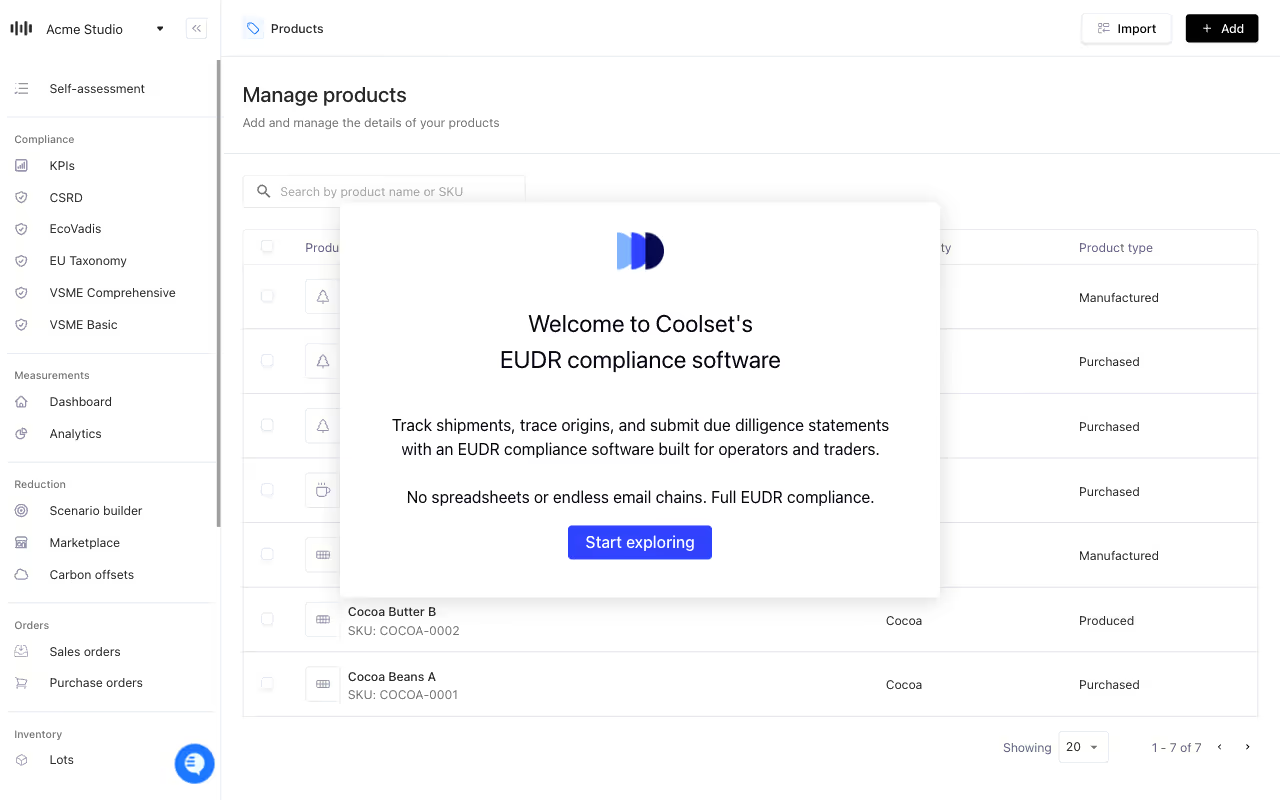
- Coolset helps compliance teams build defensible EUDR evidence packs. See the Coolset EUDR platform.
Article 9(1)(h) of Regulation (EU) 2023/1115 requires operators to collect 'adequately conclusive and verifiable information that the relevant products have been produced in accordance with the relevant legislation of the country of production, including any arrangement conferring the right to use the respective area'. The 2026 Commission Guidance Document reiterates that points (a) to (h) of Article 2(40) specify the legislation this test covers, and treats them as illustrative categories rather than an exhaustive checklist. That evidence standard is the single hardest line to satisfy in the due diligence file.
Regulation (EU) 2025/2650 sets the application date at 30 December 2026 for large and medium operators, and 30 June 2027 for micro and small operators. That leaves a short runway to build a legality pack. Generic supplier attestations and country-level legality certificates do not close the gap. Article 9(1)(h) demands documentary proof that ties each shipment to the plot of production and to specific producer-country laws.
The legality gap Article 9(1)(h) is designed to close
Article 9(1)(h) goes further than the earlier EU Timber Regulation, which the EUDR repeals. The EUTR only asked if timber was legally harvested. The EUDR asks the same of cattle, cocoa, coffee, oil palm, rubber, soy, wood and their Annex I derived products, against all relevant producer-country law. That covers chocolate, tires, paper and dozens of downstream goods a supplier might treat as processed rather than agricultural.
'Relevant legislation' is defined in Article 2(40) by the law of the country of production. The Commission's implementation pages confirm that it can include national laws, secondary law, jurisprudence and international law as applicable in domestic law. The Commission also notes that the Regulation lists legislative areas without naming particular legal acts, because those differ from country to country.
A single missing category is enough to disqualify a shipment. Unpaid land-use taxes, an absent Free, Prior and Informed Consent (FPIC) consultation record, or a labor inspection gap can each render a batch non-compliant even where the environmental and deforestation-free status is unquestioned. The Regulation treats legality as a cumulative test, not a weighted score, so operators need a document trail that covers every category the law of the country of production imposes.
What 'adequately conclusive and verifiable' means in practice
'Adequately conclusive and verifiable' means the operator must confirm each document is authentic, issued by the right authority and clearly linked to the plot of the shipment in question. The 2024 Guidance Document (Commission Notice C/2024/6789) makes clear that documentation collected under Article 9(1)(h) feeds the Article 10 risk assessment, not a self-certifying conclusion. A supplier declaration is a claim to be verified, not proof that the claim is correct.
The 2026 Guidance reinforces this. Article 2(40) must be read with the objectives in Article 1(1)(a) and (b), so any law linked to halting deforestation is also relevant. Verifiability requires traceable references that the operator can cross-check: permit numbers, cadastral identifiers, tax receipts, labor inspection reports, land-title registrations, or public register entries.
Where producer-country enforcement is weak or documents are hard to obtain, the operator's obligation does not shrink. The 2024 Guidance lists country risks that undermine document reliability: corruption, falsified documents, weak enforcement, human rights violations, armed conflict, and UN or EU sanctions. In those situations, Article 9(1)(h) still requires 'adequately conclusive' information, so operators must supplement records with independent audits, third-party verification, or satellite evidence.
The Commission's due diligence steps tie this evidence collection directly to the plot. Article 9 requires the commodity, quantity, supplier, country of production, evidence of legal harvest, and the geographic coordinates of every plot where the commodity was produced. Legality evidence that cannot be mapped back to those coordinates is not conclusive in the sense the Regulation requires. For teams building this data layer, the Coolset guide on EUDR geolocation requirements walks through polygon collection and validation.
{{product-tour-injectable}}
The nine categories of legality suppliers must document
Article 2(40) points (a) to (h) list the nine legal areas. The Commission Notice C/2025/4524 confirms the list: land use rights, environmental protection, forest-related rules, third parties' rights, labor rights, human rights protected under international law, FPIC where indigenous or local communities are affected, tax, anti-corruption, and trade and customs regulations. Suppliers need category-specific documentation for each area that applies to the plot and the commodity.
Practical evidence differs by category, but the pattern is consistent across sourcing geographies:
- Land use rights: title deeds, concession contracts, lease agreements or cadastral extracts tied to the geolocation coordinates submitted under Article 9(1)(d). The 2024 Guidance notes that whether a land title is required depends on national legislation: if domestic law does not require one, none is required for Article 9(1)(h), but the operator still needs proof that the production arrangement is lawful.
- Environmental protection and forest-related rules: environmental permits, forest management plans, impact assessments and clearance approvals issued by the competent producer-country authority.
- Third parties' rights: evidence that customary or private rights over the plot have been recognized, respected and, where required, formally acquired.
- Labor rights and human rights: records showing compliance with producer-country labor law and with human rights protected under international law as transposed, including forced-labor, child-labor and occupational safety obligations.
- FPIC: documented consultation records with indigenous peoples or local communities where domestic or international law requires their consent, beyond an assumption that consent exists.
- Tax, anti-corruption, trade and customs: export duty receipts, VAT records, beneficial ownership disclosures, and customs declarations that a competent authority can reconcile with the shipment.
The Commission's guidance on subjects of obligations lists the document types most likely to satisfy these categories: official documents from public authorities, contractual agreements, court decisions, impact assessments and audits. That list is not exhaustive, and the choice of instrument depends on what the country of production actually requires.
Why country-level certificates and blanket statements fail the test
Country-level legality benchmarks and general 'legal compliance' certificates cannot on their own satisfy Article 9(1)(h). The Regulation requires plot-level and shipment-level evidence. The Article 10 risk assessment sits downstream of Article 9(1)(h), which means the operator must first hold document-based evidence of legality before it can conclude that risk is negligible.
Voluntary certification schemes can support the evidence file, but they do not discharge the operator's due diligence duty. The Commission's implementation guidance is direct: operators must verify that documents are verifiable and reliable, taking into account the risk of corruption in the country of production. A certificate is a starting point for verification, not an endpoint. Where certification schemes cover only a subset of the nine categories, they leave gaps in tax, customs or FPIC evidence that the operator still has to close.
Supplier declarations of conformity carry the same limitation. Under Article 9, non-SME operators may cite an earlier Due Diligence Statement (DDS) number under Article 33. That is allowed only after confirming due diligence was done under paragraph 1. Referencing an upstream DDS does not shift liability upward. The operator remains responsible for the underlying legality facts.
Country risk classification interacts with the risk assessment step, not with the Article 9 information set. For teams sizing up how country risk fits into the wider workflow, the Coolset guide on EUDR country risk classification covers what changes when the Commission's benchmarks are updated.
What the July 2026 simplification package added to the evidence workflow
The July 2026 acts do not lower the Article 9(1)(h) evidence standard, but they add two workflow anchors. On 13 July 2026 the Commission adopted a Delegated Act updating and simplifying the list of products covered by the Regulation, together with an Implementing Act setting out the functioning of the EU Information System. Both build on Regulation (EU) 2025/2650 and complete the simplification package presented in May 2026.
The first workflow change concerns product scope. The Delegated Act changes which derived products fall within EUDR scope. Operators should reconfirm their in-scope commodities and derived products against the updated Annex I before assembling evidence packs. The Council's 18 December 2025 adoption note already removed certain printed products, including books, newspapers and printed pictures, on the ground of limited deforestation risk. Products that dropped out of scope no longer need an Article 9(1)(h) file.
The second workflow change concerns the DDS submission channel. The Implementing Act sets out how the EU Information System operates, and Article 9(1)(h) evidence sits behind the DDS reference number that authorities and downstream operators use to access the underlying due diligence file. The 2025 Commission Notice confirms that the principle of proportionality applies to interpretation and enforcement, but proportionality operates against the evidence file, not instead of it.
Building a supplier evidence pack that survives competent authority review
A defensible evidence pack maps each of the nine legal categories under Article 2(40) to specific documents, issuers, validity dates and the geolocation polygons submitted under Article 9(1)(d). The Commission's due diligence pages describe the DDS as the point where all relevant information is entered into the EU Information System. The underlying evidence pack has to be assembled in a structure that supports that submission and any subsequent authority request.
Contractual terms with upstream suppliers should require category-by-category evidence delivery and audit rights, with non-conformity treated as a shipment-blocking event rather than a matter for later correction. Where the operator sits several tiers away from the primary producer, the contract chain needs to preserve those rights all the way to the plot, because that is where the documentary evidence originates. For a broader view of how supplier prioritization fits into this, see the Coolset guide on EUDR supplier management.
Documents in the producer country's language should be accompanied by certified translations. Where feasible, verify them against public registries or independent third-party audits. The 2026 Guidance notes that data analytics and AI-based tools may support due diligence and enforcement by prioritizing cases, checking consistency of documents, and flagging anomalies. That is where automated cross-checks between geolocation polygons, cadastral registries and permit numbers become operationally useful.
Two related workflow questions come up here. Where a product is re-imported or further processed inside the EU, the operator needs to know whether a new DDS is required. The Coolset guide on EUDR re-imports and processed products works through that scenario. Primary producers using the simplified declaration route still need to hold legality evidence at plot level, as explained in the Coolset guide on the EUDR simplified declaration for micro and small operators.
{{custom-cta}}
Where to start with your Article 9(1)(h) evidence review
The starting point for any Article 9(1)(h) review is the gap between supplier attestations and verifiable primary documents mapped to the nine categories in Article 2(40). Make sure you can prove the Article 2(40) requirements with documents which can be linked to the plot of origin.
Frequently asked questions
What does Article 9(1)(h) of the EUDR actually require?
Article 9(1)(h) requires operators to collect 'adequately conclusive and verifiable information' that the relevant products were produced in accordance with the legislation of the country of production, including any arrangement giving the right to use the production area. It is one of the mandatory information elements behind every Due Diligence Statement.
Are voluntary certification schemes enough to satisfy Article 9(1)(h)?
No. The Commission's guidance requires operators to verify that legality documents are reliable, taking into account country-level risks such as corruption. A certification scheme can support the evidence file, but the operator retains the duty to verify and cannot rely on the certificate alone to discharge Article 9(1)(h).
Which nine legal areas does 'relevant legislation' cover?
Points (a) to (h) of Article 2(40) cover land use rights, environmental protection, forest-related rules, third parties' rights, labor rights, human rights under international law, FPIC where applicable, tax, anti-corruption, and trade and customs regulations. The 2025 Commission Notice confirms these are illustrative categories rather than an exhaustive checklist.
Can a supplier declaration alone satisfy Article 9(1)(h)?
No. The 2024 Guidance Document treats documents collected under Article 9(1)(h) as input for the Article 10 risk assessment, not as self-certifying conclusions. A supplier declaration is a claim the operator must verify against source documents from public authorities, contracts, court decisions or audits.
When does the Article 9(1)(h) obligation start applying?
Under Regulation (EU) 2025/2650, large and medium operators must comply with the main EUDR obligations from 30 December 2026, and natural persons and micro and small enterprises from 30 June 2027. Legality evidence packs need to be in place before the first shipment placed on the EU market on or after those dates.
The EUDR requires plot-level legality evidence across nine categories of producer-country law. Coolset helps compliance teams map supplier documents to Article 9(1)(h), verify them and file DDS records that survive competent authority review.


on mobile screens
to experience this demo.


↘ Check if your documentation meets PPWR requirements
This free compliance checker scans your packaging documentation and maps it against mandatory PPWR data requirements, giving you a clear view of your compliance status. Get actionable insights on documentation gaps before they become compliance issues.

.webp)