EUDR re-imports and processed products: when you need a new due diligence statement


Disclaimer: New EUDR developments - December 2025
In November 2025, the European Parliament and Council backed key changes to the EU Deforestation Regulation (EUDR), including a 12‑month enforcement delay and simplified obligations based on company size and supply chain role.
Key changes proposed:
- New enforcement timeline: 30 December 2026 for large/medium operators, 30 June 2027 for small/micro operators
- Simplified DDS: One-time declarations for small and micro primary producers
- Narrowed scope: Most downstream actors and non‑SME traders would no longer need to submit DDSs
- New DDS requirement: Estimated annual quantity of regulated products must be included
These updates are not yet legally binding. A final text will be confirmed through trilogue negotiations and formal publication in the EU’s Official Journal. Until then, the current EUDR regulation and deadlines remain in force.
We continue to monitor developments and will update all guidance as the final law is adopted.
Key takeaways
- A new DDS is required each time a relevant product is placed on the EU market or exported for the first time under Article 4 EUDR, including re-imports after the goods have left the EU customs territory.
- Downstream operators placing a product made from inputs that already cleared EUDR due diligence don't file a fresh DDS; they reference the verified upstream DDS number.
- Stock placed on the EU market before application (30 December 2026, or 30 June 2027 for micro and small operators not already covered by the EUTR) stays outside EUDR for its entire commercial life, but the operator carries the burden of proving it.
- Coolset helps compliance teams manage DDS workflows, upstream reference numbers, and supplier data across their EUDR obligations.
On 23 December 2025, the EU published Regulation (EU) 2025/2650. This targeted amendment to the EU Deforestation Regulation (EUDR) postpones application to 30 December 2026 for most operators. Micro and small operators not already covered by the EU Timber Regulation (EUTR) get a six-month cushion until 30 June 2027. The amendment also introduces a new downstream operator category with lighter filing duties.
That change reshapes an operational question at the heart of the regulation. When a shipment moves, is reprocessed, or comes back into the EU, do you need a fresh due diligence statement (DDS)? Or can you reference one that is already in the system?
The answer sits in Article 4 of the EUDR itself, sharpened by the December 2025 amendment and the Commission's implementation guidance. A new DDS is triggered every time a relevant product is placed on the EU market or exported for the first time. That covers re-imports after the goods have left the EU customs territory. It also covers transformations into a different Annex I product. Where an input has already been cleared by an upstream operator, the actor downstream can reference that number instead of repeating the full exercise, but only if the reference is verified and correctly recorded.
When re-imports and processing reset the DDS obligation
A new DDS is required whenever a relevant product is placed on the EU market or exported, and each of those acts is a separate triggering event. Article 4(1) of Regulation (EU) 2023/1115 requires operators to exercise due diligence before placing relevant products on the market or exporting them. Article 4(2) prohibits either act without prior submission of a DDS through the Article 33 Information System. Compliance upstream does not carry across a new placement, because responsibility attaches to the operator performing the current act.
The Commission's guidance narrows the rule in one direction. It states that "placing on the market for the first time" does not include situations where a new relevant product is made from other relevant products that were already placed on the EU market and already underwent due diligence. In that case the actor is a downstream operator, not an upstream one. The obligation shifts from filing a fresh DDS to referencing the existing upstream statement.
Two practical consequences follow. A re-import from outside the EU customs territory is a new placement and needs a new DDS, because the product has left the market and is entering again. A transformation of an input that has not yet passed through EUDR due diligence (for example, one imported directly from a third country) also requires the first placer to file a full DDS on the resulting Annex I product.
{{product-tour-injectable}}
Re-imports: what counts as re-entry and who files
A product exported from the EU and later re-imported is treated as a new placement, and the operator bringing it back in files the DDS. The Commission's guidance on due diligence confirms that for relevant products entering the EU, the DDS reference number (or simplified declaration identifier) must be made available on the customs declaration by the customs declarant. That obligation applies whether the goods are entering the EU for the first time or coming back after an export.
Filing happens through the Article 33 Information System. The Commission notes that DDS and simplified declarations submitted in the live server have legal value and their content can be subject to checks by competent authorities. The system functions pursuant to Commission Implementing Regulation (EU) 2024/3084, and bulk management is available via a machine-to-machine API with reference documentation published on CIRCABC.
Where the original exporter already filed an export DDS, the re-import statement should cite that upstream reference to preserve traceability across the chain. Commission guidance is clear that operators must pass on their DDS reference number to their direct downstream buyer for traceability. Re-imports are one of the flows where that link is easiest to lose. Filing a fresh statement while carrying the earlier reference forward keeps the chain intact and gives competent authorities a single audit path.
Processed products: when transformation creates a new Annex I obligation
A new DDS is required when an input commodity is transformed into a different Annex I product and that product is placed on the EU market for the first time. Annex I of the EUDR lists cattle, cocoa, coffee, palm oil, rubber, soy, wood and certain products made from them, each with a customs classification code. If the input has never been through EUDR due diligence (typically because it was imported directly from a third country), the processed product is a new relevant product. The first placer files the full DDS.
The picture changes when the input has already passed through EUDR due diligence upstream. Commission guidance states that where a new relevant product is manufactured from products already covered by upstream due diligence, the actor placing the new product on the market is a downstream operator. Downstream operators do not file a fresh DDS on the geolocation of the underlying plots. They reference the upstream DDS numbers instead. That is the simplification Regulation (EU) 2025/2650 was designed to enable when it introduced the downstream operator category, with obligations on downstream operators aligned with those of traders.
The downstream operator still has to verify that due diligence was exercised. Commission guidance is explicit that non-SME downstream operators and traders only need to verify upstream due diligence if there is a substantiated concern. The reference number itself must still be captured, stored, and made available to competent authorities on request. Passing a number through is not the same as trusting it blindly. The operator that places the processed product on the market carries the responsibility if the upstream evidence turns out to be defective.
{{eudr-scope-checker}}
Stocks and the 30 December 2026 cutoff
Products placed on the EU market before EUDR applies stay outside the regulation for their entire commercial life. The Commission's implementation page states that from 30 December 2026, products placed on, sold within or exported from the EU must be free from deforestation under the EUDR. The Council's press release confirms application is postponed until 30 December 2026 for all large and medium operators as well as micro and small operators already covered by the EUTR, with the six-month cushion for all other micro and small operators running to 30 June 2027. Stock placed on the market before those dates is not caught by the DDS obligation even if it is later resold.
The burden of proof sits with the operator claiming the exemption. Customs entry records, commercial invoices and warehouse receipts dated before the cutoff are the evidence competent authorities will expect if they ask. Documentation practice matters here, because Article 4 of the EUDR already requires operators to keep records of the DDS for five years from the date of submission through the Information System. The same discipline is worth applying to the paper trail behind any pre-application stock relied on for the exemption.
Enforcement runs on the same clock. The Commission's proposal aligned obligations of competent authorities to carry out checks under Articles 16 to 19, 22 and 24 with the postponed application dates, and prior to entry into application, competent authorities may issue warnings and recommendations. The Council revision also removed certain printed products (books, newspapers, printed pictures) from scope due to limited deforestation risk, per the Council's press release. A simplification review by the Commission was published on May 4, 2026.
Building the DDS decision into operational workflows
The choice between filing a fresh DDS and referencing an upstream number turns on three tests per SKU. Is the product re-entering the EU customs territory? Is it a transformation of an input that has not yet been through EUDR due diligence? Was it placed on the market before the applicable cutoff? The answers determine whether the operator files a new DDS, references an upstream number under the downstream operator regime, or documents the exemption.
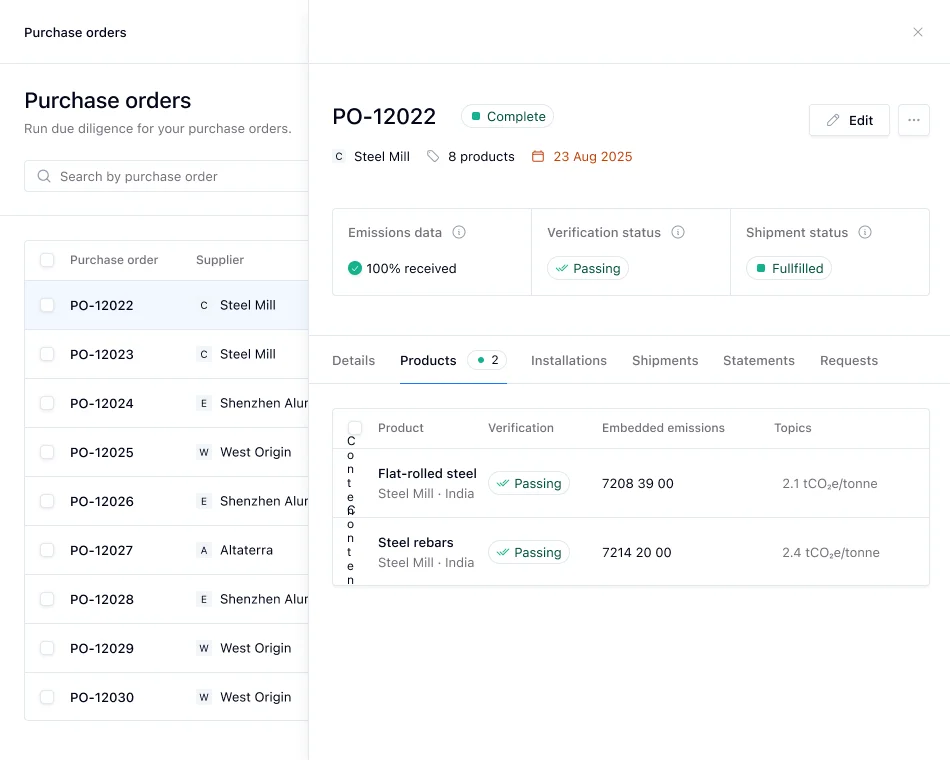
Upstream reference numbers are the connective tissue of that workflow. Commission guidance makes the pass-through explicit: operators must send their DDS reference number to their direct downstream buyer so the chain can be reconstructed by any competent authority. Storing those numbers next to purchase orders removes the friction of finding them later, when a downstream operator needs to reference them under the regime introduced by Regulation (EU) 2025/2650.
On the customs side, the reference number carries the DDS into the entry. Where a DDS covers multiple shipments or batches, the same DDS reference number can be referred to in several customs declarations as long as EUDR requirements are respected. Recurring imports of the same batch profile can reuse a single statement. That does not remove the need to review whether the underlying due diligence still holds for later shipments. For the declaration itself, Coolset's free HS, CN and TARIC codes guide covers TARIC measures 776 and 777 and shows which document code to declare for each Annex I entry.
{{custom-cta}}
Where to focus before the December 2026 cutoff
Start by mapping which product flows will trigger a new DDS after 30 December 2026: direct imports from third countries, exports, re-imports of previously exported goods, and processed goods produced from third-country inputs. That single map separates the flows that need a fresh statement from those where an upstream reference under the downstream operator regime will do.
Frequently asked questions
What are the new EU import regulations for 2026?
The EUDR applies from 30 December 2026 for large and medium operators as well as for micro and small operators already covered by the EUTR, and from 30 June 2027 for other micro and small operators, following the postponement adopted in Regulation (EU) 2025/2650. Products in scope include cattle, cocoa, coffee, palm oil, rubber, soy, wood and certain derived products listed in Annex I. Each must be covered by a DDS before being placed on the EU market or exported.
What are the requirements for EUDR compliance?
Under Article 4 of Regulation (EU) 2023/1115, operators must exercise due diligence and submit a DDS through the Article 33 Information System before placing relevant products on the market or exporting them. Documentation must be kept for five years. Downstream operators can reference upstream DDS numbers instead of filing a fresh statement.
Does a re-imported product need a new DDS?
Yes. A product that has left the EU customs territory and re-enters is placed on the market again, so Article 4 requires a new DDS from the operator carrying out the re-import. Referencing the original export DDS number preserves traceability across the chain.
Do processed products always need a new DDS?
No. If the input was already placed on the EU market and already underwent EUDR due diligence, the actor producing the processed product is a downstream operator and references the upstream DDS number instead of filing a fresh one, per Commission guidance. A new DDS is needed when the input has not yet passed through EUDR due diligence.
Coolset helps compliance teams file EUDR due diligence statements, track upstream DDS reference numbers across suppliers, and separate in-scope flows from pre-application stock before the December 2026 cutoff.

↘ Check if your products are in scope for EUDR
Learn if the EUDR applies to your products and company. Answer a few questions about your commodities and your role in the supply chain, and see what you must do before the deadline.
Join the EUDR Winter School
Live sessions on geolocation, due diligence statements and audit readiness before the 30 December deadline.

.webp)