EUDR Information System: how to register and submit your first DDS in 2026



Disclaimer: New EUDR developments - December 2025
In November 2025, the European Parliament and Council backed key changes to the EU Deforestation Regulation (EUDR), including a 12‑month enforcement delay and simplified obligations based on company size and supply chain role.
Key changes proposed:
- New enforcement timeline: 30 December 2026 for large/medium operators, 30 June 2027 for small/micro operators
- Simplified DDS: One-time declarations for small and micro primary producers
- Narrowed scope: Most downstream actors and non‑SME traders would no longer need to submit DDSs
- New DDS requirement: Estimated annual quantity of regulated products must be included
These updates are not yet legally binding. A final text will be confirmed through trilogue negotiations and formal publication in the EU’s Official Journal. Until then, the current EUDR regulation and deadlines remain in force.
We continue to monitor developments and will update all guidance as the final law is adopted.
Key takeaways
- The EUDR Information System was in restricted mode until recently, but has now been re-opened with new features.
- Large and medium operators must apply the EUDR from 30 December 2026; micro and small operators from 30 June 2027.
- Registration uses EU Login and TRACES NT, with separate accounts required for ACCEPTANCE (training) and LIVE (production).
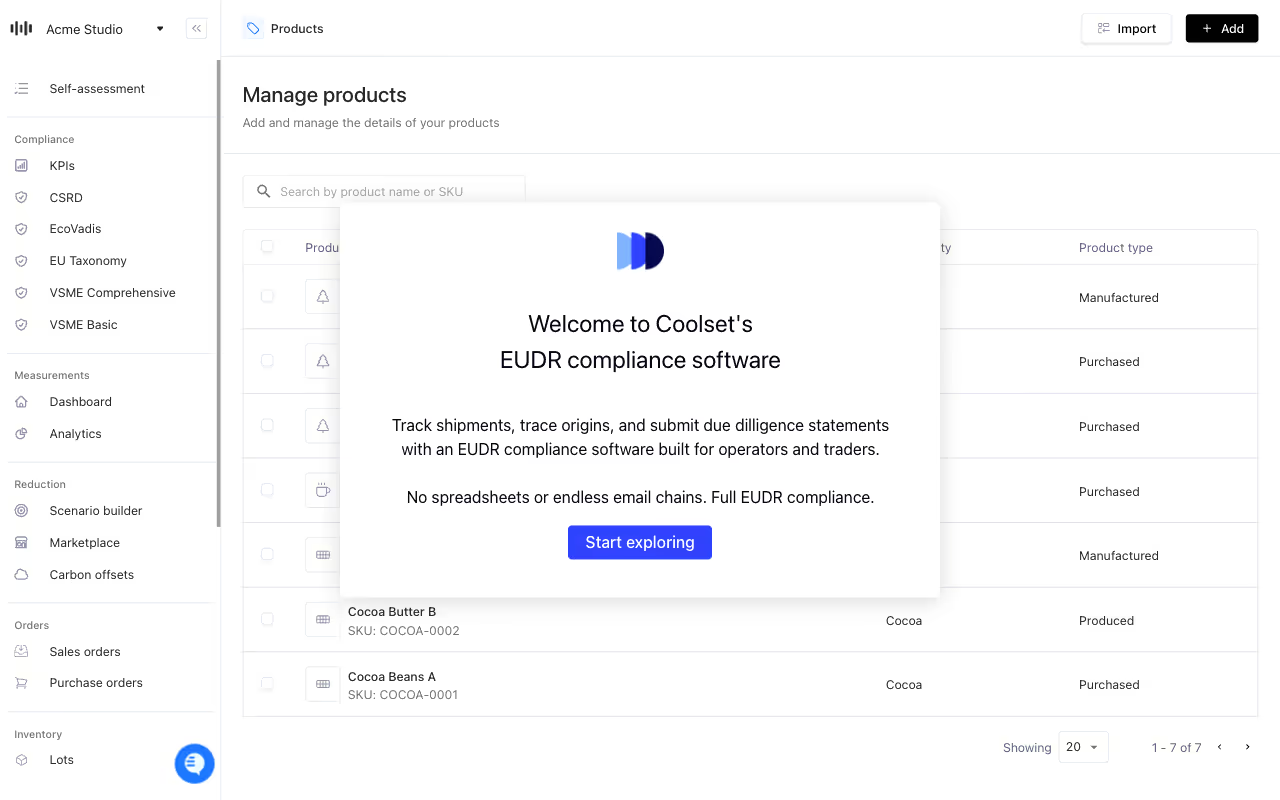
- Coolset helps teams prepare role classification, geolocation data, and DDS workflows ahead of reopening. See the EUDR platform.
The EUDR Information System has been in restricted mode since 16 February 2026 until recently. The European Commission reopened the platform in July 2026 with the features required by the revised Regulation, with the remaining functionalities being added later in summer.
Operators in scope of the EU Deforestation Regulation (EUDR) must apply the regulation from 30 December 2026, with micro and small operators following on 30 June 2027. Companies placing cattle, cocoa, coffee, palm oil, rubber, soy, wood, or derived products on the EU market need three things before the first shipment moves: an EU Login account, a TRACES NT registration for the EUDR module, and a tested DDS submission flow. In the sections below, we walk you through what is in the system, what changed in December 2025, and how to prepare so the first DDS clears on the first attempt.
What the EUDR Information System actually is
The EUDR Information System is the EU's online platform for Due Diligence Statements. Operators, traders, and competent authorities use it to file and review DDS records under Article 33 of Regulation (EU) 2023/1115. The system functions pursuant to Commission Implementing Regulation (EU) 2024/3084, which defines its rules of operation. The platform is hosted inside TRACES NT and reached over the tracesnt subdomain of webcloud.ec.europa.eu.
Every relevant product placed on or exported from the EU market must be covered by a DDS, or a simplified declaration in specific cases, submitted into the system before the product moves. The Commission's due diligence guidance sets out that Step 1 of the duty (Article 9) requires the operator to gather commodity, quantity, supplier, country of production, evidence of legal harvest, and geolocation of the plots where the commodity was produced. The DDS is the structured record of that work, and the reference number returned by the system is what links the declaration to customs.
One DDS can cover multiple shipments. The same DDS reference number may be cited in several customs declarations, and a single customs declaration may carry multiple DDS reference numbers. That flexibility shapes how operators batch their data, particularly importers running high-frequency shipments out of one origin.
{{product-tour-injectable}}
Why registration under Traces was closed
Registrations were closed as the Commission was rebuilding parts of the system to reflect the December 2025 revision of the EUDR. Behind the scenes, the system needed to integrate new categories that did not exist in the original text.
Regulation (EU) 2025/2650 amends the original EUDR, Regulation (EU) 2023/1115, in several ways that touch the data model. It introduces a downstream operator category whose obligations mirror those of traders, redefines ‘operator’ under Article 2(15), and creates the new Article 2(15a) definition of micro- or small primary operator. The text of the Regulation also deletes Annex II point 4 and sets out a new Annex III template for the simplified declaration used by micro and small primary operators.
The Commission's revision responds directly to feedback that the IT system was not ready and the administrative load was too high. The Council formally adopted the revision on 18 December 2025, citing the readiness of the IT system necessary for the effective functioning of the EUDR as one of the explicit drivers. The result was a system in maintenance until the new fields, screens, and validation rules were adequately in place.
What changed since the reopening of the EUDR information system
The Information System has been updated to reflect the structural changes introduced by Regulation (EU) 2025/2650. According to the European Commission, this update covers the core features required under the revised Regulation, with additional functionalities expected to roll out later in the summer. Among the changes are simplifications requested by member states and industry stakeholders — most notably, a simplified declaration process for micro and small primary operators, along with updated technical specifications for the system's application programming interfaces (APIs).
Three changes drove most of the rebuilding work.
- The downstream operator category needs its own profile. A downstream operator carries the same obligations as a trader and does not submit a full DDS once an upstream operator has already lodged one.
- The simplified declaration route under Annex III for micro and small primary operators is a different submission, with reduced fields covering name, address, EORI number, HS code, a free-text description, and a one-off estimated annual quantity in net mass.
- Only the first business to place a relevant product on the EU market is responsible for submitting the DDS, which means downstream parties should not be set up to file the full statement at all.
%20Template%20-%20Split%20width%20-%201_1%20-%20Visual%20Right%20(1).webp)
The practical effect is that the role you select on registration determines what you can and cannot submit. Choosing the wrong role at sign-up creates the wrong obligations on screen and breaks the chain of reference numbers your customers or downstream partners rely on. Confirming role and scope before the first registration matters more than registering quickly.
How registration in the EUDR Information System works
Registration in the EUDR Information System runs through EU Login and TRACES NT, and access is approved by a local administrator or the relevant competent authority. The login page confirms that authentication is handled by EU Login, the Commission's central identity service. Each EU Member State designates one or more competent authorities responsible for fulfilling the obligations under the Regulation and those authorities are the gatekeepers for company-level access in their territory.
The general method, once the system reopens, will reflect the following process:
- Create an EU Login account for each user who will sign DDS or simplified declarations.
- Request access to the EUDR module in TRACES NT under the correct role. Selecting operator commits you to full Article 9 due diligence; selecting downstream operator commits you to the lighter regime under the revised text.
- Register separately for the ACCEPTANCE training environment and the LIVE production environment. The Commission has confirmed that an account in one environment does not grant access to the other; each registration is independent.
- Wait for confirmation from the local administrator or competent authority before lodging anything in LIVE.
Splitting ACCEPTANCE from LIVE is deliberate. ACCEPTANCE is where teams should test data structures, geolocation file formats, and API connections without affecting their official record. Treating ACCEPTANCE as a sandbox keeps experimental submissions and incorrect references out of the production trail that customs and competent authorities can see.
{{custom-cta}}
How to submit your first Due Diligence Statement
A first DDS is built from the dataset described in Article 9 of the EUDR and lodged through either the web interface or the bulk API. The Commission's due diligence guidance confirms that Annex II of the EUDR provides the template for the DDS, while Annex III provides the template for the simplified declaration available to micro and small primary operators classified under Article 29 low-risk countries.
The dataset the system expects for a standard DDS includes:
- Operator's name, address, and EORI number (where applicable).
- The commodity or product, identified by HS code, description, and trade name.
- The quantity, expressed in net mass and, where relevant, volume or units.
- Country of production and geolocation coordinates of every plot of land where the commodity was produced.
- Reference number of an existing DDS, if relying on due diligence carried out upstream.
- The declaration that due diligence was exercised and no or only a negligible risk was found.
- Signature (name, function, date).
For high-volume importers, the Commission exposes a machine-to-machine API that supports bulk DDS management. The API reference documentation is published on CIRCABC. Teams running ERPs or procurement systems that already hold supplier, HS, and geolocation data should plan to feed that data through the API rather than rekey it into the web form.
Once submitted, the system returns a DDS reference number. That number flows into the customs declaration so the customs authority can match the import against the due diligence record. Because one DDS reference can be re-used across multiple shipments, importers shipping repeatedly from the same plots can compress the number of distinct DDS records they manage.
What to prepare until the end of 2026
From now until the end of 2026 is the window to fix data, not software access. Three workstreams pay off most: role classification, the underlying product data, and dry-run testing once ACCEPTANCE is back.
Role classification comes first. The revised Article 2 definitions decide whether a company files as an operator, a downstream operator, or a trader, and the default under Article 2(15) is operator. The Commission's environment portal notes that the December 2025 amendment creates two new categories that change how obligations are distributed within the supply chain. Documenting the reasoning behind the chosen role is what allows a company to defend a lighter classification later.
The product data spine is the second workstream. Each in-scope SKU links to a commodity, an HS code, a country of production, a supplier, and the plots of land behind it. Article 9 requires geolocation coordinates of those plots, and this is usually the slowest data to gather from upstream partners. The country classification adopted through the Commission's implementing act tells operators whether each origin is low, standard, or high risk, which affects the depth of risk assessment owed.
Dry-run testing closes the gap. The ACCEPTANCE environment exists for trialling geolocation file uploads, DDS structures, and, where relevant, the bulk API connection before any official record is lodged. Catching schema or coordinate errors in ACCEPTANCE costs nothing; catching them on the first live shipment creates customs delays.
Register on the platform now
The timing leaves less than six months until the 30 December 2026 application date for large and medium operators. The Commission's Access2Markets update confirms that large operators must comply with the main obligations of Regulation (EU) 2023/1115 from 30 December 2026, while natural persons and micro and small enterprises must comply from 30 June 2027.
That gap is shorter than it looks. Competent authorities are now required to report significant IT system disruptions to the Commission, per the December 2025 political agreement. The second half of 2026 is the realistic window to absorb most onboarding work before the application date.
Frequently asked questions
When can I register for the EUDR Information System?
The Commission has stated that the Information System will become accessible again in June 2026 with the main features required by the revised Regulation, and that further functionalities will follow later in summer 2026. New registrations are not accepted while the system is in restricted mode.
Do I need separate accounts for ACCEPTANCE and LIVE?
Yes. The Commission confirms that registering an account in one environment does not grant access to the other. ACCEPTANCE is the training environment used for testing; LIVE is the production environment where official DDS records are lodged. Each requires its own registration once the system reopens.
Can SMS still be used as a second factor for EU Login?
No. From 30 June 2025, SMS is no longer accepted as a second factor for EU Login, which is the identity service behind the EUDR Information System. Users need an authenticator app, security key, or another supported method.
Who has to submit the DDS in a multi-step supply chain?
Only the business that is first to place a relevant product on the EU market is responsible for submitting the DDS. Subsequent operators and traders, including the new downstream operator category, are not required to file a full DDS once one has been lodged upstream, per the December 2025 amendment.
What is the simplified declaration under Annex III?
The simplified declaration is a one-time submission available to micro or small primary operators established in countries classified as low risk under Article 29. It carries reduced data: name, address, EORI number, HS code, a free-text product description, and a one-off estimated annual quantity expressed in net mass.
Coolset helps compliance teams classify operators under the revised EUDR, structure Annex II data, and prepare bulk DDS submissions so the first filing in TRACES NT clears on the first attempt.


on mobile screens
to experience this demo.



.webp)