EUDR FAQ: Top 25 frequently asked questions on the EU Deforestation Regulation (2026)


Disclaimer: New EUDR developments - December 2025
In November 2025, the European Parliament and Council backed key changes to the EU Deforestation Regulation (EUDR), including a 12‑month enforcement delay and simplified obligations based on company size and supply chain role.
Key changes proposed:
- New enforcement timeline: 30 December 2026 for large/medium operators, 30 June 2027 for small/micro operators
- Simplified DDS: One-time declarations for small and micro primary producers
- Narrowed scope: Most downstream actors and non‑SME traders would no longer need to submit DDSs
- New DDS requirement: Estimated annual quantity of regulated products must be included
These updates are not yet legally binding. A final text will be confirmed through trilogue negotiations and formal publication in the EU’s Official Journal. Until then, the current EUDR regulation and deadlines remain in force.
We continue to monitor developments and will update all guidance as the final law is adopted.
Key takeaways
- The EUDR applies from 30 December 2026, requiring deforestation-free proof for seven commodity groups.
- Operators must complete three-step due diligence and submit a due diligence statement via TRACES NT per consignment.
- Plot-level geolocation is mandatory, with country benchmarks setting inspection rates of 1%, 3%, or 9%.
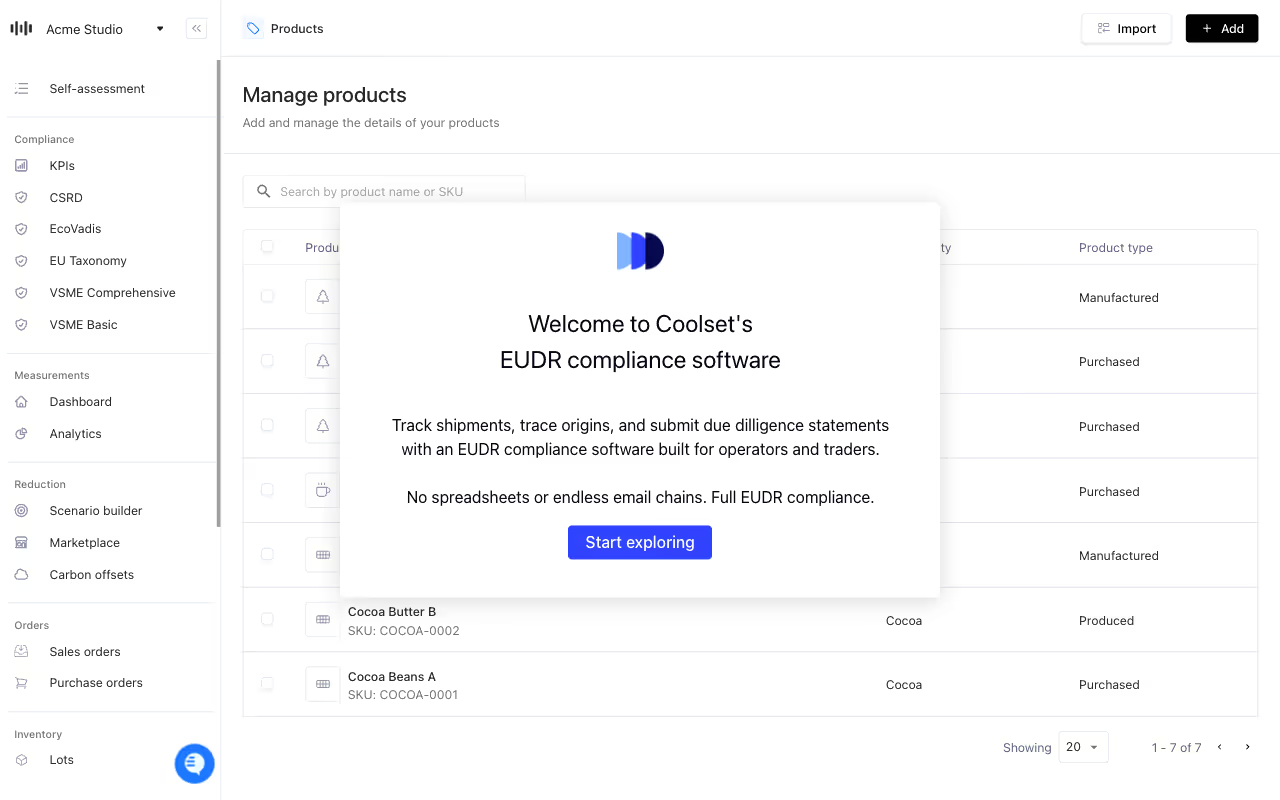
- Coolset's EUDR compliance platform automates geolocation validation, deforestation checks, and DDS preparation.
The EU Deforestation Regulation (EUDR) requires companies placing specific commodities on the EU market - or exporting them from it - to prove those products are deforestation-free and legally produced. With the application date now confirmed for 30 December 2026, compliance teams need clear answers to plan their implementation. This FAQ covers the 25 questions we hear most often from operators, traders, and their supply-chain partners.
If you are new to the regulation, start with our comprehensive EUDR explainer for the full picture. The questions below go deeper into scope, deadlines, due diligence mechanics, geolocation requirements, risk benchmarks, enforcement, and practical implementation steps.
Scope and applicability
1. What is the EUDR and why was it introduced?
The EU Deforestation Regulation (Regulation 2023/1115) is a binding EU law that prohibits placing commodities and derived products on the EU market - or exporting them - unless they are deforestation-free, produced in compliance with the legislation of the country of production, and covered by a due diligence statement. It entered into force on 29 June 2023.
The regulation was introduced because the EU's consumption footprint is a significant driver of global deforestation. The EUDR replaces the older EU Timber Regulation (EUTR) and extends the scope from wood alone to seven high-risk commodity groups. Its goal is to break the link between EU demand and forest destruction worldwide.
2. Which commodities and products are covered by the EUDR?
The EUDR covers seven commodities: cattle, cocoa, coffee, oil palm, rubber, soya, and wood. Critically, it also covers a wide range of derived products - for example, leather, chocolate, printed paper, tyres, furniture, and soy-based animal feed. Annex I of the regulation lists the full set of CN codes.
If your product contains, was fed with, or was made using any of these commodities, it likely falls within scope. For a sector-by-sector breakdown, see our EUDR product coverage guide.
3. What is the difference between an operator and a trader under the EUDR?
An operator is any natural or legal person who, in the course of a commercial activity, places relevant commodities or products on the EU market or exports them (Art. 2). In practice, this is typically the importer of record or the first company to make the product available on the EU market. An operator bears the full due diligence obligation.
A trader is any person in the supply chain - other than the operator - who makes relevant products available on the market in the course of a commercial activity. Traders who are not SMEs carry the same due diligence obligations as operators. SME traders can rely on the due diligence statement numbers provided by their upstream suppliers, though they must still collect and retain those references. For the full role breakdown, see our EUDR role-by-role compliance guide. Traders can also consult our dedicated EUDR reporting guide for traders.
4. Are SMEs exempt from the EUDR?
No. SMEs are not exempt from the EUDR. They must still ensure their products are deforestation-free and legally produced. However, SMEs that qualify as traders (not operators) benefit from a simplified due diligence regime under Art. 4(8): they are not required to conduct their own full due diligence system but must collect, retain, and be able to present the reference numbers of the due diligence statements from their upstream suppliers.
SMEs also receive a later application date - 30 June 2027 instead of 30 December 2026. This gives smaller businesses an additional six months to prepare. For practical guidance on what this means, read our EUDR reporting guide for SMEs.
5. Does the EUDR apply to products sourced within the EU?
Yes. The EUDR is origin-neutral. It applies to all relevant commodities and products placed on the EU market regardless of where they were produced - including within the EU itself. A German furniture manufacturer using German-sourced wood, or a French dairy company with EU-raised cattle, must still demonstrate that the commodity was produced on land that was not subject to deforestation after 31 December 2020.
The practical burden is lighter for EU-sourced products because all EU member states have been classified as low-risk under the country benchmarking system, which reduces inspection rates. But the legal obligation to conduct due diligence and submit a due diligence statement remains. See the compliance breakdown by role for specifics.
{{custom-cta}}
Key deadlines and timeline
6. When does the EUDR apply?
The EUDR entered into force on 29 June 2023, but its obligations apply from 30 December 2026 for large operators and traders. For micro, small, and medium-sized enterprises (SMEs) that qualify as traders, the application date is 30 June 2027.
These dates were pushed back by one year through Regulation 2025/2650, published on 23 December 2025. The original deadlines were 30 December 2025 and 30 June 2026 respectively. Despite the delay, the European Commission has confirmed that the regulation will apply without further postponement. For a timeline overview, see our EUDR delay explainer.
7. What is the deforestation cut-off date?
The cut-off date is 31 December 2020 (Art. 2(13)). This means that relevant commodities must have been produced on land that was not subject to deforestation after this date. The cut-off date was not affected by the one-year delay to the application date - it remains fixed.
In practice, this means you need to establish that the plot of land where your commodity was produced was not converted from forest to agricultural use (or did not undergo forest degradation, in the case of wood) at any point between 1 January 2021 and the date the product was placed on the market. Historical satellite imagery is the primary tool most companies use to verify this.
8. Has the EUDR been delayed?
Yes, once. In December 2025, the European Parliament and Council adopted Regulation 2025/2650, which postponed the application dates by exactly one year. Large operators and traders now face a 30 December 2026 deadline; SME traders have until 30 June 2027.
The delay was granted to give companies and third-country governments more time to prepare, and to allow the European Commission to finalise the IT systems (particularly TRACES NT) and country benchmarks needed for compliance. However, the Commission has also announced a simplification review due by 30 April 2026, which may result in targeted adjustments - though not a further delay. For the full political context, read our analysis of what the EU vote means for importers.
Since the delay, the Commission has restricted access to the EUDR Information System (TRACES NT) from 16 February 2026 for maintenance and updates. The system is expected to reopen shortly after mid-April 2026. Meanwhile, a Community of Practice was launched on 11 March 2026 by the European Forest Institute and the EU Sustainable Supply Chains Coalition to support practical implementation. The Commission's simplification review, due by 30 April 2026, is expected to deliver updated guidance and potential adjustments to the product scope (Annex I) without reopening the core regulation. The Commission published its simplification package in May 2026 – read the full EUDR simplification 2026 breakdown. For a timeline of all key milestones, see our EUDR compliance timeline.
Due diligence requirements
9. What are the three steps of EUDR due diligence?
Article 8 of the EUDR requires operators and non-SME traders to operate a due diligence system with three mandatory steps:
- Information gathering - Collect product descriptions, quantities, geolocation coordinates of the production plots, supplier details, and evidence that the product is deforestation-free and legally produced (Art. 9).
- Risk assessment - Analyse the collected information against defined criteria (country benchmarks, commodity-specific risks, complexity of the supply chain, etc.) to determine whether there is a risk that the products are non-compliant (Art. 10).
- Risk mitigation - Where the risk assessment identifies a non-negligible risk, take adequate measures to reduce it - such as independent audits, satellite monitoring, supplier verification, or additional documentation (Art. 10).
Only when the risk has been reduced to negligible can the operator submit a due diligence statement and place the product on the market. For a walkthrough, see our EUDR due diligence requirements explainer.
10. What is a due diligence statement (DDS)?
A due diligence statement is a formal declaration submitted via the EU's information system (TRACES NT) before the relevant product is placed on the EU market or exported. By submitting it, the operator or trader confirms that due diligence was carried out and that no more than a negligible risk of non-compliance was found (Art. 4(2)).
Each DDS receives a unique reference number that must travel with the product through the supply chain. Downstream traders need this number to meet their own obligations. The statement includes the commodity type, country of production, geolocation data, supplier and operator details, and a declaration of compliance. For a complete breakdown, read our guide to the EUDR due diligence statement.
11. Can I rely on certifications like FSC or RSPO instead of doing my own due diligence?
Not as a substitute, but they can be a useful input. The EUDR explicitly states that certifications and third-party verification schemes may be used as part of the risk assessment and risk mitigation steps, but they do not replace the operator's own due diligence obligation (Art. 10(2)). You remain legally responsible for the accuracy of your due diligence statement.
In practice, a credible certification scheme can strengthen your risk assessment - especially if it includes geolocation tracking and independent auditing - but you still need to verify that the certification is valid, that the specific supply chain is covered, and that all EUDR-specific data requirements (like plot-level geolocation) are met. For a detailed look at how specific schemes stack up, see our guide to EUDR certification schemes. For broader implementation advice, read our EUDR compliance how-to guide.
12. Do I need to do due diligence for every shipment?
Yes. The EUDR requires a due diligence statement for each consignment of relevant products placed on or exported from the EU market. There is no blanket approval for suppliers or origins.
However, this does not mean you start from scratch each time. Your due diligence system can be designed to process recurring supply chains efficiently - reusing verified supplier data, pre-assessed geolocation plots, and established risk profiles. What matters is that every DDS reflects current and accurate information for the specific shipment it covers.
13. How long must I retain due diligence records?
Operators and traders must retain all documentation related to their due diligence - including the information gathered, risk assessments, risk mitigation measures, and the due diligence statements themselves - for a minimum of five years from the date the statement was submitted (Art. 12). This documentation must be made available to competent authorities upon request.
Geolocation and traceability
14. What geolocation data is required under the EUDR?
The EUDR requires the geolocation of all plots of land where the relevant commodity was produced (Art. 9(1)(d)). The format depends on the size of the plot:
- For plots smaller than 4 hectares: a single latitude/longitude point (using at least six decimal places) is sufficient.
- For plots of 4 hectares or more: a polygon describing the perimeter of the plot is required.
This is one of the most operationally demanding requirements of the EUDR, particularly for commodities sourced from smallholder farmers in complex supply chains. For a practical guide on what to submit and how, see our EUDR reporting guide for operators.
15. How do I collect geolocation data from suppliers?
Collecting accurate geolocation data is one of the biggest practical challenges of EUDR compliance. The approach depends on your supply chain structure. For direct sourcing, you can work with producers to map plots using GPS-enabled devices or mobile applications. For indirect or multi-tier supply chains, you will need to engage upstream suppliers - cooperatives, aggregators, or first-mile traders - and establish clear data-sharing protocols.
Key practical steps include: defining the data format and accuracy requirements upfront, providing suppliers with tools or templates, integrating geolocation collection into purchasing contracts, and validating incoming data against satellite imagery. Start early - many suppliers will need training and support. Read our guide on how to collect EUDR data from suppliers for detailed advice.
16. What about blended or mixed-origin commodities?
The EUDR does not exempt blended products. If a commodity has been mixed - for example, cocoa beans from multiple farms aggregated at a cooperative, or soy meal from multiple origins - the operator must provide geolocation data for all plots of land that could have contributed to the final product. Segregation is the simplest path to compliance, but where blending is unavoidable, you must trace back to every potential source plot.
This has major implications for procurement. Companies sourcing blended commodities should evaluate whether to shift towards segregated supply chains, work with suppliers who can provide full traceability, or invest in mass-balance systems that maintain plot-level records even through blending. For more, see our guide on integrating the EUDR into procurement.
17. Can I use satellite imagery to verify deforestation-free status?
Yes, and in most cases you should. Satellite imagery is the primary tool for verifying that a plot of land has not been deforested after the 31 December 2020 cut-off date. The European Commission encourages the use of freely available data sources such as Copernicus Sentinel imagery, Global Forest Watch, and the Joint Research Centre's forest monitoring tools.
Satellite monitoring is particularly valuable in the risk assessment step (Art. 10). It can confirm forest cover status at the cut-off date, detect subsequent changes, and flag plots for further investigation. However, satellite data alone does not prove legality - you still need documentation that the commodity was produced in accordance with local laws. For a deeper dive into risk assessment methodology, see our EUDR risk assessment and mitigation guide.
Risk assessment and country benchmarks
18. How does risk assessment work under the EUDR?
Risk assessment under the EUDR (Art. 10) requires you to evaluate whether the products in a given consignment carry a non-negligible risk of being non-compliant - meaning they might be linked to deforestation after 31 December 2020 or produced in violation of local laws. The assessment must consider a defined set of criteria, including the country or region of production, the presence of forests, the prevalence of deforestation, the commodity-specific risk, the complexity of the supply chain, and any relevant supplementary information.
If the assessment identifies a non-negligible risk, you must proceed to risk mitigation before you can submit a due diligence statement. Only when the risk is reduced to negligible can you place the product on the market. For the full methodology and practical examples, see our EUDR risk assessment and mitigation guide.
19. What does "negligible risk" mean and how do I demonstrate it?
"Negligible risk" is the threshold the EUDR requires you to meet before submitting a due diligence statement (Art. 3). The regulation does not define it quantitatively - it is a judgement the operator must make based on the totality of the evidence gathered and the risk assessment performed. In practice, it means that after analysing all available information and, where necessary, taking mitigation measures, you have no substantive reason to believe the product is linked to post-2020 deforestation or was produced illegally.
You demonstrate negligible risk through the documentation in your due diligence system: verified geolocation data matched against satellite imagery, confirmed legal compliance of the production, supplier verification records, and - where applicable - the results of on-the-ground audits or independent checks. The key is a well-documented, defensible process.
20. How does the country benchmarking system work?
The European Commission published its first country benchmarks on 22 May 2025, classifying countries into three tiers based on deforestation risk: low, standard, and high. These benchmarks directly affect the level of due diligence scrutiny and the rate at which competent authorities inspect consignments from each tier.
As of the May 2025 publication: 140 countries are classified as low-risk, including all EU member states, the United States, Canada, and China. Four countries are classified as high-risk: Belarus, Myanmar, North Korea, and Russia. All remaining countries are classified as standard-risk. Benchmarks will be reviewed and updated periodically. For a detailed analysis, see our guide to EUDR risk benchmarks and due diligence responsibilities.
21. What changes for low-risk vs high-risk countries?
The country benchmark determines two things: the inspection rate applied by competent authorities and the simplified due diligence option available for low-risk sourcing.
For products sourced from low-risk countries, competent authorities will inspect approximately 1% of operators and consignments. Operators sourcing exclusively from low-risk countries may apply a simplified due diligence procedure - though they must still submit a due diligence statement and retain records. For standard-risk countries, the inspection rate rises to 3%. For high-risk countries, the rate is 9%, and competent authorities must apply enhanced scrutiny. The full due diligence system - information gathering, risk assessment, and risk mitigation - applies in all cases, but the practical burden is proportionate to the risk tier. Read our guide to EUDR due diligence for low-risk countries for the specifics.
Enforcement and penalties
22. What are the penalties for non-compliance with the EUDR?
The EUDR requires Member States to establish penalties that are "effective, proportionate, and dissuasive" (Art. 25). While the exact penalty amounts are set at national level, the regulation specifies a minimum framework: fines must be proportionate to the environmental damage and the market value of the products concerned, and must at minimum be set at a level that deprives the operator of the economic benefit gained through non-compliance.
Beyond fines, competent authorities can order the confiscation of products and revenues, impose temporary bans on placing products on the market, and exclude non-compliant operators from public procurement processes. Repeat offenders face escalating penalties. For a comprehensive overview, read our EUDR enforcement and penalties guide.
23. What percentage of operators will be inspected?
Inspection rates are tied directly to the country benchmarking system and are defined in the regulation:
- High-risk countries: 9% of operators and 9% of the quantity of relevant products
- Standard-risk countries: 3% of operators and 3% of the quantity
- Low-risk countries: 1% of operators and 1% of the quantity
These are minimum thresholds - competent authorities may exceed them. Inspections can include documentary checks, review of due diligence statements, verification of geolocation data against satellite imagery, and physical inspections of products and facilities. The TRACES NT system facilitates risk-based targeting, so operators with incomplete or inconsistent filings are more likely to be selected. See our EUDR enforcement guide for more.
Practical implementation
24. Do I need EUDR compliance software?
You are not legally required to use dedicated software, but for most companies handling multiple commodities, suppliers, or geographies, doing so is a practical necessity. The data management requirements - collecting and validating geolocation coordinates for every production plot, running risk assessments, generating due diligence statements, and retaining records for five years - are difficult to manage reliably in spreadsheets at scale.
Good EUDR compliance software should automate geolocation data collection and validation, integrate satellite monitoring for deforestation checks, streamline the risk assessment process, connect to TRACES NT for DDS submission, and maintain an auditable trail for competent authority inspections. For guidance on building your compliance technology stack, see our guide to the EUDR compliance stack.
25. How does the EUDR relate to the EU Timber Regulation (EUTR)?
The EUDR replaces the EU Timber Regulation (Regulation 995/2010), which has been in force since 2013 and applied only to timber and timber products. The EUTR is formally repealed once the EUDR becomes applicable - meaning the EUTR remains in force until 30 December 2026 for large operators and until 30 June 2027 for SME traders.
During this transition period, operators placing timber products on the EU market must continue to comply with the EUTR. After the EUDR application date, the EUTR obligations cease and the EUDR takes over entirely. If you are currently compliant with the EUTR, you have a head start on EUDR compliance for wood - but you will need to expand your system to meet the EUDR's additional requirements, including plot-level geolocation and the deforestation-free criterion. For more on the transition, see our EUTR-to-EUDR transition guide.
{{product-tour-injectable}}
Related: EUDR penalties: what non-compliance actually costs companies in 2026
Speak to one of our supply chain experts.


on mobile screens
to experience this demo.


↘ Check if your documentation meets PPWR requirements
This free compliance checker scans your packaging documentation and maps it against mandatory PPWR data requirements, giving you a clear view of your compliance status. Get actionable insights on documentation gaps before they become compliance issues.
Prepare your supply chain for the EUDR
Get your systems ready for traceability, risk assessment and due diligence.


.webp)