EUDR certification schemes: do FSC, RSPO or Rainforest Alliance count?



Disclaimer: New EUDR developments - December 2025
In November 2025, the European Parliament and Council backed key changes to the EU Deforestation Regulation (EUDR), including a 12‑month enforcement delay and simplified obligations based on company size and supply chain role.
Key changes proposed:
- New enforcement timeline: 30 December 2026 for large/medium operators, 30 June 2027 for small/micro operators
- Simplified DDS: One-time declarations for small and micro primary producers
- Narrowed scope: Most downstream actors and non‑SME traders would no longer need to submit DDSs
- New DDS requirement: Estimated annual quantity of regulated products must be included
These updates are not yet legally binding. A final text will be confirmed through trilogue negotiations and formal publication in the EU’s Official Journal. Until then, the current EUDR regulation and deadlines remain in force.
We continue to monitor developments and will update all guidance as the final law is adopted.
Key takeaways:
- No certification scheme (FSC, RSPO, Rainforest Alliance, PEFC) fully satisfies EUDR requirements. The highest-scoring scheme, FSC, covers only 58% of compliance indicators.
- Article 10(2) allows certifications as supporting evidence in risk assessment, but operators retain full legal liability for compliance.
- Four gaps are universal: misaligned cut-off dates, no plot-level geolocation, incomplete legality scope, and no transfer of operator liability.
- Coolset closes these gaps with geolocation collection, satellite screening, risk assessment, and DDS automation.
Many companies assume that holding a sustainability certification such as FSC, RSPO, or Rainforest Alliance means they are already compliant with the EU Deforestation Regulation (EUDR). An overlap between these certifications and EUDR requirements exists, but they are not the same.
Article 10(2) of the EUDR states that certifications or other third-party verified schemes "may be taken into account" during the risk assessment phase of due diligence - but they never replace the obligation itself. The operator retains full legal liability regardless of any certification held by the supplier.
With enforcement beginning on 30 December 2026 for large and medium operators (following the adoption of Regulation (EU) 2025/2650), understanding what certifications can and cannot do is essential for building a compliant due diligence system. This article examines the major certification schemes one by one, identifies where each falls short, and explains how to use them effectively as part of your EUDR compliance process, not as a substitute for it.
{{custom-cta}}
What the EUDR actually says about certifications
Article 10(2) - certifications as a risk assessment tool
The regulation's position on certifications is specific and limited. Article 10(2) allows operators to "take into account" certifications or third-party verified schemes during risk assessment, but only when three conditions are met:
- The scheme is verified by an independent third party.
- The scope of the certification adequately covers the requirements being assessed.
- The certification addresses both the deforestation-free status and legality of production.
Critically, "taken into account" does not mean "accepted as proof". The operator must still carry out a full due diligence process, including independent data collection, risk assessment, and where necessary, mitigation. Even with a certified supply chain, the legal liability for placing non-compliant products on the EU market rests entirely with the operator.
This distinction matters because certification bodies audit against their own standards, not against the EUDR's specific requirements. No certification body has designed its scheme to fully mirror the regulation's obligations around geolocation data, cut-off dates, or the breadth of local-law compliance the EUDR demands.
What the European Commission has said
The European Commission has consistently reinforced this position. In its published guidance and FAQ, the Commission states that no certification scheme is recognized as a substitute for EUDR due diligence. Operators cannot rely on any single certification to demonstrate compliance.
The Commission's simplification review, due by 30 April 2026, may address how certifications are treated in future guidance. However, the scope of this review is focused on Annex I product definitions, FAQ updates, and implementing regulation revisions, not on granting formal recognition to certification schemes. Companies should not expect the review to change the fundamental requirement for independent due diligence.
Scheme-by-scheme analysis: what each certification covers and where it falls short
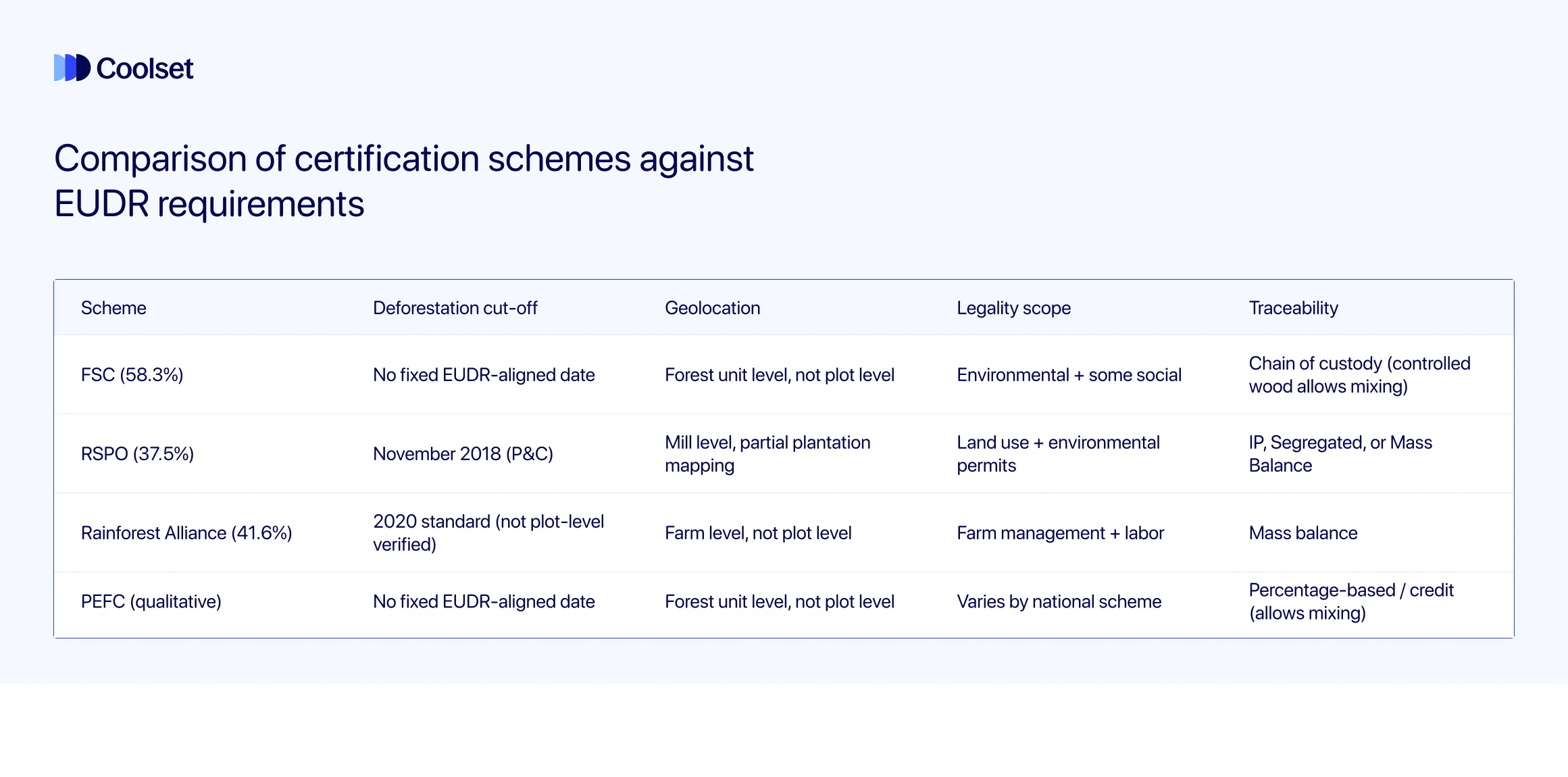
A 2024 study compared the sustainability standards in question against 24 EUDR compliance indicators. For each of the standards, a percentage alignment was determined.
FSC (Forest Stewardship Council) - approximately 58% alignment
FSC is the most widely referenced certification in the timber sector and scores the highest alignment with EUDR requirements among the schemes studied. FSC has publicly acknowledged the gaps between its standards and the EUDR and is working on alignment initiatives.
What FSC covers:
- Chain of custody traceability through FSC-certified supply chains
- Legal compliance requirements for certified forest management units
- Some deforestation-related criteria, including high conservation value (HCV) protections
Where FSC falls short:
- No plot-level geolocation: FSC does not require the GPS coordinates or polygon mapping that the EUDR mandates for every product. Forest management unit boundaries are recorded, but not at the specific plot level the regulation requires.
- Cut-off date mismatch: FSC's chain of custody system does not specifically verify against the EUDR's 31 December 2020 deforestation cut-off date. FSC's own deforestation-related provisions use different reference dates.
- "Controlled wood" allows unverified mixing: FSC's "controlled wood" category permits mixing certified and uncertified material under certain conditions. Under the EUDR, every unit of product must be independently traceable to its origin.
- Forest degradation definition differs: The EUDR's definition of forest degradation is broader than FSC's, covering structural changes to forest canopy that FSC standards may not fully capture.
Practical implication: FSC certification provides useful supporting evidence for timber risk assessments, particularly around legal compliance and supply chain traceability. However, operators must still independently collect geolocation data, verify the 31 December 2020 cut-off, and confirm full local-law compliance beyond what FSC audits cover.
RSPO (Roundtable on Sustainable Palm Oil) - approximately 37.5% alignment
RSPO is the dominant certification for sustainable palm oil and has been actively positioning itself for EUDR readiness. RSPO's own EUDR guidance has also acknowledged that certification alone does not satisfy the regulation.
What RSPO covers:
- Supply chain traceability, particularly under the Identity Preserved (IP) and Segregated (SG) models
- No-deforestation commitment under the 2018 Principles and Criteria (P&C)
- Some legality requirements related to land use and environmental permits
Where RSPO falls short:
- Mass balance allows mixing: RSPO's mass balance model permits certified and uncertified palm oil to be physically mixed during processing. The EUDR requires product-level traceability back to the specific plot of land. Only RSPO IP and Segregated models maintain physical separation, but even these lack the granularity the EUDR demands.
- Cut-off date mismatch: RSPO's no-deforestation commitment uses November 2018 as the reference date under the 2018 P&C. The EUDR uses 31 December 2020. Land cleared between these dates could be RSPO-compliant but EUDR non-compliant.
- No plot-level geolocation: RSPO requires mill-level geolocation and some plantation mapping, but does not mandate the plot-level GPS coordinates or polygon boundaries the EUDR requires.
- Narrower legality scope: RSPO's legality requirements focus on land use rights and environmental permits. The EUDR requires compliance with all applicable laws in the country of production, including labor, tax, trade, and anti-corruption legislation.
Practical implication: RSPO IP or Segregated certification is more useful than mass balance for EUDR purposes because it maintains physical traceability. However, operators still need to independently collect plot-level geolocation data, verify the 31 December 2020 cut-off, and confirm compliance with the full scope of local laws beyond RSPO's coverage.
Rainforest Alliance - approximately 41.6% alignment
Rainforest Alliance (which absorbed UTZ in 2018) is a major certification for cocoa, coffee, tea, and other agricultural commodities. It scores slightly above RSPO but well below the EUDR's requirements.
What Rainforest Alliance covers:
- Farm-level audits covering good agricultural practices
- Some traceability through its supply chain certification program
- Environmental management requirements, including shade cover and biodiversity protections
Where Rainforest Alliance falls short:
- No EUDR-aligned deforestation cut-off: Rainforest Alliance's 2020 standard includes a no-deforestation requirement, but it does not specifically verify against the EUDR's 31 December 2020 cut-off date at the plot level for every certified farm.
- Limited geolocation: While farm locations are recorded in the certification system, the standard does not mandate the precise GPS or polygon data the EUDR requires for each production plot.
- Mass balance traceability: Rainforest Alliance uses a mass balance model for many supply chains, which allows mixing of certified and uncertified product. This does not meet the EUDR's product-level traceability requirement.
- Legality focus on farm management: The certification's legality requirements centre on farm-level environmental and labor practices. They do not cover the full range of applicable laws the EUDR demands, including land tenure, tax, and trade regulations.
Practical implication: Rainforest Alliance certification provides useful supplementary evidence for cocoa and coffee supply chains, particularly around farm-level practices and environmental management. However, operators face significant gaps in geolocation, cut-off date verification, traceability model, and legal compliance scope that must be addressed independently.
PEFC, SAN and other schemes
Beyond the three major schemes, several other certifications are commonly referenced in EUDR discussions:
PEFC (Programme for the Endorsement of Forest Certification): PEFC faces similar limitations to FSC, with additional concerns. PEFC's percentage-based and credit methods allow mixing of certified and uncertified timber within supply chains. Some PEFC-endorsed national certification schemes have weaker standards than the overarching PEFC framework, creating inconsistency in what the certification actually guarantees.
SAN (Sustainable Agriculture Network): SAN developed the standard that preceded Rainforest Alliance's current certification. It has been largely superseded and is not independently assessed against EUDR requirements.
ISPO and MSPO (Indonesian and Malaysian Sustainable Palm Oil): These national palm oil certification schemes are mandatory in their respective countries but were designed to meet national sustainability goals, not EU regulatory requirements. Neither scheme independently meets EUDR requirements for geolocation, cut-off dates, or the full scope of legality verification.
None of these schemes change the fundamental conclusion: no certification independently satisfies the EUDR.
Why no certification scheme fully satisfies the EUDR
The four gaps every scheme shares
Across all major certification schemes, four structural gaps prevent any of them from fully meeting EUDR requirements:
1. Cut-off date
The EUDR uses a fixed deforestation cut-off of 31 December 2020. Any product linked to land deforested after this date is non-compliant, regardless of other factors. Certification schemes either use different reference dates (RSPO's November 2018, for example), have no fixed cut-off, or do not verify deforestation status at the plot level against a specific date. This mismatch means a product can be fully certified yet still linked to post-2020 deforestation.
2. Geolocation at plot level
The EUDR requires GPS point coordinates for plots under 4 hectares and polygon boundaries for plots over 4 hectares. No major certification scheme mandates this level of geographic precision. Schemes may record farm or concession locations, but not the plot-level data the regulation requires for each product placed on the market. For detailed guidance on the EUDR's geolocation requirements, see our compliance guide.
3. Full local-law compliance
The EUDR requires that products are produced in compliance with all applicable laws in the country of origin. This includes environmental law, land tenure and use rights, labor law, human rights protections, tax law, anti-corruption legislation, and trade and customs regulations. Certification schemes cover subsets of these, typically environmental management and some labor standards, but none audit against the full breadth of legislation the EUDR demands.
4. Operator liability
A certification body's audit does not transfer legal liability from the operator to the certifier. Under the EUDR, the operator placing products on the EU market bears full responsibility for compliance. Even if a supplier holds a valid certification and a certification body has conducted an audit, the operator remains legally accountable for any non-compliant product. This is a fundamental structural difference between voluntary certification and regulatory obligation.
Comparison of certification schemes against EUDR requirements
How to use certifications effectively in your EUDR due diligence
Use certifications as supporting evidence in risk assessment
While certifications cannot replace due diligence, Article 10(2) explicitly allows them to serve as a positive indicator during risk assessment and mitigation. A valid FSC chain of custody certificate, for example, provides evidence that some level of traceability and legal compliance verification has already taken place. This can reduce, but not eliminate, the assessed risk for a given supply chain.
In practice, certifications are most useful when they:
- Cover the specific product and origin being assessed (not just the supplier's broader operations)
- Use a traceability model that maintains physical separation (IP or Segregated rather than mass balance)
- Include recent audit findings that are relevant to deforestation and legality
The key principle is that certifications lower risk, they do not remove it. Your country risk benchmark classification, supplier history, and product-specific factors all remain part of the assessment.
Cross-reference certificate data with your own verification
Any certification data used in your risk assessment should be independently verified against your own due diligence findings. This means:
- Verify the certificate is current: Check expiry dates, audit cycle status, and whether the certificate has been suspended or withdrawn. Certification databases (such as FSC's public certificate search or RSPO's ACOP reports) can confirm active status.
- Confirm the scope matches: Ensure the certification covers the specific product type, origin country, and production site relevant to your shipment. A supplier may hold a valid certificate for one product line while sourcing uncertified material for another.
- Collect geolocation data independently: Regardless of certification status, you must collect and verify plot-level GPS coordinates or polygon boundaries as required by the EUDR. No certification scheme provides this data in the format the regulation demands.
- Verify the cut-off date independently: Use satellite imagery or other deforestation screening tools to confirm that production land was not deforested after 31 December 2020, regardless of what the certification standard requires.
For practical guidance on supplier data collection, see our guide on how to collect EUDR data from suppliers and ensure their engagement.
Document your reasoning
Every time a certification is factored into your risk assessment, the reasoning must be documented. This creates a defensible audit trail that demonstrates your due diligence process was thorough and considered.
Your documentation should record:
- Which certification was considered and for which specific shipment or product
- How it was factored into the risk assessment (e.g., "FSC chain of custody certificate reduced traceability risk from standard to low")
- Why the certification was insufficient on its own and what additional verification steps were taken
- The outcome of those additional steps and how the final risk determination was reached
This level of documentation is essential for your due diligence statement and for any subsequent inspection by competent authorities. A well-documented process that honestly assesses certification gaps is far more defensible than one that assumes certification equals compliance.
What could change: the EU's recognition framework
Article 10(2) of the EUDR includes a provision for the European Commission to potentially recognize specific certification schemes that meet defined criteria. If formally recognized, such schemes could carry greater weight in risk assessments, though the regulation as written does not allow any scheme to fully replace due diligence.
As of March 2026, no certification scheme has been formally recognized under this framework. The Commission has not published the criteria for recognition, nor has it indicated a timeline for doing so.
The April 2026 simplification review is unlikely to grant formal recognition to any scheme. The review's scope, as outlined by the Commission, focuses on potential changes to Annex I (product scope), updated FAQ guidance, and amendments to implementing regulations. Certification recognition is a separate process that would require substantial regulatory development.
Until formal guidance is issued, the prudent approach is to treat all certifications as supporting evidence only. Companies that build their due diligence systems around independent verification, with certifications as a supplementary input, will be well positioned regardless of how the recognition framework develops.
For more on enforcement timelines and competent authority responsibilities, see our guide on EUDR compliance and enforcement.
How Coolset helps close the gaps certifications leave
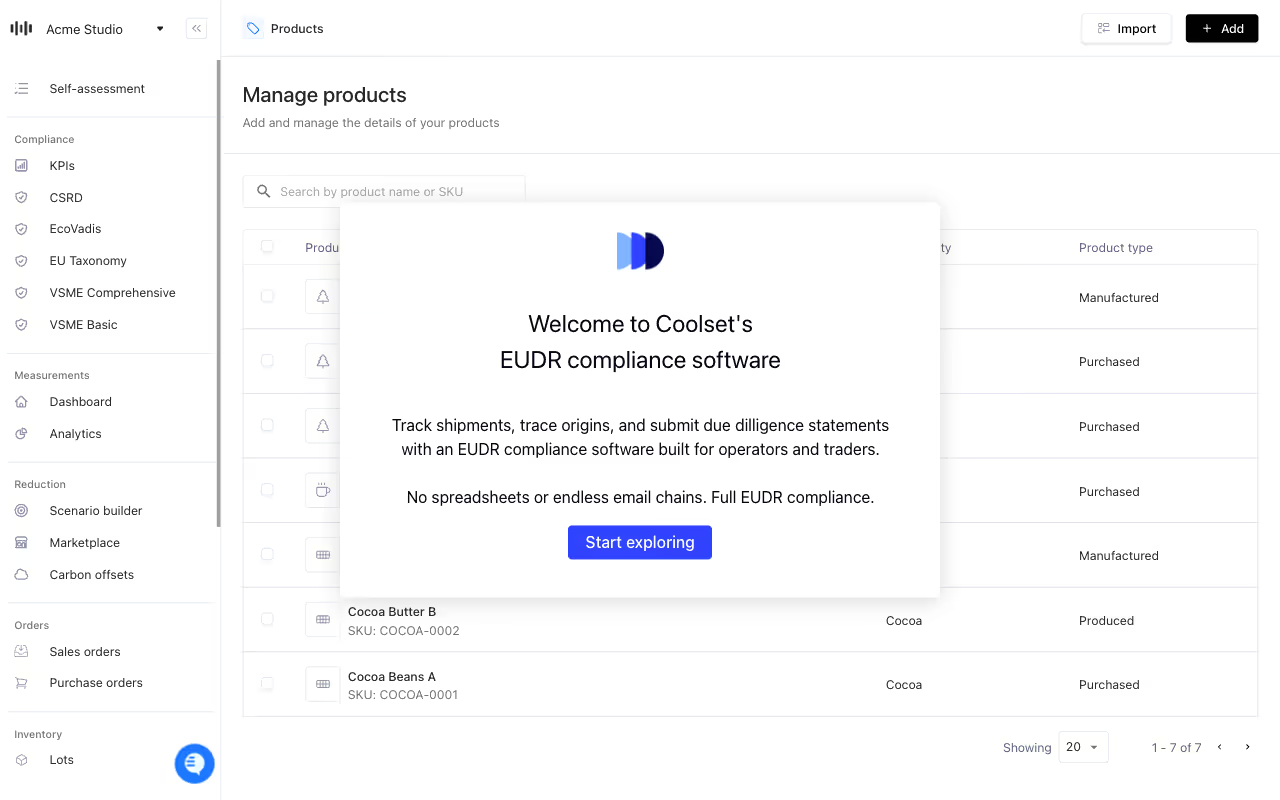
Where certifications fall short on geolocation, cut-off verification, and legality scope, Coolset's EUDR platform fills the gaps:
- Plot-level geolocation collection and validation: Collect GPS coordinates and polygon boundaries directly from suppliers through structured workflows, with built-in validation to ensure data meets EUDR format requirements.
- Satellite-based deforestation screening: Automated screening against the 31 December 2020 cut-off date, using satellite imagery to verify that production land was not deforested, independent of any certification claim.
- Risk assessment incorporating certification data: Factor certification status into your risk assessment alongside independent verification data, country risk benchmarks, and supplier-specific indicators, all within a single, auditable workflow.
- DDS generation and TRACES submission: Automatically generate due diligence statements from verified data and submit them through the EU's TRACES system before shipment.
- Five-year audit trail: Every data point, risk decision, and certification reference is recorded and stored for the full retention period the regulation requires.
Explore the Coolset EUDR solution or schedule a demo to see how it works with your existing supply chain certifications.
{{product-tour-injectable}}
FAQ - EUDR and certification schemes
Can FSC certification replace EUDR due diligence?
No. FSC certification covers approximately 58% of EUDR compliance indicators and can support your risk assessment, but it does not replace the obligation to independently collect plot-level geolocation data, verify the 31 December 2020 deforestation cut-off, confirm full local-law compliance, or submit a due diligence statement. The operator retains full legal liability regardless of FSC status.
Does the EUDR recognize any certification scheme?
No. As of March 2026, no certification scheme has been formally recognized under Article 10(2) of the EUDR. The European Commission has stated that certifications can be "taken into account" during risk assessment but do not replace due diligence. The April 2026 simplification review is not expected to change this position.
How does RSPO certification align with the EUDR?
RSPO achieves approximately 37.5% alignment with EUDR indicators. Identity Preserved (IP) and Segregated models offer stronger traceability than mass balance, but RSPO still lacks plot-level geolocation, uses a November 2018 cut-off date (versus the EUDR's 31 December 2020), and covers a narrower scope of legality requirements. Operators must fill these gaps with independent verification.
What is the difference between EUDR due diligence and certification audits?
Certification audits assess compliance against the scheme's own voluntary standards, which were designed for market differentiation rather than regulatory compliance. EUDR due diligence requires independent operator verification against a specific set of legal requirements, including geolocation, cut-off dates, and full local-law compliance, with the operator bearing legal liability for the outcome. A certification audit does not transfer this liability.
Will the April 2026 simplification review change how certifications are treated?
The review is unlikely to grant formal recognition to any certification scheme. Its scope focuses on Annex I product definitions, FAQ updates, and implementing regulation adjustments. A separate recognition framework under Article 10(2) would be required to formally elevate any scheme's status, and the Commission has not indicated a timeline for this. Companies should continue building due diligence systems based on independent verification.
Related: EUDR penalties: what non-compliance actually costs companies in 2026
Related: EUDR downstream operator: what the regulation means for your business in 2026
Related: EUDR Information System: how to register and submit your first DDS in 2026
Related: EUDR Annex I changes: which products are affected by the 2026 delegated act updates
Related: EUDR compliance audit: documentation checklist for December 2026
Learn how to build traceability, run audit-proof risk assessments, generate DDSs in EU TRACES and stay audit-ready.
.png)

on mobile screens
to experience this demo.


↘ Check if your documentation meets PPWR requirements
This free compliance checker scans your packaging documentation and maps it against mandatory PPWR data requirements, giving you a clear view of your compliance status. Get actionable insights on documentation gaps before they become compliance issues.

.webp)