PPWR compliance audits: how to avoid costly mistakes and get your technical documentation inspection-ready


Disclaimer: New EUDR developments - December 2025
In November 2025, the European Parliament and Council backed key changes to the EU Deforestation Regulation (EUDR), including a 12‑month enforcement delay and simplified obligations based on company size and supply chain role.
Key changes proposed:
- New enforcement timeline: 30 December 2026 for large/medium operators, 30 June 2027 for small/micro operators
- Simplified DDS: One-time declarations for small and micro primary producers
- Narrowed scope: Most downstream actors and non‑SME traders would no longer need to submit DDSs
- New DDS requirement: Estimated annual quantity of regulated products must be included
These updates are not yet legally binding. A final text will be confirmed through trilogue negotiations and formal publication in the EU’s Official Journal. Until then, the current EUDR regulation and deadlines remain in force.
We continue to monitor developments and will update all guidance as the final law is adopted.
Key takeaways
- Since 12 August 2026, the PPWR applies across the EU. Manufacturers must hold an EU Declaration of Conformity and Annex VII technical documentation for each packaging type, available to authorities on request.
- Documentation gaps typically trace to fragmented packaging inventories, stale supplier declarations and missing substance test evidence, not to misreading the regulation.
- Recyclability and recycled content obligations apply from 2030, but the supplier evidence behind them takes years to build.
- Coolset helps compliance teams build the packaging evidence chain PPWR audits require. See the PPWR platform.
Since 12 August 2026, Regulation (EU) 2025/40 (PPWR) applies across the EU. Manufacturers must draw up a Declaration of Conformity (DoC) and the technical documentation set out in Annex VII for each packaging type they place on the market, and keep it available to national authorities on request. Importers must verify that this has been done. For many companies, the first documentation request is when gaps in the evidence trail surface.
The failures rarely come from misreading substance limits or recyclability rules. They come from a small set of preventable data and governance gaps: fragmented packaging portfolios, missing supplier test evidence, and unowned recyclability claims. Each is invisible in a polished Declaration of Conformity (DoC), and each is fixable well before an inspection.
Where PPWR compliance evidence breaks down
PPWR compliance usually breaks down on evidence quality, not regulatory understanding. Sustainability and packaging teams typically know what the Regulation requires. What they cannot produce on demand is the supplier data linking each packaging type to its material composition and substance test results. The Commission guidance confirms that compliance must be substantiated through documented evidence held in the technical file under Annex VII, not asserted in a summary claim.
The structural problem sits upstream of the audit. Packaging portfolios live in disconnected systems: procurement holds supplier contracts, R&D holds material specifications, marketing or design hold label files, and finance owns the extended producer responsibility (EPR) filings. No single owner reconciles packaging composition across these systems. When an authority asks one question, four teams answer with four data sets that do not match.
Two governance patterns make it worse. Supplier declarations are often collected at onboarding and never refreshed, so the certificate on file is not the one that describes today's shipment. And environmental claims, including recyclability claims, are often treated as marketing assertions rather than conclusions of a documented assessment. For a deeper view of how a portfolio should be segmented, see PPWR packaging classification explained in three axes.
What non-compliance can cost
Enforcement follows a two-step logic. Under Article 62, where the DoC or technical documentation is missing, incomplete or incorrect, the Member State must first require the economic operator to end the non-compliance. If it persists, authorities must prohibit the packaging from being made available on the market or have it recalled or withdrawn. The latest Commission FAQ recommends that authorities start with information requests and corrective action within a reasonable timeline. National penalty regimes must be in place by 12 February 2027.
The stakes scale with volume. The EU generated 79.7 million tonnes of packaging waste in 2023, or 177.8 kg per inhabitant, according to Eurostat. EPR fees are calculated on the tonnage each producer places on the market and will be modulated by recyclability grade once grades apply, so the composition data behind the technical file also drives EPR cost.
{{product-tour-injectable}}
Five documentation pitfalls to fix first
Five pitfalls account for most documentation gaps. Four concern obligations that apply now. The fifth concerns 2030 obligations whose evidence must be built today. Each maps to a specific evidence category in the Annex VII file.
1. Incomplete inventories
Manufacturers routinely overlook packaging types because secondary and tertiary packaging, e-commerce mailers and service packaging fall outside the master list used for sustainability reporting. The PPWR applies to all packaging placed on the market, and technical documentation is required per packaging type. A missing category is a missing file.
2. Silent supplier data gaps
Article 5(4) caps the combined concentration of heavy metals (lead, cadmium, mercury and hexavalent chromium) at 100 mg/kg. The limit is not new, but compliance must now be demonstrated in the Annex VII file for each packaging type. Packaging containing recycled glass may exceed the limit under Decision 2001/171/EC, provided none of these metals is intentionally introduced.
3. Missing PFAS test evidence
PFAS limits for food-contact packaging apply from 12 August 2026, but supporting test data is often missing from supplier specification sheets. The Commission guidance (March 2026) sets out a stepwise testing approach, as no harmonised EU method yet exists for food-contact packaging. Where total fluorine exceeds 50 mg/kg, the supplier must provide proof on request of whether that fluorine comes from PFAS.
4. Missing traceability identification
Manufacturers must ensure each packaging item can be identified, or is accompanied by a document that identifies it. The Commission FAQ confirms that a type, batch or serial number or equivalent is sufficient, and that not every component needs marking. Stock placed on the market before 12 August 2026 does not need relabelling.
5. Treating 2030 obligations as a future problem
Recyclability (Article 6) and minimum recycled content in plastic packaging (Article 7) apply only from 1 January 2030, but supplier contracts, chain-of-custody arrangements and redesigns take years. Until the delegated acts for recycled content calculation and design-for-recycling criteria are adopted, RecyClass, CEFLEX and 4evergreen offer documented interim assessment methods. Classify composites correctly now. That classification determines which Annex V restrictions and recycled content exemptions apply from 2030.
Building an inspection-ready evidence chain
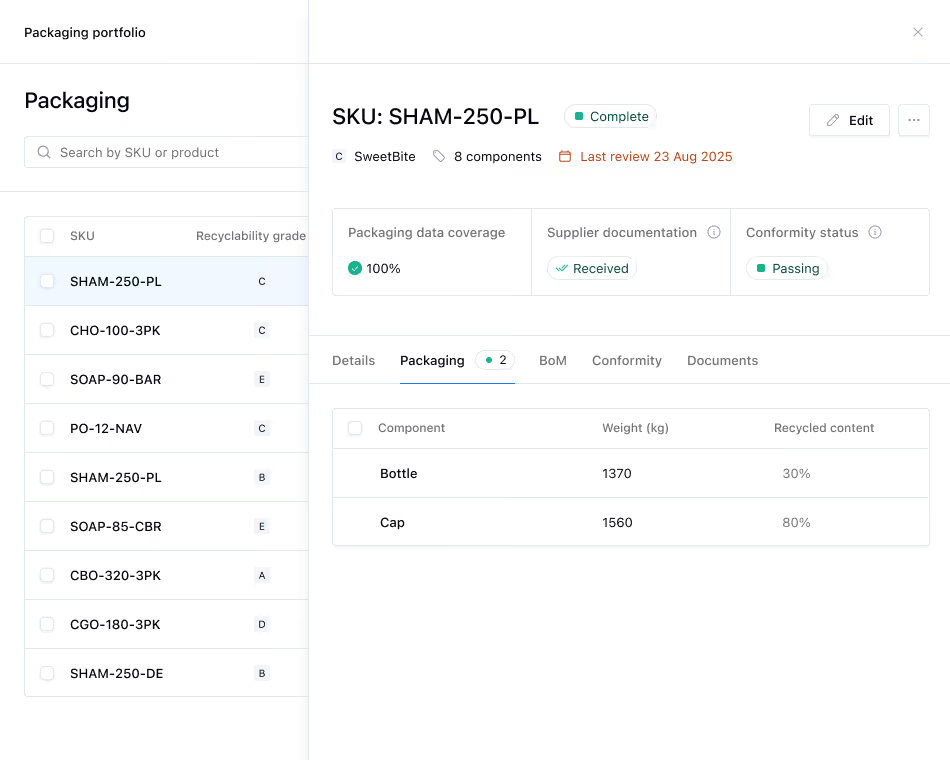
An inspection-ready evidence chain starts from a single packaging master record. Every packaging type links to its material composition, supplier declarations, substance test results, DoC and EPR registrations. One identifier, one source of truth. The Commission guidance confirms that compliance must be demonstrated through documented evidence, and a fragmented record cannot be documented coherently.
Supplier evidence collection is the second lever. Move it from a one-off onboarding task to a scheduled refresh cycle tied to contract renewal and material change events. Article 16 already requires suppliers to provide manufacturers with the information needed to demonstrate compliance. Contracts should make this operational, with clauses covering substance declarations, change notification and, ahead of 2030, recycled content verification.
Ownership is the third lever, and the most often neglected. Assign a named owner for each substantive PPWR requirement that applies to the portfolio: recyclability, recycled content, substance restrictions, reuse obligations and labeling. Where every requirement has an owner, every gap has a person accountable for closing it before inspection.
Compostable packaging deserves a separate note, ahead of the February 2028 compostability requirement for tea bags, coffee pods and similar formats. The Commission guidance explains that presumption of conformity with harmonized standards on compostable packaging will only apply once a new decision listing those standards is adopted. EN 13432 can be used as interim guidance. Teams claiming compostability today should record which standard they tested against.
Run internal mock inspections against the Annex VII requirements before national authorities do. Use the evidence categories inspectors will request, and document the assessment method, not only the conclusion. Under the remedy-first approach, a defensible method with acknowledged gaps is far easier to correct than a clean claim with no working behind it.
{{custom-cta}}
What to have in place before the first documentation request
Before the first documentation request, one artifact determines whether a response takes days or months: a complete packaging register, organised by packaging type and reconciled against EPR filings. Every packaging unit placed on the market from 12 August 2026 falls within scope, so the register should already be in place.
Supplier contracts should already carry PPWR-specific data clauses. Change-notification requirements need to be strong enough that a substitution in resin grade or barrier film reaches the compliance team before the shipment leaves the supplier. Substance test results, supplier declarations and DoCs should be stored in a structured, exportable format. For the interaction with the Digital Product Passport regime, see PPWR and Digital Product Passport compliance: choosing the right approach for 2026.
Start with the highest-risk packaging types
Begin with food-contact packaging and packaging with coatings, inks or recycled inputs, where substance-restriction gaps are most likely. The evidence template built there can then be applied across the rest of the portfolio.
Frequently asked questions
When does PPWR start to apply for audit purposes?
The PPWR entered into force on 11 February 2025 and applies generally from 12 August 2026. Member State authorities can now request the Annex VII technical documentation file for any packaging type placed on the EU market.
What document must be ready before the first inspection?
The Annex VII technical documentation file referenced in Regulation (EU) 2025/40 is the primary compliance reference. It must be drawn up by the manufacturer, held per packaging type, and kept for 5 years for single-use packaging or 10 years for reusable packaging.
Does the Commission guidance change what is legally required?
No. The Commission guidance is interpretative. Binding interpretation of EU legislation remains the exclusive competence of the Court of Justice of the European Union. The guidance clarifies expected practice but does not add or remove obligations.
How should recycled content evidence be stored?
In a structured, exportable format tied to the packaging type and, where relevant, the batch, with supplier declarations and test reports dated and linked to the relevant contract clause. This also supports later export into a Digital Product Passport once secondary legislation is adopted.
What are the most common documentation gaps?
Incomplete packaging inventories, missing heavy-metals and PFAS test evidence, missing traceability identification, and no plan for the evidence 2030 recyclability and recycled content obligations will require. Each is preventable with a single packaging master record and a scheduled supplier data refresh cycle. For a broader Q&A, see PPWR Q&A: your top questions on declarations of conformity, substances and EPR answered.
The Packaging and Packaging Waste Regulation (PPWR) requires an Annex VII technical file for every packaging unit. Coolset helps compliance teams build the SKU-level evidence chain that stands up to national inspection.
.png)

on mobile screens
to experience this demo.


↘ Check if your documentation meets PPWR requirements
This free compliance checker scans your packaging documentation and maps it against mandatory PPWR data requirements, giving you a clear view of your compliance status. Get actionable insights on documentation gaps before they become compliance issues.

.webp)