PPWR Declaration of Conformity: what it is, when you need it and how to get it from suppliers


Disclaimer: New EUDR developments - December 2025
In November 2025, the European Parliament and Council backed key changes to the EU Deforestation Regulation (EUDR), including a 12‑month enforcement delay and simplified obligations based on company size and supply chain role.
Key changes proposed:
- New enforcement timeline: 30 December 2026 for large/medium operators, 30 June 2027 for small/micro operators
- Simplified DDS: One-time declarations for small and micro primary producers
- Narrowed scope: Most downstream actors and non‑SME traders would no longer need to submit DDSs
- New DDS requirement: Estimated annual quantity of regulated products must be included
These updates are not yet legally binding. A final text will be confirmed through trilogue negotiations and formal publication in the EU’s Official Journal. Until then, the current EUDR regulation and deadlines remain in force.
We continue to monitor developments and will update all guidance as the final law is adopted.
Key takeaways
- The PPWR requires every EU packaging type to have a manufacturer-issued Declaration of Conformity (DoC) from 12 August 2026.
- Importers must collect and hold the DoC per packaging type for 5 to 10 years and make it available to authorities on request.
- Without a valid DoC, packaging cannot legally enter the EU market; each packaging type requires its own document.
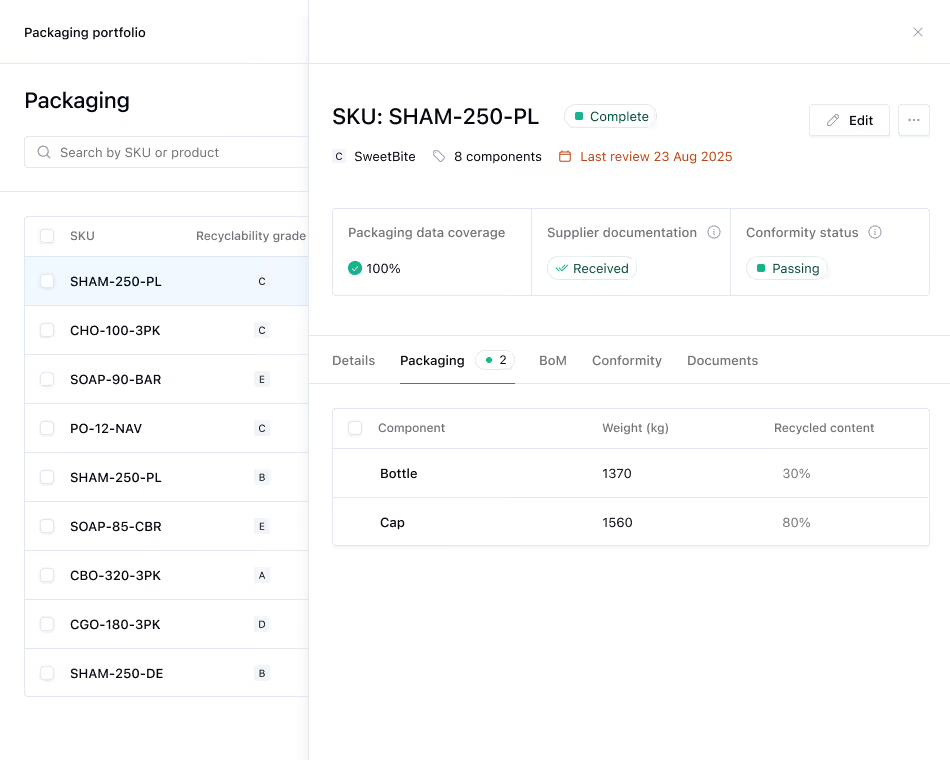
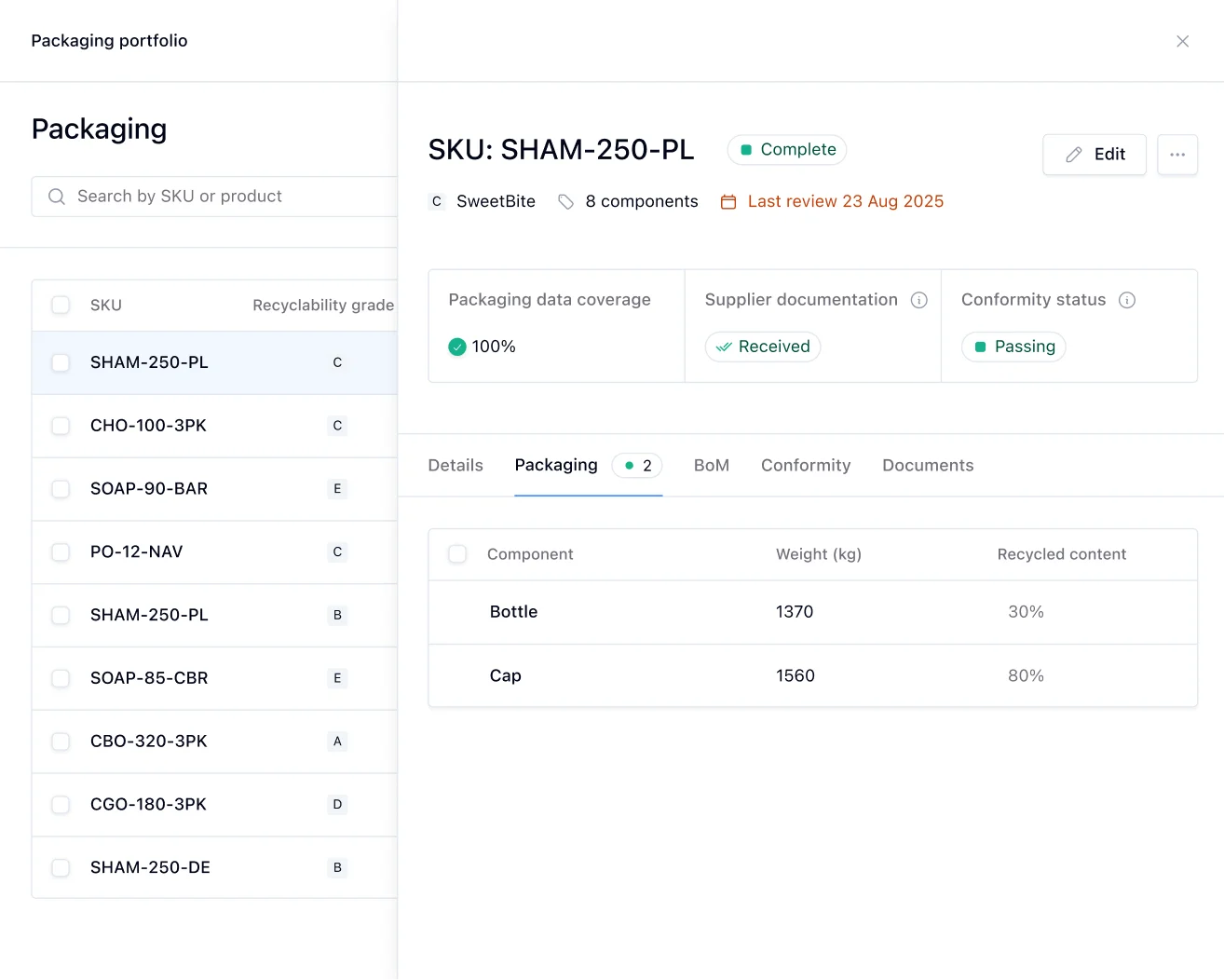
- Coolset's PPWR module helps manufacturers, importers, and distributors manage packaging compliance documentation, track portfolios, and stay audit-ready in one platform.
If your company imports products into the EU, you already manage customs declarations, product safety certificates and supplier audits. Starting 12 August 2026, there is a new document to add to that list: the PPWR Declaration of Conformity (DoC). Unlike most compliance paperwork you don't have to create this one, but rather collect it.
The Packaging and Packaging Waste Regulation (Regulation (EU) 2025/40) requires every packaging type placed on the EU market to be backed by a signed Declaration of Conformity from the manufacturer. For importers working with dozens or hundreds of packaging suppliers, that means building a process to request, verify and store DoCs at scale before the deadline hits.
Read our full breakdown of the PPWR regulation in our step-by-step guide to requirements here.
Most existing guides explain how manufacturers create a DoC. This guide flips the perspective. It covers what the PPWR Declaration of Conformity is, what it must contain, who is responsible for what and most importantly, how to collect it from your suppliers without drowning in email threads. For a full breakdown of which roles apply to your company, see the guide to PPWR supply chain roles explained.
{{custom-cta}}
What is the PPWR Declaration of Conformity?
The EU Declaration of Conformity (DoC) is a written self-declaration by the packaging manufacturer confirming that a specific packaging type meets the sustainability requirements of Articles 5–12 of Regulation (EU) 2025/40 – the Packaging and Packaging Waste Regulation. The DoC follows the model structure in Annex VIII of the PPWR. By signing it, the manufacturer takes full legal responsibility for the packaging's compliance (Article 39(4)).
For importers, the key point is: you don't create the DoC. Your supplier, who manufactures the packaging you use, creates the DoC. Under Article 18(7), you must hold a copy and keep it available for market surveillance authorities. Without a valid DoC, the packaging cannot legally be placed on the EU market. If you want more control over the content of the DoC, you can proactively supply them with a template.
You can help your manufacturers and supply them with a template proactively.
The DoC is not a CE marking, the PPWR regulation explicitly states that CE marking on packaging would cause confusion with product-level CE marks. It is not a test certificate. It is a self-declaration backed by technical documentation that proves the packaging meets PPWR requirements for substance restrictions, recyclability and minimization.
What must a PPWR Declaration of Conformity contain?

Annex VIII of the PPWR sets out the mandatory elements of the Declaration of Conformity. Each element serves a specific purpose and each one is something importers should verify when a supplier submits a DoC.
- A unique DoC identification number that links the document to internal systems, SAP material numbers or supplier IDs. Essential for traceability across a multi-supplier portfolio.
- Name and address of the manufacturer (and authorized representative if applicable). This identifies who takes legal responsibility for the declaration.
- A statement of sole responsibility where the manufacturer confirms the DoC is issued under their sole responsibility. No hedging, no shared liability.
- Unique identification of the packaging including type, batch, serial number or other traceability element. A generic "all our packaging" statement does not meet this requirement.
- Object of the declaration with identification and description of the packaging the DoC applies to, including materials and key characteristics.
- Conformity statement confirming the packaging conforms with Regulation (EU) 2025/40, specifically Articles 5–12 covering substance restrictions, recyclability, minimization and reusability.
- References to harmonized standards or common specifications used to demonstrate conformity. If no harmonized standards exist yet (largely the case in 2026), references to other technical specifications or internal methods.
- Notified body details, where applicable. Not required for the standard Module A internal production control procedure that most packaging falls under.
- Additional information: any supplementary details relevant to the conformity claim.
- Signature, place and date signed by or on behalf of the manufacturer. Without a valid signature, the DoC has no legal standing.
For practical Q&A on DoC grouping, batch numbers, and supplier refusals, see our PPWR webinar Q&A on manufacturers' obligations.
{{ppwr-document-checker}}
How does the Declaration of Conformity connect to the conformity assessment and technical documentation?
The Declaration of Conformity doesn't exist in isolation. It sits at the top of a three-part compliance chain. Understanding how these parts connect is critical for importers verifying supplier documentation.
The conformity assessment procedure (Annex VII, Module A)
The PPWR uses internal production control (Module A) as its conformity assessment procedure, set out in Annex VII. The manufacturer assesses conformity internally, no third-party notified body is required under the standard procedure.
The process works in three steps: the manufacturer prepares technical documentation covering design, materials and compliance assessments; ensures the manufacturing process delivers compliant packaging; and then draws up the DoC based on that documentation.
The technical documentation under Annex VII must contain a general description of the packaging, design drawings, materials of components, harmonized standards applied, qualitative descriptions of recyclability, minimization and reusability assessments (Articles 6, 10, 11) and relevant test reports.
How the DoC sits on top of the technical documentation
The DoC is the summary declaration. The technical documentation is the proof underneath it. If market surveillance authorities request documentation under Article 18(8), they want both: the DoC itself and access to the technical documentation behind it.
A DoC without technical documentation is a claim without evidence. Technical documentation without a DoC means the manufacturer hasn't formally declared compliance. Both must exist for the packaging to be lawfully placed on the EU market.
What does this mean for importers?
Under Article 18(2), before placing packaging on the market, importers must ensure the manufacturer has completed the conformity assessment, drawn up the technical documentation, labeled the packaging correctly and complied with identification requirements.
Importers keep a copy of the DoC (Article 18(7)) and must also present documentation to authorities on request. In practice, this means requesting both the DoC and written confirmation that technical documentation exists and is accessible.
Who is responsible for the DoC and what are your obligations as an importer?
Manufacturers (Art. 15) are responsible for creating the DoC, technical documentation and signing them. Non-EU manufacturers must also appoint an authorised representative in each EU member state to manage EPR obligations on their behalf. Under Annex VII, it is the manufacturer who carries out the conformity assessment. Manufacturers should hold on to both documents for at least five years for single-use packaging and ten years for reusable packaging.
Importers (Art. 18) verify that the manufacturer has completed the assessment and documentation prior to placing packaging on the market. They should store these documents and make them available to authorities upon request. If non-conformity is discovered, importers must take immediate action.
Distributors (Art. 19) check that both manufacturers and importers have met identification requirements. They verify that packaging has been labeled correctly. Distributors do not need to hold a copy of the DoC, but must ensure that non-conforming packaging does not reach the market.
When importers become manufacturers (Article 21)
If an importer or distributor places packaging under their own name or trademark, or modifies packaging already on the market in a way that affects conformity, they take on the role of manufacturer under Article 21. That means carrying out the full conformity assessment, preparing the technical documentation and issuing the DoC themselves under Article 15.
This is particularly relevant for private label importers and retailers. If the packaging carries your brand name, the compliance obligation sits with you – not your supplier.
When do you need a DoC? Key dates and retention periods
The PPWR entered into force on 11 February 2025, but the DoC obligation applies from 12 August 2026 – the general application date of the regulation. Importers must have a functioning collection process running by then.

How to request and collect the Declaration of Conformity from your suppliers
This is where the PPWR Declaration of Conformity shifts from a regulatory concept to an operational challenge. For importers working with multiple packaging suppliers, collecting DoCs requires a structured process.
Step 1: Identify which suppliers need to provide a DoC
Every packaging manufacturer supplying packaging that will be placed on the EU market needs to issue a DoC for each packaging type. Start by mapping your suppliers to the packaging types in your portfolio. A supplier providing three distinct packaging formats needs three separate DoCs.
Step 2: Send a standardized documentation request
Don't leave it open-ended. Send a structured request that specifies exactly what you need:
- A DoC per Annex VIII for each packaging type supplied
- Confirmation that technical documentation per Annex VII exists and is accessible
- The specific packaging types covered, identified by type, batch or article number
- The format and language you need the documentation in
Common problems with unstructured requests: suppliers provide generic quality certificates (ISO 9001, food-contact certificates) instead of PPWR-specific DoCs, or they submit a single DoC for "all packaging" without per-type identification.
Step 3: Verify completeness against Annex VIII
Check each returned DoC against the 10 required elements outlined above
- Is there a unique identification number?
- Does it reference Regulation (EU) 2025/40 specifically?
- Is it signed?
- Does it cover the specific packaging type, not just a general product family?
Step 4: Track submissions and follow up on gaps
Build a tracking view with the following columns: supplier name, packaging type, DoC status (requested, received, complete, incomplete), date received and whether an update is needed. Flag suppliers who haven't responded or who submitted incomplete documents.
Step 5: Store with version control for audit readiness
Store DoCs in a system that maintains version history. Authorities may ask for documentation from years ago, so avoid endless searches with an audit-proof system.
What are the most common mistakes importers make with PPWR Declarations of Conformity?
Even well-organized compliance teams run into predictable failure modes when collecting PPWR Declarations of Conformity from suppliers. Here are the most common ones and how to avoid them.
- Assuming existing quality certificates cover PPWR: ISO 9001 or food-contact certificates do not replace a DoC. The DoC must specifically reference the PPWR regulation.
- Accepting a single DoC for all packaging types: DoCs must identify specific packaging types. A blanket declaration does not meet the PPWR requirements.
- Not checking for technical documentation: a DoC without underlying technical documentation lacks proof. If authorities request the technical files and you cannot produce them, you run the risk of a conformity gap.
- No system in place for updates: Packaging materials and design can change, then a DoC must be updated. Without a tracking system, outdated DoCs will cause clutter.
- Overlooking Art. 21 trigger: if you sell packaging under your brand, you are the manufacturer and need to issue a DoC yourself.
- Relying on email for DoC storage: the 5-10 year retention means you need structured, searchable systems. Check each returned DoC against the 10 required elements outlined above
How can software help with DoC collection and management?
Requesting documents from dozens of suppliers, verifying completeness against Annex VII, tracking submission status and maintaining version history are exactly the kind of repetitive tasks that benefit from a dedicated platform.
At Coolset we are developing our supply chain traceability platform to include supplier documentation workflows designed specifically for PPWR compliance. This aims to make compliance with PPWR simpler and faster for importers and distributors.
Explore our solution here!
Frequently asked questions
What is the PPWR Declaration of Conformity?
The DoC is a written declaration by packaging manufacturers. It confirms that a specific packaging type complies with sustainability requirements of Articles 5–12 of Regulation (EU) 2025/40. The DoC is mandatory for all packaging placed on the EU market from 12 August 2026.
What is the conformity assessment procedure for PPWR?
The PPWR conformity assessment follows Module A – internal production control, set out in Annex VII. The packaging manufacturer prepares technical documentation covering design, materials, recyclability and minimization assessments, and test reports. Based on this documentation, the manufacturer draws up and signs the EU Declaration of Conformity per Annex VIII.
How do importers get a Declaration of Conformity?
Importers request the DoC from the packaging manufacturer, they do not create it themselves. Under Article 18(2), importers must ensure the manufacturer has carried out the conformity assessment and drawn up the technical documentation before placing packaging on the EU market.
Who signs the PPWR Declaration of Conformity?
The packaging manufacturer or an authorized representative signs the DoC. By signing the DoC, manufacturers assume legal responsibility for the packaging's compliance with PPWR requirements.
How long must importers keep PPWR documentation?
Importers must keep a copy of the EU Declaration of Conformity for 5 years (single-use packaging) or 10 years (reusable packaging) from the date the packaging was placed on the market.
What happens if an importer doesn't have a valid DoC?
Under Article 62, if the DoC has not been drawn up or has not been drawn up correctly, the Member State can require the economic operator to resolve the non-compliance. If the issue persists, the Member State can prohibit the packaging from being made available on the market, or require it to be recalled or withdrawn.
Does the DoC replace CE marking for packaging?
No. The PPWR explicitly does not use CE marking for packaging compliance (Recital 109). CE marking on packaging refers only to the packaged product's compliance with other EU product law, not to the packaging itself. PPWR compliance is demonstrated through the DoC and technical documentation, not through CE marking.
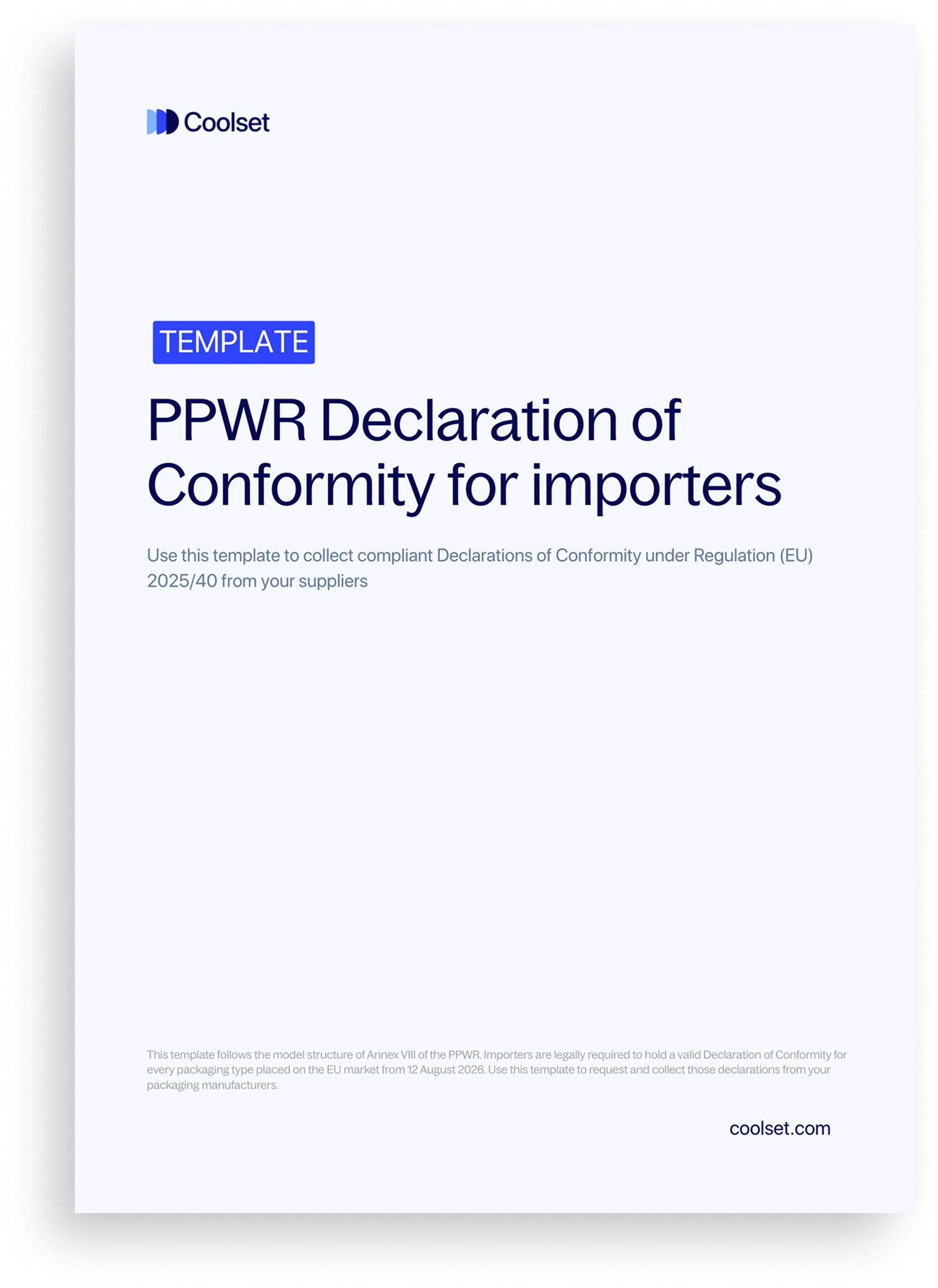
Get a ready-to-use template to request compliant DoCs from packaging suppliers (Annex VIII format).
↘ Check if your documentation meets PPWR requirements
This free compliance checker scans your packaging documentation and maps it against mandatory PPWR data requirements, giving you a clear view of your compliance status. Get actionable insights on documentation gaps before they become compliance issues.
Prepare for PPWR with Coolset
Coolset gives manufacturers, importers and distributors manage supplier documentation, track conformity and stay audit-proof.

.webp)