PPWR compliance for importers and distributors: a step-by-step guide to requirements, documentation and conformity


Disclaimer: New EUDR developments - December 2025
In November 2025, the European Parliament and Council backed key changes to the EU Deforestation Regulation (EUDR), including a 12‑month enforcement delay and simplified obligations based on company size and supply chain role.
Key changes proposed:
- New enforcement timeline: 30 December 2026 for large/medium operators, 30 June 2027 for small/micro operators
- Simplified DDS: One-time declarations for small and micro primary producers
- Narrowed scope: Most downstream actors and non‑SME traders would no longer need to submit DDSs
- New DDS requirement: Estimated annual quantity of regulated products must be included
These updates are not yet legally binding. A final text will be confirmed through trilogue negotiations and formal publication in the EU’s Official Journal. Until then, the current EUDR regulation and deadlines remain in force.
We continue to monitor developments and will update all guidance as the final law is adopted.
Key takeaways
- The PPWR holds importers and distributors legally accountable for packaging compliance from 12 August 2026, even if they didn't design it.
- Article 18 requires importers to verify supplier DoCs, hold them for 5 to 10 years, and respond to authority requests within 10 days.
- Importers who sell under their own brand trigger Article 21, becoming manufacturers with full DoC and conformity obligations.
- Coolset's PPWR module helps manufacturers, importers, and distributors manage packaging compliance documentation, track portfolios, and stay audit-ready in one platform.
If your company imports or distributes packaged goods in the EU, you carry legal responsibility for packaging you did not design. That is the core tension of the Packaging and Packaging Waste Regulation (PPWR) – Regulation (EU) 2025/40 – for importers and distributors.
Under Articles 18 and 19 of the PPWR, importers must verify conformity assessments, keep declarations on file and produce technical documentation on request. Distributors must confirm labeling and registration requirements before making packaging available. Neither role controls what the manufacturer designs – but both are accountable when non-conforming packaging reaches the EU market.
PPWR compliance applies from 12 August 2026, with sustainability requirements phased in through 2038. This guide breaks down what the PPWR requires, what documentation importers need, and how to build a preparation plan from scratch.
What is the PPWR and why does it matter for importers and distributors?
The PPWR functions as a market access regulation. Importers and distributors cannot legally place non-conforming packaging on the EU market. Under Articles 18 and 19, importers carry verification and documentation obligations for every packaging type they bring into the EU. Distributors must confirm that upstream obligations have been met before making packaging available.
The Packaging and Packaging Waste Regulation (PPWR) applies identically across all 27 EU member states without requiring national transposition – replacing the Packaging and Packaging Waste Directive (94/62/EC) with a single, directly applicable regulation.
Importers and distributors carry legal responsibility for PPWR compliance – but they do not control packaging design. That responsibility gap shapes every operational decision that follows. For companies sourcing from non-EU manufacturers, an additional layer applies: the non-EU manufacturer may need to appoint an authorised representative in each member state to handle EPR obligations.
{{custom-cta}}
Who does the PPWR apply to?
The PPWR applies to all economic operators who place packaging on the EU market or make it available. Article 3 defines four key roles, and a single company can hold more than one simultaneously.
- A manufacturer (Article 3(13)) is any person who manufactures packaging or has packaging designed or manufactured and markets it under their own name or trademark.
- An importer (Article 3(17)) is any person established in the EU who places packaging from a third country on the EU market.
- A distributor (Article 3(18)) is any person in the supply chain – other than the manufacturer or importer – who makes packaging available on the market.
- A producer (Article 3(15)) is a broader category covering anyone who first makes a packaged product available on the national market of a member state – this role triggers Extended Producer Responsibility (EPR) obligations.
What importers must do under Article 18
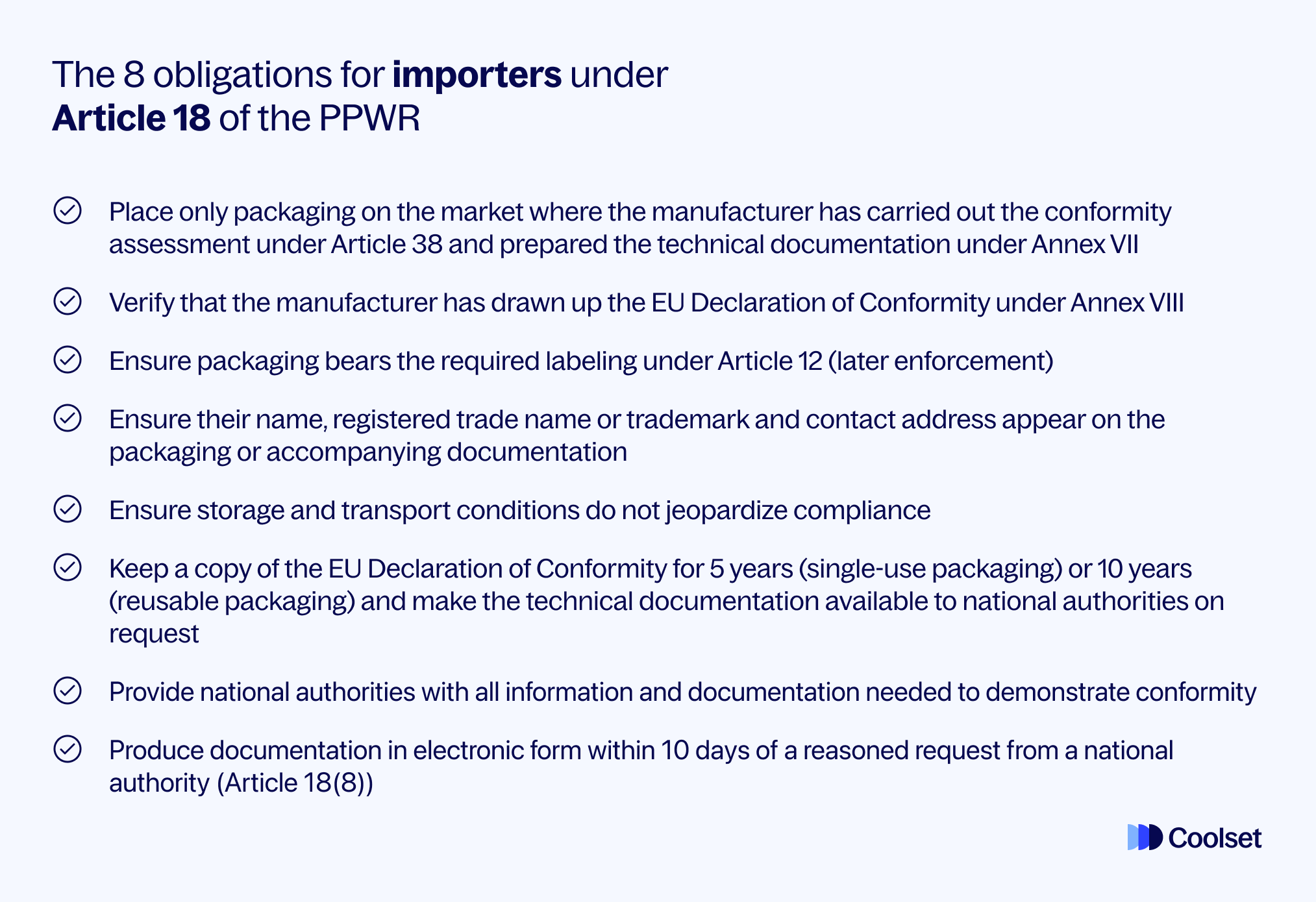
Importers carry eight specific obligations under Article 18 of the PPWR:
- Place only packaging on the market where the manufacturer has carried out the conformity assessment under Article 38 and prepared the technical documentation under Annex VII
- Verify that the manufacturer has drawn up the EU Declaration of Conformity under Annex VIII
- Ensure packaging bears the required labeling under Article 12 (later enforcement)
- Ensure their name, registered trade name or trademark and contact address appear on the packaging or accompanying documentation
- Ensure storage and transport conditions do not jeopardize compliance
- Keep a copy of the EU Declaration of Conformity for 5 years (single-use packaging) or 10 years (reusable packaging) and make the technical documentation available to national authorities on request
- Provide national authorities with all information and documentation needed to demonstrate conformity
- Produce documentation in electronic form within 10 days of a reasoned request from a national authority (Article 18(8))
What distributors must do under Article 19
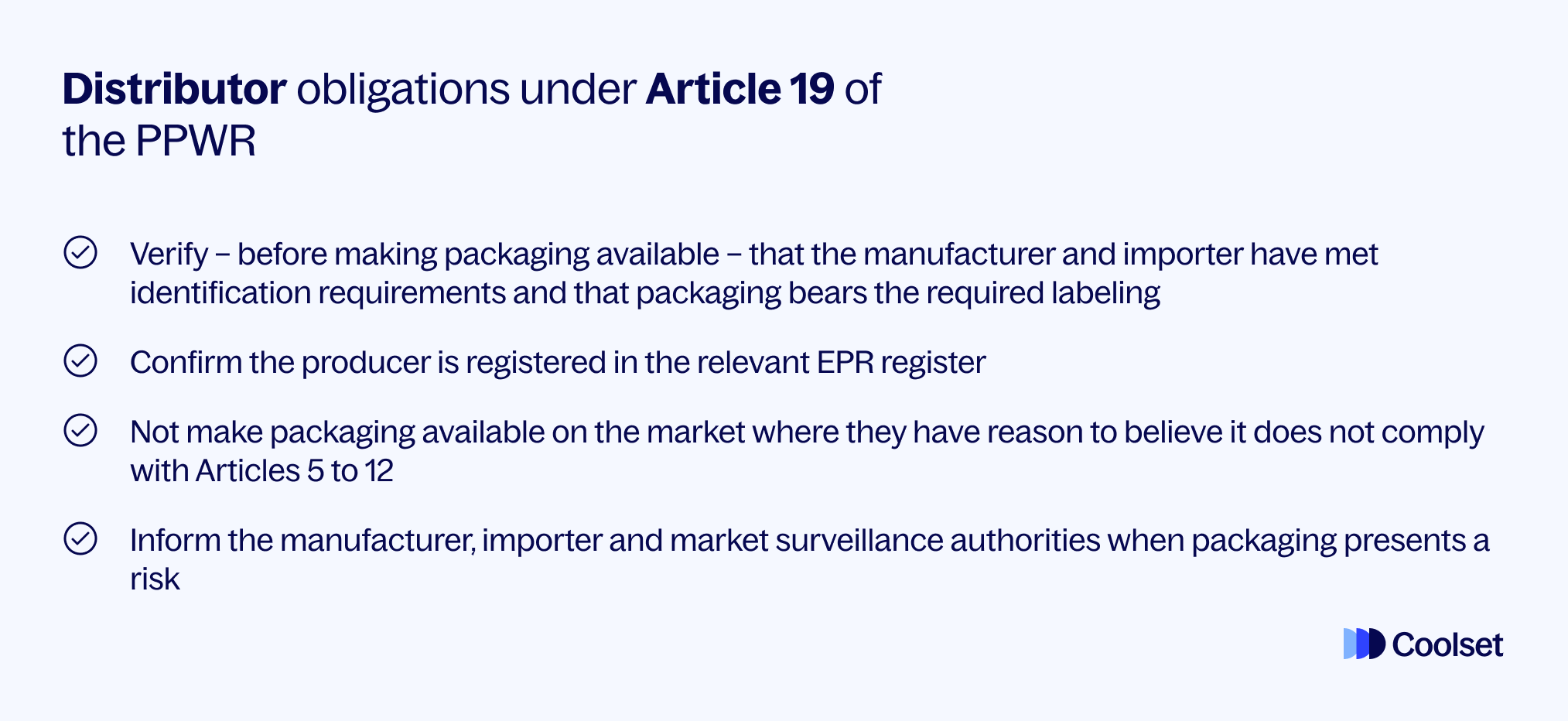
Distributors carry lighter but still binding obligations:
- Verify – before making packaging available – that the manufacturer and importer have met identification requirements and that packaging bears the required labeling
- Confirm the producer is registered in the relevant EPR register
- Not make packaging available on the market where they have reason to believe it does not comply with Articles 5 to 12
- Inform the manufacturer, importer and market surveillance authorities when packaging presents a risk
When importers or distributors become manufacturers under Article 21
Article 21 creates a critical trigger. If an importer or distributor places packaging on the market under its own name or trademark, or modifies packaging already on the market in a way that affects compliance, the PPWR treats that importer or distributor as a manufacturer. The full obligations of Article 15 then apply – including carrying out the conformity assessment, preparing all technical documentation and issuing the EU Declaration of Conformity.
For companies that use private-label or own-brand packaging, Article 21 means the compliance burden shifts entirely to them.
What are the key PPWR requirements importers and distributors need to track?
The PPWR sets sustainability and design requirements for all packaging placed on the EU market including considerations in regards to substances of concern, recyclability, recycled content, compostable and reusable packaging as well as labeling and packaging minimisation strategies. Articles 5 through 12 define what packaging must meet – and importers must verify that manufacturers have complied with each one. The thresholds and deadlines below come directly from the regulation.
Substances of concern (Article 5)
The combined concentration of lead, cadmium, mercury and hexavalent chromium in packaging must not exceed 100 mg/kg by weight. For food-contact packaging, per- and polyfluoroalkyl substances (PFAS) limits apply from 12 August 2026: a maximum of 25 ppb for any individual PFAS substance and 250 ppb for the total sum.
Recyclability (Article 6)
The PPWR assigns recyclability performance grades to all packaging based on the weight that can be recycled into secondary raw materials. The grades are:
- Grade A: ≥95% recyclable by weight
- Grade B: ≥80% recyclable by weight
- Grade C: ≥70% recyclable by weight
From 1 January 2030, only packaging with grades A, B or C may reach the market. From 1 January 2038, only grades A and B qualify.
The European Commission will adopt delegated acts establishing Design for Recycling criteria and recyclability assessment methodology by 1 January 2028. From 1 January 2035, packaging must also be "recycled at scale" – meaning the collection, sorting and recycling infrastructure exists in practice.
Recycled content (Article 7)
Plastic packaging must contain minimum percentages of recycled content recovered from post-consumer plastic waste. By 1 January 2030:
- 30% for contact-sensitive PET packaging
- 10% for contact-sensitive plastic packaging made from materials other than PET
- 35% for single-use plastic beverage bottles
- 35% for all other plastic packaging
Higher targets apply from 1 January 2040: 50% for contact-sensitive PET, 25% for other contact-sensitive plastics, 65% for single-use beverage bottles and 65% for all other plastic packaging.
Compostable packaging (Article 9)
Certain packaging types must be industrially compostable by 12 February 2028: permeable tea and coffee bags and single-serve coffee or tea system pods, sticky labels placed directly on fruit and vegetables, and very lightweight plastic carrier bags. Member states may require these to be home-compostable as well.
Minimization (Article 10)
From 1 January 2030, all packaging must be designed to reduce weight and volume to the minimum necessary. The empty space ratio in grouped, transport and e-commerce packaging must not exceed 50%. Packaging must meet five specific performance criteria related to product protection, manufacturing processes, logistics, information requirements and legal obligations.
Reusable packaging (Article 11)
Packaging designed for reuse must complete a minimum number of rotations within a reuse system. The PPWR sets reuse targets for transport packaging: 40% by 1 January 2030 and 70% by 1 January 2040. Reusable packaging must meet specific design requirements including durability, cleanability and repairability.
Labeling (Article 12)
From 12 August 2028, all packaging must carry harmonized material composition labels to support consumer sorting. The labeling must follow a format established by the Commission through implementing acts. From 12 February 2029, reusable packaging must carry additional labels with QR codes providing information on the reuse system, collection points and available deposit schemes.
What documentation do importers need for PPWR compliance?
Importers need access to two core documents for every packaging type they place on the EU market: the EU Declaration of Conformity and the technical documentation. Importers do not create these documents – manufacturers do. But importers are legally required to verify they exist, keep copies and produce them on request.
EU Declaration of Conformity (Article 39, Annex VIII)
The manufacturer issues the EU Declaration of Conformity as a written self-declaration confirming that packaging meets the requirements of Articles 5 to 12. Annex VIII specifies the contents:
- A unique declaration of conformity number
- The name, registered trade name or trademark and contact address of the manufacturer
- A statement that the declaration is issued under the sole responsibility of the manufacturer
- Identification of the packaging (including a photograph) allowing traceability
- A statement that the packaging meets the relevant requirements of the PPWR
- References to the harmonized standards or other technical specifications applied
- The name and identification number of any notified body involved
- Date of issue and signature of the responsible person
The importer keeps a copy of the EU Declaration of Conformity for 5 years after the last unit of single-use packaging reaches the market, or 10 years for reusable packaging. The manufacturer must update the Declaration whenever the PPWR or harmonized standards change.
Technical documentation (Annex VII, Module A)
The technical documentation supports the conformity assessment and demonstrates how the packaging meets each applicable requirement. Under Annex VII, Module A (internal production control), it must include:
- A general description of the packaging
- Conceptual design and manufacturing drawings, including material compositions of all components
- Descriptions and explanations necessary to understand the drawings and the operation of the packaging
- A list of harmonized standards applied in full or in part
- Results of design calculations and examinations
- Qualitative assessments demonstrating compliance with recyclability, minimization and reusability requirements
- Test reports
The manufacturer creates and maintains the technical documentation. The importer must ensure it exists and can produce it to national authorities on request.
The 10-day rule
Article 18(8) sets a hard deadline: upon a reasoned request from a national market surveillance authority, importers must provide all information and documentation necessary to demonstrate conformity within 10 days – in electronic form.
For a company managing dozens or hundreds of packaging types across multiple suppliers, meeting the 10-day rule requires a systematic approach to data collection, storage and retrieval. Documentation must stay current for as long as packaging remains on the market – and retained for years afterward.
What is the PPWR timeline?
The PPWR phases in requirements over more than a decade. Not every deadline applies to importers and distributors directly – some target the Commission or member states. The timeline below highlights the dates that affect economic operators placing packaging on the EU markets.
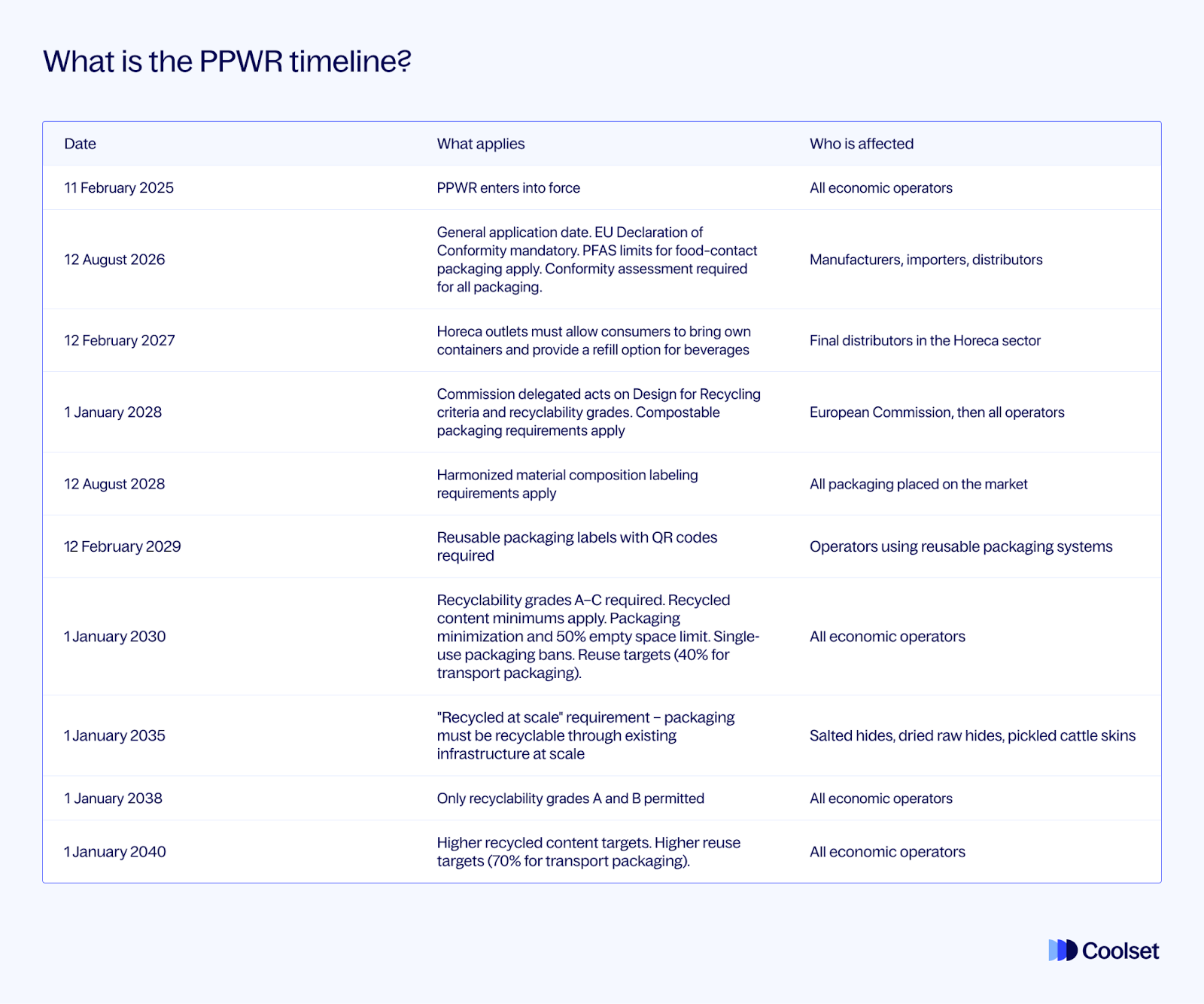
For importers, the most critical near-term deadline is 12 August 2026. From that date, every packaging type placed on the EU market must have a completed conformity assessment, a valid EU Declaration of Conformity and compliant labeling. The documentation collection process should start well in advance.
How should importers and distributors prepare for PPWR compliance?
Preparing for PPWR compliance requires a structured approach. The six steps below are sequenced for a compliance manager starting from zero – beginning with data collection and ending with audit readiness.
Step 1: Map your packaging portfolio
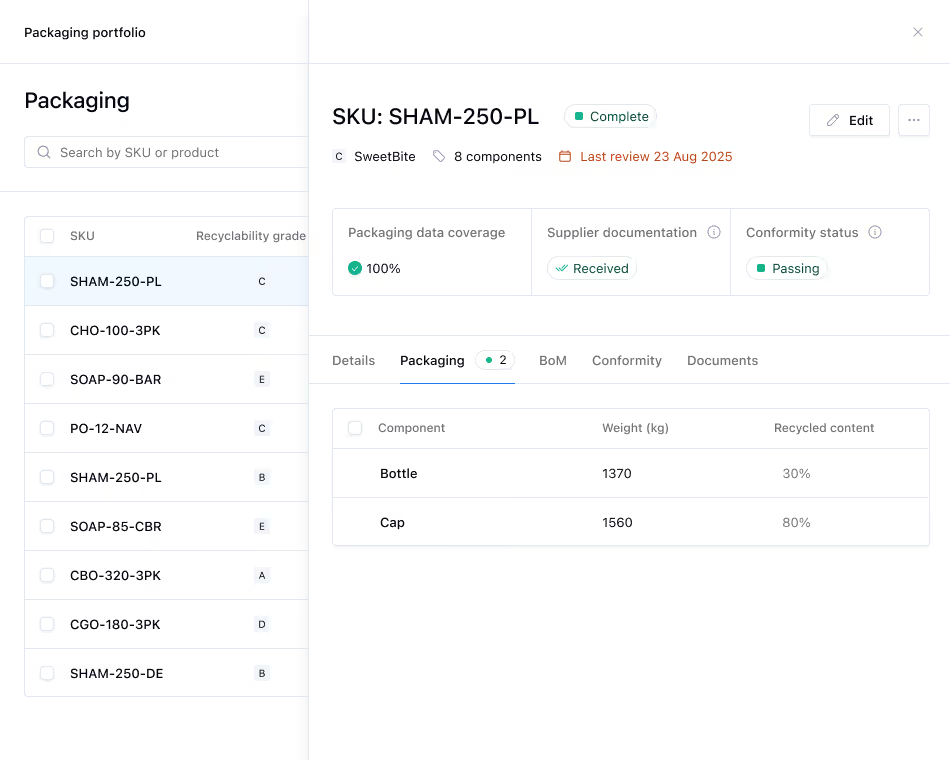
Start by creating a full inventory of every packaging type across your product range. Record the packaging material, number of components, weight, dimensions and the supplier responsible for each type. This baseline determines which PPWR requirements apply and what documentation to collect.
For importers handling hundreds of SKUs, this step often reveals packaging types and material compositions that were never formally documented. A food importer bringing in products from 15 suppliers across Asia, for example, may discover mixed-material packaging that falls outside current recyclability grades.
Step 2: Classify your role per product line
For each product line, determine whether your company acts as the importer, distributor or manufacturer under the PPWR definitions. Pay particular attention to Article 21: if any packaging is placed on the market under your own name or trademark, you carry full manufacturer obligations under Article 15 – not just importer duties.
A company that imports third-party branded goods and also sells own-label products will hold different roles for different SKUs, each with different compliance obligations.
Step 3: Request documentation from suppliers
For every packaging type, request the EU Declaration of Conformity and supporting technical documentation from the manufacturer. Use a standardized request template that specifies exactly what is needed per Annex VII (technical documentation) and Annex VIII (Declaration of Conformity).
Be specific in requests. Ask for the unique DoC number, the list of harmonized standards applied, the recyclability assessment method used and the material composition of each packaging component. Generic "compliance certificates" do not meet the PPWR requirements.
Step 4: Track submissions and flag gaps
Build a tracking system for documentation status across your full supplier base. Record which suppliers have submitted complete documentation, which submissions are incomplete and which suppliers have not responded.
Flag packaging types where the manufacturer has not completed a conformity assessment – these cannot legally be placed on the EU market from 12 August 2026. Importers who identify non-compliance before market placement avoid the enforcement risk. Importers who discover it afterward face potential fines, product recalls and market surveillance actions.
Step 5: Assess packaging against sustainability requirements
Review each packaging type against the substance limits (Article 5), recyclability performance grades (Article 6) and recycled content targets (Article 7). Identify packaging that meets current requirements but will need to change before 2030 – when only recyclability grades A–C are permitted and recycled content minimums kick in.
This assessment also surfaces packaging that will need a complete redesign. A composite plastic pouch with a recyclability grade below C, for example, cannot remain on the market after 1 January 2030. The sooner the importer flags this to the manufacturer, the more time both parties have to find an alternative.
Step 6: Set up document retention and audit readiness
Store EU Declarations of Conformity, technical documentation and internal conformity decisions in a central system with version history. Retention periods are strict: 5 years after the last unit of single-use packaging is placed on the market, 10 years for reusable packaging.
Structure the system to meet the 10-day rule. If a national authority requests documentation under Article 18(8), the importer must produce it in electronic form within 10 business days. That means documents need to be searchable, current and accessible – not buried in email chains or scattered across shared drives.
How can software help with PPWR compliance?
Software helps importers manage the operational complexity of PPWR compliance at scale. Tracking hundreds of SKUs across multiple suppliers, collecting Declarations of Conformity in a consistent format, monitoring conformity status per packaging type and retaining documentation with full version history – these are data management problems that spreadsheets cannot reliably solve.
Coolset is building PPWR compliance into its ESG and supply chain platform, connecting packaging data with existing CSRD, EUDR and EUTR workflows. For companies already managing supplier due diligence for deforestation or sustainability reporting under ESRS, adding packaging conformity tracking to the same platform avoids duplicating effort across compliance teams.
PPWR is one of six EU regulations reshaping supply chain compliance between 2025 and 2027 - for the full picture, see which EU regulations affect your supply chain.
For answers to 48 real practitioner questions from Coolset's manufacturers webinar, see the PPWR webinar Q&A.
Frequently asked questions
What is the PPWR?
The Packaging and Packaging Waste Regulation (PPWR) is a directly applicable EU regulation replacing the Packaging and Packaging Waste Directive. The PPWR sets harmonized requirements for packaging recyclability, recycled content, labeling and documentation. The PPWR applies from 12 August 2026.
When does the PPWR come into force?
The PPWR entered into force on 11 February 2025. The general application date is 12 August 2026, with sustainability requirements phased in through 2038. EU Declarations of Conformity become mandatory from 12 August 2026.
What are the PPWR obligations for importers?
Under Article 18, importers must verify the manufacturer completed the conformity assessment, check labeling, keep the EU Declaration of Conformity for 5–10 years and produce technical documentation to authorities within 10 days of a request.
What is a PPWR Declaration of Conformity? T
The PPWR Declaration of Conformity is a self-declaration by the manufacturer confirming packaging meets Articles 5–12 of the regulation. The Declaration follows Annex VIII and must be retained for 5 years (single-use) or 10 years (reusable).
What are the PPWR recyclability grades?
PPWR recyclability grades are A (≥95% recyclable by weight), B (≥80%) and C (≥70%). From 1 January 2030, only grades A–C may reach the EU market. From 1 January 2038, only grades A and B are permitted.
Does the PPWR apply to distributors?
Yes. Under Article 19, distributors must verify the producer's EPR registration, confirm correct labeling and must not make non-conforming packaging available. Distributors must inform authorities when packaging presents a risk.
What happens if an importer places packaging under its own brand?
Under Article 21, an importer or distributor placing packaging under its own name or trademark becomes a manufacturer. The importer must then complete the conformity assessment, prepare technical documentation and issue the EU Declaration of Conformity under Article 15.
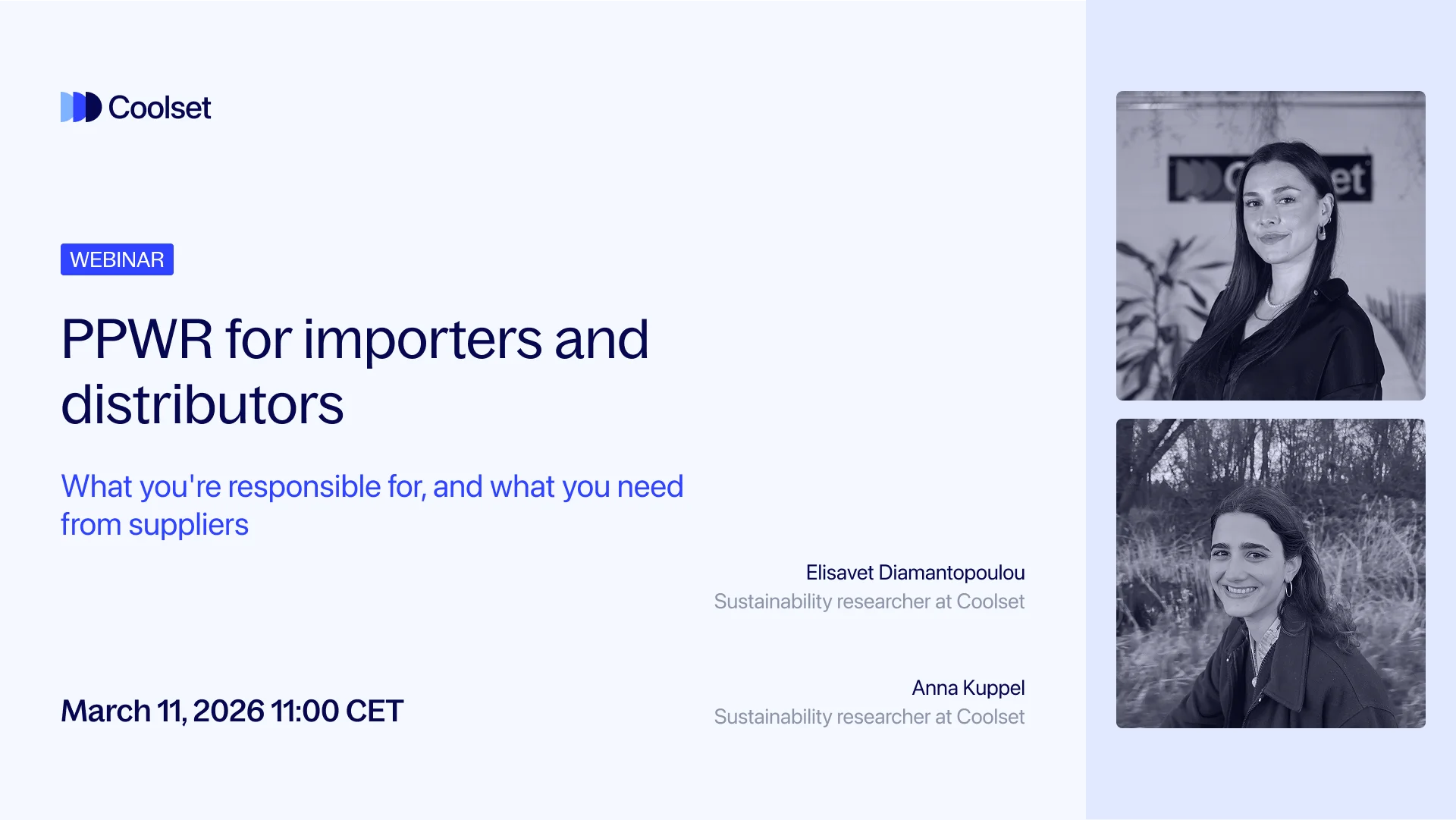
Practical session on your responsibilities, the packaging data you need, the DoC and how to manage supplier requests
PPWR compliance for manufacturers, importers and distributors
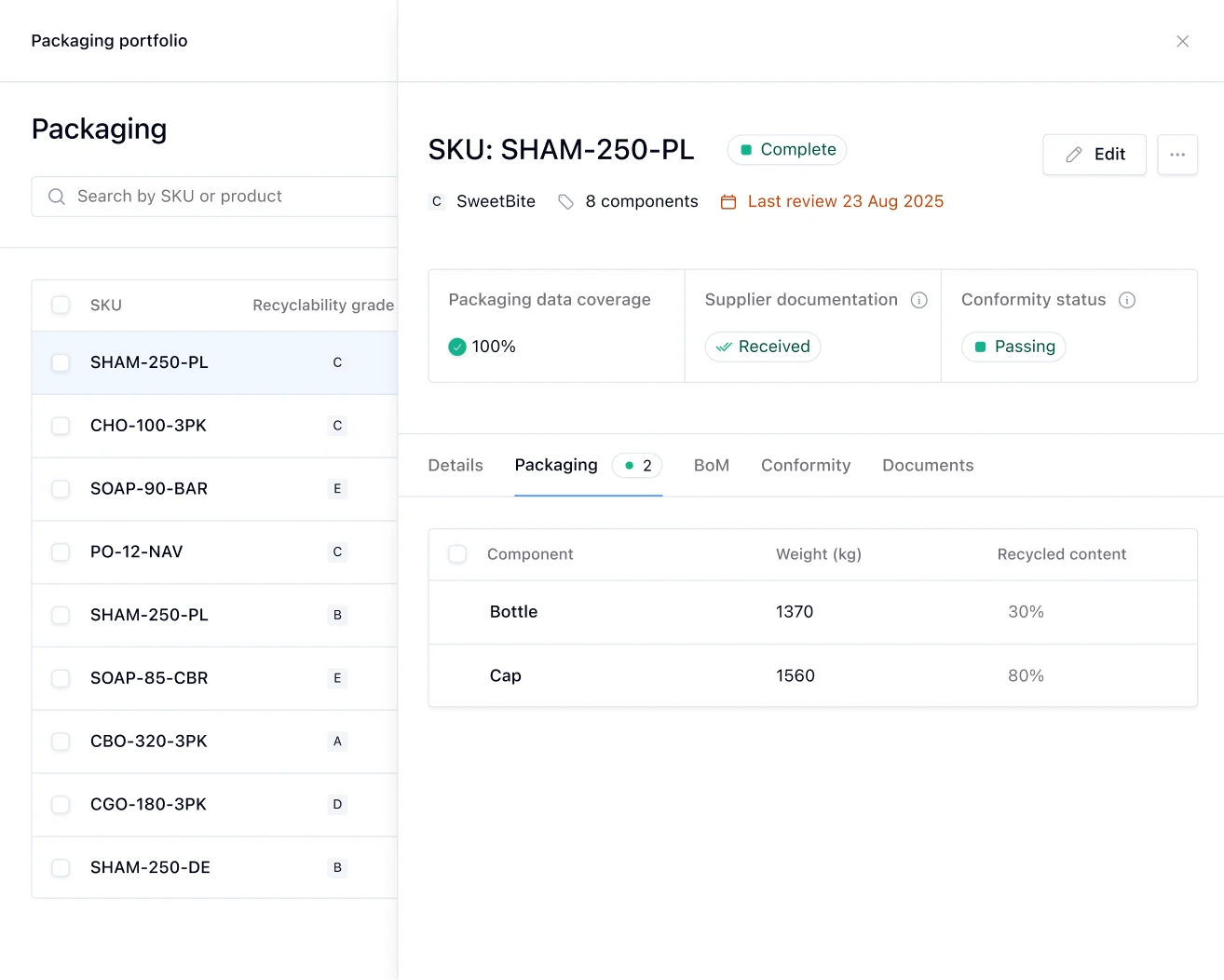
Coolset gives manufacturers, importers and distributors the system to collect proof, track conformity and act on risks - across every SKU, supplier and packaging change.

.webp)