PPWR webinar Q&A: manufacturers' obligations answered


Disclaimer: New EUDR developments - December 2025
In November 2025, the European Parliament and Council backed key changes to the EU Deforestation Regulation (EUDR), including a 12‑month enforcement delay and simplified obligations based on company size and supply chain role.
Key changes proposed:
- New enforcement timeline: 30 December 2026 for large/medium operators, 30 June 2027 for small/micro operators
- Simplified DDS: One-time declarations for small and micro primary producers
- Narrowed scope: Most downstream actors and non‑SME traders would no longer need to submit DDSs
- New DDS requirement: Estimated annual quantity of regulated products must be included
These updates are not yet legally binding. A final text will be confirmed through trilogue negotiations and formal publication in the EU’s Official Journal. Until then, the current EUDR regulation and deadlines remain in force.
We continue to monitor developments and will update all guidance as the final law is adopted.
Key takeaways
- PPWR (EU 2025/40) applies to all packaging placed on the EU market from 12 August 2026; recyclability grades and recycled-content targets phase in from 2030.
- Manufacturers issue a DoC per packaging type; importers retain it and produce it within 10 working days on request.
- Substance limits cover PFAS (food-contact) and four heavy metals (all packaging), including inks, coatings and adhesives.
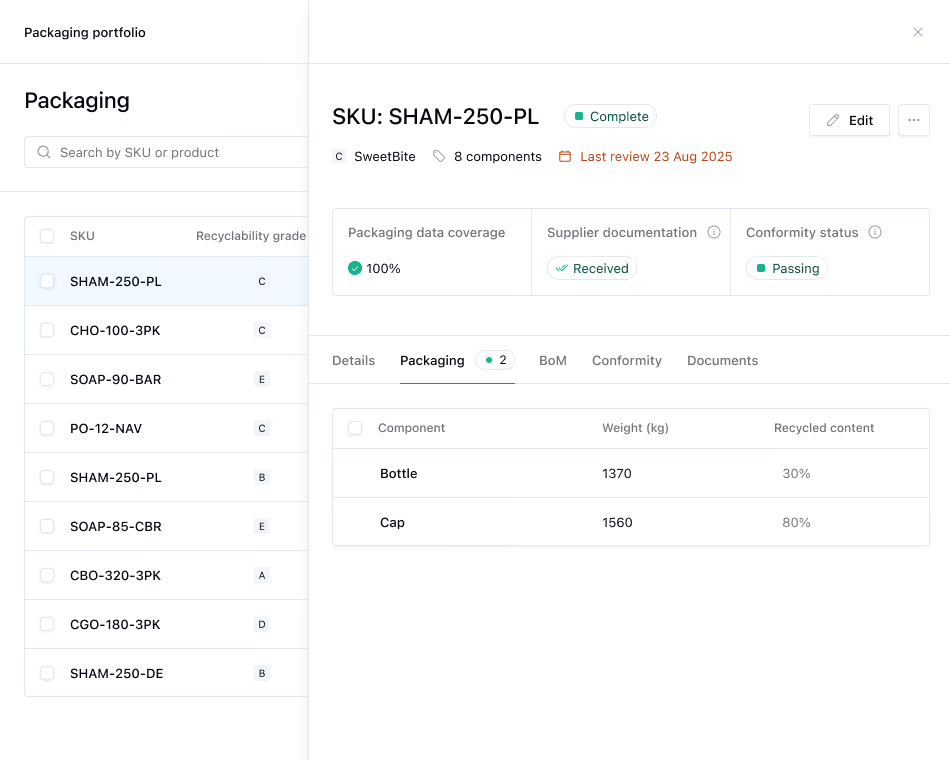
- Coolset's PPWR platform centralises DoCs and keeps supplier documentation audit-ready.
Manufacturers' Obligations Webinar — 16 April 2026
Prepared by Coolset Research Team | Based on PPWR Regulation (EU) 2025/40, Commission FAQ & Guidance Document (March 2026)
This document provides answers to all 49 questions submitted during the PPWR for Manufacturers webinar. Questions answered live during the session are marked accordingly. Answers draw from the webinar transcript, PPWR Regulation (EU) 2025/40, the Commission Guidance Document (published March 2026), and the Commission FAQ document. For a broader overview of responsibilities across the packaging chain, see our PPWR compliance guide for importers and distributors.
{{custom-cta}}
Q1 — DoC / Recyclability
Do we need to declare compliance with recyclability in the DoC by August 2026? The criteria to meet are not yet available – how can the manufacturer perform the assessment and declare conformity?
Yes, a recyclability assessment must be included in your conformity assessment and DoC from 12 August 2026. However, the Commission has clarified that until the new delegated acts (with specific recyclability grades) are in place, manufacturers should assess against the existing predecessor harmonised standards (e.g. EN 13430 series). The baseline obligation for August 2026 is simply that packaging must be "recyclable" – formal A/B/C/D grade targets only apply from January 2030.
In practice: document which existing standards you applied, perform the assessment in good faith against those standards, and state this clearly in your technical documentation. When new delegated acts are published, you will need to reassess.
Q2 — Scope
How about packaging imported with parts for production (packaging itself is not put on the market by us). Do we need declarations from our suppliers for that?
PPWR applies to packaging placed on the EU market. If the packaging is used purely internally (e.g. to transport components between your own facilities) and never made available on the market, it may fall outside scope. However, if that packaging eventually reaches a customer or end user, it is in scope.
As a rule of thumb: if you are the company placing the packaged product on the EU market, you need to ensure the packaging is compliant and retain the relevant DoC (either issued by you or your supplier, depending on your role). If your supplier is located in the EU and you are a microenterprise (<10 employees, <€2M turnover), your supplier bears the manufacturer responsibility.
Q3 — DoC
Do we need to translate the DoC into all EU languages?
No – not all EU languages. Under Article 39(2) of the PPWR, the DoC must be drawn up in, or translated into, one or more languages required by the Member State(s) in which the packaging is placed on or made available on the market.
So if you sell only in Germany, a German DoC suffices. If you sell across multiple Member States, you need to check each country's requirements and provide translations accordingly. Many Member States accept English for B2B documentation, but this should be verified per country.
Q4 — Substances
Do all inks/adhesives of different packaging types need to be tested?
Yes – the PPWR is explicit that PFAS and heavy metal limits apply to the packaging unit as a whole, including all associated inks, varnishes, glues, and adhesives (Commission FAQ Q15). This means each packaging type that contains inks or adhesives needs to have those components covered in the conformity assessment.
- Food-contact packaging: each ink/adhesive must be assessed for PFAS (limits: 25 ppb per individual PFAS, 250 ppb total PFAS, 50 ppm total fluorine).
- All packaging: inks/adhesives must be covered in the heavy metals assessment (combined Pb, Cd, Hg, Cr(VI) ≤ 100 mg/kg).
Request test data or declarations from your ink/adhesive suppliers and include them in your technical documentation.
Q5 — General
From a practical point of view, packaging is highly dependent on supply/demand and geographical location. This will pose huge administrative burdens for companies across Europe and even bigger burdens for companies outside Europe.
This reflects a widely shared concern. The regulation is designed as a directly applicable regulation across all 27 EU Member States precisely to reduce fragmentation – one unified set of rules instead of 27 different national transpositions. That said, the compliance burden is real, especially for companies with diverse global supply chains.
The Commission's approach is that the manufacturer (or deemed manufacturer) bears responsibility because they have the contractual leverage to influence packaging design and sourcing. The practical path forward is to build data collection into supplier contracts and use compliance tools to centralise documentation. Coolset's PPWR solution is designed specifically to help manage this at scale.
Q6 — Substances
Could a statement from suppliers about heavy metals absence be accepted as proof for the DoC?
The PPWR does not explicitly require third-party test reports for heavy metals — it requires that compliance be demonstrated in the technical documentation. A supplier declaration can form part of this evidence, but it must be substantiated.
In practice, market surveillance authorities will scrutinise declarations, and a bare self-declaration without any testing basis is a weak form of evidence. For heavy metals, many packaging types (especially plastics, pigmented materials, coatings) will need test reports to back up declarations. We recommend obtaining ISO 17025-accredited test reports for any packaging where there is a plausible risk of heavy metal contamination. For clearly low-risk materials (e.g. plain unprinted natural paper), a supplier declaration may be more defensible.
Q7 — Scope / Manufacturer
If we use cardboard boxes to ship prototypes to our customers or to our factories at other sites, are we subject to PPWR? Or does it apply only to the tape? Or the entire cardboard?
PPWR applies to all packaging placed on the EU market – including transport packaging. If you ship prototypes to customers, the cardboard box is in scope and the manufacturer of that packaging (whether you or your supplier) must have a DoC.
- Unbranded, standardised cardboard boxes purchased off the shelf: your supplier (the physical manufacturer) is the manufacturer for PPWR purposes and should provide the DoC – you retain it.
- Tape bearing your brand: you become the manufacturer of the tape and must issue its DoC.
- The unbranded cardboard box: your supplier remains responsible.
So effectively you would retain a DoC from your box supplier and issue one yourself for branded tape. For more on when branding shifts responsibility, see our guide to PPWR roles and Article 21.
Q8 — Governance
Who within the organisation typically owns and manages the DoC and technical documentation?
There is no regulatory prescription on internal ownership – the regulation assigns legal responsibility to the manufacturer entity, not a specific function. In practice, ownership tends to fall across teams:
- Regulatory Affairs / Compliance: overall responsibility and sign-off on DoCs
- Procurement / Supplier Management: data collection from suppliers
- R&D / Packaging Engineering: technical documentation, design specifications
- Legal: contract provisions requiring suppliers to provide compliant documentation
For cross-functional coordination to work, many companies are appointing a PPWR Compliance Lead to drive the programme. Documentation should be centralised in a system that allows retrieval within the 10-working-day window authorities require.
Q9 — Logistics
Will the slides be shared?
Yes – Coolset shared the slides with registered attendees after the webinar. If you haven't received them, please reach out to Coolset directly via their website (coolset.com) or the contact email provided at the end of the session.
Q10 — Substances
Is there a list of Substances of Concern (SoC)?
No definitive list exists yet. The Commission has tasked ECHA with preparing a report on substances of concern in packaging by 31 December 2026. That report is expected to include a list of SoCs based on current packaging manufacturing knowledge.
In the meantime, manufacturers should use existing frameworks to identify SoCs:
- The ECHA Candidate List (SVHCs under REACH)
- Annex VI of CLP Regulation (classified hazardous substances)
- The ESPR definition of "substance of concern" which covers carcinogens, mutagens, reprotoxics, endocrine disruptors, PBT/vPvB substances, and substances that negatively affect recycling
The four heavy metals with explicit limits (Pb, Cd, Hg, Cr(VI)) and PFAS (for food-contact packaging) are the only substances with specific concentration limits as of August 2026.
Q11 — DoC
Is it permitted to issue one Declaration of Conformity for a product family with identical packaging characteristics, or does PPWR require a separate DoC for each individual product?
The PPWR requires a DoC per packaging type, not per individual product. A "packaging type" is defined as packaging with the same material composition, design and format, the same product inside, and no differences that affect PPWR compliance requirements.
The Commission's FAQ (Q11 in the conformity assessment section) confirms: if bottles are different sizes but contain the same product and the size difference does not affect compliance with Articles 5–12, one DoC may cover both. But if the product inside differs (different content = different packaging type), a separate DoC is required. Be conservative – when in doubt, issue separate DoCs rather than risk non-compliance.
Q12 — Supplier Engagement
Some suppliers have refused to share technical documentation because the product falls under their IP. But under PPWR we are considered the manufacturer since it's our brand name. How can we go about this?
This is a real tension. Article 16 places a legal obligation on suppliers to provide manufacturers with all information necessary to demonstrate conformity — this is a statutory requirement, not optional.
Practical steps:
- Cite Article 16 explicitly in your supplier contracts and supplier engagement letters — non-compliance exposes them to losing your business.
- Negotiate under NDA — confidential data can be provided under NDA or in a redacted form that still allows conformity assessment.
- Use third-party testing labs — suppliers may be more comfortable sharing data with an accredited lab who then certifies compliance without disclosing proprietary formulations.
- Commission independent testing of the packaging materials you receive, and use those results to build your technical documentation.
- Consider switching suppliers — if a supplier persistently refuses, you may need alternative suppliers who will cooperate.
Q13 — DoC
How much flexibility ("margin of discretion") do companies have when deciding how to group packaging under a DoC?
The regulation gives manufacturers some discretion, but it is bounded by the definition of "packaging type." The Commission's FAQ confirms: you may group packaging under one DoC only when characteristics are the same in view of all applicable PPWR requirements and the packaged products are identical.
Key test: if any PPWR requirement (PFAS, heavy metals, recyclability, minimisation, recycled content) would produce a different compliance outcome for two packaging formats, they must have separate DoCs. If all requirements give identical results, grouping is permissible. The burden of proof lies with the manufacturer to demonstrate grouping is valid. Our recommendation: err on the side of issuing more DoCs rather than fewer — the cost of non-compliance far outweighs the administrative burden of an additional document.
Q14 — DoC
What exactly needs to be included in the six required elements of the DoC (Annex VIII) in practice?
Annex VIII of the PPWR specifies the mandatory elements of the EU Declaration of Conformity:
- Unique identification number of the DoC
- Name and address of the manufacturer (and authorised representative if applicable)
- Statement that the DoC is issued under the sole responsibility of the manufacturer
- Object of the declaration — identification of the packaging allowing traceability (type, batch or serial number + description)
- Statement that the packaging is in conformity with the relevant Union harmonisation legislation (reference PPWR Regulation (EU) 2025/40 and the specific articles)
- References to harmonised standards or common specifications used (or explanation of other technical specifications used if no harmonised standards applied)
Plus: where applicable, details of any notified body involved; additional information; place, date, name/function and signature of the signatory. Coolset has a DoC template based on the EU model – reach out to access it.
Q15 — DoC
Is the DoC expected to be updated per batch, or can it remain static for a packaging type?
The DoC is linked to a packaging type, not a production batch. You issue one DoC per packaging type and it remains valid as long as the packaging and its compliance characteristics remain unchanged.
However, the PPWR requires that the DoC be "continuously updated" (Article 39(2)). This means: if the material composition, design, inks, adhesives, or any other compliance-relevant characteristic changes, you must reassess conformity and update or reissue the DoC. You should also update if the harmonised standards or technical specifications you relied upon are replaced by new ones. In practice, build a change management process with your suppliers so that any packaging modification triggers a compliance review.
Q16 — DoC
How should batch numbers or serial numbers be handled in the DoC, given that these change with each packaging batch?
The DoC must "identify the packaging for which it has been drawn up" using "unique identification" (type, batch or serial number). The Commission's FAQ (Q3 on conformity assessment) clarifies that the DoC identifies the packaging type – it does not need to list every individual batch number.
In practice: your DoC should include the packaging type description and a type reference code. Batch/serial numbers are applied to the physical packaging itself (Article 15(5)) to enable traceability, but they do not need to appear individually in the DoC. The DoC covers the type; the batch/serial marking on the product covers specific production runs.
Q17 — DoC / Importer
Is it only the DoC and not the technical documentation we need to request if the packaging is unbranded?
For unbranded packaging where your supplier is the manufacturer: you as the importer/distributor must obtain and retain the DoC (Article 18). You do not need to hold the full technical documentation yourself, but you must verify that it exists and is accessible – i.e., the manufacturer can produce it within 10 working days if an authority requests it.
In practice: request from your supplier both the DoC and written confirmation that the technical documentation exists and is maintained. This gives you audit coverage without requiring the full documentation bundle in your own systems.
Q18 — Manufacturer / Deemed Manufacturer
If we have an unbranded box but seal it with tape bearing our brand name, are we responsible only for the tape or for the entire box?
You are the manufacturer for the tape (branded — Article 21 trigger applies). For the unbranded box, you are not the manufacturer — your box supplier is, and they must provide the DoC for the box.
The critical question is whether affixing branded tape "modifies" the box in a way that affects PPWR compliance. In most cases, tape on an unbranded box does not modify the box's compliance characteristics – so the box supplier remains the manufacturer for the box. You retain the box's DoC from your supplier and issue your own DoC for the branded tape.
Q19 — Manufacturer / Deemed Manufacturer
Is it correct that if you have an unbranded plastic bag on which you put a branded sticker — you are the manufacturer of both the sticker and the plastic bag?
Yes — adding a branded sticker to an unbranded plastic bag triggers Article 21 (deemed manufacturer), making you the manufacturer of the entire packaging unit (the plastic bag + sticker system).
The Commission's guidance is clear: if you place your name or trademark on packaging (including via a sticker), you are deemed the manufacturer and take on full manufacturer responsibilities for that packaging. You must therefore carry out the conformity assessment, create the technical documentation, and issue the DoC for the whole packaging, not just the sticker. This is the case regardless of whether the physical production was done by someone else.
Q20 — DoC / Packaging Type
The material is the same, but the colour is different. Should they be counted separately or can they be combined? For example, cardboard or EPE foam in different colours.
Potentially they can be grouped, but only if the colour difference does not affect any PPWR compliance requirement. The test is whether Articles 5–12 produce identical compliance outcomes for both colours.
The key risk area is inks and pigments: different coloured inks may have different substance profiles (e.g., heavy metals or PFAS in certain pigments). If the pigments used in different colour variants are materially different, you would need to assess each separately and may need separate DoCs. If the same pigment system is used in different proportions to achieve different colours, and you can demonstrate the same compliance outcome, grouping may be defensible. Document your rationale carefully.
Q21 — DoC / Manufacturer
Do you need to issue this as brand owner if your packaging supplier has already issued these documents?
It depends on your role:
- Your brand name or trademark is on the packaging: Article 21 deems you the manufacturer, you must issue the DoC yourself. Your supplier's documentation may form part of your technical documentation, but the DoC must come from you as the deemed manufacturer.
- The packaging is unbranded and your supplier physically produces it: your supplier is the manufacturer and issues the DoC. You (as importer or distributor) obtain and retain a copy of that DoC.
Q22 — General / Policy
Does the Commission understand that they could create a total block of the market as there is no harmonised system for tracking and reporting?
The Commission is aware of implementation challenges. The regulation is designed with phased timelines precisely to allow market participants and harmonised standard bodies time to develop the necessary infrastructure. The most urgent obligations (PFAS limits, heavy metals, basic recyclability, DoCs) apply from August 2026; more complex obligations (recyclability grades, recycled content targets, EPR fee modulation) phase in from 2030 onwards.
On harmonisation of testing: work is ongoing via the EURL on Food Contact Materials and national reference laboratories to develop harmonised PFAS testing protocols. On tracking and reporting: EPR registry harmonisation is part of the regulation's mandate for Member States. The Commission's FAQs and guidance documents represent an ongoing effort to clarify requirements before the application date.
Q23 — Substances
Do the heavy metal requirements only apply to food packaging?
No – the heavy metals limit (combined Pb + Cd + Hg + Cr(VI) ≤ 100 mg/kg) applies to all packaging from 12 August 2026, not just food packaging. This is confirmed explicitly in the Commission's FAQ: "The general obligation to minimise SoC in Article 5(1) and the limits on four heavy metals in Article 5(4) apply to all packaging from 12 August 2026."
PFAS restrictions, by contrast, apply only to food-contact packaging from August 2026. So the heavy metals rule is broader in scope than PFAS.
Q24 — Scope / Materials
We are packing our product in non-woven bags. Can we still use it after August 2026?
Yes, if your non-woven bags comply with the PPWR requirements. The regulation does not ban non-woven bags per se – it requires all packaging (including non-woven bags) to meet substance limits, be recyclable, and carry the correct labels.
Key questions to assess:
- Do your bags meet PFAS limits (if food-contact)?
- Do they meet heavy metal limits?
- Are they recyclable under current assessment standards?
Non-woven polypropylene bags can be recyclable, but this needs to be assessed and documented. If your bags meet the requirements, you can continue using them. If not, you'll need to reformulate or switch materials.
Q25 — Substances / PFAS
For PFAS: is a supplier "self-declaration" without any test report sufficient? (Answered live during the webinar)
No – a bare statement that "PFAS is not intentionally added" is not sufficient evidence of compliance.
The Commission's recommended stepwise approach requires actual testing:
- Step 1: Total Fluorine quantification — if below 50 mg/kg, provisionally compliant.
- Step 2: If TF ≥ 50 mg/kg, pyrolysis-GC/MS to determine if fluorine is organic or inorganic.
- Step 3: Direct TOP analysis to verify the 25 ppb and 250 ppb limits.
A supplier declaration without supporting test data cannot demonstrate compliance with this framework. Test reports from accredited laboratories (ISO 17025) are strongly recommended.
Q26 — Substances / PFAS
Does the no-PFAS rule apply only to food containers, or to every package for other products as well?
PFAS concentration limits under Article 5(5) apply only to food-contact packaging – packaging which is intended to be brought into contact with food or is already in contact with food. This is explicit in the regulation text and confirmed by the Commission's FAQ.
For non-food-contact packaging: there is no specific PFAS concentration limit from August 2026. However, the general obligation to minimise substances of concern (Article 5(1)) does apply to all packaging, which means PFAS used in non-food packaging should also be minimised as a matter of principle. Future delegated acts may extend PFAS limits to non-food packaging.
Q27 — Recyclability / Timeline
Can you clarify what you mean by "all packaging sold in the EU must meet design, recyclability and labelling standards in August 2026" if the first recyclability standards only start as of January 2030?
This requires clarification. In August 2026, packaging must be "recyclable" in a general sense (the baseline obligation under the regulation). However, the specific recyclability grade system (A/B/C/D/E) and the requirement that only Grade C and above is allowed only begins in January 2030.
- From August 2026: demonstrate that packaging is recyclable based on existing harmonised standards (the "predecessor standards"). This is a declaration obligation.
- From 2030: the formal grade-based system applies with the 70% recyclability threshold (Grade C).
Think of August 2026 as a "recyclability declaration" obligation, and 2030 as when the performance thresholds and grades become enforceable.
Q28 — Labelling
The address of the responsible person must appear on all packaging (including secondary and transport packaging), but is it acceptable to use a code that allows traceability instead? This is due to confidential clients, for example.
Article 15(6) requires manufacturers to indicate on the packaging (or via QR code or data carrier) their name, registered trade name/trademark, and postal address. Where this is not possible on the packaging itself, the information may be provided via QR code or in a document accompanying the packaged product.
A code that enables traceability may be acceptable if it links to a publicly accessible registry or data system that reveals the contact information – this is consistent with the regulation's data carrier provisions. However, a code that simply obscures the manufacturer's identity without any way for authorities to trace it is unlikely to comply. If you have genuine confidentiality concerns (e.g., white-label B2B products), discuss this with your legal advisors — the regulation does allow for authorised representatives to be listed in place of the manufacturer in some contexts.
Q29 — Scope / Pharma
How are all PPWR requirements impacting pharmaceutical packaging and medical devices? Are there any exemptions or adjusted timelines/deadlines?
The PPWR applies to pharmaceutical and medical device packaging, but with some specific provisions:
- Labelling exemption (Article 12): Waste sorting labelling requirements do not apply to packaging of human/veterinary medicinal products and medical devices used only by professional end users in industrial/professional settings. For medical devices, "immediate packaging" = packaging in contact with the device; "outer packaging" = sales packaging.
- Custom-made transport packaging: Article 15(11) exempts "custom-made transport packaging for configurable medical devices and medical systems used in industrial and healthcare environments" from contact info and identification marking obligations (Articles 15(2) and (3)).
- All other PPWR obligations (substance limits, recyclability, DoC, technical documentation) apply to pharmaceutical/medical packaging on the standard timeline.
Packaging of medicinal products that are integral delivery devices (e.g., pre-filled syringes as part of the product) may fall outside PPWR scope, seek legal advice on this boundary.
Q30 — Recyclability (Answered live during the webinar)
What does it mean that packaging must be recyclable by August 2026? There are no clear recyclability criteria yet, right?
This is correct – there are no specific recyclability grade criteria yet as of August 2026. The implementing act that will define the detailed grade methodology is due by August 2026, but the grade-based targets (only Grade C and above) only apply from January 2030.
For August 2026: manufacturers must carry out a recyclability assessment and declare conformity based on existing predecessor harmonised standards (EN 13430 series etc.). This is a "best effort" baseline assessment. More detailed guidance is expected in the implementing act before August 2026. Monitor developments closely.
Q31 — Importer / Non-EU Manufacturer
If the manufacturer is outside the EU and we import and place on market (unbranded, and we did not design the packaging) — who should be the manufacturer?
If the packaging is unbranded and you did not specify or design it, the physical manufacturer (your non-EU supplier) is the packaging manufacturer for PPWR purposes. However, as an EU importer placing that packaging on the EU market, you carry obligations under Article 18 – primarily to verify the manufacturer's compliance and retain the DoC.
Since your non-EU supplier cannot themselves be the EU importer (they have no EU establishment), you as the EU importer must ensure a DoC exists and is valid. If the non-EU manufacturer has not produced one, you may need to engage a third party or commission independent testing to create the compliance evidence. If you have an EU-established authorised representative acting for the non-EU manufacturer, that representative can hold the technical documentation on the manufacturer's behalf.
Q32 — Importer / Trader
We are a trader, the packaging is produced outside the EU and it is unbranded. Products are sold to retailers. Will we have the responsibility?
Yes – as the entity placing the packaged product on the EU market for the first time in a given Member State, you are the "producer" for EPR purposes and the "importer" for conformity obligations. Your responsibilities include:
- Verifying the DoC exists (issued by the non-EU manufacturer)
- Retaining a copy of the DoC
- Ensuring the packaging meets PPWR substance limits and recyclability requirements
- Registering for EPR in each Member State where you make products available
Since the packaging is unbranded and you didn't design it, you are not the "manufacturer", you don't need to issue the DoC yourself, you retain the DoC from the producer. But you carry verification and retention obligations, and you cannot place the product on the EU market without a valid DoC.
Q33 — Scope
Are boxes for watches and jewellery concerned by PPWR?
Yes – PPWR applies to all packaging placed on the EU market regardless of the product category. Watch and jewellery boxes are packaging under the regulation's definition, covering all packaging that is discarded upon or after purchase of the product.
If your watch/jewellery box bears your brand name or trademark, you are the manufacturer (Article 21 applies). You must carry out the conformity assessment, create technical documentation, and issue the DoC. The substance limits, recyclability assessment, and labelling requirements all apply.
Q34 — DoC / Transport Packaging
Will reusable transit packaging need its own DoC?
Yes – transport packaging has no exemption from the conformity assessment and DoC requirements. The Commission's FAQ explicitly confirms (Q12, conformity assessment section): "There is no exemption for transport packaging. Indeed, completely different packaging types, such as pallets, pallet collars, wrappings and straps, must undergo separate assessments and must have separate declarations of conformity."
Reusable transport packaging has the same DoC requirement but a longer retention period: documentation must be retained for 10 years (vs. 5 years for single-use packaging).
Q35 — Substances / PFAS (Answered live during the webinar)
We have over 20 suppliers for which we are the manufacturer. Most saying PFAS is not intentionally added in the material but not tested. Will a statement from the factory suffice? Multiple suppliers testing for PFAS is not feasible.
No – a bare statement is not sufficient. The Commission's guidance makes clear that compliance must be demonstrated, not merely declared. The three-step testing approach applies: (1) Total Fluorine below 50 mg/kg → provisionally compliant; (2) If TF ≥ 50 mg/kg, further testing required.
On feasibility: the recommended first step (Total Fluorine quantification) is relatively low-cost and widely available at commercial labs. On the basis of the Commission's own data, packaging without intentionally added PFAS typically passes the TF screening test. So the practical approach is: run TF screening first across your supplier base; only those that fail the TF screen need further targeted PFAS analysis. This makes the testing burden manageable at scale.
Q36 — Substances / PFAS
PFAS limits apply only to packaging intended to be in direct contact with food, correct? And they apply to the entire unit of packaging, not just the single part in contact, correct?
Correct on both counts:
- PFAS limits apply only to food-contact packaging — packaging intended to be brought into contact with food, or already in contact with food. Non-food packaging is not subject to PFAS limits (though the general SoC minimisation obligation applies).
- The PFAS limits apply to the packaging unit as a whole, including all associated inks, varnishes, glues and adhesives. So if your outer cardboard is fine but your food-contact inner liner or coating contains PFAS above the threshold, the whole packaging unit is non-compliant.
Q37 — Substances
Are test reports required for heavy metals?
The PPWR requires that compliance be demonstrated in technical documentation, but does not mandate a specific form of test report. However, for heavy metals, test reports from accredited laboratories provide the strongest evidence. Supplier declarations can supplement but typically should not be the sole basis.
- Low-risk packaging (e.g., unprinted natural cardboard): a well-substantiated supplier declaration may be defensible.
- Higher-risk packaging (coloured inks, coatings, pigments, recycled content): test reports are strongly recommended.
Market surveillance authorities conducting risk-based audits are likely to scrutinise higher-risk packaging types more closely.
Q38 — DoC / Technical Documentation
Evidence also contributes to the DoC, I think?
Correct – evidence (including test reports) is part of the technical documentation, not the DoC itself. The DoC is a declaration document that references the supporting evidence. The technical documentation (Annex VII) contains the actual test reports, material specifications, design drawings, and assessment outcomes.
Both must exist: the DoC declares conformity; the technical documentation proves it. The DoC must be producible within 10 working days of an authority request; the technical documentation underpins it and must be equally accessible.
{{ppwr-document-checker}}
Q39 — Scope
Which packaging types / part codes actually fall under PPWR? Does this apply only to secondary and tertiary packaging, or also primary?
PPWR applies to all packaging – primary, secondary, and tertiary/transport. There is no exemption based on packaging tier:
- Primary (sales packaging in direct contact with product): e.g., a bottle, blister pack, pouch — in scope.
- Secondary (grouped packaging): e.g., a carton grouping individual units — in scope.
- Tertiary/transport: e.g., pallets, stretch wrap, strapping — in scope.
- Service packaging: e.g., bags given at point of sale — in scope.
The only packaging genuinely out of scope is packaging that does not fall within the PPWR definition of "packaging" or that has specific exemptions (e.g., certain medical device packaging for professional use under the labelling provisions).
Q40 — DoC / Packaging Type (Answered live during the webinar)
Can I confirm that I understood correctly: if the packaging is the same but the content is different, it is considered a different packaging type?
Yes, that is correct. A packaging type is defined by: same material composition, same design and format, and same product inside, with no differences affecting PPWR compliance. If the product inside differs, the packaging types are different – primarily because minimisation requirements depend on the product being packaged (different volume/space occupation affects void fill assessments). Issue a separate DoC for each.
Q41 — Manufacturer / Deemed Manufacturer
I pack products in unbranded boxes that I buy from a supplier. I ship these boxes inside an outer case with my customer's brand on it. Who is the manufacturer? Should we consider the boxes and outer cases differently?
Yes – they should be treated separately:
- Unbranded inner boxes: your supplier is the manufacturer. You retain their DoC.
- Outer case with your customer's brand: your customer's brand triggers Article 21 — your customer is the deemed manufacturer for the outer case and must issue the DoC for it.
Your role: you are likely the filler/packer. You are not the manufacturer for either packaging type if you neither branded nor designed them. However, if you are placing the packaged product on the EU market for the first time (as the entity first making it available in a Member State), you may be the "producer" for EPR purposes, which is a different set of obligations.
Q42 — Timeline / DoC
Is it clear that for now (12th of August) only conformity with Article 5 is necessary? Hence not needing packaging design documents etc.?
Not quite. From 12 August 2026, companies must comply with all Articles that have that general application date, which includes:
- Article 5 (substance limits: PFAS for food-contact, heavy metals for all packaging)
- Article 12 (labelling — though specific pictograms await implementing acts)
- Article 38 (conformity assessment procedure)
- Article 39 (DoC requirement)
The DoC and technical documentation requirements do apply from August 2026, which means design documents, material specifications, and test reports should be collected and prepared before then.
What is phased:
- Recyclability grade requirements → 2030
- Recycled content targets → 2030
- Detailed waste sorting label pictograms → 2028
- EPR fee modulation by recyclability → 2030
The paperwork framework (DoC + technical documentation) is a Day 1 obligation. For a full breakdown of what applies when, see our PPWR compliance deadlines guide.
Q43 — Scope / Non-EU
How does PPWR influence export companies from Eastern European countries that are not EU members?
PPWR applies to packaging placed on the EU market – its geographic trigger is where the product enters the EU market, not where the company is based. If a non-EU Eastern European company exports packaged products into the EU, those products must comply with PPWR at the point of entry.
The practical effect:
- The EU importer (the first entity receiving the goods within the EU) bears the importer obligations (Article 18) — verifying compliance, retaining DoCs, responding to authorities.
- The non-EU manufacturer needs an EU-based authorised representative (Article 17) to hold documentation and liaise with EU authorities on their behalf.
- Non-EU manufacturers who sell directly to EU consumers (e.g., via e-commerce) are themselves responsible for compliance.
Q44 — General / Technology
What if the technology is not ready for tracking each packaging type per product?
The regulation requires documentation at packaging type level, not real-time digital tracking of every individual unit. The 10-working-day retrieval obligation is for documentation (DoCs, technical files), not for serialised product tracking.
For companies with many SKUs and packaging types, the challenge is manageable with a structured data approach: build a packaging inventory (SKU → packaging type mapping), collect documentation per type, and store it in a retrievable system. Physical tracking of individual units is not required unless you are operating a reuse system (where trip/rotation counting is relevant for reusable packaging labelling from 2029). Spreadsheets can work for smaller portfolios; dedicated compliance platforms (like Coolset) help at scale.
Q45 — Transport Packaging / EPR
Based on the Commission's interpretation, for unbranded transport packaging (pallets, palletising films, straps) — does responsibility fall under packaging suppliers (manufacturers)? Meaning DoC and EPR reporting?
Yes – for unbranded transport packaging purchased standardised off the shelf (no design input from you, no branding by you), your supplier is the manufacturer and must provide the DoC. You retain it.
For EPR: the "producer" for EPR purposes for transport packaging is typically the entity making the transport packaging available for the first time in a Member State — which is often the manufacturer/supplier of that transport packaging, unless you (as the user) are filling and making it available. For pallets and strapping purchased from a supplier who makes them available to you: the supplier is the producer for EPR. If you are purchasing empty pallets and then loading/distributing them yourself as the first placement in a Member State, check whether you become the producer for EPR.
Q46 — DoC
Do differences in the following require separate DoCs: (a) size, (b) supplier, (c) manufacturing location/site?
(a) Size: Different sizes do NOT automatically require separate DoCs, only if the size difference affects compliance with any PPWR requirement (e.g., different minimisation assessment outcomes). If compliance outcomes are identical, one DoC may cover both sizes.
(b) Different supplier: If two suppliers produce packaging of the same type to identical specifications and materials, in principle one DoC could cover both. However, different suppliers = different manufacturing processes = potential differences in compliance characteristics. We recommend separate DoCs by supplier as a conservative approach.
(c) Different manufacturing location/site: Same logic as supplier. If the same manufacturer produces at two sites with identical materials and processes, one DoC may be defensible. If different manufacturers/sites, separate DoCs are safer. Document your rationale.
Q47 — DoC (Answered live during the webinar)
Do we need a separate DoC for each packaging type, or can we group them? What qualifies as a "family of similar packaging"?
A DoC must be issued per packaging type. The regulation and Commission FAQ do not use the term "family", instead, grouping is only permissible when all compliance-relevant characteristics are identical.
Packaging type = same material composition + same design and format + same product inside + no differences that affect PPWR compliance (Articles 5–12).
If any of these differ in a way that would change the compliance outcome, separate DoCs are required. When in doubt, issue separate DoCs — the cost of an additional document is far less than the cost of non-compliance.
Q48 — DoC
How should variations (e.g. labels, languages, supplier) be handled within one DoC?
- Label/language variations: if the label change does not affect any PPWR compliance requirement (substance limits, recyclability, minimisation), it does not constitute a new packaging type — one DoC can cover all language variants of the same packaging.
- Supplier variations: treat cautiously — different suppliers may have different material compositions even for nominally identical packaging. See Q46.
- If a label contains inks with different substance profiles (e.g., a special colour for a limited edition), this may require a separate assessment and DoC.
Document your reasoning for grouping decisions clearly within your technical documentation.
For further guidance, reach out to the Coolset research team or book a 1-to-1 advisory session via coolset.com/ppwr
Related: PPWR compliance for e-commerce: how to meet empty space rules and marketplace duties in 2026
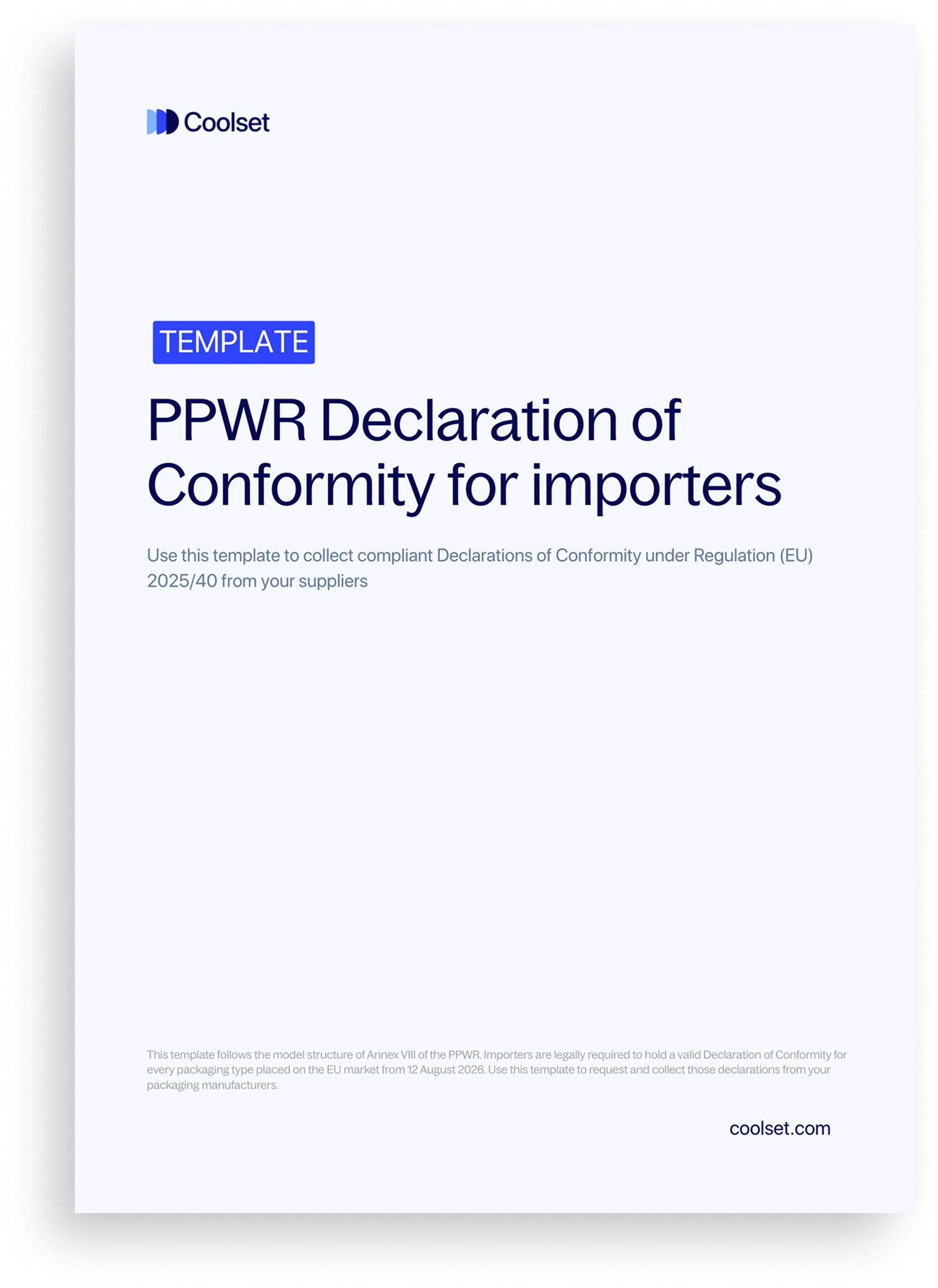
Get a ready-to-use template to request compliant DoCs from packaging suppliers (Annex VIII format).
↘ Check if your documentation meets PPWR requirements
This free compliance checker scans your packaging documentation and maps it against mandatory PPWR data requirements, giving you a clear view of your compliance status. Get actionable insights on documentation gaps before they become compliance issues.

.webp)