PPWR supply chain roles explained: manufacturer, importer, distributor, and producer

Disclaimer: New EUDR developments - December 2025
In November 2025, the European Parliament and Council backed key changes to the EU Deforestation Regulation (EUDR), including a 12‑month enforcement delay and simplified obligations based on company size and supply chain role.
Key changes proposed:
- New enforcement timeline: 30 December 2026 for large/medium operators, 30 June 2027 for small/micro operators
- Simplified DDS: One-time declarations for small and micro primary producers
- Narrowed scope: Most downstream actors and non‑SME traders would no longer need to submit DDSs
- New DDS requirement: Estimated annual quantity of regulated products must be included
These updates are not yet legally binding. A final text will be confirmed through trilogue negotiations and formal publication in the EU’s Official Journal. Until then, the current EUDR regulation and deadlines remain in force.
We continue to monitor developments and will update all guidance as the final law is adopted.
Key takeaways
- PPWR assigns five supply chain roles (manufacturer, importer, distributor, supplier, final distributor) and two accountability roles, each with distinct obligations.
- The producer role is geography-dependent: the same company can be the producer in Germany but not France, depending on who first places packaging on that market.
- Importers must verify manufacturer compliance and collect Declarations of Conformity; distributors must check EPR producer registration.
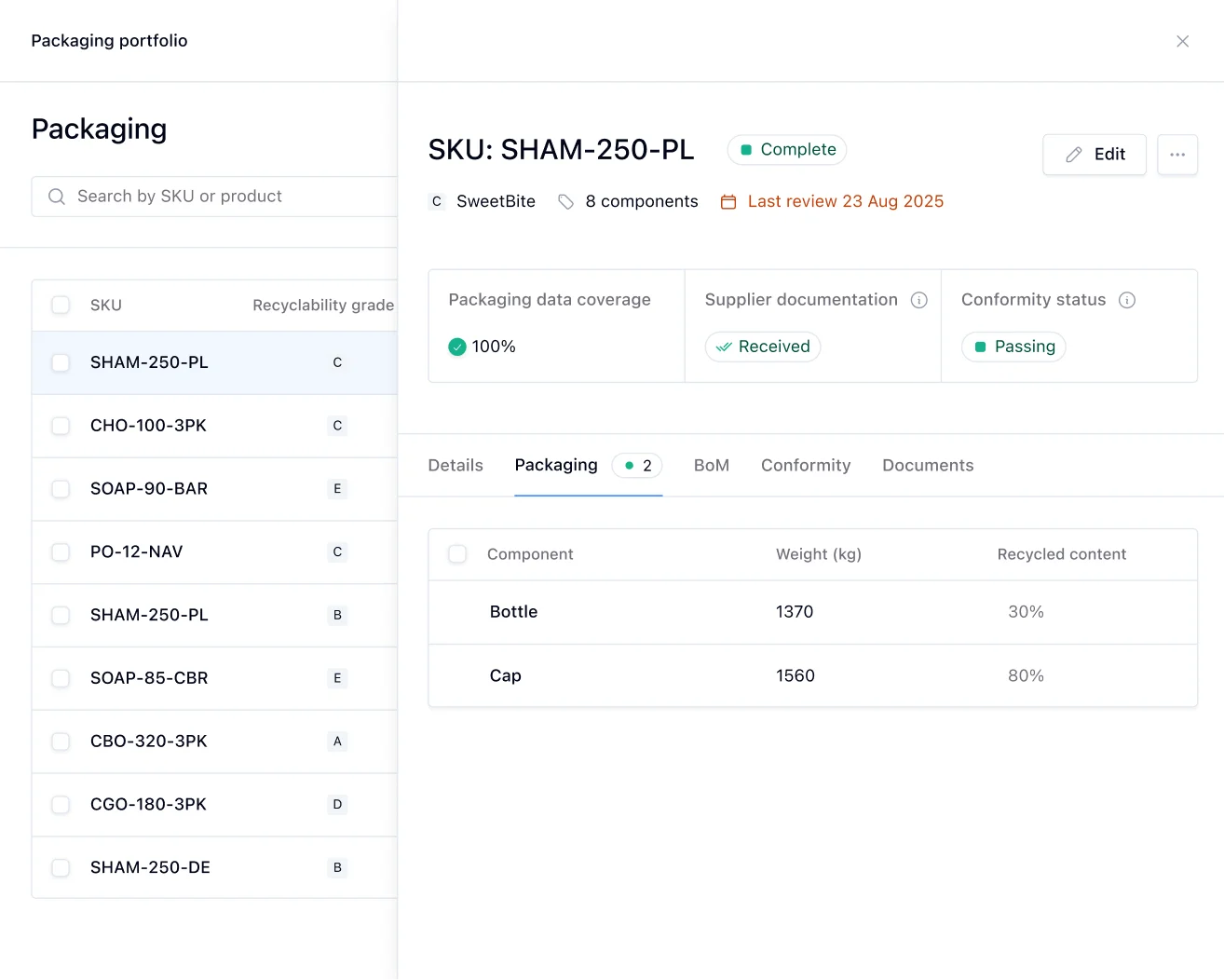
- Coolset's PPWR software helps manage Declarations of Conformity and EPR documentation across EU markets.
What is an economic operator under PPWR?
The Packaging and Packaging Waste Regulation (PPWR), Regulation (EU) 2025/40, introduces binding compliance obligations that follow you based on what you do with packaging, not just what your company sells. Article 3 defines "economic operator" broadly: anyone who manufactures, supplies, imports, distributes, or fulfills orders involving packaging on the EU market.
If you touch packaging at any point in the chain, you are in scope. The role you play determines your obligations. The same company can hold more than one role, and different products in the same portfolio can trigger different obligations.
Understanding your role is the foundation for every compliance decision you make before the August 12, 2026 application date.
Supply chain roles under PPWR
PPWR distinguishes between two types of roles: supply chain roles and accountability roles. Supply chain roles describe what you physically and commercially do with packaging. They do not change based on geography; they describe actions.
Article 3 PPWR defines five supply chain roles:
- Supplier: the company that makes or provides packaging material to another company, which then brands it. Suppliers do not carry PPWR compliance responsibilities directly, because they are not placing branded packaging on the market.
- Manufacturer: the company whose name or trademark appears on the packaging. Branding the packaging is what makes you the manufacturer, regardless of where it was physically produced. Manufacturers hold the most extensive obligations under PPWR, including technical documentation, conformity assessment, and the Declaration of Conformity.
- Importer: any company that brings packaging into the EU from a third country for the first time. If you import packaging under someone else's brand, you are an importer. If you import packaging under your own brand, you are simultaneously the manufacturer and the importer.
- Distributor: any company that moves packaging along the supply chain without owning the brand. Distributors do not create technical documentation but are required to verify that manufacturers and importers have done so, and to check that producers are registered for extended producer responsibility (EPR) in the relevant member states.
- Final distributor: the last commercial step before the product reaches the end consumer. This could be a retailer, an online marketplace, or any business that delivers directly to customers. The final distributor is both a distributor and, in many cases, the EPR producer for the relevant member state.
Accountability roles: producer and authorized representative
Accountability roles are distinct from supply chain roles. They describe who carries legal and financial responsibility for what happens to packaging after it becomes waste, specifically who must register and pay into EPR schemes.
A producer under PPWR is not defined by what you manufacture. A producer is the company that first introduces packaging into a specific EU member state for the first time. The same company can be the producer in one country and not in another, depending on who first places the packaging on that market.
The producer role is geography-dependent. You become the producer in a country when you are the first to make a packaged product available on that market, or when you sell directly to end users in that country from another EU member state. Only one company can be the producer for a given unit of packaging in a given member state.
An authorized representative (AR) is a company or individual established in an EU member state, appointed to handle EPR registration and reporting on behalf of a producer who has no physical presence in that country. If a non-EU company sells directly to consumers in France but has no French establishment, it must appoint a French-based authorized representative to register and report to French authorities.
Supply chain roles vs accountability roles: what is the difference?
The distinction between these two categories is operationally important and often misunderstood.
Supply chain roles cover the physical and commercial journey of packaging from production to consumption:
- Every company in the chain has at least one supply chain role.
- Roles can overlap. An importer can simultaneously be the manufacturer if it places packaging under its own brand.
- Supply chain roles do not change based on geography. They describe actions, not locations.
- These roles determine what documentation you must create, verify, or retain.
Accountability roles cover end-of-life responsibility:
- Only one company per packaging unit per member state carries the producer accountability.
- These roles are geography-dependent. The same company can be the producer in Germany but not in the Netherlands for the same product.
- These roles determine who must register in national producer registers, contribute to PRO (producer responsibility organisation) fees, and report placed-on-market volumes.
%252520Template%252520-%252520Split%252520width%252520-%2525201_1%252520-%252520Visual%252520Right%252520(1).webp)
How to determine your supply chain roles
The following questions help you classify your supply chain role for each product line or packaging format:
- Is my brand or trademark on the packaging? If yes, you are the manufacturer.
- Do I make or provide packaging that another company brands? If yes, you are the supplier.
- Do I bring packaging into the EU from outside the EU commercially? If yes, you are the importer.
- Do I move packaging along the chain without owning the brand? If yes, you are a distributor.
- Am I the last commercial step before the consumer? If yes, you are the final distributor.
Note that Article 21 PPWR creates an important reclassification rule: any importer or distributor that places packaging on the EU market under its own name, brand, or trademark becomes a manufacturer under the regulation, regardless of where the packaging was originally made. This is sometimes called the "deemed manufacturer" rule. For a detailed breakdown of when this applies, see the Coolset article on when importers become manufacturers under Article 21.
How to determine your accountability roles
Once supply chain roles are clear, determine producer status per market:
- Am I first to introduce packaging in my own EU country to anyone (B2B or B2C)? If yes, you are the producer in that country.
- Am I selling directly to end users in another EU country? If yes, you are also the producer in that country.
- Is nobody upstream already the producer for this packaging in this country? If yes, you are the producer by default.
- Am I a producer in a country where I have no physical presence? If yes, you need an authorized representative in that country.
EPR registration becomes mandatory across all EU member states by August 2028, with reporting obligations starting August 12, 2026. For a full breakdown of what applies when, see the guide to PPWR compliance deadlines.
What are your obligations per supply chain role?
PPWR does not assign the same obligations to everyone. The responsibilities below reflect what each supply chain role is required to do, verify, or retain under Articles 18 and 19.
Manufacturers must:
- Ensure packaging conforms with Articles 5 to 12 (design, substances, recyclability, recycled content, minimisation, labelling, reusability).
- Create technical documentation (Annex VII, Module A) as the underlying evidence base for compliance.
- Carry out the conformity assessment.
- Draw up and retain the EU Declaration of Conformity.
- Display their contact information on the packaging.
- Apply identification marking (batch or lot number).
- Retain documentation for five years for single-use packaging, ten years for reusable packaging.
Importers must:
- Verify that the manufacturer has carried out the conformity assessment and drawn up the Declaration of Conformity before placing packaging on the EU market.
- Verify that technical documentation exists and is accessible.
- Display their own contact information on the packaging.
- Retain a copy of the Declaration of Conformity for five years (single-use) or ten years (reusable).
- Not place packaging on the market if they have reason to believe it is non-compliant.
Distributors must:
- Verify that the manufacturer and importer have fulfilled their obligations (contact information present, identification marking applied).
- Verify that the producer is registered in the EPR register of the relevant member state before making packaging available.
- Not make packaging available if they have reason to believe it is non-compliant.
- Distributors do not create or retain technical documentation and are not required to draw up or keep the Declaration of Conformity.
For a detailed walkthrough of documentation workflows, including how to request the Declaration of Conformity from your suppliers, see the full guide on PPWR Declarations of Conformity.
Case study: the same platform, three different compliance pictures
To illustrate the different roles, let's explore how the same online platform can assume different PPWR reponsibilities depending on pacakging branding and shipping.
Scenario 1: Amazon sells a Philips blender (EU-only chain)
A Dutch box maker produces the cardboard packaging for the Philips blender but places no brand on it. It is the supplier. No PPWR compliance responsibility falls on it.
Philips buys the box and puts its brand on it. Branding the packaging makes Philips the manufacturer under Article 3 PPWR. Philips is responsible for technical documentation, the conformity assessment, and the Declaration of Conformity.
Amazon stores and delivers the packaged blender to a customer in Germany. Amazon never puts its name on the packaging and never owns the product. This makes Amazon a distributor, and specifically the final distributor, the last commercial step before the customer.
Because Amazon is the first to introduce the Philips blender with its packaging on the German market, it is also the producer in Germany for EPR purposes. This means Amazon must verify that Philips is registered in the German producer register and, if not, it cannot make the product available.
Scenario 2: Amazon sells "Amazon Basics" products (non-EU manufacturer)
Amazon EU SARL brands the packaging with "Amazon Basics". Branding makes Amazon EU SARL the manufacturer. Because Amazon EU SARL is also the entity bringing the packaging into the EU for the first time from China, it is simultaneously the importer. This is the Article 21 "deemed manufacturer" scenario in action. The supplier of the box is not in scope for PPWR.
Each local Amazon entity (Amazon DE, Amazon NL, Amazon FR) is the first to make the Amazon Basics packaged product available directly to end users in its country. This makes each entity the producer in its respective member state and the final distributor in that chain. Each national entity must register for EPR in its own country separately.
Scenario 3: Amazon sells a Korean brand's product directly to French consumers, with no physical possession
The Korean brand places its name on the packaging, making it the manufacturer. Because the Korean brand ships directly from Korea to French consumers, it is a non-EU entity selling directly to EU end users. This makes it the producer in France.
Amazon never takes physical possession of the goods and never places its name on the packaging. In this scenario, Amazon is acting purely as a marketplace and is not an importer, distributor, or final distributor.
Because the Korean brand is the producer in France but has no physical presence there, it cannot register or report directly to French authorities. It must appoint a French-based compliance firm as its authorized representative to handle all EPR obligations in France on its behalf.
This third scenario is increasingly common for cross-border e-commerce and represents a compliance gap that many non-EU brands are not yet aware of.
Getting ready for the 2026 deadline
The PPWR applies from August 12, 2026. PFAS bans on food-contact packaging and Declaration of Conformity obligations are among the first requirements that become enforceable. Here is how to prepare based on your role classification:
Step 1: Identify your roles per product line
Apply the decision questions above to every packaging format in your portfolio. Note that the same company can hold different roles for different products.
Step 2: Request technical documentation and Declarations of Conformity from manufacturers
Importers and distributors should be sending structured templates to their suppliers now. A Declaration of Conformity checklist should verify: unique identification number, full manufacturer details, responsibility statement, packaging description, applicable standards, relevant regulatory references, test reports, and signature. If your supplier cannot provide a complete DoC, the packaging cannot be verified as compliant.
Step 3: Register for EPR in every member state where you are the producer
Registration requirements and deadlines vary per country. In the Netherlands, registration via PackTool is required by April 1 each year for producers placing more than 50,000 kg on the market, or using any single-use packaging. For a step-by-step walkthrough of what this involves, see the PPWR compliance guide for importers and distributors.
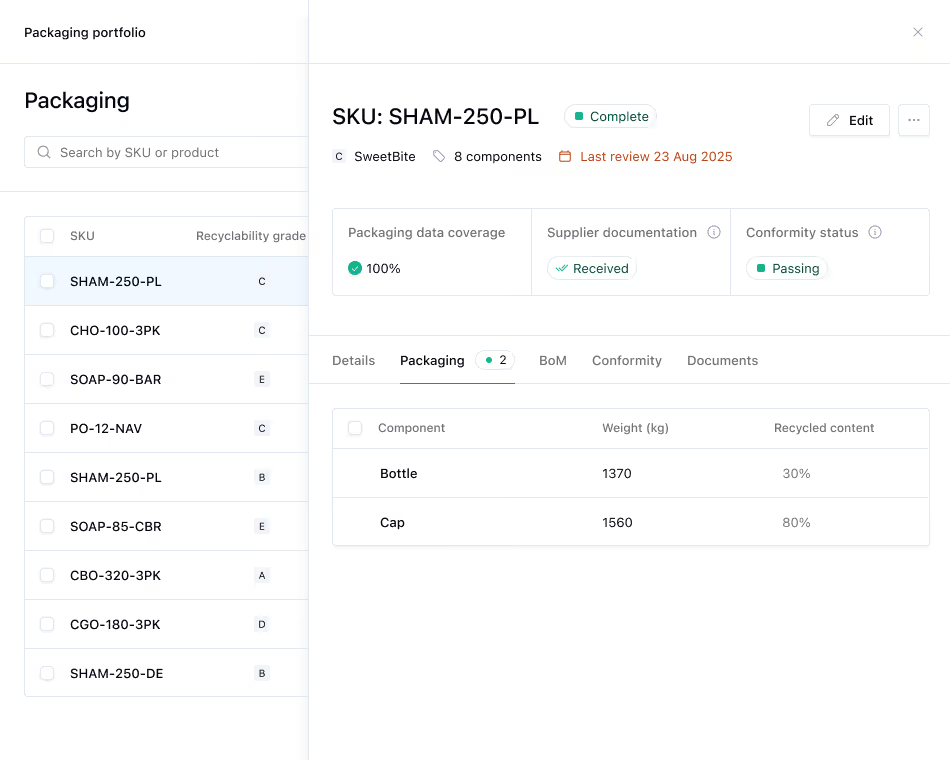
Step 4: Build your packaging data foundation
Collect material composition, weight per unit, packaging type, and recycled content percentages at the SKU level. Map each component to PPWR material categories for accurate EPR reporting. For a full overview of what software can help with this process, see the best PPWR compliance tools for 2026.
Step 5: Prepare for the ten-day rule
Under PPWR, market surveillance authorities can request your compliance documentation at any time. You have ten days to produce it electronically. Inability to present documentation is as legally significant as the packaging itself failing compliance. Set up document retention systems now, not after the first audit request.
Frequently asked questions
1. Can one company hold multiple PPWR roles at the same time?
Yes. A company that imports packaging and places it on the EU market under its own brand is simultaneously the manufacturer (under Article 21) and the importer. The same company can also be the producer in the member states where it first introduces the packaging.
2. What is the difference between a manufacturer and a producer under PPWR?
A manufacturer is the company whose brand is on the packaging. A producer is the company responsible for EPR registration and fees in a specific EU member state. These roles often overlap but are not the same. A manufacturer in the Netherlands is automatically the producer there; a manufacturer in Korea selling to France becomes the producer in France and may need an authorized representative.
3. What is an authorized representative under PPWR?
An authorized representative (AR) is a company or individual established in an EU member state, appointed by a producer who has no physical presence in that country to handle EPR registration, reporting, and compliance obligations on their behalf.
4. Does PPWR apply to companies that only distribute packaging?
Yes. Distributors have specific obligations under Article 19 PPWR, including verifying that manufacturers and importers have met their compliance obligations and checking that the producer is registered in the national EPR register. Distributors who cannot verify compliance must not make the packaging available on the market.
5. When does PPWR apply from?
PPWR applies from August 12, 2026, when Declaration of Conformity requirements, PFAS bans on food-contact packaging, and EPR reporting obligations become enforceable. Further requirements phase in through 2030 and 2038. For a full timeline, see the PPWR compliance deadlines guide.
6. How does EPR reporting work for producers?
Producers must report to the national competent authority via the producer register each year. Reports cover quantities by weight of packaging placed on the market for the first time, broken down by material category. Producers placing less than 10 tonnes per year submit a simplified seven-material breakdown. For more on EPR registration in the Netherlands, see the step-by-step compliance guide for importers and distributors.
{{custom-cta}}
Related: Packaging and packaging waste regulation: PPWR essentials
Related: PPWR compliance for e-commerce: how to meet empty space rules and marketplace duties in 2026
Explore Coolset's top features and use cases.

on mobile screens
to experience this demo.


↘ Check if your documentation meets PPWR requirements
This free compliance checker scans your packaging documentation and maps it against mandatory PPWR data requirements, giving you a clear view of your compliance status. Get actionable insights on documentation gaps before they become compliance issues.

.webp)