EUDR and TARIC codes: a compliance guide for importers in 2026



Disclaimer: New EUDR developments - December 2025
In November 2025, the European Parliament and Council backed key changes to the EU Deforestation Regulation (EUDR), including a 12‑month enforcement delay and simplified obligations based on company size and supply chain role.
Key changes proposed:
- New enforcement timeline: 30 December 2026 for large/medium operators, 30 June 2027 for small/micro operators
- Simplified DDS: One-time declarations for small and micro primary producers
- Narrowed scope: Most downstream actors and non‑SME traders would no longer need to submit DDSs
- New DDS requirement: Estimated annual quantity of regulated products must be included
These updates are not yet legally binding. A final text will be confirmed through trilogue negotiations and formal publication in the EU’s Official Journal. Until then, the current EUDR regulation and deadlines remain in force.
We continue to monitor developments and will update all guidance as the final law is adopted.
Key takeaways
- EUDR scope is set by Annex I CN codes, not TARIC, and the two further TARIC digits have no legal effect on classification.
- Delegated Regulation (EU) 2026/2102 added, removed and reworded Annex I entries, so mappings built against the original text need to be rerun.
- Large operators must comply from 30 December 2026, micro and small enterprises from 30 June 2027, under Regulation (EU) 2025/2650.
- Coolset supports EUDR mapping, geolocation and DDS submission end to end. See the EUDR platform.
Regulation (EU) 2023/1115 (EUDR) applies to the seven commodities and derived products listed in Annex I, identified by their Combined Nomenclature (CN) codes. Following the postponement introduced by Regulation (EU) 2025/2650, the regulation is scheduled to apply from 30 December 2026 for most operators and traders, and from 30 June 2027 for obligated micro and small enterprises, subject to specific exceptions.
The European Commission’s TARIC document for EUDR published by DG ENV on 25 September 2026 sets out the document codes customs authorities use for EUDR-related declarations. However, knowing which code to enter is only part of the process. Importers still need to answer a more fundamental question: is the product they are importing actually covered by the EUDR?
That question cannot be answered from TARIC alone. Annex I uses CN codes, often at the four-, six- or eight-digit level, while TARIC adds two further digits for tariff and trade measures. A single CN heading can include both in-scope and out-of-scope products, and recent amendments to Annex I have changed the scope of the Regulation.
Importers therefore need to map their tariff codes against the applicable version of Annex I, check the product itself where necessary, and document the outcome ahead of the relevant application date.
Why TARIC codes alone do not decide EUDR scope?
TARIC codes do not, by themselves, determine whether a product falls within the EUDR. Annex I of Regulation (EU) 2023/1115 identifies the products covered by the Regulation using CN classifications. The two additional TARIC digits support the application of customs tariffs and trade measures, but do not independently establish EUDR scope.
Where Annex I identifies an eight-digit CN subheading, the corresponding TARIC codes generally fall under that classification, subject to the precise wording of the entry and any applicable exclusions. The same principle applies to four-digit headings and their subordinate codes, although the product description and any limitations in Annex I must still be considered.
In other words, the TARIC code tells customs how a product is classified for customs purposes. It does not, on its own, tell the importer whether the product is subject to EUDR obligations.
Annex I covers cattle, cocoa, coffee, oil palm, rubber, soya and wood, together with a defined list of derived products. The consolidated EUDR text as amended by Regulation (EU) 2025/2650 covers goods containing, fed with or made using those seven commodities, from leather and chocolate to tires, soy flour, palm oil derivatives, furniture, paper and certain printed books.
However, the presence of a relevant commodity does not automatically bring every finished product within scope. The product must first fall within an applicable Annex I entry and meet the Regulation’s other conditions. Equally, where a product is listed, its obligations cannot simply be dismissed because the relevant commodity represents a small proportion of its weight or value.
The distinction matters for composite products. A rubber component in machinery or a wooden component in a finished article does not automatically make the whole product subject to the EUDR. Importers must check the classification of the finished product against Annex I and assess any relevant exclusions.
Relying on a customs broker’s TARIC classification without separately checking Annex I can therefore lead to incorrect scope decisions.
{{product-tour-injectable}}
How Annex I maps to CN and TARIC in practice
Annex I identifies covered commodities and derived products through specific CN codes and accompanying descriptions. The relevant entries span multiple chapters of the customs nomenclature.
Wood-related products, for example, appear in Chapters 44, 47 and 48, as well as certain entries in Chapter 94 covering products such as wooden furniture. Cattle-related entries cover Chapters 1, 2, 15, 16, 41 and 42 and include specified live animals, meat, animal products, hides and leather goods. Cocoa, coffee, oil palm, rubber and soya likewise have their own sets of relevant classifications.
The practical challenge is that classification at chapter level is not sufficiently precise. Importers need to compare each product’s actual CN classification with the exact wording of Annex I, including any exclusions, product descriptions and effective dates.
The scope of the EUDR is not static. Commission Delegated Regulation (EU) 2026/2102 of 13 July 2026, published in the Official Journal on 17 September 2026, amended Annex I under Article 34(1) of the EUDR. The amendments include the removal of certain cattle hides, skins and leather products, as well as selected rubber products, retreaded tyres, conveyor and transmission belts, certain vehicle and aircraft seats, and soybeans for sowing. The Regulation also adds certain products, including frozen cattle tongues and soluble coffee, with the new products subject to the EUDR from 30 December 2027.
The amendments also clarify the treatment of certain products, including used and second-hand goods. Importers should check the exact wording of each amended entry rather than assuming that every product in a broader category is now excluded.These changes can have a significant effect on existing product mappings. Businesses that assessed their products against the original Annex I should review those assessments against the amended text. Printed products have also been affected. Regulation (EU) 2025/2650 removed certain Chapter 49 printed products from Annex I alongside the postponement, which reduces the number of products covered for some publishers and retailers importing books, newspapers and other printed materials.
Product classification is not the only consideration. The date on which a product was produced can also affect how the EUDR applies. The Commission Notice C/2026/3896 of 20 July 2026, provides guidance on the Regulation, including its application dates and due diligence requirements. However, the treatment of products produced before 29 June 2023 needs to be assessed against the relevant transitional provisions and the type of product concerned.
Importers should not assume that every product produced before that date is automatically outside the EUDR. Specific transitional rules apply to certain timber and timber products, including products covered by the former EU Timber Regulation.
The production date should therefore be recorded alongside the CN classification, with supporting evidence retained where relevant. Where transitional provisions may apply, the importer should check the precise legal requirements rather than relying on the date alone.
Composite and processed goods: where importers misclassify
Composite and processed goods are where TARIC-only classification fails most often as it becomes a common source of confusion because the finished-product classifications do not always make the relevant commodity obvious. Examples include leather footwear, cocoa-containing bakery products, soy-fed meat preparations and furniture made from a combination of wood, metal and plastic. Each product needs to be assessed against the relevant Annex I entry, taking account of its classification and any applicable exclusions.
If the CN code is in Annex I, the entire product carries the due diligence obligation, even where the relevant commodity is a small share by weight or value. If the CN code is not in Annex I, the product is out of scope even when it physically contains a relevant commodity. Cosmetic preparations containing palm oil derivatives, for example, should not be treated as automatically in scope simply because of their ingredients. Their classification must be checked against Annex I.
The Delegated Regulation (EU) 2026/2102 changes shift this picture for several composite categories. Removing cattle hides and leather from Annex I takes finished leather goods made from those inputs out of the direct cattle supply chain for EUDR, which materially reduces the file for footwear and leather accessories importers whose only cattle exposure was through the hide route. The new wood entry wording that excludes used and second-hand products removes refurbished furniture and reclaimed plywood from scope. Teams that classified products as in-scope under the original Annex I need to rework those lines against the amended text before building a 2026 import file.
Misclassification can lead to unnecessary compliance work or, more seriously, missed legal obligations. Article 25 of the EUDR requires Member States to set penalties that are effective, proportionate and dissuasive. Those penalties include fines proportionate to environmental damage and to the value of the commodities or products concerned. They also cover confiscation of the products and the revenues gained, and temporary exclusion from public procurement and public funding. Classifying a product that falls under the EUDR as out of scope may lead to missed due diligence requirements. Conversely, classifying a product that is excluded from the EUDR as in scope can lead to unnecessary administrative work and data collection.
For more sector-specific guidance, see Coolset’s guide to cattle traceability and its analysis of the mixing and circumvention, which explain how commodity-level traceability requirements apply in practice.
Building a reliable TARIC-to-Annex I mapping for 2026 imports
A reliable mapping starts from the importer's own customs master data. Every CN or TARIC code used in the last twelve months is checked against the current Annex I list, as consolidated after Regulation (EU) 2025/2650 and amended by Delegated Regulation (EU) 2026/2102. The review should be carried out line by line rather than by broad product category. Products with similar classifications can have different scope outcomes, particularly where Annex I includes in-scope and out-of-scope items under neighboring codes within the same chapter. Each in-scope tariff line is then linked to the specific relevant commodity it contains. That link drives what comes next under the consolidated EUDR text: the plots of land that need geolocation, the country of production used in the risk assessment, and the supplier responsible for the primary data. Where a CN heading mixes in-scope and out-of-scope variants, the resolution is by product specification, not by tariff code, and the reasoning is recorded in the due diligence file so that a competent authority can retrace it later.
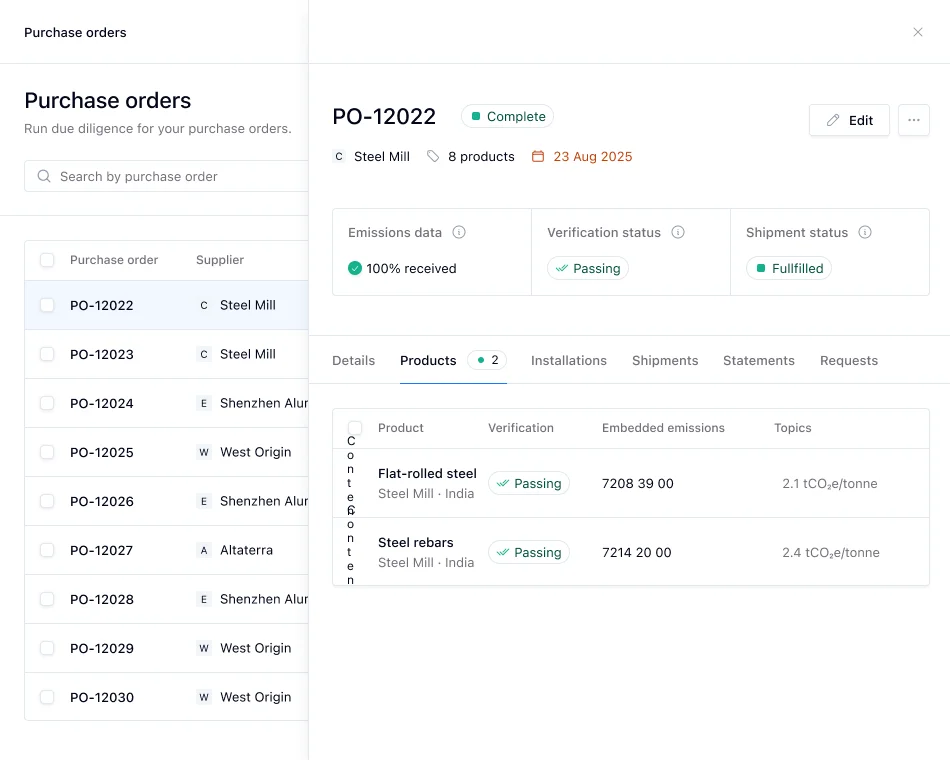
Once a product has been identified as in scope, the importer needs to determine which due diligence requirements apply to its role in the supply chain. The due diligence statement itself is submitted through the EU Information System (TRACES). Each submission generates a reference number, which the operator passes to downstream operators and traders. The reference number travels with the goods through subsequent trade and customs declarations, and the DG ENV TARIC document published on 25 September 2026 sets out the TARIC document codes that must appear in the customs declaration for EUDR-relevant imports and exports. Annex I of the base regulation also requires quantities and product classifications to be recorded consistently with the applicable reporting requirements. For relevant products entering or leaving the EU market, the EUDR specifies quantities in kilograms of net mass and, where applicable, the relevant supplementary unit.
For further guidance on the responsibilities that follow from this mapping, see Coolset’s guide to EUDR operator obligations and its overview of common EUDR audit pitfalls.
{{custom-cta}}
What is the difference between December 2026 and June 2027?
The EUDR application dates depend on the operator’s category and circumstances.
Under Regulation (EU) 2025/2650, the main dates are:
- 30 December 2026: for most operators and traders, including large and medium-sized operators.
- 30 June 2027: for eligible micro and small operators, subject to the exception for those already covered by the EU Timber Regulation.
Large and medium operators must comply with the EUDR from 30 December 2026. Other eligible micro and small operators have an additional six months, until 30 June 2027. DG TRADE confirmed those dates in a January 2026 update on the postponement. The one-year shift was adopted as Regulation (EU) 2025/2650 on 19 December 2025, following the Commission proposal COM(2025) 652 final of 21 October 2025.
The same amendment narrowed who must file the DDS. Regulation (EU) 2025/2650 amended EUDR to simplify downstream and SME obligations. DG TRADE's January 2026 note describes the same effect: the amendment adjusts due diligence obligations and reduces the burden on small operators. The Commission's October 2025 proposal that became the amending regulation also introduced a new sub-category of micro and small operators exempt from submitting due diligence statements.
The amendment also added a simplification review clause. Under the consolidated text, the Commission must carry out a simplification review of the Regulation and present a report by 30 April 2026. Importers building a 2026 file should track that report when it is published, together with any further Annex I amendments.
Preparing the 2026 import file
The TARIC-to-Annex I mapping should be treated as a living document, not a one-off exercise. Start by reviewing the tariff codes used in recent imports and checking each product against the latest applicable Annex I. Record the legal basis for each scope decision, together with the product details and any supporting evidence needed to explain the result. Next, connect each in-scope product to the relevant due diligence process and customs declaration requirements. Where an amendment changes the treatment of a product, update the mapping and related compliance records. The mapping should also include a version date so that the company can show which legal text it relied on when making its decision.
The key is to establish a clear, defensible scope assessment for every relevant product line. TARIC provides an important starting point, but the applicable Annex I entry, the product’s characteristics and the relevant transitional provisions determine the outcome.
Frequently asked questions
What are the EUDR commodity codes?
The EUDR commodity codes are the Combined Nomenclature (CN) codes listed in Annex I of Regulation (EU) 2023/1115 for the seven commodities (cattle, cocoa, coffee, oil palm, rubber, soya and wood) and their derived products. The list was amended by Delegated Regulation (EU) 2026/2102 and by Regulation (EU) 2025/2650. Importers should check the current consolidated Annex I, including subsequent amendments, rather than relying on TARIC alone.
What are HS codes, and how do they differ from CN codes?
The Harmonized System (HS) is an international system for classifying traded goods, developed by the World Customs Organization (WCO). HS codes generally consist of six digits and are used as a common basis for customs classification worldwide. The EU’s Combined Nomenclature (CN) builds on the HS by adding two digits, creating an eight-digit code used for EU customs and trade statistics. TARIC further extends the CN with additional digits to identify specific EU tariff and trade measures. Although these systems are closely related, they serve different purposes. For EUDR purposes, the relevant product classifications are those listed in Annex I using CN codes.
What is the latest update on the EUDR?
The key changes relevant to this article include Delegated Regulation (EU) 2026/2102 of 13 July 2026, which amended Annex I, and the DG ENV TARIC document for EUDR published on 25 September 2026, which postponed the application dates and amended certain operator obligations. Application for large operators remains 30 December 2026 and for micro and small enterprises 30 June 2027.
What are the EU tariff codes?
EU customs classifications are based on the Combined Nomenclature (CN), established under Council Regulation (EEC) No 2658/87. TARIC extends the CN classification with two additional digits for tariff and trade measures. The EUDR refers to CN codes in Annex I, so the TARIC code does not independently determine whether a product falls within scope.
Which products are covered by the EUDR?
EUDR covers the relevant products listed in Annex I that contain, were fed with or were made using cattle, cocoa, coffee, oil palm, rubber, soya or wood, when produced from 29 June 2023 onward. The Commission Notice C/2026/3896 of 20 July 2026 confirms that products produced before that date are outside scope.
Do TARIC codes alone determine whether a product is in EUDR scope?
No. TARIC codes alone do not determine EUDR scope. Annex I is written in CN terms, and a single CN heading can mix in-scope and out-of-scope goods. The physical composition of the product and its production date decide scope, and the result is documented in the due diligence file submitted through TRACES.
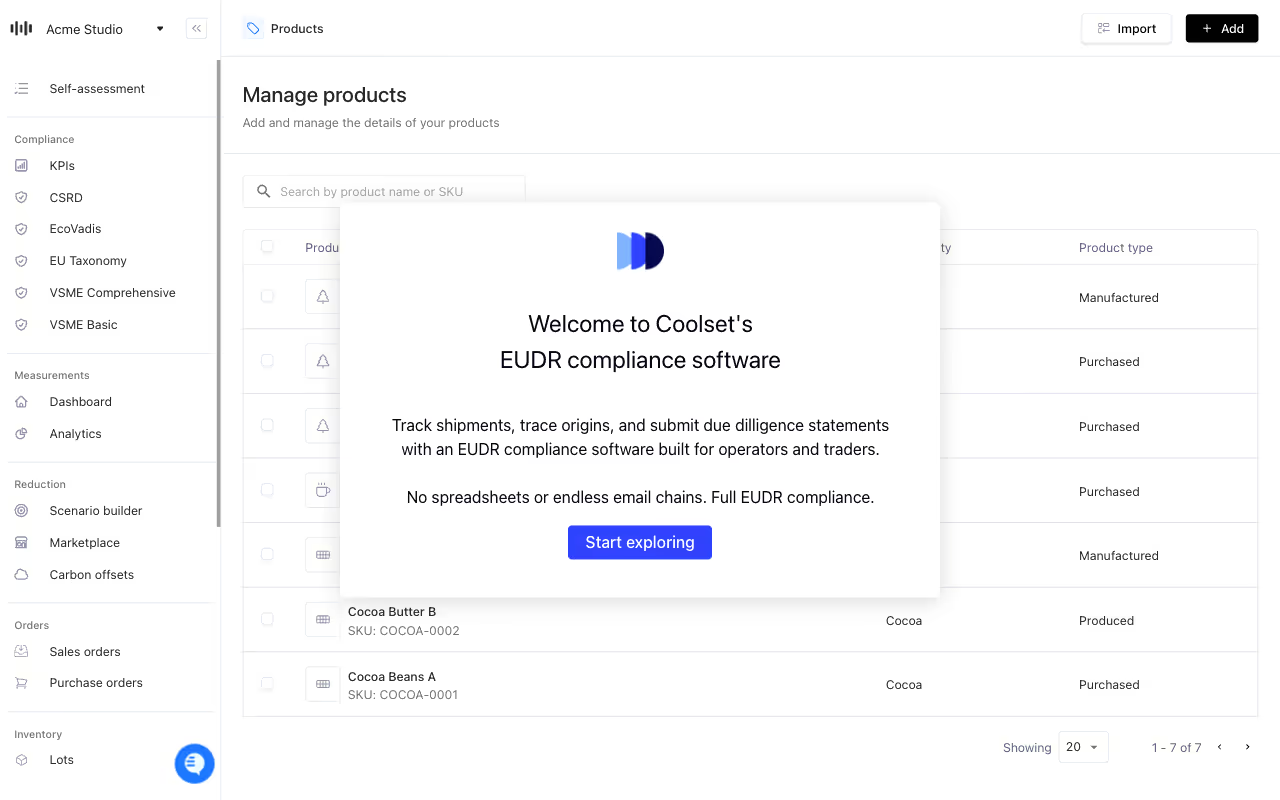
Coolset helps compliance teams map TARIC and CN codes to EUDR Annex I, collect plot-level geolocation and submit due diligence statements through TRACES before the 30 December 2026 application date.


on mobile screens
to experience this demo.



Join the EUDR Winter School before enforcement starts
Live sessions on geolocation, due diligence statements and audit readiness before the 30 December deadline.