EUDR meaning: What the EU Deforestation Regulation covers and who it affects


Disclaimer: New EUDR developments - December 2025
In November 2025, the European Parliament and Council backed key changes to the EU Deforestation Regulation (EUDR), including a 12‑month enforcement delay and simplified obligations based on company size and supply chain role.
Key changes proposed:
- New enforcement timeline: 30 December 2026 for large/medium operators, 30 June 2027 for small/micro operators
- Simplified DDS: One-time declarations for small and micro primary producers
- Narrowed scope: Most downstream actors and non‑SME traders would no longer need to submit DDSs
- New DDS requirement: Estimated annual quantity of regulated products must be included
These updates are not yet legally binding. A final text will be confirmed through trilogue negotiations and formal publication in the EU’s Official Journal. Until then, the current EUDR regulation and deadlines remain in force.
We continue to monitor developments and will update all guidance as the final law is adopted.
Key takeaways
- The EUDR bans placing cattle, cocoa, coffee, oil palm, rubber, soya and wood, plus Annex I derived products, on the EU market unless they are deforestation-free after 31 December 2020 and legal at origin.
- Main obligations apply from 30 December 2026 for large and medium operators, and from 30 June 2027 for most micro and small operators, after the December 2025 revision.
- Due diligence requires plot-level geolocation, risk assessment and a statement submitted through TRACES before the product reaches the EU market.
- Coolset helps compliance teams run EUDR due diligence end to end.
Regulation (EU) 2023/1115, from the EU Deforestation Regulation (EUDR) introduces new requirements for businesses placing certain commodities and products on the EU market or exporting them from the EU. Its objective is to reduce the EU's contribution to global deforestation and forest degradation by ensuring that products covered by the Regulation are both deforestation-free and legally produced.
The Regulation covers seven key commodities: cattle, cocoa, coffee, oil palm, rubber, soya and wood, as well as specific products derived from them. Businesses must be able to demonstrate that these products do not originate from land subject to deforestation after 31 December 2020 and, in the case of wood, that harvesting has not caused forest degradation after that date. Following the targeted revision agreed by the European Parliament and the Council in December 2025, the application dates and certain due diligence requirements have changed. Large and medium-sized operators and traders, together with micro and small enterprises already covered by the EU Timber Regulation (EUTR), must comply from 30 December 2026. Most other micro and small enterprises must comply from 30 June 2027.
Although the Regulation primarily places legal obligations on operators and traders involved in the EU market, its effects extend well beyond the EU's borders. Businesses importing relevant commodities will need information and supporting evidence from their suppliers, including producers, farmers and cooperatives in non-EU countries. Understanding the products covered, the responsibilities of different supply chain participants and the information required for compliance is therefore essential for businesses preparing for the EUDR.
What does the EUDR regulate?
The EUDR covers seven commodities associated with global deforestation and forest degradation:
- Cattle
- Cocoa
- Coffee
- Oil palm
- Rubber
- Soya
- Wood
In addition to these raw commodities, the Regulation covers specific products derived from them. These products are listed in Annex I and identified using Combined Nomenclature (CN) codes. Examples include chocolate, certain palm oil derivatives, animal feed, soy flour, furniture, wood products and selected rubber products. For any importer, the CN code is the practical entry point: if a product's CN classification appears in Annex I and the product description matches, the EUDR applies.
The Regulation applies to goods placed on the EU market, made available on it, or exported from it, no matter where production took place. Article 3(a) of the Regulation prohibits placing, making available or exporting relevant commodities and products unless they are deforestation-free, as explained in the Commission's guidance document. For example, an EU business importing cocoa beans from Côte d'Ivoire may be subject to the Regulation. However, a company purchasing cocoa products that have already undergone the required upstream due diligence has a different role and set of responsibilities. This distinction is important: the EUDR follows the product throughout the supply chain, but the obligations depend on the company's position and activities within that chain.
One of the central requirements of the EUDR is that relevant products must be deforestation-free. Under Article 2(13), a product is considered deforestation-free when the relevant commodity was produced on land that has not been subject to deforestation after 31 December 2020.
For wood products, an additional requirement applies: the wood must not have been harvested from land where forest degradation occurred after that date. The cut-off date is fixed and applies globally. It does not depend on the country of production or whether the conversion of forest land was permitted under national legislation. For example, if a cocoa plantation was established on land cleared of forest in January 2021, the resulting cocoa would not meet the EUDR's deforestation-free requirement, even if the land conversion was legal under local law. This means businesses must be able to trace relevant commodities back to their production areas and demonstrate that the land meets the Regulation's requirements.
Importantly, being deforestation-free is only one part of the compliance assessment. Products must also have been produced in accordance with the relevant legislation of the country of production. This includes applicable requirements relating to:
- Land-use rights.
- Environmental protection.
- Forest-related legislation.
- Third-party rights, including the rights of Indigenous Peoples.
- Labour and human rights.
- Tax, anti-corruption and trade and customs legislation.
These are two separate requirements. A product must be both deforestation-free and legally produced to meet the EUDR and before a due diligence statement can be submitted. More detail on how EU customs reads the Annex I codes is in Coolset's guide to EUDR and TARIC codes.
{{product-tour-injectable}}
Who is responsible for complying with EUDR?
Upstream operators
An operator is generally the business or individual that first places a relevant product on the EU market or exports it from the EU. This includes EU-based companies importing relevant commodities from non-EU countries, as well as businesses placing relevant products produced within the EU on the market for the first time. Upstream operators carry the primary responsibility for conducting due diligence. They must collect the necessary information, assess the risk of non-compliance and, where necessary, introduce measures to mitigate that risk.
Once the assessment demonstrates that the risk of non-compliance is no more than negligible, the operator must submit a due diligence statement through the EU Information System before placing the product on the market or exporting it.
Downstream operators and traders
Downstream operators and traders are businesses that sell, process or otherwise make available products that have already undergone the required upstream due diligence. For example, an EU chocolate manufacturer purchasing cocoa beans that have already been placed on the EU market following upstream due diligence is generally considered a downstream operator.
Following the December 2025 revision, downstream operators and traders no longer have to conduct their own full due diligence or submit separate due diligence statements for products already covered by upstream due diligence.
However, they still have certain responsibilities. All downstream operators and traders must keep information about their suppliers and buyers for at least five years and notify the relevant authorities and business partners if they become aware of potential non-compliance. Larger downstream businesses must also register in the EUDR Information System and verify upstream due diligence where they identify substantiated concerns about a product's compliance.
The first downstream operator or trader in the supply chain must additionally collect and retain the upstream due diligence statement reference number or simplified declaration identifier. This information does not generally need to be passed further down the supply chain.
What about non-EU suppliers?
Although the EUDR does not automatically impose obligations on every non-EU producer supplying goods to the European market, these suppliers play an important role in enabling their EU customers to comply.
EU importers need information about where commodities were produced, including plot-level geolocation data, production details and evidence of legal production. This information is often held by farmers, cooperatives, plantation owners, concessionaires and other businesses operating in the country of production. As a result, EU importers will need to work closely with their suppliers to obtain the necessary information. This is likely to influence purchasing agreements, supplier requirements and the way companies manage their international supply chains.
The Regulation can therefore have significant commercial consequences for businesses outside the EU, even where they are not directly responsible for submitting an EUDR due diligence statement.
How does EUDR due dilligence work?
Due diligence is a key requirement of the EUDR. Under Articles 8–11 of Regulation (EU) 2023/1115, operators must follow three steps before placing relevant products on the EU market or exporting them:
- Collect information
- Assess the risk
- Mitigate risks
These steps must be completed before the relevant products are placed on the EU market or exported.
Step 1: Collect information
Under Article 9, operators must collect information, documents and data demonstrating that their products comply with the Regulation.
This includes:
- A description of the relevant commodity or product.
- The quantity of the product.
- The country of production.
- Information about suppliers and business partners.
- The date or period of production.
- Geolocation coordinates of the plots of land where the commodity was produced.
- Evidence demonstrating that the product is deforestation-free and legally produced.
Geolocation is particularly important because it allows businesses and competent authorities to identify the precise areas where commodities originate. For agricultural commodities such as cocoa, coffee and soya, this means obtaining information at the level of the individual production plot rather than relying solely on general supplier or cooperative information. If the required information cannot be obtained, the operator cannot complete the necessary due diligence and must not place the product on the EU market or export it.
Step 2: Assess the risk
Once the necessary information has been collected, operators must assess whether there is a risk that the products do not comply with the EUDR.
Article 10 identifies several factors that must be considered, including:
- The risk classification of the country or region of production.
- The presence of forests and Indigenous Peoples in the production area.
- Consultation and cooperation with Indigenous Peoples.
- The prevalence of corruption.
- The complexity of the supply chain.
- The risk of mixing with products of unknown origin
- The reliability and completeness of the available information.
The assessment must consider the circumstances surrounding the actual production areas and supply chain, rather than relying exclusively on a country's general reputation or risk classification. The objective is to establish whether there is no more than a negligible risk of non-compliance.
Step 3: Mitigate identified risks
If the risk assessment identifies more than a negligible risk, the operator must take appropriate measures to reduce it. These measures may include requesting additional documentation, conducting independent surveys or audits, obtaining further information from suppliers or supporting suppliers in improving their data collection and traceability systems. The operator must ensure that any identified risk has been reduced to a negligible level before proceeding. The results of the due diligence process are recorded in a due diligence statement submitted through the EU Information System, which operates within the TRACES platform. The system generates a reference number that can be used to identify the relevant due diligence statement and support traceability within the supply chain.
Simplified due diligence for low-risk countries
The EUDR also introduces a simplified due diligence process for products originating from countries classified as low risk. Under Article 13, operators sourcing from low-risk countries still need to collect the required information. However, they are not required to complete the full risk assessment and risk mitigation stages unless relevant information or substantiated concerns indicate a potential risk of non-compliance. This distinction reduces the administrative burden for businesses sourcing from countries considered to present a lower risk of deforestation.
Country benchmarking and compliance checks
To support a risk-based approach, the European Commission has introduced a country benchmarking system. Countries are classified into three categories:
- Low risk: Countries considered to present a low risk of producing relevant commodities associated with deforestation.
- Standard risk: Countries that are not classified as either low or high risk.
- High risk: Countries considered to present a high risk of non-compliance with the deforestation-free requirements.
The classification influences the level of due diligence required and the frequency of checks carried out by national competent authorities. Commission Implementing Regulation (EU) 2025/1093, adopted on 22 May 2025, established the initial country benchmarking classifications. The system is intended to help authorities focus their enforcement activities on supply chains and production areas where the risk of non-compliance is considered higher. However, a low-risk classification does not mean that businesses are automatically exempt from the EUDR. The underlying requirements concerning deforestation-free production and legality continue to apply.
How does the EUDR affect different industries?
Although the Regulation applies to seven commodities, its practical impact varies considerably between industries. Each sector faces different challenges relating to sourcing, traceability, documentation and supplier engagement.
Cocoa and coffee supply chains are particularly affected because production often involves large numbers of smallholder farmers supplying cooperatives and intermediaries. Historically, businesses have frequently relied on cooperative-level documentation and supplier certifications to demonstrate the origin of their products. Under the EUDR, however, operators must obtain the required geolocation information for the plots where the commodities were produced. This creates additional challenges for businesses sourcing from regions where production data is incomplete or where supply chains involve several intermediaries.
The EUDR replaces the EU Timber Regulation (EUTR), introducing a broader approach to addressing deforestation and forest degradation. While the EUTR focused primarily on preventing illegally harvested timber from entering the EU market, the EUDR also requires businesses to demonstrate that relevant products are deforestation-free. Companies with existing timber due diligence systems may therefore be able to build on their current processes, but they will need to ensure that these systems meet the additional requirements of the EUDR. This includes appropriate geolocation information and evidence that harvesting has not caused forest degradation after 31 December 2020. Micro and small businesses already covered by the EUTR must also pay attention to the earlier application date of 30 December 2026.
Palm oil and soya are widely used in food production, animal feed, industrial processing and other manufacturing activities. Their supply chains can involve multiple producers, traders, crushers and refiners, making it challenging to maintain clear traceability from the finished product back to its original production areas. Businesses must identify which derived products fall within Annex I and ensure that the relevant information is available for the commodities used in their production. This is particularly important for companies operating in sectors where deforestation-related supply chain requirements have not traditionally been part of their compliance processes.
The cattle and rubber sectors also fall within the scope of the EUDR, although the precise products covered depend on Annex I. For cattle-related products, traceability must support the identification of the relevant production areas and demonstrate compliance with the deforestation-free and legality requirements. Rubber-related products can bring additional supply chain complexity, particularly where raw materials pass through several processing and manufacturing stages. However, businesses should not assume that every leather or rubber product is covered.
Each sector carries its own scope boundaries, which Coolset's note on EUDR exemptions sets out in detail.
What does EUDR compliance require in practice?
Preparing for the EUDR requires businesses to review their product classifications, supplier relationships, internal systems and due diligence procedures. Compliance involves more than collecting documentation; companies must be able to demonstrate how products are traced back to their production areas and how the information supporting their due diligence has been verified. There are several key areas businesses should address.
Conduct a product-by-product scope assessment
The first step is to identify which products fall within the scope of the EUDR by reviewing the CN codes listed in Annex I. Each stock-keeping unit (SKU) sold or exported should be matched against its relevant CN classification and checked against the corresponding product description. This is important because a single CN heading may cover products that are both inside and outside the scope of the Regulation. Businesses should therefore assess individual products rather than relying solely on broad product categories or commodity descriptions. They must also use the latest version of Annex I, taking into account the amendments introduced in 2026, as the list of covered products may differ from the original version adopted in 2023.
Review supplier contracts and requirements
Supplier agreements should be reviewed to ensure that upstream suppliers can provide the information required under the EUDR. This includes plot-level geolocation coordinates, production dates and evidence demonstrating that commodities are legally produced and deforestation-free. Contracts should clearly establish suppliers' responsibilities for providing accurate and verifiable information, as well as their obligation to cooperate with audits or verification activities where necessary. Traditional purchasing agreements often place limited emphasis on the precise origin of commodities. Under the EUDR, however, businesses need greater transparency and traceability throughout their supply chains.
Ensure internal systems support traceability
Businesses must be able to connect product information, purchase orders, shipment records and due diligence statement reference numbers. This allows them to demonstrate which due diligence statement covers a particular product or market entry and identify the production plots associated with it. Enterprise resource planning (ERP) systems and customs platforms should therefore be capable of recording and retrieving the relevant EUDR information. Without appropriate systems, businesses may have to reconstruct supply chain records manually when responding to requests from competent authorities, increasing the risk of errors and delays.
Establish clear responsibilities and documented procedures
Companies should establish clear internal responsibilities for managing EUDR compliance. Under Article 8, operators must establish and maintain a due diligence system, including procedures for collecting information, assessing risks and implementing mitigation measures. These procedures should be documented, regularly reviewed and updated at least annually, or whenever relevant changes occur. Businesses operating through multiple legal entities should also assess how their responsibilities are structured. In particular, groups should clarify which entity acts as the operator and is responsible for submitting due diligence statements. This decision can affect legal accountability, internal systems and the management of compliance across different business units.
Monitor regulatory developments
Finally, businesses should regularly monitor changes to the EUDR and the guidance published by the European Commission. This includes amendments to Annex I, updates to the EU Information System, country risk classifications and changes to implementation requirements. Keeping internal procedures and product assessments up to date is essential, as relying on outdated regulatory information or product classifications could result in incorrect compliance decisions.
{{custom-cta}}
Where should businesses start?
With the first application date approaching on 30 December 2026, businesses should prioritise understanding their exposure to the EUDR and identifying any gaps in their existing compliance processes.
A practical starting point is to conduct a product-by-product assessment against the latest Annex I list. This establishes which products are covered and helps identify where additional supplier information and documentation will be needed. Companies should then review their sourcing arrangements, assess supplier data availability and establish the internal processes required to manage traceability and compliance.
For businesses sourcing from outside the EU, early engagement with suppliers is particularly important. Obtaining reliable production and geolocation information may require cooperation across several levels of the supply chain. More detail on operator obligations is in Coolset's guide to the EU Deforestation Regulation.
Frequently asked questions
What does EUDR stand for in the context of the EU?
EUDR stands for the European Union Deforestation Regulation, formally Regulation (EU) 2023/1115 on deforestation-free products. It was adopted on 31 May 2023 and repeals the EU Timber Regulation, Regulation (EU) No 995/2010. Its stated aim is to reduce the EU's contribution to global deforestation and forest degradation linked to the production of specific commodities.
What are the EUDR commodities?
The Regulation covers seven commodities: cattle, cocoa, coffee, oil palm, rubber, soya and wood. It also covers specific products derived from these commodities, as listed in Annex I. Examples include chocolate, certain palm oil derivatives, animal feed, soy flour, furniture and selected wood and rubber products. Not every product containing one of these commodities is automatically covered. The relevant Annex I product classification must be checked.
What are the effects of deforestation that the EUDR addresses?
The Regulation addresses greenhouse gas emissions and biodiversity loss driven by agricultural expansion into forests and by forest degradation. The Commission estimates the EUDR will cut carbon emissions linked to EU consumption and production of the covered commodities by at least 32 million tonnes per year, as described in the DG Environment overview.
When does the EUDR apply?
The EUDR applies to large and medium operators and traders, and to micro and small operators already covered by the EU Timber Regulation, from 30 December 2026. Other micro and small operators must comply from 30 June 2027. These dates follow the targeted revision agreed by the Council and Parliament in December 2025.
Does the EUDR apply to non-EU producers?
The Regulation can apply to a non-EU business if it acts as an operator placing relevant products on the EU market or exporting them from the EU. However, non-EU farmers and producers who simply supply commodities to an EU-based importer are not automatically subject to the Regulation. In practice, they may still need to provide their EU customers with geolocation information, production details and supporting legality evidence to enable the importer to fulfil its obligations.
Does a low-risk country mean a business is exempt from the EUDR?
No. Products originating from low-risk countries are eligible for simplified due diligence. Operators must still collect the required information and ensure that the products are deforestation-free and legally produced. However, they generally do not need to complete the full risk assessment and mitigation stages under Article 13, unless relevant concerns arise.
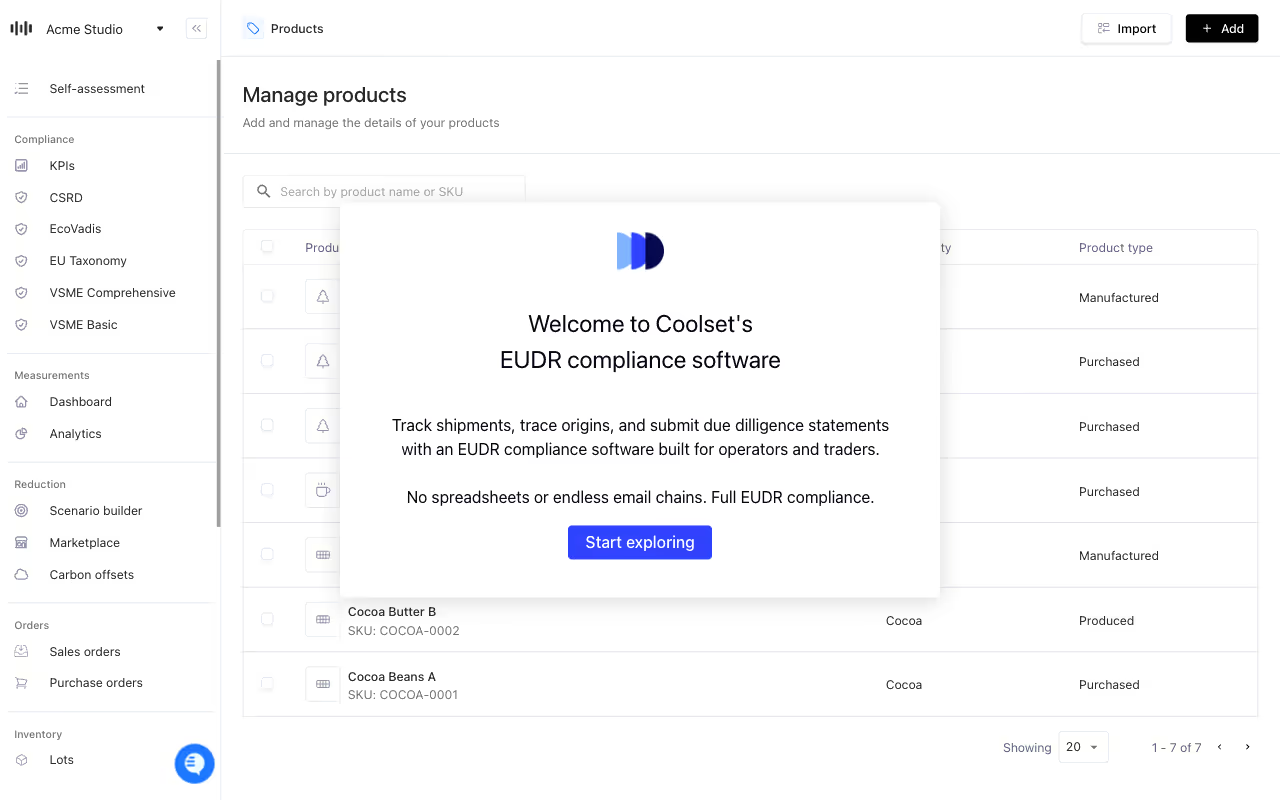
The EU Deforestation Regulation requires plot-level geolocation, risk assessment and TRACES submissions before 30 December 2026. Coolset gives compliance teams one workspace to collect supplier data, run Article 10 risk checks and file due diligence statements.


on mobile screens
to experience this demo.


Join the EUDR Winter School before enforcement starts
Live sessions on geolocation, due diligence statements and audit readiness before the 30 December deadline.