Disclaimer: New EUDR developments - December 2025
In November 2025, the European Parliament and Council backed key changes to the EU Deforestation Regulation (EUDR), including a 12‑month enforcement delay and simplified obligations based on company size and supply chain role.
Key changes proposed:
These updates are not yet legally binding. A final text will be confirmed through trilogue negotiations and formal publication in the EU’s Official Journal. Until then, the current EUDR regulation and deadlines remain in force.
We continue to monitor developments and will update all guidance as the final law is adopted.
August 12 2026 is circled on the calendar by compliance teams across Europe. From then onwards, the Packaging and Waste Regulation (PPWR), formally Regulation (EU) 2025/40, becomes enforceable. PPWR requires companies to have the right packaging documentation in place, meet design and material standards, register for extended producer responsibility (EPR) schemes and hold verified supplier declarations for every packaging type they put on or distribute in the EU market.
Managing that across dozens of packaging formats, hundreds of suppliers and multiple EU Member States pushes beyond the boundaries of what a spreadsheet can handle. A growing number of software vendors now offer PPWR compliance platforms. They vary significantly in scope, depth and maturity. Knowing which questions to ask before signing a contract can prevent a costly re-evaluation twelve months from now.
PPWR compliance requires companies to manage several interconnected obligations: maintaining technical documentation and Declarations of Conformity for each packaging unit, reporting packaging data for EPR schemes (covering composition, recyclability, and recycled content), and meeting the regulation's substance requirements. These will phase in on different timelines, with recyclability targets, minimum recycled content thresholds, and reuse obligations each entering into force at staggered dates between 2030 and 2040. Understanding which scopes of conformity apply and when is essential, because the compliance burden grows significantly with each new deadline.
Before evaluating vendors, it helps to understand the full scope of PPWR obligations. The regulation is not a single requirement, it is a layered framework with staggered timelines. Most of the core obligations apply from August 12, 2026, with additional requirements for digital labeling, reuse targets and recycled content kicking in through 2027-2040. See the full PPWR compliance deadline overview for a breakdown by date.
Any platform you evaluate should be mapped against this timeline and not just consider the 2026 requirements.

Many vendors enter the PPWR software space with a specific capability: recyclability assessment, EPR reporting, or supplier document management. Few offer end-to-end coverage from day one. Ask vendors to map their current product capabilities against each PPWR article, and be explicit about which areas are live, which are in development and which are not on the roadmap.
A platform that handles your Declaration of Conformity workflow but cannot manage EPR reporting means you will need a second tool, doubling the data management overhead. Understanding your own compliance footprint first makes this conversation more productive. The PPWR compliance guide for importers and distributors is a useful starting point.
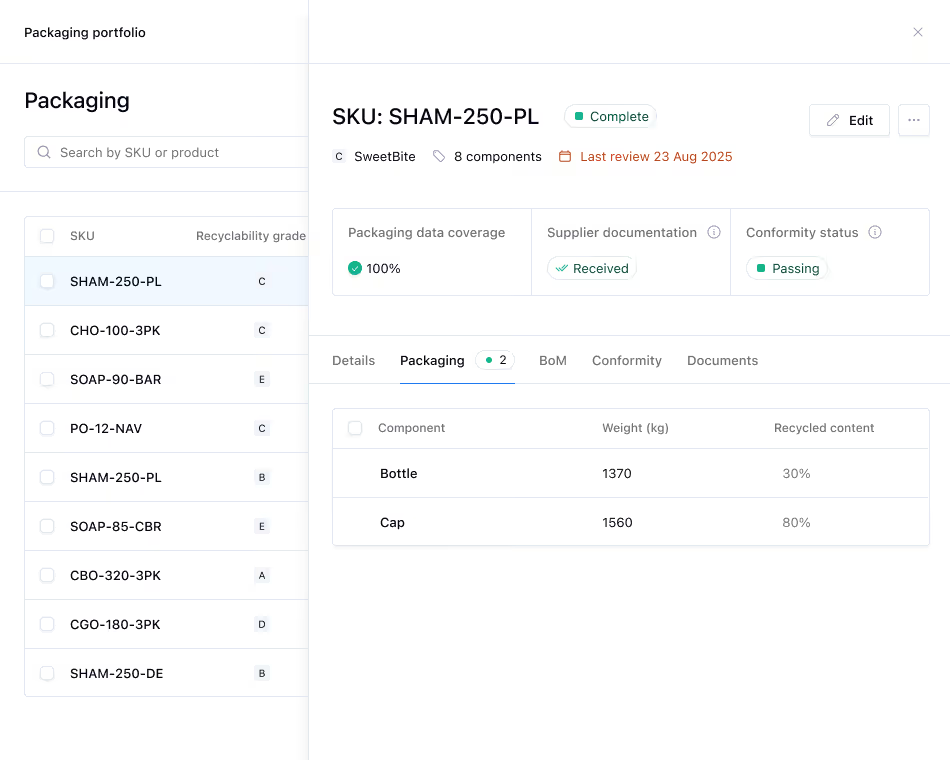
From August 12, 2026, every packaging type placed on the EU market must be backed by a manufacturer-issued Declaration of Conformity (DoC). Importers are required to collect these documents, hold them for five to ten years (depending on product type) and make them available to authorities on request. For companies managing hundreds of products and dozens of suppliers, this quickly becomes a significant operational challenge.
Ask vendors how their platform handles this process: does it offer a supplier portal where manufacturers can upload DoCs directly? Can it track which packaging types have valid, current declarations and flag gaps? Does it support version control and full audit trails?
EPR obligations under PPWR require companies to register with producer responsibility organizations and report packaging volumes placed on the market in each EU Member State where they operate. The formats, thresholds, reporting frequencies and fee structures differ significantly between countries.
Ask how many EU Member States the platform supports for EPR reporting, whether it integrates directly with national EPR registries or exports data for manual submission, and whether it can track multiple entity registrations from a single dashboard. This is one of the most operationally demanding parts of PPWR for companies with broad EU distribution and one of the highest-value capabilities a platform can deliver.
PPWR is a framework regulation. Several implementing and delegated acts are still not finalized. Recyclability assessment criteria, recycled content calculation methods and the technical specifications for digital labeling are still in development. Some of these are expected before the end of 2026, and the regulation's requirements will continue to tighten through 2040.
Ask vendors how their regulatory monitoring process works. Is there a dedicated team tracking EU delegated acts and technical committee outputs? How quickly are platform updates released after new requirements are published? Will you be automatically notified when a change affects your product categories? A platform that was accurate at purchase can fall behind quickly without a rigorous regulatory update process.
August 2026 is the start of compliance, not the end of it. From 2027, packaging must carry digital identifiers (QR codes or similar) linking to structured material and recyclability data. Reuse targets for industrial and commercial packaging escalate toward 2030. The regulation sets progressive packaging waste reduction targets of 5% by 2030, 10% by 2035 and 15% by 2040 compared to 2018 levels, per Regulation (EU) 2025/40.
Ask vendors for a product roadmap tied to the PPWR timeline. Are future requirements already in development? Are they included in the base product price or available as paid add-ons? A platform built only for 2026 requirements will require re-evaluation or significant upgrades within the next year.
{{ppwr-document-checker}}
Packaging data does not live in isolation. Material specifications come from product design systems. Supplier relationships are managed in procurement platforms. Emissions data flows into ESG reporting tools. A PPWR platform that requires manual re-entry of data from multiple internal systems creates overhead and introduces error risk.
Ask which ERP systems the platform integrates with natively and what the setup complexity looks like. If your organization already uses a sustainability or ESG reporting platform, ask whether the two systems can exchange data. Under the Corporate Sustainability Reporting Directive (CSRD), packaging-related Scope 3 emissions are increasingly part of sustainability disclosures, connected data architecture reduces duplication across both compliance areas.
With less than six months until the general application date, implementation timelines are no longer theoretical. A platform requiring significant data migration, system integration or supplier onboarding could leave you with insufficient time to achieve full compliance before the deadline.
Ask vendors for a realistic onboarding timeline given your packaging portfolio size and supplier base. Request references from companies of comparable complexity. Ask what internal pre-work is required from your team because data quality issues on your side will extend implementation regardless of the platform's capabilities. Understanding your role as a manufacturer, importer or distributor under PPWR also affects what needs to be in place and by when.
From 2027, PPWR requires packaging to carry digital identifiers linking to information about material composition, recyclability and reuse instructions. The exact technical specifications are still being finalized by the European Commission. Separately, the Ecodesign for Sustainable Products Regulation (ESPR) is building a Digital Product Passport (DPP) framework that will apply to a wide range of product categories.
Ask vendors whether digital labeling is on their roadmap, what level of technical detail they are aiming for. Whether their data model is being built to align with emerging DPP standards is a useful proxy for how seriously the vendor is investing in long-term regulatory alignment. A platform designed only for narrow PPWR labeling requirements will not provide the same long-term value as one built toward interoperable product data infrastructure.
PPWR compliance does not sit in isolation. Companies managing packaging compliance may simultaneously need to handle chemical restrictions under REACH, supply chain due diligence for wood and paper-derived materials under the EU Deforestation Regulation (EUDR), and sustainability disclosures under CSRD. Managing separate tools for each regulation multiplies overhead and creates fragmented data.
Ask whether the vendor is building toward a broader product compliance hub, covering substance restrictions, material declarations and supply chain traceability across multiple regulations. For companies with complex supplier networks and multi-regulation obligations, a unified platform reduces reporting effort and simplifies internal governance over time.
Regulatory coverage → Which PPWR articles does the platform address today? What is on the roadmap?
Supplier workflows → Is there a portal for suppliers to upload required documentation? How is version control managed?
EPR reporting → How many EU Member States are supported? What is the submission process?
Integration → Which ERP systems does it connect with natively? Does it share data with ESG platforms?
Implementation → What is the realistic onboarding timeline for a company of our size?
Future-proofing → What does the product roadmap look like for 2027-2030 requirements?

Choosing the right PPWR compliance platform starts with understanding your own obligations clearly. How many packaging types do you manage? In which EU Member States do you place packaging on the market? What is your role: manufacturer, importer or distributor under PPWR? Are you considered a producer in the member states where you operate? Those answers define which software capabilities matter most for your situation.
The August 2026 deadline is close. Starting the vendor evaluation process now and asking the right questions will give you time to make a considered decision rather than a reactive one.
At Coolset, we help companies understand PPWR requirements and build practical compliance processes. If you're working through your options, speak to our team to see how we approach packaging compliance.
What is the PPWR and when does it apply? The Packaging and Packaging Waste Regulation (PPWR) – Regulation (EU) 2025/40 is a directly applicable EU regulation governing all packaging placed on the EU market. It entered into force on February 11, 2025, and its core requirements become mandatory from August 12, 2026, with additional obligations phasing in through 2040.
Who needs to comply with PPWR? All companies placing packaging on the EU market must comply, regardless of size or sector. This includes manufacturers, importers and distributors. Companies placing packaging under their own name or brand take on manufacturer-level obligations, including the requirement to issue a Declaration of Conformity.
What is a Declaration of Conformity under PPWR? A Declaration of Conformity confirms that a packaging type meets PPWR's essential requirements for design, materials and recyclability. From August 12, 2026, every packaging type needs one. Importers must collect and retain these documents from suppliers for five to ten years and make them available to authorities on request.
What does PPWR compliance software do? PPWR compliance software typically helps companies collect and manage supplier declarations, track recycled content and recyclability status, handle EPR registration and reporting across EU Member States, and monitor regulatory changes as the regulation's implementing acts are finalized. Scope and capability vary significantly between vendors.
How does PPWR compliance relate to CSRD reporting? CSRD requires companies to disclose their environmental impacts, including packaging-related emissions and waste data across their value chain. PPWR focuses on packaging design and market access requirements. The two overlap in practice, as packaging material data and EPR reporting feed into Scope 3 emissions calculations and supply chain disclosures required under CSRD.
This free compliance checker scans your packaging documentation and maps it against mandatory PPWR data requirements, giving you a clear view of your compliance status. Get actionable insights on documentation gaps before they become compliance issues.
Collect supplier documentation, track conformity and stay audit-proof.

Based on customer case studies our team has developed a realistic timeline and planning for EUDR compliance. Access it here.