The GHG protocol explained: A complete guide to corporate emissions reporting



Disclaimer: New EUDR developments - December 2025
In November 2025, the European Parliament and Council backed key changes to the EU Deforestation Regulation (EUDR), including a 12‑month enforcement delay and simplified obligations based on company size and supply chain role.
Key changes proposed:
- New enforcement timeline: 30 December 2026 for large/medium operators, 30 June 2027 for small/micro operators
- Simplified DDS: One-time declarations for small and micro primary producers
- Narrowed scope: Most downstream actors and non‑SME traders would no longer need to submit DDSs
- New DDS requirement: Estimated annual quantity of regulated products must be included
These updates are not yet legally binding. A final text will be confirmed through trilogue negotiations and formal publication in the EU’s Official Journal. Until then, the current EUDR regulation and deadlines remain in force.
We continue to monitor developments and will update all guidance as the final law is adopted.
Key takeaways
- The GHG Protocol is the most widely used framework for measuring corporate emissions across Scope 1 (direct), Scope 2 (energy), and Scope 3 (value chain) categories.
- Under the CSRD, companies reporting under ESRS E1 must disclose emissions following GHG Protocol methodology - making it a regulatory requirement.
- Coolset's carbon management platform measures Scope 1-3 emissions using TUV-certified GHG Protocol methodology and generates CSRD-compliant reports.
The GHG Protocol is the most widely used international standard for measuring corporate greenhouse gas emissions. Developed by the World Resources Institute (WRI) and the World Business Council for Sustainable Development (WBCSD), it provides the methodology that thousands of companies use to calculate their carbon footprint across Scope 1, 2, and 3 emissions.
Under the CSRD, companies reporting under ESRS E1 (Climate Change) are required to disclose emissions following GHG Protocol methodology. This makes it not just a voluntary framework but a regulatory foundation for corporate climate reporting in the EU.
This guide explains what the GHG Protocol is, how its three scopes of emissions work, and how to use it as the basis for CSRD-compliant reporting.
{{custom-cta}}
What is the GHG Protocol?
The Greenhouse Gas Protocol is a comprehensive framework for measuring, managing, and reporting corporate greenhouse gas emissions. It was first published in 2001 by the World Resources Institute (WRI) and the World Business Council for Sustainable Development (WBCSD), and has since become the global standard for carbon accounting.
As of 2016, 92% of Fortune 500 companies responding to CDP used the GHG Protocol directly or indirectly. The framework covers seven greenhouse gases: carbon dioxide (CO2), methane (CH4), nitrous oxide (N2O), hydrofluorocarbons (HFCs), perfluorocarbons (PFCs), sulphur hexafluoride (SF6), and nitrogen trifluoride (NF3).
The GHG Protocol is not a single document but a suite of interconnected standards:
- Corporate Standard - the core standard for preparing a corporate-level GHG emissions inventory. It defines how to set organizational and operational boundaries, categorize emissions into scopes, and report results.
- Corporate Value Chain (Scope 3) Standard - provides requirements and guidance for companies to measure and report emissions across their full value chain, organized into 15 categories.
- Product Standard - enables companies to understand the full lifecycle emissions of individual products and identify reduction opportunities.
- Scope 2 Guidance - standardizes how companies measure emissions from purchased electricity, steam, heat, and cooling, including both market-based and location-based accounting methods.
Together, these standards provide a complete system for corporate emissions measurement - from direct operations to the full value chain.
The five principles of GHG Protocol reporting
The GHG Protocol is built on five accounting and reporting principles that guide how companies should prepare their emissions inventory:
- Relevance - ensure the GHG inventory reflects the actual emissions of the company and serves the decision-making needs of both internal and external users.
- Completeness - account for all emission sources and activities within the chosen inventory boundary. Any exclusions must be disclosed and justified.
- Consistency - use consistent methodologies over time so that emissions data can be meaningfully compared across reporting periods.
- Transparency - disclose sufficient information about assumptions, methodologies, and data sources so that third parties can assess the credibility of the reported figures.
- Accuracy - reduce uncertainties as far as practical and ensure reported emissions are neither systematically overstated nor understated.
These principles align directly with the qualitative characteristics required under CSRD reporting, making GHG Protocol a natural fit for companies preparing their sustainability statements.
The three scopes of emissions explained
The GHG Protocol categorizes emissions into three scopes to distinguish between direct and indirect sources. This classification helps companies structure their inventory and ensures that emissions are not double-counted between organizations.
Scope 1 - direct emissions
Scope 1 covers all direct greenhouse gas emissions from sources that a company owns or controls. These are the emissions your organization produces on-site or through assets you operate directly.
Common examples include:
- On-site combustion of natural gas for heating or manufacturing
- Fuel burned in company-owned vehicles and fleet
- Emissions from industrial processes (e.g. cement or chemical production)
- Fugitive emissions from refrigerants and air conditioning systems
Scope 1 emissions are measured using activity data (e.g. litres of fuel, cubic meters of gas) multiplied by source-specific emission factors. For most service-sector companies, Scope 1 represents a relatively small share of total emissions - but for manufacturing or logistics, it can be substantial.
Scope 2 - indirect energy emissions
Scope 2 covers indirect emissions from the generation of purchased or acquired electricity, steam, heating, and cooling. These emissions physically occur at the facility where the energy is generated, but are attributed to the company that purchases and consumes it.
The GHG Protocol's Scope 2 Guidance (updated in 2015) requires companies to report Scope 2 emissions using two methods:
- Location-based method - uses average grid emission factors for the region where energy is consumed. This reflects the actual physical emissions of the local electricity grid.
- Market-based method - uses emission factors specific to the energy a company has contractually purchased, such as renewable energy certificates (RECs) or green electricity contracts.
Reporting both methods gives stakeholders a complete picture: the location-based figure shows actual grid impact, while the market-based figure reflects procurement decisions.
Scope 3 - value chain emissions
Scope 3 covers all other indirect emissions that occur across a company's value chain - both upstream (suppliers, purchased goods, business travel) and downstream (use of sold products, end-of-life treatment). These are emissions your company influences but does not directly control.
Scope 3 is by far the largest category for most companies. Research consistently shows that value chain emissions represent 70-90% of a company's total carbon footprint. This makes Scope 3 measurement essential for any credible decarbonization strategy - and increasingly, a regulatory requirement under CSRD.
Measuring Scope 3 is also the most complex part of GHG accounting, which is why the challenges of Scope 3 measurement often drive companies to invest in dedicated carbon management tools.
The 15 categories of Scope 3 emissions
The GHG Protocol organizes Scope 3 emissions into 15 categories, split between upstream and downstream activities. Understanding which categories are relevant to your company is the first step toward a complete value chain inventory.
Upstream categories (1-8)
- Category 1: Purchased goods and services - emissions from the production of all goods and services your company buys. For most companies, this is the largest Scope 3 category.
- Category 2: Capital goods - emissions from the production of long-lived assets like machinery, buildings, and IT equipment.
- Category 3: Fuel- and energy-related activities - emissions from the extraction, production, and transport of fuels and energy purchased by your company (not already covered in Scope 1 or 2).
- Category 4: Upstream transportation and distribution - emissions from transporting purchased goods from suppliers to your facilities, paid for by your company.
- Category 5: Waste generated in operations - emissions from the treatment and disposal of waste produced at your facilities.
- Category 6: Business travel - emissions from employee travel for business purposes in vehicles not owned by the company (flights, trains, rental cars, hotels).
- Category 7: Employee commuting - emissions from employees traveling between their homes and workplaces.
- Category 8: Upstream leased assets - emissions from the operation of assets leased by your company that are not already included in Scope 1 or 2.
Downstream categories (9-15)
- Category 9: Downstream transportation and distribution - emissions from transporting and distributing sold products to customers (not paid for by your company).
- Category 10: Processing of sold products - emissions from further processing of intermediate products sold by your company.
- Category 11: Use of sold products - emissions from end-users using the products your company sells. For energy-consuming products, this can be a major category.
- Category 12: End-of-life treatment of sold products - emissions from the disposal or recycling of products your company has sold.
- Category 13: Downstream leased assets - emissions from the operation of assets owned by your company but leased to others.
- Category 14: Franchises - emissions from the operation of franchises not included in Scope 1 or 2.
- Category 15: Investments - emissions associated with your company's investments, including equity investments and project finance.
Not every category is relevant to every company. The GHG Protocol recommends screening all 15 categories to identify which are material, then prioritizing data collection and calculation for the most significant ones.
GHG Protocol calculation methods
The GHG Protocol offers multiple approaches to calculating emissions. The right method depends on your data availability, the emission source, and the level of accuracy you need.
Activity-based method
Activity-based calculation uses actual physical data - such as kilowatt-hours of electricity consumed, litres of fuel burned, or kilometres traveled - multiplied by emission factors specific to each activity. This method delivers the highest accuracy and is the preferred approach whenever reliable data is available.
For Scope 1 and 2 emissions, activity-based calculation is standard practice. For Scope 3, it requires collecting specific data from suppliers and partners, which can be more resource-intensive but produces far more reliable results.
Spend-based method
Spend-based calculation estimates emissions based on financial expenditure. It applies average emission factors (typically expressed as kg CO2e per euro spent) to procurement categories. This method requires less detailed data and can be used as a starting point when activity data is not yet available.
The trade-off is accuracy: spend-based estimates rely on industry averages rather than actual measurements, so they are less precise. However, they provide a useful baseline and help identify which categories deserve deeper analysis.
Hybrid approaches
For most mid-market companies, a hybrid approach works best. This means using activity-based calculation for the most material emission sources (where you have good data and the impact is significant) and spend-based estimates for categories where detailed data is harder to obtain.
As your carbon management matures, you can progressively shift from spend-based to activity-based methods across more categories - improving accuracy over time without delaying your first measurement. A well-prepared financial data set can accelerate this transition significantly.
How the GHG Protocol connects to CSRD reporting
The GHG Protocol is not just a voluntary framework - it is now embedded in European regulatory requirements. Under the CSRD, companies reporting under ESRS E1 (Climate Change) must disclose their Scope 1, 2, and 3 greenhouse gas emissions. The ESRS explicitly references the GHG Protocol as the methodology standard for this disclosure.
Specifically, ESRS E1 requires companies to:
- Report Scope 1 and Scope 2 emissions separately, with Scope 2 disclosed using both location-based and market-based methods
- Report material Scope 3 emissions broken down by category
- Disclose the methodologies, emission factors, and data sources used
- Present a transition plan with reduction targets, ideally aligned with science-based targets (SBTi)
This means that companies preparing for CSRD compliance need a GHG Protocol-aligned emissions inventory as a foundation. The GHG Protocol provides the measurement standard, ESRS E1 defines the disclosure requirements, and frameworks like SBTi guide target-setting.
Companies that already measure their emissions using GHG Protocol methodology have a significant advantage: their data is already structured in the format that CSRD reporting requires.
How to start measuring emissions with the GHG Protocol
Getting started with GHG Protocol measurement follows a structured process. Here is a practical overview of the five key steps. For a detailed walkthrough, see our step-by-step guide to measuring your company's carbon footprint.
Step 1: Define organizational boundaries
Decide which entities, subsidiaries, and operations to include in your inventory. The GHG Protocol offers two approaches: the equity share approach (accounting for emissions proportional to ownership) and the operational control approach (accounting for 100% of emissions from operations you control). For most mid-market companies, operational control is the more practical choice - it aligns with CSRD requirements and gives you direct leverage over reduction actions.
Step 2: Identify emission sources by scope
Map all potential emission sources across Scope 1, 2, and 3. Start by identifying your direct operations (Scope 1), energy purchases (Scope 2), and then screen the 15 Scope 3 categories to determine which are relevant and material for your business.
Step 3: Collect activity data
Gather the underlying data needed for calculations - energy bills, fuel purchase records, travel bookings, supplier invoices, waste disposal records. The quality of your emissions inventory depends directly on the quality of your input data.
Step 4: Apply emission factors
Convert activity data into CO2-equivalent emissions using recognized emission factor databases. Common sources include DEFRA (UK), EPA (US), ecoinvent, and ADEME (France). The choice of emission factors should be documented for transparency and audit readiness.
Step 5: Calculate, verify, and report
Aggregate your calculations into a structured GHG inventory. For companies preparing for CSRD, this inventory forms the basis of your ESRS E1 disclosure. An audit-proof GHG assessment requires clear documentation of boundaries, methods, data sources, and any exclusions or estimates.
Frequently asked questions
What is the GHG Protocol and who created it?
The GHG Protocol is the most widely used international standard for corporate greenhouse gas accounting. It was developed jointly by the World Resources Institute (WRI) and the World Business Council for Sustainable Development (WBCSD), with the first edition of the Corporate Standard published in 2001. The framework has since expanded to include standards for Scope 3 emissions, product-level accounting, and city-level reporting.
Is GHG Protocol reporting mandatory under CSRD?
Yes. Under ESRS E1 (Climate Change), companies in scope of the CSRD must disclose Scope 1, 2, and 3 emissions following GHG Protocol methodology or an equivalent standard. The European Financial Reporting Advisory Group (EFRAG) explicitly references the GHG Protocol in the ESRS technical guidance.
What is the difference between GHG Protocol and SBTi?
The GHG Protocol provides the measurement methodology for calculating emissions - it tells you how to measure your carbon footprint. The Science Based Targets initiative (SBTi) uses GHG Protocol data to set reduction targets aligned with climate science. They are complementary: you measure with the GHG Protocol, then set reduction targets with SBTi. Learn more in our guide on how to set science-based targets.
What are the 15 categories of Scope 3 emissions?
The GHG Protocol defines 15 Scope 3 categories split between upstream (categories 1-8) and downstream (categories 9-15). Upstream categories include purchased goods and services, capital goods, fuel- and energy-related activities, transportation, waste, business travel, employee commuting, and leased assets. Downstream categories include transportation and distribution, processing of sold products, use of sold products, end-of-life treatment, leased assets, franchises, and investments.
What is the difference between activity-based and spend-based calculation?
Activity-based calculation uses physical data (kWh, litres, km) multiplied by specific emission factors - it delivers higher accuracy. Spend-based calculation uses financial data (euros spent) multiplied by average emission factors per economic sector - it is faster to implement but less precise. Most companies use a hybrid approach, starting with spend-based estimates and progressively shifting to activity-based methods for their most material categories.
Getting started with Coolset
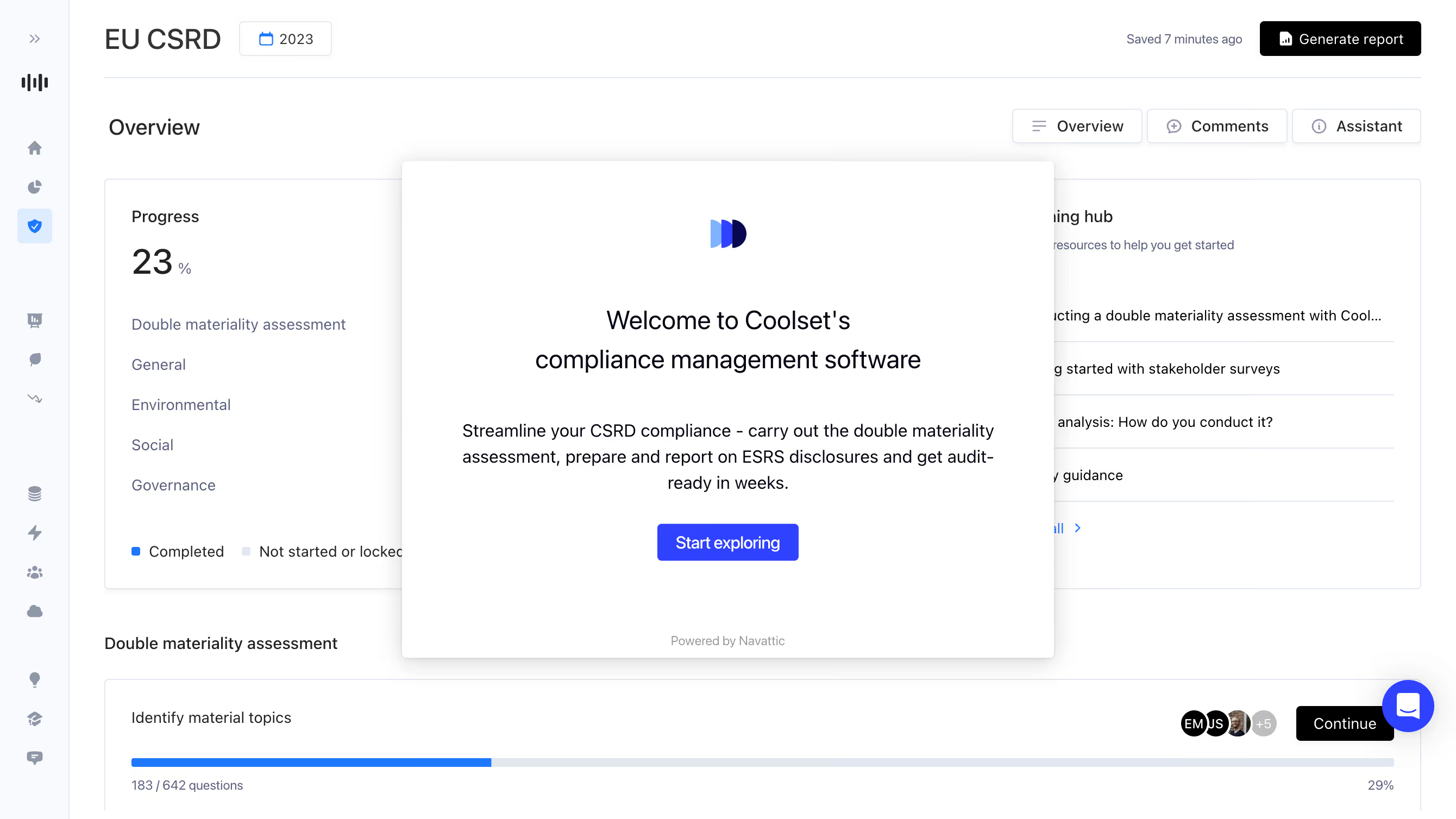
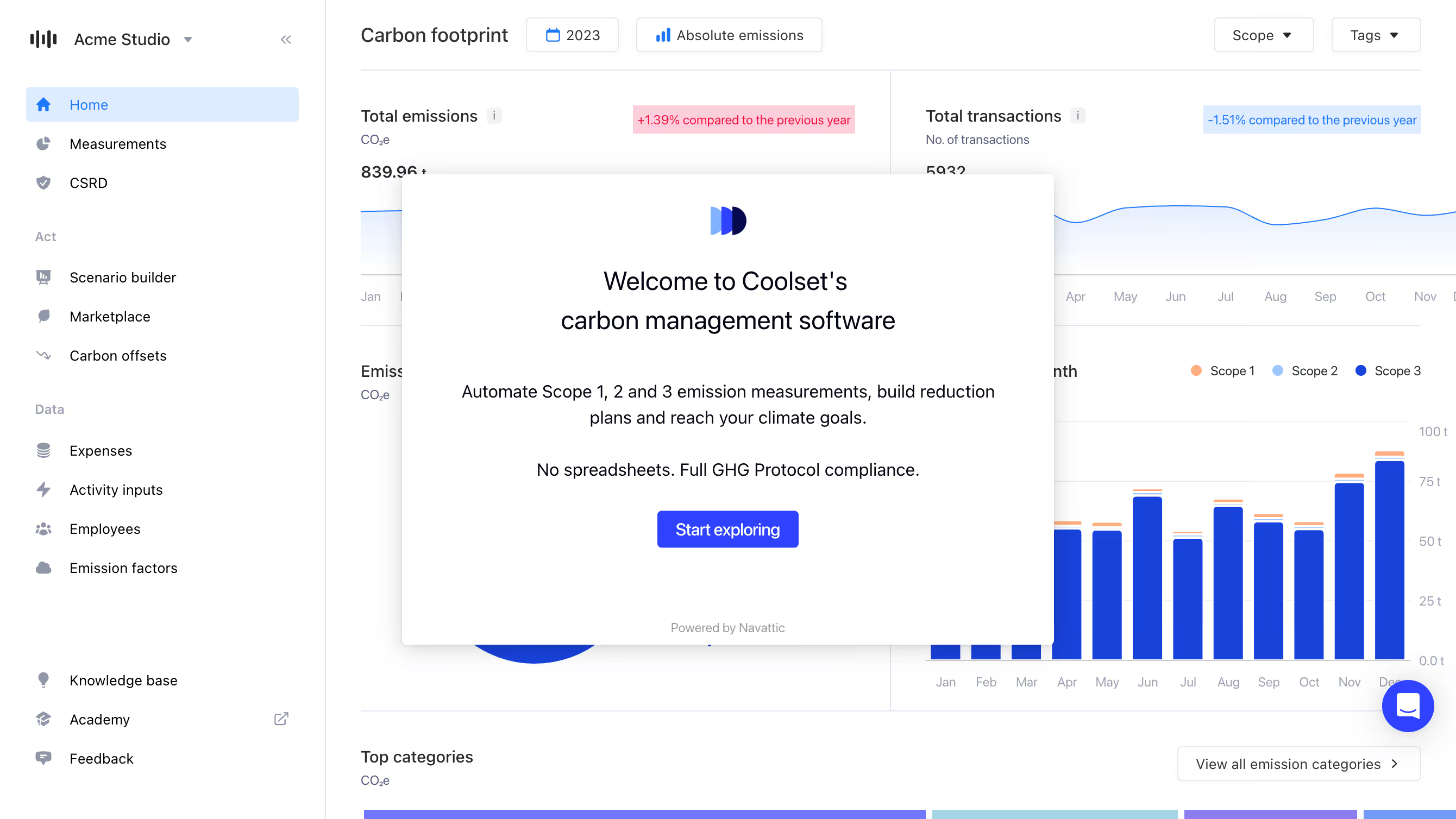
Coolset's carbon management platform measures Scope 1, 2, and 3 emissions using TUV-certified GHG Protocol methodology. The platform automates data collection, applies verified emission factors, and generates reports that align with ESRS E1 requirements - so your team can focus on reducing emissions instead of calculating them.
Whether you are starting your first carbon footprint measurement or preparing for CSRD reporting, Coolset helps you build a GHG Protocol-compliant inventory and translate it into actionable reduction plans.
Get practical, usable methods you can apply right away


on mobile screens
to experience this demo.


↘ Check if your documentation meets PPWR requirements
This free compliance checker scans your packaging documentation and maps it against mandatory PPWR data requirements, giving you a clear view of your compliance status. Get actionable insights on documentation gaps before they become compliance issues.
Explore how Coolset can measure your GHG emissions
Automate your scope 1-3 emission calculations, set targets and plan reductions


.webp)