Hoe je PPWR compliance software evalueert: 9 vragen voor je koopt


Disclaimer: New EUDR developments - December 2025
In November 2025, the European Parliament and Council backed key changes to the EU Deforestation Regulation (EUDR), including a 12‑month enforcement delay and simplified obligations based on company size and supply chain role.
Key changes proposed:
- New enforcement timeline: 30 December 2026 for large/medium operators, 30 June 2027 for small/micro operators
- Simplified DDS: One-time declarations for small and micro primary producers
- Narrowed scope: Most downstream actors and non‑SME traders would no longer need to submit DDSs
- New DDS requirement: Estimated annual quantity of regulated products must be included
These updates are not yet legally binding. A final text will be confirmed through trilogue negotiations and formal publication in the EU’s Official Journal. Until then, the current EUDR regulation and deadlines remain in force.
We continue to monitor developments and will update all guidance as the final law is adopted.
12 augustus 2026 staat rood omcirkeld in de agenda van compliance teams door heel Europa. Vanaf die datum wordt de Packaging and Packaging Waste Regulation (PPWR), formeel Verordening (EU) 2025/40, afdwingbaar. De PPWR verplicht bedrijven om de juiste verpakkingsdocumentatie op orde te hebben, te voldoen aan ontwerp- en materiaalnormen, zich te registreren voor extended producer responsibility (EPR)-regelingen en geverifieerde leveranciersverklaringen te bezitten voor elk verpakkingstype dat zij op de EU-markt brengen of distribueren.
Dat beheren over tientallen verpakkingsformaten, honderden leveranciers en meerdere EU-lidstaten gaat verder dan wat een spreadsheet aankan. Een groeiend aantal softwareleveranciers biedt inmiddels PPWR compliance platforms aan. Ze verschillen aanzienlijk in reikwijdte, diepgang en volwassenheid. Weten welke vragen je moet stellen voordat je een contract tekent, voorkomt een kostbare herevaluatie over twaalf maanden.
Wat PPWR compliance software daadwerkelijk moet dekken
PPWR compliance vereist dat bedrijven meerdere onderling verbonden verplichtingen beheren: het bijhouden van technische documentatie en Conformiteitsverklaringen voor elke verpakkingseenheid, het rapporteren van verpakkingsgegevens voor EPR-regelingen (inclusief samenstelling, recyclebaarheid en gerecycled materiaal) en het voldoen aan de materiaalvereisten van de verordening. Deze worden gefaseerd ingevoerd op verschillende tijdlijnen, waarbij recycleerbaarheidsdoelen, minimumdrempels voor gerecycled materiaal en hergebruiksverplichtingen elk op gespreide data in werking treden tussen 2030 en 2040. Begrijpen welke conformiteitsvereisten van toepassing zijn en wanneer is essentieel, omdat de compliance-last met elke nieuwe deadline aanzienlijk toeneemt.
Voordat je leveranciers evalueert, is het nuttig om de volledige reikwijdte van de PPWR-verplichtingen te begrijpen. De verordening is geen enkelvoudige vereiste, maar een gelaagd kader met gespreide tijdlijnen. De meeste kernverplichtingen gelden vanaf 12 augustus 2026, met aanvullende eisen voor digitale etikettering, hergebruiksdoelen en gerecycled materiaal die doorlopen tot 2027-2040. Bekijk het volledige overzicht van PPWR compliance-deadlines voor een uitsplitsing per datum.
- Vanaf 12 augustus 2026
- Minimalisering van verpakkingsontwerp (max. 40% lege ruimte)
- PFAS-verbod in verpakkingen voor voedselcontact
- Conformiteitsverklaring per verpakkingstype
- EPR-registratie en -rapportage in alle EU-lidstaten
- Vanaf 2027
- Digitale etikettering (QR-codes met materiaalgegevens)
- Vanaf 2030
- Recycleerbaarheidsvereisten (alle verpakkingen)
- Hergebruiks- en navuldoelen (B2B afhaalverpakkingen)
- 2030-2040
- Doelen voor gerecycled materiaal in kunststofverpakkingen
Elk platform dat je evalueert moet worden afgezet tegen deze tijdlijn en niet alleen de vereisten voor 2026 in beschouwing nemen.

9 vragen voor elke PPWR compliance softwareleverancier
1. Dekt het platform alle PPWR compliance-pijlers, niet slechts één of twee?
Veel leveranciers betreden de PPWR-softwaremarkt met een specifieke functionaliteit: recycleerbaarheidsbeoordeling, EPR-rapportage of beheer van leveranciersdocumenten. Weinigen bieden vanaf dag één end-to-end dekking. Vraag leveranciers om hun huidige productmogelijkheden te koppelen aan elk PPWR-artikel, en wees expliciet over welke onderdelen live zijn, welke in ontwikkeling zijn en welke niet op de roadmap staan.
Een platform dat je Conformiteitsverklaring-workflow beheert maar geen EPR-rapportage aankan, betekent dat je een tweede tool nodig hebt, waardoor de overhead voor gegevensbeheer verdubbelt. Je eigen compliance-voetafdruk eerst begrijpen maakt dit gesprek productiever. De PPWR compliance-gids voor importeurs en distributeurs is een nuttig startpunt.
2. Hoe verzamelt en beheert de software Conformiteitsverklaringen van leveranciers?
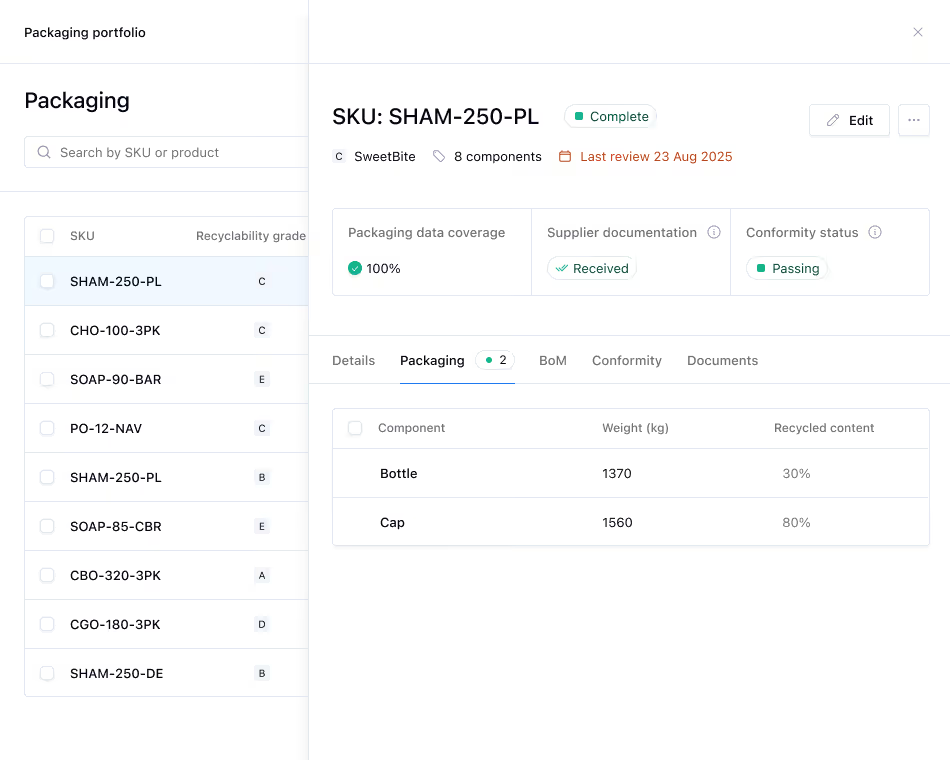
Vanaf 12 augustus 2026 moet elk verpakkingstype dat op de EU-markt wordt gebracht worden ondersteund door een door de fabrikant afgegeven Conformiteitsverklaring (DoC). Importeurs zijn verplicht deze documenten te verzamelen, vijf tot tien jaar te bewaren (afhankelijk van het producttype) en op verzoek beschikbaar te stellen aan autoriteiten. Voor bedrijven die honderden producten en tientallen leveranciers beheren, wordt dit al snel een aanzienlijke operationele uitdaging.
Vraag leveranciers hoe hun platform dit proces afhandelt: biedt het een leveranciersportaal waar fabrikanten DoC's rechtstreeks kunnen uploaden? Kan het bijhouden welke verpakkingstypes geldige, actuele verklaringen hebben en hiaten signaleren? Ondersteunt het versiebeheer en volledige audittrails?
3. Kan het platform EPR-registratie en -rapportage in meerdere landen aan?
EPR-verplichtingen onder de PPWR vereisen dat bedrijven zich registreren bij producentenverantwoordelijkheidsorganisaties en verpakkingsvolumes rapporteren die op de markt worden gebracht in elke EU-lidstaat waar zij actief zijn. De formats, drempelwaarden, rapportagefrequenties en tariefstructuren verschillen aanzienlijk per land.
Vraag hoeveel EU-lidstaten het platform ondersteunt voor EPR-rapportage, of het direct integreert met nationale EPR-registers of gegevens exporteert voor handmatige indiening, en of het meerdere entiteitsregistraties vanuit één dashboard kan bijhouden. Dit is een van de operationeel meest veeleisende onderdelen van de PPWR voor bedrijven met een brede EU-distributie en een van de meest waardevolle functionaliteiten die een platform kan bieden.
4. Hoe houdt de leverancier regelgeving bij naarmate de PPWR evolueert?
De PPWR is een kaderverordening. Verschillende uitvoerings- en gedelegeerde handelingen zijn nog niet afgerond. Criteria voor recycleerbaarheidsbeoordeling, berekeningsmethoden voor gerecycled materiaal en de technische specificaties voor digitale etikettering zijn nog in ontwikkeling. Sommige hiervan worden verwacht voor eind 2026, en de vereisten van de verordening zullen blijven aanscherpen tot 2040.
Vraag leveranciers hoe hun proces voor regelgevingsmonitoring werkt. Is er een toegewijd team dat EU-gedelegeerde handelingen en technische commissie-outputs bijhoudt? Hoe snel worden platformupdates uitgebracht nadat nieuwe vereisten zijn gepubliceerd? Word je automatisch op de hoogte gesteld wanneer een wijziging van invloed is op jouw productcategorieën? Een platform dat accuraat was bij aankoop kan snel achterlopen zonder een rigoureus updateproces voor regelgeving.
5. Ondersteunt het platform toekomstige PPWR-verplichtingen na augustus 2026?
Augustus 2026 is het begin van compliance, niet het einde. Vanaf 2027 moeten verpakkingen digitale identificatoren dragen (QR-codes of vergelijkbaar) die verwijzen naar gestructureerde materiaal- en recycleerbaarheidsgegevens. Hergebruiksdoelen voor industriële en commerciële verpakkingen lopen op richting 2030. De verordening stelt progressieve doelen voor de vermindering van verpakkingsafval van 5% in 2030, 10% in 2035 en 15% in 2040 ten opzichte van 2018-niveaus, conform Verordening (EU) 2025/40.
Vraag leveranciers om een productroadmap gekoppeld aan de PPWR-tijdlijn. Zijn toekomstige vereisten al in ontwikkeling? Zijn ze inbegrepen in de basisproductprijs of beschikbaar als betaalde uitbreidingen? Een platform dat alleen is gebouwd voor de vereisten van 2026 zal binnen het jaar een herevaluatie of aanzienlijke upgrades vereisen.
{{ppwr-document-checker}}
6. Hoe integreert de software met bestaande ERP- en ESG-systemen?
Verpakkingsgegevens staan niet op zichzelf. Materiaalspecificaties komen uit productontwerpssystemen. Leveranciersrelaties worden beheerd in inkoopplatforms. Emissiegegevens stromen door naar ESG-rapportagetools. Een PPWR-platform dat handmatige herinvoer van gegevens uit meerdere interne systemen vereist, creëert overhead en introduceert foutenrisico.
Vraag met welke ERP-systemen het platform native integreert en hoe complex de implementatie is. Als je organisatie al een duurzaamheids- of ESG-rapportageplatform gebruikt, vraag dan of de twee systemen gegevens kunnen uitwisselen. Onder de Corporate Sustainability Reporting Directive (CSRD) maken verpakkingsgerelateerde Scope 3-emissies steeds vaker deel uit van duurzaamheidsrapportages; een verbonden data-architectuur vermindert duplicatie over beide compliance-gebieden.
7. Hoe lang duurt de implementatie en is augustus 2026 haalbaar?
Met minder dan zes maanden tot de algemene toepassingsdatum zijn implementatietijdlijnen niet langer theoretisch. Een platform dat aanzienlijke datamigratrie, systeemintegratie of leveranciersonboarding vereist, kan je onvoldoende tijd laten om volledige compliance te bereiken voor de deadline.
Vraag leveranciers om een realistische onboardingtijdlijn op basis van de omvang van je verpakkingsportfolio en leveranciersbasis. Vraag om referenties van bedrijven met vergelijkbare complexiteit. Vraag welk intern voorbereidend werk van je team vereist is, want datakwaliteitsproblemen aan jouw kant zullen de implementatie verlengen ongeacht de mogelijkheden van het platform. Begrijpen wat je rol als fabrikant, importeur of distributeur onder de PPWR is, beïnvloedt ook wat er geregeld moet zijn en wanneer.
8. Ondersteunt het platform digitale etikettering en Digital Product Passport-vereisten?
Vanaf 2027 vereist de PPWR dat verpakkingen digitale identificatoren dragen die verwijzen naar informatie over materiaalsamenstelling, recyclebaarheid en hergebruiksinstructies. De exacte technische specificaties worden nog afgerond door de Europese Commissie. Afzonderlijk bouwt de Ecodesign for Sustainable Products Regulation (ESPR) een Digital Product Passport (DPP)-kader dat van toepassing zal zijn op een breed scala aan productcategorieën.
Vraag leveranciers of digitale etikettering op hun roadmap staat en welk niveau van technisch detail zij nastreven. Of hun datamodel wordt gebouwd om aan te sluiten op opkomende DPP-standaarden is een nuttige indicator voor hoe serieus de leverancier investeert in langetermijn regelgevingsafstemming. Een platform dat alleen is ontworpen voor beperkte PPWR-etiketteringsvereisten biedt niet dezelfde langetermijnwaarde als een platform dat is gebouwd voor interoperabele productdata-infrastructuur.
9. Kan het platform meegroeien met het bredere EU compliance-landschap?
PPWR compliance staat niet op zichzelf. Bedrijven die verpakkingscompliance beheren, moeten mogelijk tegelijkertijd chemische beperkingen afhandelen onder REACH, due diligence in de toeleveringsketen voor hout- en papiergebaseerde materialen onder de EU Deforestation Regulation (EUDR), en duurzaamheidsrapportages onder CSRD. Afzonderlijke tools beheren voor elke verordening vermenigvuldigt de overhead en creëert gefragmenteerde data.
Vraag of de leverancier werkt aan een bredere product compliance hub die materiaalrestricties, materiaalverklaringen en traceerbaarheid van de toeleveringsketen over meerdere verordeningen heen dekt. Voor bedrijven met complexe leveranciersnetwerken en verplichtingen onder meerdere verordeningen vermindert een uniform platform de rapportage-inspanning en vereenvoudigt het de interne governance op termijn.
Hoe goede PPWR softwareselectie er in de praktijk uitziet
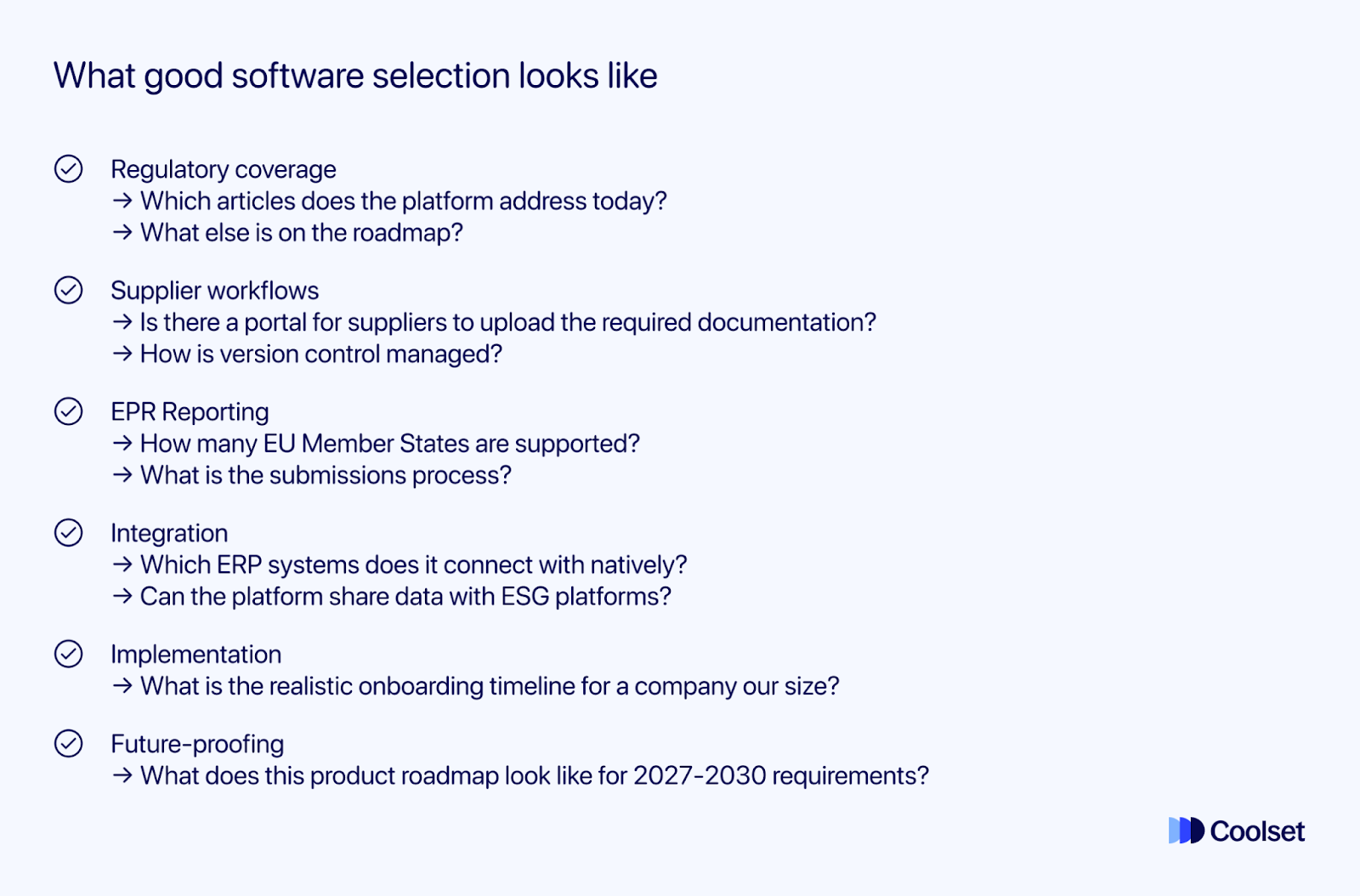
Regelgevingsdekking: welke PPWR-artikelen adresseert het platform vandaag? Wat staat er op de roadmap?
Leveranciersworkflows: is er een portaal voor leveranciers om vereiste documentatie te uploaden? Hoe wordt versiebeheer geregeld?
EPR-rapportage: hoeveel EU-lidstaten worden ondersteund? Hoe verloopt het indieningsproces?
Integratie: met welke ERP-systemen verbindt het native? Deelt het gegevens met ESG-platforms?
Implementatie: wat is de realistische onboardingtijdlijn voor een bedrijf van onze omvang?
Toekomstbestendigheid: hoe ziet de productroadmap eruit voor de vereisten van 2027-2030?
Wat nu?
De juiste PPWR compliance software kiezen begint met een helder beeld van je eigen verplichtingen. Hoeveel verpakkingstypes beheer je? In welke EU-lidstaten breng je verpakkingen op de markt? Wat is je rol: fabrikant, importeur of distributeur onder de PPWR? Word je beschouwd als producent in de lidstaten waar je actief bent? Die antwoorden bepalen welke softwaremogelijkheden het meest relevant zijn voor jouw situatie.
De deadline van augustus 2026 nadert snel. Door nu te beginnen met de leveranciersevaluatie en de juiste vragen te stellen, heb je de tijd om een weloverwogen beslissing te nemen in plaats van een reactieve.
Bij Coolset helpen we bedrijven de PPWR-vereisten te begrijpen en praktische compliance-processen op te bouwen. Als je je opties aan het verkennen bent, spreek dan met ons team om te zien hoe wij verpakkingscompliance aanpakken.
Veelgestelde vragen
Wat is de PPWR en wanneer is deze van toepassing? De Packaging and Packaging Waste Regulation (PPWR), Verordening (EU) 2025/40, is een rechtstreeks toepasselijke EU-verordening die alle verpakkingen op de EU-markt reguleert. Ze trad in werking op 11 februari 2025 en de kernvereisten worden verplicht vanaf 12 augustus 2026, met aanvullende verplichtingen die gefaseerd worden ingevoerd tot 2040.
Wie moet voldoen aan de PPWR? Alle bedrijven die verpakkingen op de EU-markt brengen moeten voldoen, ongeacht omvang of sector. Dit omvat fabrikanten, importeurs en distributeurs. Bedrijven die verpakkingen onder hun eigen naam of merk op de markt brengen, nemen fabrikantverplichtingen op zich, inclusief de verplichting om een Conformiteitsverklaring af te geven.
Wat is een Conformiteitsverklaring onder de PPWR? Een Conformiteitsverklaring bevestigt dat een verpakkingstype voldoet aan de essentiële PPWR-vereisten voor ontwerp, materialen en recyclebaarheid. Vanaf 12 augustus 2026 heeft elk verpakkingstype er één nodig. Importeurs moeten deze documenten verzamelen en bewaren bij leveranciers gedurende vijf tot tien jaar en ze op verzoek beschikbaar stellen aan autoriteiten.
Wat doet PPWR compliance software? PPWR compliance software helpt bedrijven doorgaans bij het verzamelen en beheren van leveranciersverklaringen, het bijhouden van de status van gerecycled materiaal en recyclebaarheid, het afhandelen van EPR-registratie en -rapportage in EU-lidstaten, en het monitoren van regelgevingswijzigingen naarmate de uitvoeringshandelingen van de verordening worden afgerond. Reikwijdte en mogelijkheden verschillen aanzienlijk per leverancier.
Hoe verhoudt PPWR compliance zich tot CSRD-rapportage? CSRD verplicht bedrijven hun milieu-impact te rapporteren, inclusief verpakkingsgerelateerde emissies en afvalgegevens in hun waardeketen. PPWR richt zich op verpakkingsontwerp en markttoegangsverplichtingen. De twee overlappen in de praktijk, omdat verpakkingsmateriaalgegevens en EPR-rapportage bijdragen aan Scope 3-emissieberekeningen en toeleveringsketinrapportages die vereist zijn onder CSRD.
Gerelateerd: Packaging and packaging waste regulation: PPWR essentials
Gerelateerd: PPWR compliance voor e-commerce: hoe je voldoet aan regels voor lege ruimte en marktplaatsverplichtingen in 2026

op mobiele schermen
om deze demo te ervaren.


↘ Check if your documentation meets PPWR requirements
This free compliance checker scans your packaging documentation and maps it against mandatory PPWR data requirements, giving you a clear view of your compliance status. Get actionable insights on documentation gaps before they become compliance issues.
Stay ahead of PPWR compliance
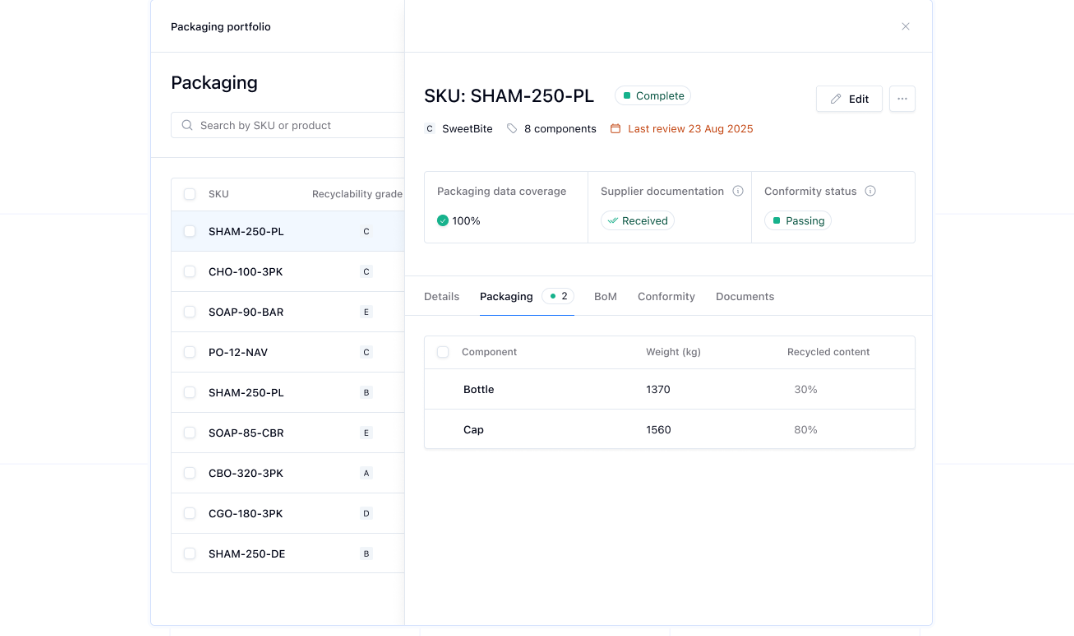
Manage supplier documentation, track conformity and stay audit-proof.

.webp)