Verpakkings- en verpakkingsafvalverordening: de essentie van PPWR


Disclaimer: New EUDR developments - December 2025
In November 2025, the European Parliament and Council backed key changes to the EU Deforestation Regulation (EUDR), including a 12‑month enforcement delay and simplified obligations based on company size and supply chain role.
Key changes proposed:
- New enforcement timeline: 30 December 2026 for large/medium operators, 30 June 2027 for small/micro operators
- Simplified DDS: One-time declarations for small and micro primary producers
- Narrowed scope: Most downstream actors and non‑SME traders would no longer need to submit DDSs
- New DDS requirement: Estimated annual quantity of regulated products must be included
These updates are not yet legally binding. A final text will be confirmed through trilogue negotiations and formal publication in the EU’s Official Journal. Until then, the current EUDR regulation and deadlines remain in force.
We continue to monitor developments and will update all guidance as the final law is adopted.
- PPWR-verplichtingen zijn toegewezen per rol in de keten: fabrikanten voeren conformiteitsbeoordelingen uit en stellen een DoC op per verpakkingstype; importeurs wier merk op de verpakking staat, worden onder artikel 21 als fabrikant aangemerkt.
- PPWR geldt gefaseerd: stoffenbeperkingen vanaf 12 augustus 2026, recycleerbaarheidsgraden en doelstellingen voor gerecycled materiaal vanaf 2030, digitale identificatoren en labeling in respectievelijk 2027 en 2028.
- Coolsets PPWR-playbook begeleidt complianceteams door elke werkstroom.
Verpakkingen raken elk product dat op de EU-markt wordt gebracht. Omdat de Packaging and Packaging Waste Regulation (PPWR) van toepassing is vanaf 12 augustus 2026, moet elk bedrijf dat verpakte goederen in de EU verhandelt begrijpen wat de verordening vereist, wanneer die geldt en hoe compliance er in de praktijk uitziet.
Voor duurzaamheidsmanagers bij middelgrote bedrijven is PPWR geen ver-van-je-bed-show. De deadline van augustus 2026 nadert snel, stoftesten kunnen weken duren en leveranciersdocumentatie kost tijd om te verzamelen. Bedrijven die wachten tot Q2 2026 lopen tegen hiaten aan die ze voor de deadline niet meer kunnen dichten.
Deze gids behandelt wat PPWR is, voor wie het geldt, wat het vereist en hoe je je organisatie voorbereidt op compliance.
Wat is de verpakkings- en verpakkingsafvalverordening?
De Packaging and Packaging Waste Regulation (PPWR) is Verordening (EU) 2025/40, gepubliceerd in het Publicatieblad van de Europese Unie op 22 januari 2025. De verordening is op 12 februari 2025 in werking getreden en is van toepassing vanaf 12 augustus 2026.
PPWR vervangt de Richtlijn Verpakkingen en Verpakkingsafval (Richtlijn 94/62/EG), die elke EU-lidstaat verplichtte om verpakkingsregels via nationale wetgeving te implementeren. Omdat PPWR een verordening is en geen richtlijn, geldt ze rechtstreeks in alle lidstaten zonder afzonderlijke nationale implementatie. Één set regels is van toepassing op de gehele EU-markt.
De verordening heeft betrekking op alle verpakkingen en verpakkingsafval die op de EU-markt worden gebracht: consumentenverpakkingen, groepsverpakkingen, transport- en industriële verpakkingen, e-commerceverpakkingen en verpakkingen die worden gebruikt in de diensten- en horecabranche. Als verpakkingen de EU-markt betreden, is PPWR van toepassing.
Waarom PPWR is ingevoerd
Verpakkingsafval is een van de snelst groeiende afvalstromen in de EU. De Europese Commissie heeft PPWR geïntroduceerd om die groei aan te pakken door bindende recycleerbaarheidseisen, minimale doelstellingen voor gerecycled materiaal, beperking van lege ruimte en hergebruiksverplichtingen vast te stellen. De verordening maakt deel uit van het EU-pakket voor de circulaire economie, dat verpakkingen beschouwt als een grondstof die teruggewonnen en hergebruikt moet worden in plaats van weggegooid.
PPWR pakt ook regelgevingsfragmentatie aan. Onder het vorige richtlijnkader moesten bedrijven die actief waren in meerdere EU-markten navigeren door verschillende nationale implementaties van dezelfde regels. PPWR elimineert die complexiteit voor bedrijven die actief zijn in twee of meer lidstaten.
Voor welke bedrijven geldt PPWR?
PPWR geldt voor alle marktdeelnemers die verpakkingen of verpakte producten op de EU-markt brengen. Er is geen algemene vrijstelling voor kleine of micro-ondernemingen. De kernvereisten van de verordening, waaronder stoffenbeperkingen en de verplichting tot een conformiteitsverklaring, gelden ongeacht de bedrijfsomvang.
Verplichtingen zijn verdeeld over drie rollen in de toeleveringsketen. De fabrikant is het bedrijf wiens merknaam of handelsmerk op de verpakking staat. Fabrikanten dragen de zwaarste compliancelast: zij moeten conformiteitsbeoordelingen uitvoeren, een conformiteitsverklaring opstellen voor elk verpakkingstype en technische documentatie bewaren. De importeur is verantwoordelijk voor het verifiëren dat de documentatie van de fabrikant volledig is voordat goederen op de EU-markt worden gebracht. De distributeur moet ervoor zorgen dat hij geen niet-conforme verpakkingen op de markt brengt.
Eén bedrijf kan voor verschillende producten verschillende rollen vervullen. Een importeur die verpakte goederen verkoopt onder zijn eigen merknaam wordt op grond van artikel 21 voor dat product aangemerkt als fabrikant. Voor een volledig overzicht van hoe rollen worden toegewezen en wat elke rol vereist, zie PPWR supply chain roles explained: manufacturer, importer, distributor, and producer.
Waarom PPWR belangrijk is voor jouw bedrijf
Niet-naleving van PPWR heeft directe commerciële gevolgen. Nationale bevoegde autoriteiten zijn verantwoordelijk voor handhaving in alle EU-lidstaten. Autoriteiten kunnen eisen dat niet-conforme producten van de markt worden gehaald, toekomstige verkoop blokkeren en financiële sancties opleggen. Lidstaten stellen hun eigen sanctieniveaus vast, maar PPWR vereist dat die sancties effectief en evenredig zijn.
De meest directe consequentie is markttoegang. Verpakkingen die niet voldoen aan de PPWR-eisen mogen vanaf 12 augustus 2026 niet langer legaal op de EU-markt worden gebracht. Voor bedrijven die producten distribueren in EU-markten betekent dit: geen verkoop totdat compliance is bevestigd en gedocumenteerd.
Zakelijke voordelen naast compliance
Op grond van PPWR moeten nationale EPR-bijdragen eco-gemoduleerd worden. Verpakkingen worden beoordeeld aan de hand van duurzaamheidsprestaties, waaronder recycleerbaarheid en gerecycled materiaal, waarbij beter presterende verpakkingen leiden tot lagere EPR-bijdragen.
PPWR biedt ook concurrentievoordelen voor bedrijven die vroeg beginnen. Verpakkingen die goed scoren op recycleerbaarheid worden steeds vaker gevraagd door grote retailers en inkoopafdelingen die duurzaamheidsambities voor verpakkingen hebben vastgesteld vóór de regulatoire tijdlijn. Een recycleerbaarheidsgraad A of B onder PPWR positioneert producten gunstig in deze inkoopprocessen.
Hergebruiksystemen, verplicht voor bepaalde verpakkingscategorieën vanaf augustus 2026, creëren infrastructuur die op termijn de materiaalkosten verlaagt. Bedrijven met gedocumenteerde gegevens over gerecycled materiaal en recycleerbaarheid zijn ook beter gepositioneerd voor rapportageverplichtingen onder CSRD en ESG-vragenlijsten van klanten.
Voor een volledig overzicht van wat geldt vanaf augustus 2026 en wat later volgt, zie PPWR compliance deadlines explained: what applies from August 2026 and what comes later.
{{product-tour-injectable}}
Kernvereisten van PPWR
PPWR stelt eisen op vijf gebieden: stoffenbeperkingen, minimalisering van verpakkingen, recycleerbaarheid, gerecycled materiaal en administratieve documentatie. Niet alle vereisten gaan in op 12 augustus 2026. De verordening introduceert een gefaseerd schema, waarbij ontwerpvereisten voor recycleerbaarheid en gerecycled materiaal gelden vanaf 2030.
Stoffenbeperkingen (augustus 2026)
Vanaf 12 augustus 2026 mogen voedselverpakkingen die PFAS bevatten op of boven de gespecificeerde concentratielimieten niet meer op de EU-markt worden gebracht. Dit geldt voor alle voedselverpakkingen, ongeacht het materiaaltype. Er is geen overgangsperiode en geen uitputtingsregeling voor voorraden voor deze deadline.
PPWR handhaaft ook beperkingen op zware metalen in verpakkingen, waaronder lood, cadmium, kwik en zeswaardig chroom. Concentratielimieten voor zware metalen zijn vastgesteld op 100 delen per miljoen totaal voor alle vier stoffen, consistent met de limieten die zijn overgenomen uit de vorige richtlijn.
Stoftestresultaten voor PFAS en zware metalen vereisen laboratoriumwerk en kunnen verwerkingstijd in beslag nemen. Bedrijven die voedselverpakkingen op de EU-markt brengen, dienen nu met testen te beginnen als ze dat nog niet hebben gedaan.
Minimalisering van verpakkingen en lege ruimte (augustus 2026)
Vanaf 12 augustus 2026 mag de verhouding van lege ruimte (void space) tot het totale verpakkingsvolume niet meer dan 50% bedragen. Verpakkingen moeten ook worden geminimaliseerd in gewicht en volume, consistent met de productbeschermingsvereisten.
Deze vereiste geldt voor verpakte producten die online worden verkocht en naar consumenten worden verzonden. Bedrijven die te grote dozen gebruiken voor standaard productverzendingen moeten verpakkingsformaten herontwerpen of documenteren waarom de huidige volumes technisch noodzakelijk zijn.
Recycleerbaarheidsvereisten (vanaf 2030)
PPWR introduceert een recycleerbaarheidsbeoordelingssysteem onder Bijlage II dat elke verpakkingseenheid een graad van A tot E toekent op basis van het percentage van de verpakking dat effectief gerecycled kan worden op gewicht.
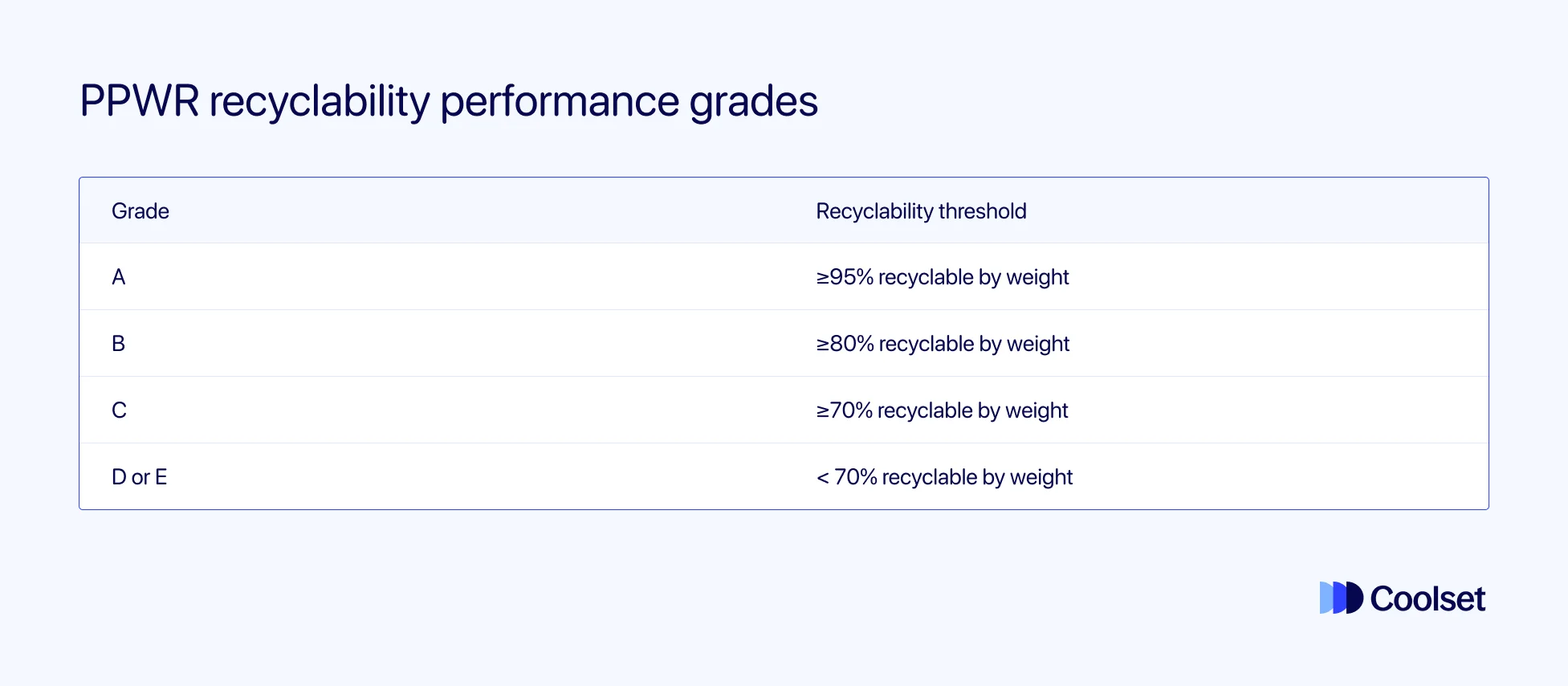
Vanaf 1 januari 2030 mag alleen verpakking met een minimale recycleerbaarheidsgraad C op de EU-markt worden gebracht. Conformiteitsbeoordelingen voor recycleerbaarheid zijn pas vereist vanaf 2030, maar de beoordelingscriteria zijn nu al vastgesteld, zodat bedrijven kunnen beoordelen waar hun verpakkingen staan ten opzichte van toekomstige vereisten.
Voor een gedetailleerde gids over het beoordelingssysteem per verpakkingsmateriaal en -categorie, zie PPWR recyclability grades and recycled content targets: what importers need to know.
Vereisten voor gerecycled materiaal (vanaf 2030)
Vanaf 1 januari 2030 moet plastic verpakking minimale percentages post-consumer recyclaat (PCR) bevatten. Doelstellingen variëren per verpakkingscategorie en worden verder verhoogd vanaf 2040.
- Contactgevoelige plastic verpakking van PET: 30% gerecycled materiaal in 2030
- Contactgevoelige plastic verpakking van andere kunststoffen: 10% gerecycled materiaal in 2030
- Niet-contactgevoelige plastic verpakking: 35% gerecycled materiaal in 2030
- Plastic verpakking voor wegwerpflessen voor dranken: 30% gerecycled materiaal in 2030, oplopend tot 65% in 2040
Deze doelstellingen gelden voor het plastic onderdeel van de verpakking, niet voor de volledige verpakkingseenheid. Bedrijven die composietverpakkingen gebruiken (deels plastic, deels papier of metaal) moeten het gerecycled materiaalgehalte van het plastic onderdeel berekenen.
Conformiteitsverklaring
Een conformiteitsverklaring (DoC) is een schriftelijke verklaring van de verpakkingsfabrikant die bevestigt dat de verpakking voldoet aan de vereisten van artikelen 5 tot en met 12 van Verordening (EU) 2025/40. Fabrikanten moeten één DoC per verpakkingstype opstellen en deze vijf jaar bewaren voor wegwerpverpakkingen of tien jaar voor herbruikbare verpakkingen.
De DoC wordt niet ingediend bij een autoriteit. Ze moet op verzoek beschikbaar zijn voor nationale bevoegde autoriteiten, die op grond van de handhavingsbevoegdheden van PPWR documentatie kunnen opvragen met korte aankondiging. Op verzoek van autoriteiten moet de DoC binnen tien dagen worden overgelegd. De ondersteunende technische documentatie die de DoC onderbouwt, moet er samen mee worden bewaard.
Voor een stapsgewijze gids voor het opstellen van de DoC en het verkrijgen ervan van leveranciers, zie PPWR Declaration of Conformity: what it is, when you need it and how to get it from suppliers.
Labelingvereisten
Vanaf 2027 moeten verpakkingen digitale identificatoren bevatten (zoals QR-codes) die verwijzen naar gestructureerde milieu-informatie, waaronder materiaalsamenstelling, recycleerbaarheidsgraad en hergebruiksdetails. Het formaat en de technische normen voor digitale identificatoren worden vastgelegd in gedelegeerde handelingen.
Vanaf 2028 gelden geharmoniseerde labelingregels, waaronder gestandaardiseerde sorteermarkeringen om consumenten te begeleiden bij het scheiden en afvoeren van verpakkingen. Deze labels moeten de symbolen en taal gebruiken die zijn vastgelegd in Bijlage VII van de verordening.
Hoe je je voorbereidt op PPWR
Voorbereiding op PPWR vereist actie op vier werkstromen: rolidentificatie, inventarisatie van het verpakkingsportfolio, verzameling van leveranciersgegevens en documentatie. De volgorde is belangrijk. Rolidentificatie bepaalt welke verplichtingen van toepassing zijn op elk product, en dat bepaalt welke gegevens verzameld moeten worden voordat documentatie kan worden afgerond.
Stap 1: Bepaal je PPWR-rol per product
Begin met rolidentificatie. Bepaal voor elk product of je bedrijf de fabrikant, importeur of distributeur is onder PPWR. De classificatie is niet gebaseerd op het type bedrijf, maar op wat elk bedrijf doet voor elk product.
Als je merknaam of handelsmerk op de verpakking staat, ben je de fabrikant. Als je verpakte goederen importeert die door een ander bedrijf zijn geproduceerd en jouw merk op het label staat, herclassificeert artikel 21 je als fabrikant. Dit heeft aanzienlijke documentatie-implicaties: als fabrikant ben je verantwoordelijk voor de volledige conformiteitsbeoordeling en conformiteitsverklaring.
Voor een praktische gids over artikel 21 en de voorwaarden waaronder importeurs fabrikanten worden, zie PPWR roles explained: when importers become manufacturers under Article 21.
Stap 2: Breng je verpakkingsportfolio in kaart
Stel een volledig overzicht op van elk verpakkingsformaat dat wordt gebruikt in je productassortiment. Categoriseer elk formaat op materiaaltype (plastic, glas, metaal, papier, hout, composiet), verpakkingsfunctie (consument, groep, transport, e-commerce), of het een voedselverpakking betreft (PFAS-beperkingen gelden) en wie de verpakking produceert (intern of externe leverancier).
Markeer verpakkingstypes die waarschijnlijk onmiddellijke actie vereisen: voedselverpakkingen voor PFAS-testen, e-commerceverpakkingen voor beoordeling van lege ruimte en verpakkingen die momenteel niet recyclebaar zijn of geen gerecycled materiaal bevatten (om toekomstige blootstelling aan vereisten vanaf 2030 te begrijpen).
Stap 3: Verzamel leveranciersdocumentatie
Voor elk verpakkingstype waarbij je bedrijf de fabrikant is, heb je technische documentatie nodig van je verpakkingsleverancier. Vraag het volgende op bij elke leverancier:
- Materiaalsamenstelling per verpakkingstype
- Stoftestresultaten voor PFAS-limieten en concentraties van zware metalen
- Recycleerbaarheidsbeoordelingsgegevens (recycleerbaarheidsgraad onder de methodologie van Bijlage II)
- Technische documentatie per modulesvereisten van Bijlage VII
- Huidig gerecycled materiaalpercentage per materiaal
Veel verpakkingsleveranciers verwerken tegelijkertijd meerdere PPWR-documentatieverzoeken. Stuur gestructureerde verzoeken met duidelijke sjablonen en expliciete deadlines. Ongestructureerde of vage verzoeken leiden consequent tot tragere en minder volledige reacties.
Stap 4: Voer de conformiteitsbeoordeling uit en stel de DoC op
Zodra leveranciersgegevens zijn verzameld, beoordeel je elk verpakkingstype aan de hand van de toepasselijke vereisten. Voor stoffenbeperkingen die gelden vanaf augustus 2026 moet de beoordeling vóór die datum zijn afgerond. Al deze resultaten moeten worden gedocumenteerd in de technische documentatie. Onderteken de conformiteitsverklaring en bewaar deze samen met het ondersteunende technische dossier.
De DoC wordt eenmalig ondertekend per verpakkingstype en blijft geldig totdat de verpakking wijzigt. Het is geen jaarlijkse indiening. Als het verpakkingsontwerp, de materiaalsamenstelling of de leverancier verandert, moet de DoC worden bijgewerkt en het conformiteitsproces worden herhaald.
Stap 5: Plan voor de vereisten van 2027 en 2028
Digitale identificatoren (2027) en geharmoniseerde labeling (2028) vereisen wijzigingen in het verpakkingsontwerp. Deze processen vereisen grondige langetermijnplanning om productie- en inkoopcycli op de juiste manier aan te passen. Het is realistisch om in 2026 te beginnen met de planning en leveranciersbriefings voor deze vereisten. In 2027 beginnen is dat niet.
Veelvoorkomende uitdagingen en hoe je ze aanpakt
De gereedheid van leveranciers is het meest voorkomende knelpunt. Veel leveranciers, met name die buiten de EU zijn gevestigd, zijn niet vertrouwd met de PPWR-documentatievereisten. Het verstrekken van gestructureerde aanvraagsjablonen, een korte toelichting op de verordening en duidelijke deadlines levert consequent betere resultaten op dan algemene vragen.
De capaciteit voor PFAS-testen is beperkt in de EU. Geaccrediteerde laboratoria verwerken een aanzienlijk volume aan testverzoeken vóór de deadline van augustus 2026. Bedrijven die begin 2026 beginnen met testen, kunnen te maken krijgen met wachttijden die de resultaten voorbij de compliancedatum duwen.
Interne rolhelderheid is een andere uitdaging. Bij middelgrote bedrijven liggen PPWR-verantwoordelijkheden vaak verspreid over juridische, inkoop-, duurzaamheids- en logistiekteams zonder één duidelijke eigenaar. Het aanwijzen van een duidelijke eigenaar per compliance-werkstroom voordat de gegevensverzameling begint, voorkomt dat er hiaten ontstaan tussen teams.
{{custom-cta}}
PPWR-tijdlijn en deadlines
PPWR wordt gefaseerd ingevoerd. De meeste directe verplichtingen gaan in op 12 augustus 2026. Ontwerp- en inhoudsvereisten gelden vanaf 2030, met verdere doelstellingen vanaf 2040.
- 22 januari 2025: PPWR gepubliceerd in het EU-Publicatieblad als Verordening (EU) 2025/40
- 12 februari 2025: PPWR in werking getreden
- 12 augustus 2026: stoffenbeperkingen (PFAS, zware metalen in voedselverpakkingen), limieten voor lege ruimte (maximaal 40% voor e-commerce- en transportverpakkingen) en vereisten voor hergebruiksystemen treden in werking
- 2027: vereisten voor digitale identificatoren gelden; verpakkingen moeten QR-codes of equivalenten bevatten die verwijzen naar milieu-informatie
- 2028: geharmoniseerde labelingregels gelden; sorteermarkeringen verplicht op verpakkingen
- 1 januari 2030: minimale recycleerbaarheidsgraad C vereist voor alle verpakkingen; doelstellingen voor gerecycled materiaal in plastic verpakkingen treden in werking; beperkingen van Bijlage V op specifieke wegwerpplastic verpakkingsformaten gelden
- 2040: hogere doelstellingen voor gerecycled materiaal gelden voor alle plastic verpakkingscategorieën
PPWR voorziet niet in een gefaseerd schema voor kleinere bedrijven. De vereisten van augustus 2026 gelden voor alle marktdeelnemers, ongeacht de bedrijfsomvang. De kernvereisten van de verordening zijn niet afhankelijk van bedrijfsgrootte.
Voor een gedetailleerd overzicht van elke deadline en wat die in de praktijk vereist, zie PPWR compliance deadlines explained: what applies from August 2026 and what comes later.
Voor een breder overzicht van hoe PPWR zich verhoudt tot EUDR, CSRD, CBAM en andere EU-regelgeving voor toeleveringsketens, zie which EU regulations affect your supply chain? EUDR, CSRD, PPWR, CBAM and more.
Hoe Coolset helpt bij PPWR-compliance
Coolsets PPWR-complianceplatform is gebouwd voor bedrijven die verpakkingscompliance beheren over meerdere productlijnen en leveranciersrelaties.
Het platform automatiseert de verzameling van leveranciersgegevens. Gestructureerde verzoeken worden via het platform naar verpakkingsleveranciers gestuurd en reacties worden centraal bijgehouden. Complianceteams kunnen zien welke verpakkingstypes volledige documentatie hebben en welke nog hiaten vertonen, zonder leveranciers individueel per e-mail te hoeven achtervolgen.
Coolset biedt conformiteitsverklaringsjablonen die zijn afgestemd op Verordening (EU) 2025/40, vooraf ingevuld met bedrijfs- en productinformatie. Zodra leveranciersdocumentatie is ontvangen, kan de DoC worden ingevuld en opgeslagen in hetzelfde systeem, waarbij de bewaartermijnen van vijf of tien jaar automatisch worden bijgehouden.
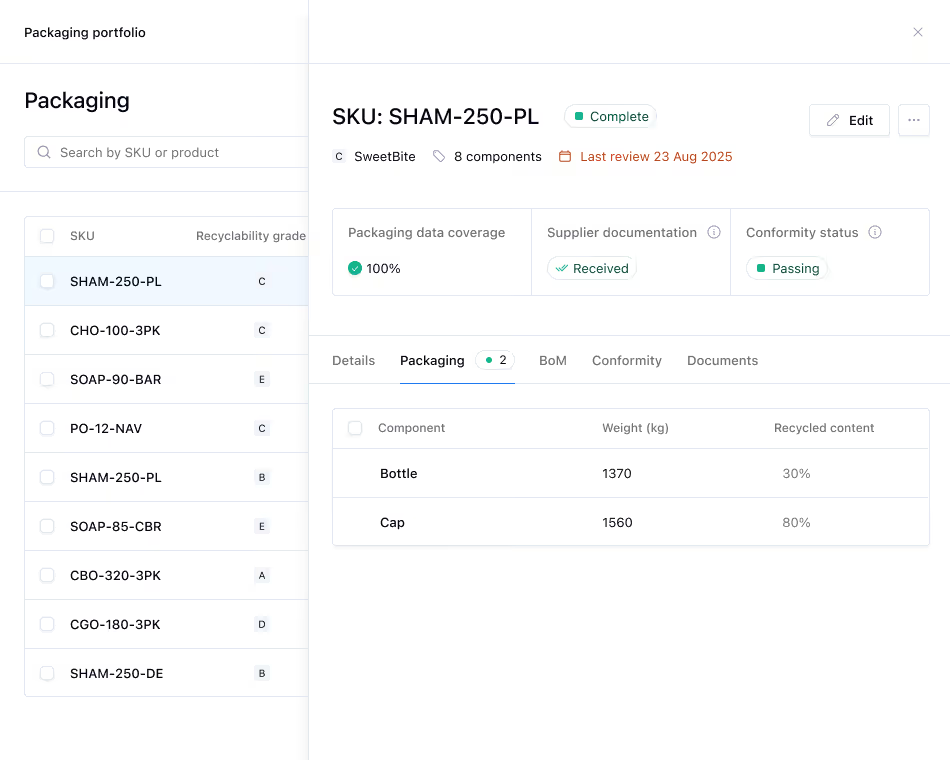
Een compliance-dashboard toont de status van elk verpakkingstype ten opzichte van de PPWR-vereisten, met deadline-tracking en een duidelijk overzicht van waar hiaten nog bestaan. Dit is met name nuttig voor middelgrote bedrijven die tientallen of honderden verpakkings-SKU's beheren over meerdere markten.
Voor een beoordeling van waar je op moet letten bij het kiezen van een PPWR-compliancetool, zie how to evaluate PPWR compliance software: 9 questions to ask before you buy.
Veelgestelde vragen over PPWR
Wat is de verpakkings- en verpakkingsafvalverordening?
De Packaging and Packaging Waste Regulation (PPWR) is Verordening (EU) 2025/40, een rechtstreeks toepasselijke EU-verordening die alle verpakkingen en verpakkingsafval op de EU-markt reguleert. Ze vervangt de vorige Richtlijn Verpakkingen en Verpakkingsafval en geldt uniform in alle EU-lidstaten vanaf 12 augustus 2026 zonder afzonderlijke nationale implementatie.
Voor wie geldt PPWR?
PPWR geldt voor alle bedrijven die verpakkingen of verpakte goederen op de EU-markt brengen: fabrikanten, importeurs en distributeurs. Er is geen algemene vrijstelling voor kleine of micro-ondernemingen. De rol die een bedrijf vervult voor elk product bepaalt welke specifieke verplichtingen van toepassing zijn.
Wanneer geldt PPWR?
De meeste PPWR-vereisten gelden vanaf 12 augustus 2026. Latere vereisten omvatten digitale identificatoren (2027), geharmoniseerde labeling (2028), minimale recycleerbaarheidsgraden en doelstellingen voor gerecycled materiaal in plastic (1 januari 2030) en hogere doelstellingen voor gerecycled materiaal (2040).
Wat gebeurt er als een bedrijf niet voldoet aan PPWR?
Niet-conforme verpakkingen mogen niet legaal op de EU-markt worden gebracht. Nationale bevoegde autoriteiten kunnen producten van de markt laten halen en financiële sancties opleggen. PPWR vereist dat lidstaten sancties vaststellen die effectief, evenredig en ontmoedigend zijn voor niet-naleving, hoewel elke lidstaat zijn eigen sanctieniveaus bepaalt.
Wat is een conformiteitsverklaring onder PPWR?
Een conformiteitsverklaring (DoC) is een schriftelijke verklaring van de verpakkingsfabrikant die bevestigt dat de verpakking voldoet aan artikelen 5 tot en met 12 van Verordening (EU) 2025/40. Per verpakkingstype is één DoC vereist. Deze moet vijf jaar worden bewaard (wegwerpverpakkingen) of tien jaar (herbruikbare verpakkingen) en op verzoek beschikbaar worden gesteld aan nationale autoriteiten.
Geldt PPWR voor bedrijven buiten de EU?
PPWR geldt op basis van waar verpakkingen de EU-markt betreden, niet waar een bedrijf is gevestigd. Niet-EU-bedrijven die verpakte producten verkopen in EU-lidstaten moeten voldoen. In de praktijk rust de verplichting op de importeur of gemachtigde vertegenwoordiger die het product namens de niet-EU-fabrikant op de EU-markt brengt.
Get PPWR compliant before August 12
.webp)

op mobiele schermen
om deze demo te ervaren.


↘ Check if your documentation meets PPWR requirements
This free compliance checker scans your packaging documentation and maps it against mandatory PPWR data requirements, giving you a clear view of your compliance status. Get actionable insights on documentation gaps before they become compliance issues.

.webp)