What documents do companies need for EUTR compliance? (2026 update)


Disclaimer: New EUDR developments - December 2025
In November 2025, the European Parliament and Council backed key changes to the EU Deforestation Regulation (EUDR), including a 12‑month enforcement delay and simplified obligations based on company size and supply chain role.
Key changes proposed:
- New enforcement timeline: 30 December 2026 for large/medium operators, 30 June 2027 for small/micro operators
- Simplified DDS: One-time declarations for small and micro primary producers
- Narrowed scope: Most downstream actors and non‑SME traders would no longer need to submit DDSs
- New DDS requirement: Estimated annual quantity of regulated products must be included
These updates are not yet legally binding. A final text will be confirmed through trilogue negotiations and formal publication in the EU’s Official Journal. Until then, the current EUDR regulation and deadlines remain in force.
We continue to monitor developments and will update all guidance as the final law is adopted.
Key takeaways:
- EUTR does not prescribe a fixed document list. Companies must collect evidence proving compliance with all applicable laws in the country of harvest
- Incomplete or poorly linked documentation is one of the most common reasons companies fail EUTR inspections
- Most required documents sit with suppliers, making structured supplier engagement and follow-up unavoidable
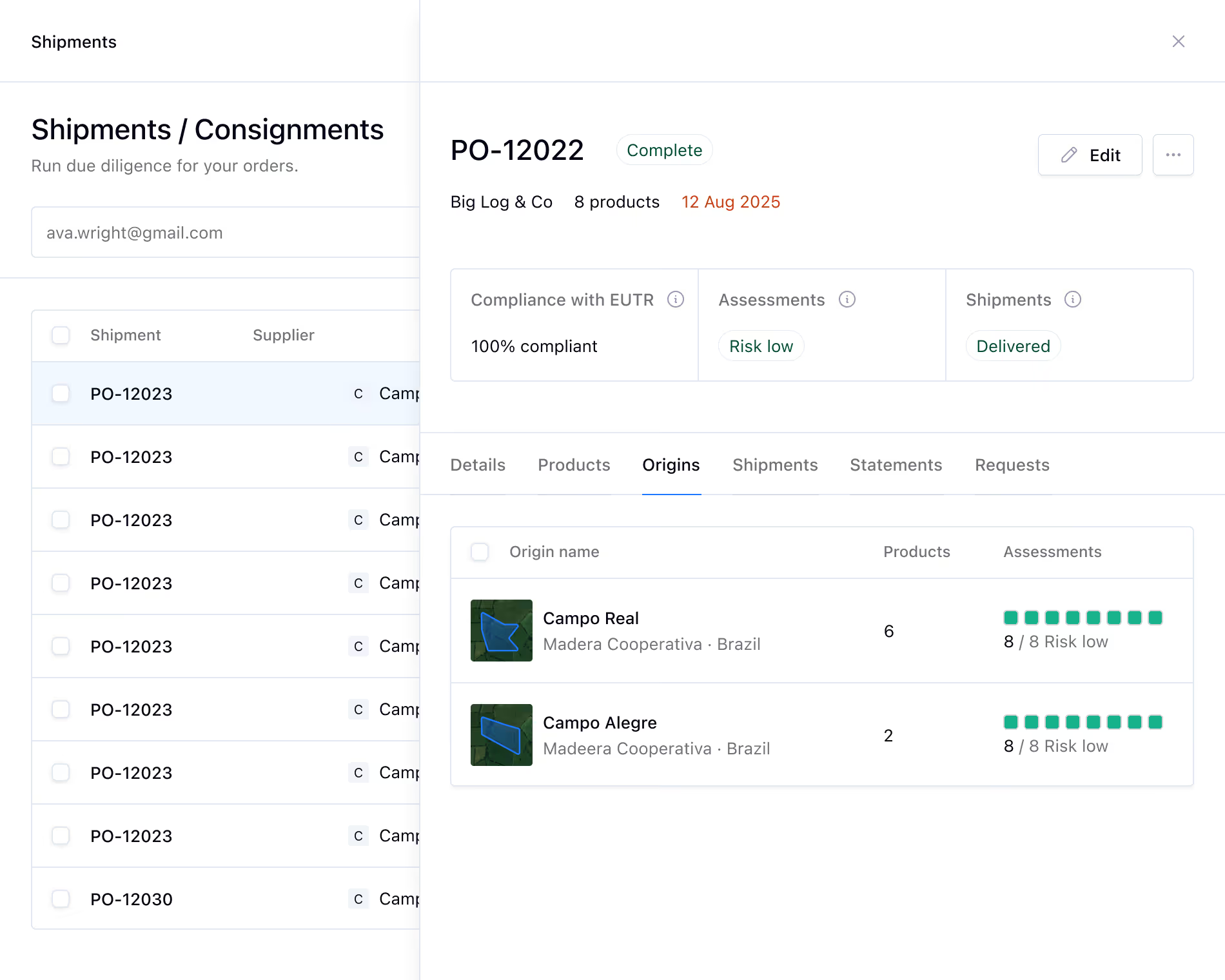
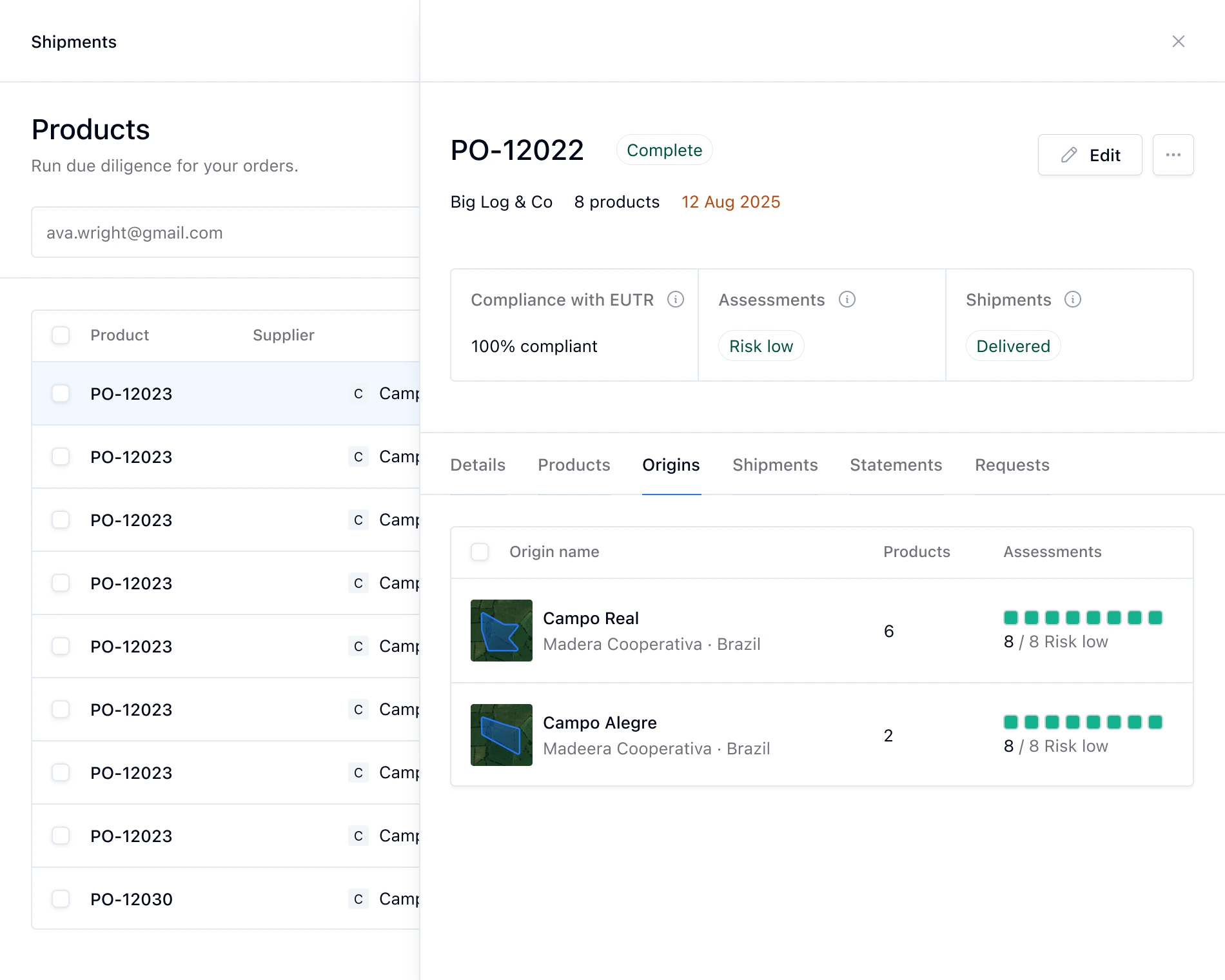
- Coolset centralizes EUTR documentation, linking evidence to products and suppliers while preparing teams for EUDR requirements
Since 2013, the EU Timber Regulation (EUTR) has been the EU’s main legal instrument to prevent illegal timber from entering the European market. Rather than relying on declarations or certifications alone, EUTR places the responsibility on companies importing timber into the EU to demonstrate that their products are legal.
At the heart of this obligation sits documentation. To comply with EUTR in 2026, operators must be able to show, using credible and relevant evidence, that timber was harvested, traded, and exported in line with the laws of the country of harvest. This is not a one-off exercise. Documentation must be collected per product and per supplier, assessed as part of a due diligence system, reviewed and, where necessary, updated at least annually in line with Commission Implementing Regulation (EU) No 607/2012, and kept available to competent authorities during inspections.
What documents do companies need for EUTR compliance?
What the regulation says about documentation
One of the most important things to understand about EUTR is that it does not provide a single, fixed list of mandatory documents. Instead, the regulation requires operators to put a due diligence system in place that enables them to assess and mitigate the risk of illegally harvested timber being placed on the EU market.
That due diligence system has three core components: information gathering, risk assessment, and risk mitigation. Documentation sits primarily within the first step, but it underpins the entire process.
Article 6(a) of EUTR, which outlines the information-gathering requirements, explicitly states that operators must collect documents or other information indicating compliance of timber and timber products with the applicable legislation in the country of harvest. In other words, companies are not just expected to describe legality, they are expected to evidence it.
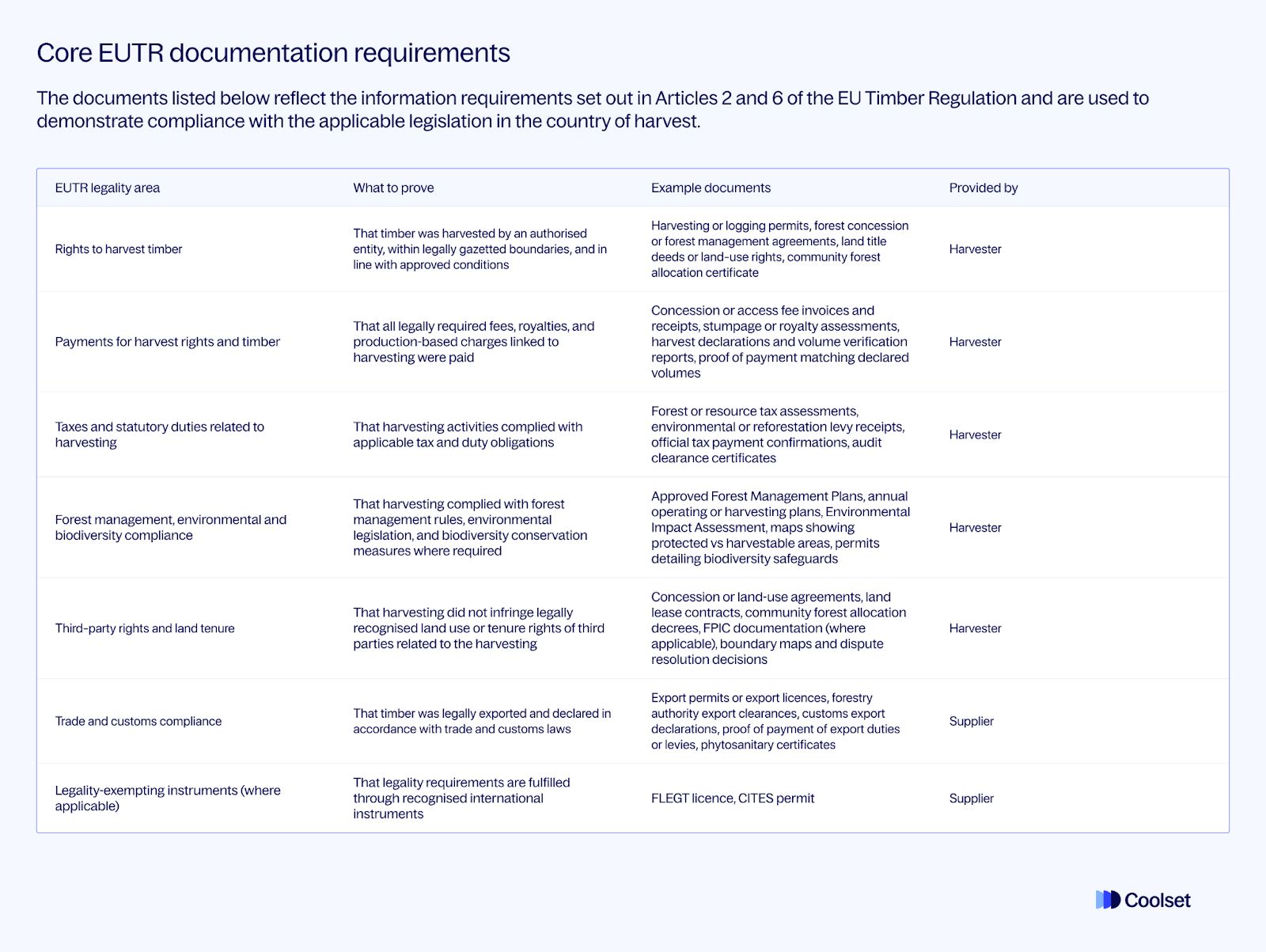
To understand what that evidence needs to cover, Article 2(h) of the regulation defines what “applicable legislation” means for EUTR purposes. Specifically, legality under EUTR relates to compliance with national laws covering:
- Rights to harvest timber within legally gazetted boundaries
- Payments for harvest rights and timber, including duties related to timber harvesting
- Timber harvesting rules, including environmental and forest legislation, forest management, and biodiversity conservation where directly related to harvesting
- Third parties’ legal rights concerning land use and tenure that are affected by timber harvesting
- Trade and customs requirements, insofar as the forest sector is concerned
These legal categories form the structural basis for EUTR documentation. Once they are clearly understood, it becomes possible to connect each category to concrete document types, such as harvesting permits, payment receipts, approved management plans, land-use titles, or export and customs records, that together demonstrate compliance.
{{custom-cta}}
Why proper documentation is central to due diligence
EUTR is, at its core, a legality regulation. While risk assessment plays an important role in identifying factors that may increase the likelihood of illegality, there is ultimately no way to confirm legal harvesting without access to the relevant documents.
Risk assessment helps companies understand where and why illegality might occur. Documentation is what allows them to confirm that it did not.
This becomes particularly clear during inspections. When authorities review an operator’s due diligence system, they will typically ask for documentation that:
- Provides concrete evidence supporting the legality claim
- Shows that the company has an established process to check and assess that documentation
- Demonstrates traceability, meaning each document can be clearly linked to a specific product, order, and supplier
Missing, expired, or poorly linked documents significantly weaken the credibility of a legality claim. In practice, documentation gaps are one of the most common reasons companies fail EUTR inspections, even when no intentional wrongdoing is involved.
Step-by-step: How to build your EUTR documentation package
Under EUTR, documentation requirements align closely with the definition of “applicable legislation.” In practice, this translates into several recurring documentation categories.
Proof of legal harvesting rights
The first requirement when proving legal production under EUTR is establishing that the timber was harvested under a valid and lawful right. Operators must be able to demonstrate that harvesting took place within legally authorised boundaries and that the entity carrying out the harvest was entitled to do so.
In practice, this is usually evidenced through documents such as:
- Harvesting or logging permits issued by competent authorities
- Forest concession or forest management agreements
- Land title deeds or leasing agreements
- Community forest allocation certificates
These documents show who holds the harvesting right, where that right applies, and under which legal conditions harvesting is permitted.
The exact documents required vary significantly by country. In many jurisdictions, holding a long-term concession or land title is not sufficient on its own. Harvesting is often subject to additional, time-bound authorisations, such as:
- Annual or periodic cutting permits issued by forestry authorities
- Approved harvest or operating plans
Taken together, harvesting rights documents allow operators to demonstrate three essential elements of legality under EUTR: where harvesting occurred, who was authorised to harvest, and what was legally allowed to be harvested.
Proof of payment of fees, royalties, and taxes
EUTR explicitly includes payment obligations as part of legality. Timber can be considered illegal if legally required fees, royalties, or taxes were not paid, even where harvesting rights were otherwise valid.
In practice, payment obligations usually fall into three main categories.
The first category concerns fees paid to obtain or maintain access to forest resources. These are payments made to the state or a competent authority in exchange for the right to harvest timber. Evidence of these payments typically includes:
- Official fee invoices issued by forestry authorities
- Payment receipts or bank transfer confirmations
- Statements of account from the forestry agency
A second category includes payments linked directly to the harvested timber itself. In many countries, charges are calculated based on actual production rather than access alone. These production-related payments may include stampage fees, volume-based royalties, or species-specific charges. Typical supporting documents include:
- Harvest declarations
- Royalty assessment notices
- Volume verification reports
- Proof of payment matching declared volumes
Finally, even in countries where no specific access fees or production royalties apply, taxes and statutory duties related to harvesting activities are usually required. These may include forest resource taxes, environmental or reforestation levies, or other legally mandated charges. Evidence of compliance typically includes:
- Tax assessments
- Official tax receipts
- Extracts from tax authority portals
- Audit clearance certificates (where applicable)
Payments documentation allows operators to demonstrate that all legally required financial obligations connected to timber harvesting were met.
Compliance with forest and environmental legislation
Legal harvesting under EUTR is not limited to holding the right permits. It also requires demonstrating that timber harvesting complied with environmental and forest legislation, including rules on forest management and biodiversity conservation, where these are directly related to harvesting activities.
Not all countries regulate these areas in the same way. For this reason, operators must first understand which legal frameworks apply in the country of production. Where such legislation exists, EUTR requires operators to collect documentation showing that harvesting activities were carried out in accordance with those rules.
One of the most common legal frameworks concerns forest management planning. In many timber-producing countries, harvesting is only permitted if it takes place within an approved forest management unit and follows an officially validated management plan. Compliance is typically demonstrated through documents such as:
- Approved Forest Management Plans (FMPs or FMUs)
- Official approval or validation issued by the forestry authority
- Maps clearly distinguishing protected areas from harvestable zones
In addition to long-term planning, some countries require harvesting activities to be formally planned and approved on an annual basis. These requirements are intended to ensure that harvesting volumes, locations, and methods remain within legal limits year by year. Evidence of compliance may include:
- Annual operating or harvesting plans (AOPs)
- Coupe or compartment-level plans
- Annual cutting permits linked to the approved plan
Many countries also operate an Environmental Impact Assessment (EIA) regime for activities with significant environmental effects, including timber harvesting. Where an EIA is legally required, operators must be able to show that the assessment process was completed and approved, or that the activity was formally exempt. Relevant documents typically include:
- EIA approval decisions
- Official exemption or screening determinations
Finally, particularly in relation to biodiversity conservation, some legal frameworks require additional licences, permits, or plans specifying conservation measures applicable to the harvest area. EUTR does not introduce a standalone biodiversity assessment requirement. Instead, operators are only required to collect biodiversity-related documentation where such obligations exist under the laws of the country of harvest and are directly linked to timber harvesting. Examples include:
- documents confirming that the harvest area does not overlap with protected zones
- permits or licences detailing biodiversity safeguards, such as no-cut zones or seasonal harvesting limits
Third-party rights and land tenure
EUTR also requires operators to assess and confirm respect for third-party legal rights related to land use and tenure that may be affected by timber harvesting. This is one of the most complex, and most frequently overlooked aspects of EUTR documentation.
To address this requirement properly, operators must look beyond harvesting permits and assess the legal basis of land use rights. This includes understanding whether harvesting rights overlap with other legally recognised rights, such as communal, customary, or Indigenous land rights. In some cases, ownership of land and the right to use that land for harvesting are held by different parties. Where this is the case, operators must be able to demonstrate that the exercise of harvesting rights did not infringe the rights of landowners or other legitimate beneficiaries.
These situations most commonly arise on state-owned or community-managed land, where multiple parties may hold legally recognised interests. Documentation used to demonstrate that third-party rights were considered and respected during the acquisition or allocation of land-use rights may include:
- Land lease agreements
- Community forest allocation decrees
- State forest gazettement decisions
- Free, prior and informed consent (FPIC) documentation, where applicable
Before determining which of these documents are required, operators often need to consult maps and boundary documentation. This step helps establish whether overlapping rights exist in the first place and, in some cases, can demonstrate that no additional third-party rights documentation is necessary. Relevant document types include:
- Official concession maps
- Records of Indigenous land rights recognised in statute
- Customary tenure rights formalised through registration
In some cases, land-use rights may have been subject to competing or disputed claims. Where such disputes exist or have existed, operators must be able to show how they were resolved and on what legal basis harvesting rights were ultimately granted. Documentation supporting this may include:
- Official recognition of the outcome of boundary or land-use disputes
Together, land tenure and third-party rights documentation allows operators to demonstrate that timber harvesting did not take place at the expense of legally recognised rights of other land users, which is a key component of legality under EUTR.
Trade and customs documentation
The final category of applicable legislation recognised under EUTR concerns trade and customs laws, insofar as they relate to the forest sector. Even where timber is legally harvested and all domestic obligations are met, it can still be considered illegal under EUTR if export and customs requirements were not complied with.
In many timber-producing countries, exporting timber or timber products requires prior authorisation from a competent authority. These export permits or licences confirm that the timber is eligible for export under national law. Typical documents include:
- Timber export permits or export licences
- Export authorisation certificates
- Forestry authority clearances for export
In addition to export authorisation, every international shipment must be accompanied by a customs export declaration. This declaration demonstrates that the shipment was formally declared to customs and cleared for export. Suppliers should be able to provide one or more of the following:
- Export declarations (e.g. SAD, DAU, EX-1, or national equivalents)
- Electronic customs declaration printouts
- Customs clearance confirmations
Trade and customs compliance also includes the payment of any applicable export duties or levies. Under EUTR, unpaid export duties are sufficient to render timber illegally placed on the EU market. Evidence of compliance typically includes:
- Export duty assessments
- Payment receipts or bank transfer confirmations
- Customs or treasury confirmations
Finally, for some wood and wood-based products, exporting countries require a phytosanitary certificate. This certificate confirms that the exported timber meets plant health requirements and is free from pests or diseases that could pose a risk to the importing country’s ecosystems. While phytosanitary certificates are primarily plant-health instruments rather than forest-law documents, they are often legally required for export and therefore form part of the trade and customs documentation that operators are expected to collect. These certificates are issued by the competent plant health authority and are typically provided by the supplier or exporter.
Legality-exempting documents: FLEGT licences and CITES permits
While EUTR generally requires operators to collect and assess a full set of legality documents, the regulation recognises two specific instruments that replace or substantially reduce standard due diligence obligations: FLEGT licences and CITES permits.
A FLEGT licence applies to timber originating from countries that have concluded a Voluntary Partnership Agreement (VPA) with the EU and operate a licensed timber export system. Timber accompanied by a valid FLEGT licence is considered legally harvested by definition under EUTR. As a result, operators placing FLEGT-licensed timber on the EU market are not required to conduct further legality checks for that timber. The licence replaces the need for collecting and assessing other legality documentation.
A CITES permit applies to timber species listed under the Convention on International Trade in Endangered Species of Wild Fauna and Flora. Where a valid CITES export or re-export permit is provided, EUTR considers the requirements relating to harvesting, trade, and customs to be fulfilled for the listed species. In these cases, operators are not required to gather additional documentation to demonstrate legality for the aspects covered by the permit.
Who needs to provide which documents for EUTR?
Like the EUDR, the EU Timber Regulation distinguishes between two roles in the market: operators and traders.
- Operators: Companies that place timber or timber products on the EU market for the first time.
- Traders: Companies that buy or sell timber that has already been placed on the EU market.
Under EUTR, only operators are required to implement a due diligence system. This includes collecting, checking, and retaining documentation that demonstrates compliance with the applicable legislation in the country of harvest. Traders, by contrast, have more limited record-keeping obligations and are not required to assess legality or collect the same documentation.
Why supplier engagement is unavoidable
Most EUTR documentation is generated outside the EU, at stages of the supply chain that operators do not directly control. Harvesting permits, payment records, forest management plans, and export documents are typically held by the producer or by the supplier exporting the timber.
As a result, EUTR compliance depends on active engagement with suppliers. Operators must request documentation, follow up on missing information, and assess whether the evidence provided is sufficient and applicable. This is often challenging, as companies are required to obtain and verify documents for processes they do not manage themselves.
How software helps manage EUTR documentation at scale
Managing EUTR documentation manually may work for a handful of suppliers. It quickly breaks down at scale.
Software helps companies standardise supplier outreach, structure document requests, track versions and expiry dates, and link documents to specific products and shipments. It also makes it easier to flag missing information, prepare for audits, and reuse documentation efficiently where legally allowed.
Because EUDR builds directly on EUTR legality requirements, having structured systems in place today also makes the transition significantly smoother.
FAQ
What documents are required for EUTR due diligence?
EUTR requires documents proving legal harvesting rights, payment of required fees and taxes, compliance with forest and environmental laws, respect for third-party rights, and legal export and customs clearance.
How often do companies need to update EUTR documentation?
EUTR does not impose a fixed annual reporting cycle, but in practice many key documents (such as harvesting permits, operating plans, or tax clearances) are issued on an annual basis. Companies must therefore review and update their EUTR documentation at least annually, and in any case whenever timber is placed on the market or sourcing conditions change.
Can supplier certifications replace EUTR documentation?
No. Certifications can support risk assessment but do not replace the need for legal documentation under EUTR. Only the FLEGT and CITES certificate can relieve the need for document collection.
Are traders required to collect the same documents as operators?
No. Only operators must operate a due diligence system and collect legality documentation.
Do I need to store documents for each shipment?
Yes. Operators must be able to demonstrate that documentation applies to the specific timber or timber products placed on the EU market.
A step-by-step transition guide to aligning due diligence and closing data gaps and staying on top of timelines


on mobile screens
to experience this demo.


↘ Check if your documentation meets PPWR requirements
This free compliance checker scans your packaging documentation and maps it against mandatory PPWR data requirements, giving you a clear view of your compliance status. Get actionable insights on documentation gaps before they become compliance issues.
Get ready for the transition to EUDR
Coolset helps you comply with EUTR today and prepare your systems for EUDR tomorrow.

.webp)