Sustainability trends in 2026: Key shifts to watch this year (report)

Disclaimer: New EUDR developments - December 2025
In November 2025, the European Parliament and Council backed key changes to the EU Deforestation Regulation (EUDR), including a 12‑month enforcement delay and simplified obligations based on company size and supply chain role.
Key changes proposed:
- New enforcement timeline: 30 December 2026 for large/medium operators, 30 June 2027 for small/micro operators
- Simplified DDS: One-time declarations for small and micro primary producers
- Narrowed scope: Most downstream actors and non‑SME traders would no longer need to submit DDSs
- New DDS requirement: Estimated annual quantity of regulated products must be included
These updates are not yet legally binding. A final text will be confirmed through trilogue negotiations and formal publication in the EU’s Official Journal. Until then, the current EUDR regulation and deadlines remain in force.
We continue to monitor developments and will update all guidance as the final law is adopted.
Key takeaways
- Key sustainability trends for 2026 include the Omnibus simplification of CSRD, growing adoption of the VSME standard, and increasing supply chain due diligence requirements under EUDR and CSDDD.
- Companies that maintain structured ESG reporting despite regulatory rollbacks gain competitive advantages through investor confidence and supply chain readiness.
- Coolset helps companies stay ahead of regulatory shifts with always up-to-date compliance modules across CSRD, EUDR, PPWR and VSME.
Sustainability trends in 2026 reflect a shift from regulatory uncertainty to execution under pressure.
In 2025, many EU-based companies expected to move into implementation mode for sustainability regulation. Instead, they faced delays, scope changes, and political back-and-forth around the Omnibus Proposal, the Corporate Sustainability Reporting Directive (CSRD), and the EU Deforestation Regulation (EUDR).
By the end of the year, most of that uncertainty had settled. Reporting timelines changed, but the overall direction did not. At the same time, expectations from investors, customers, lenders, and supply chain partners continued to rise.
This combination created a clear need for orientation. Companies were expected to keep acting on sustainability without a stable reference point for what actually matters next.
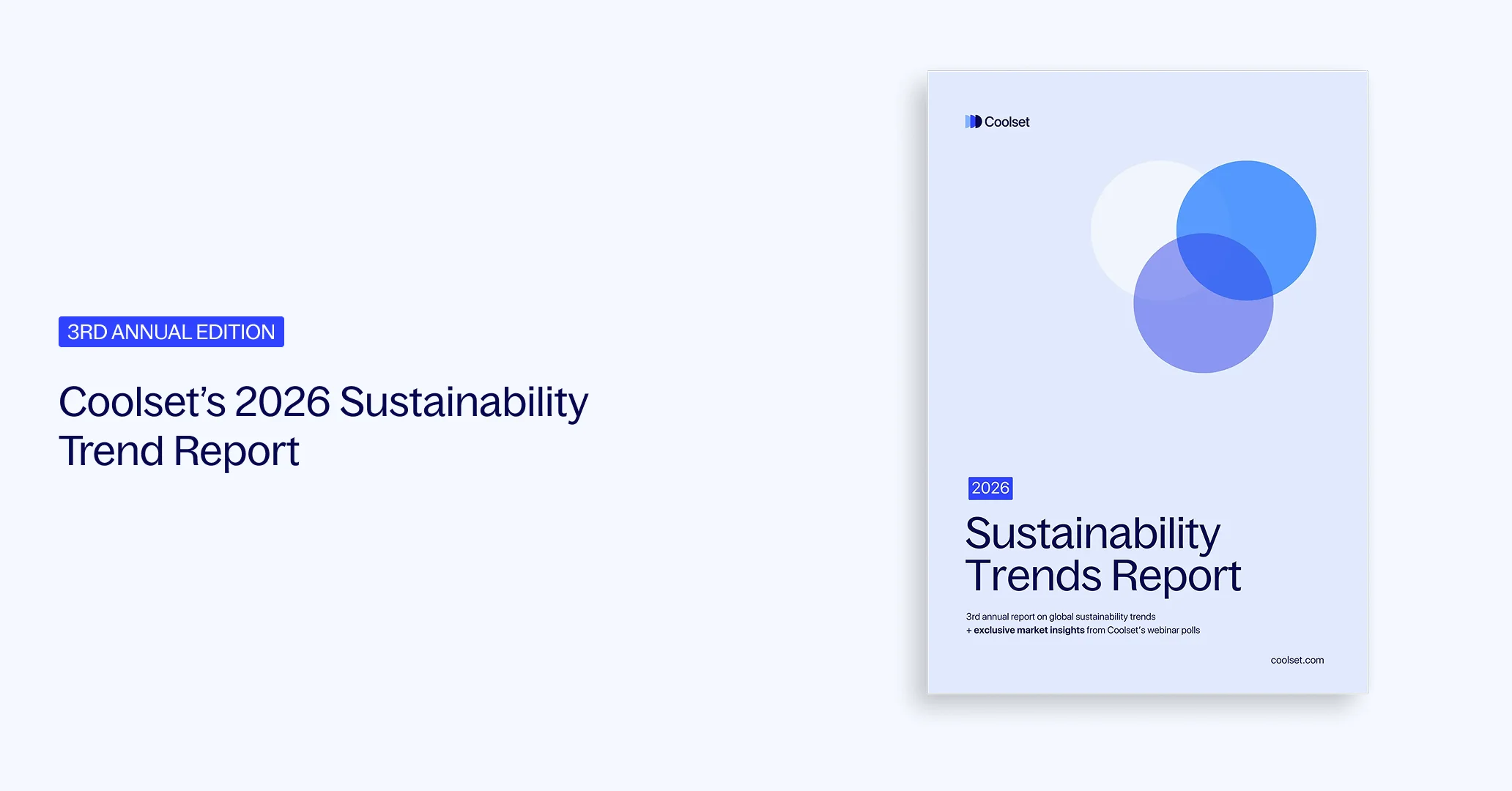
The Sustainability Trends Report 2026 was created to provide that reference.
Each year, the Coolset sustainability research team reviews regulatory developments, market data and industry signals across sustainability and supply chains. This analysis is combined with first-hand research from companies operating within the ESG and supply chain frameworks.
The 2026 edition is the third annual Sustainability Trends Report. It focuses on identifying structural shifts that already affect how companies operate, rather than predicting policy headlines or short-term noise.
{{custom-cta}}
The sustainability trends shaping 2026
Based on our research, we outline six key trends expected to shape sustainability work this year. You can download the full report here.
The trends cut across regulation, supply chains, markets, energy systems, and global governance. Together, they describe how sustainability is becoming more execution-driven, more fragmented, and more closely tied to day-to-day business decisions.
Here is an overview of trends from this year’s Sustainability Trends Report.
Trend 1: Regulatory clarity improves in Brussels
After a year of delays and political debate, EU sustainability regulation has become more predictable. While many obligations are postponed or simplified, the core scopes, definitions and timelines of frameworks such as the Corporate Sustainability Reporting Directive (CSRD), the EU Taxonomy, the Corporate Sustainability Due Diligence Directive (CSDDD), and the EU Deforestation Regulation (EUDR) are now clearly outlined.
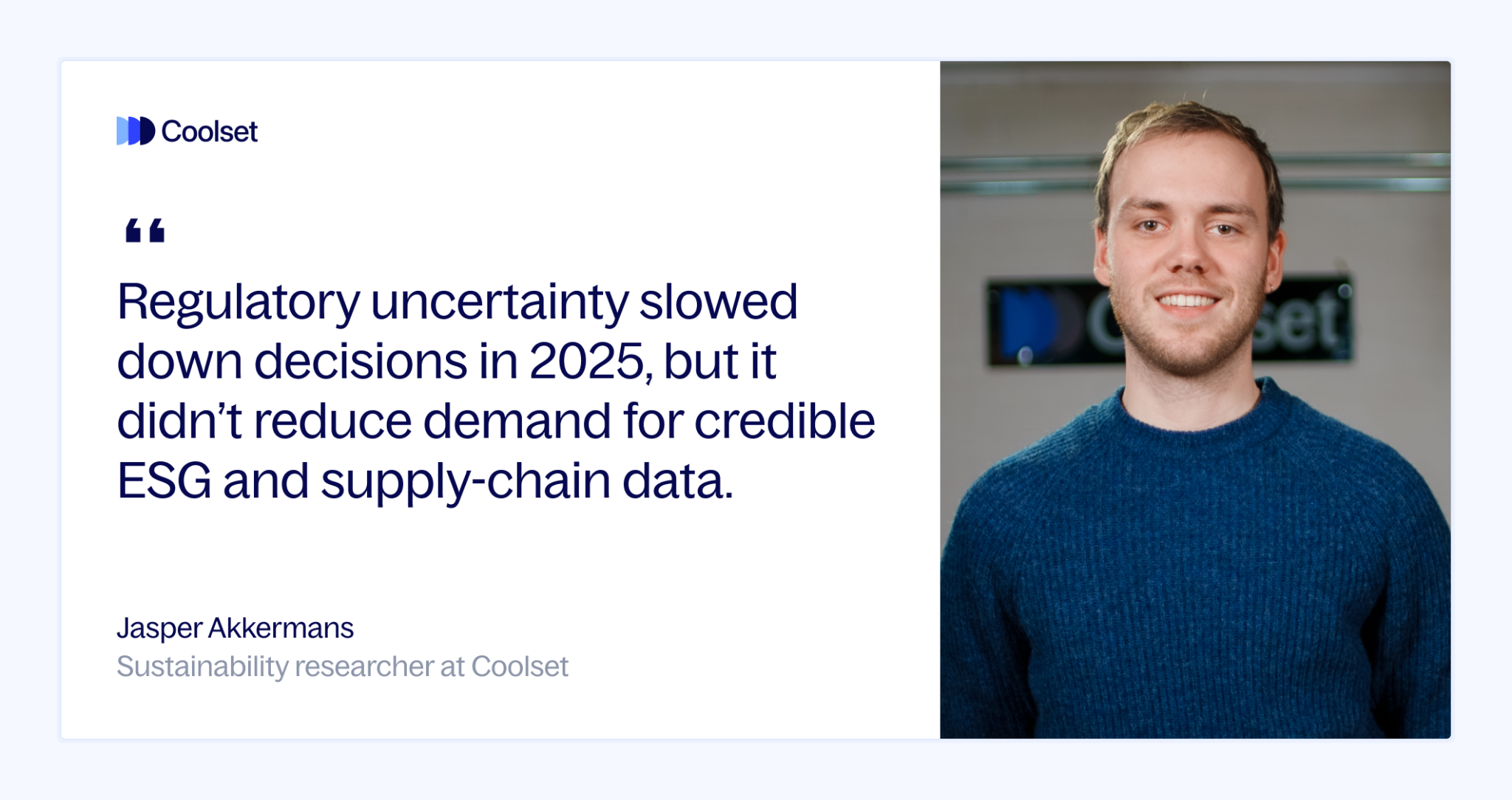
For companies, this does not mean pressure has eased. The focus shifts from interpreting what might happen to preparing for enforcement, data quality checks and increased scrutiny once implementation resumes.
Trend 2: Traceability becomes core infrastructure
In 2026, traceability won’t be treated as one-off compliance exercise and will increasingly function as core infrastructure.
Gaps in supplier, origin and product data now carry real commercial risk, from delayed market access to disrupted sourcing and lost contracts. Regulations such as the EU Deforestation Regulation and growing buyer requirements are emphasizing this shift.
Trend 3: Market incentives rise and begin replacing regulatory drivers
Even where regulation slowed in 2025, markets kept moving.
Investor expectations, procurement requirements and carbon-related costs increasingly influence financing terms, supplier selection and competitiveness. Sustainability performance shows up less as a reporting obligation and more as a factor in economic decision-making.
Trend 4: Renewables overtake coal, but grids become the bottleneck
Renewable electricity generation has overtaken coal globally, marking a major milestone in the energy transition. At the same time, grid infrastructure is struggling to keep up.
For companies, access to clean power increasingly depends on grid capacity, connection timelines, and flexibility rather than generation availability alone. Energy strategy now needs to account for infrastructure constraints, not just targets.
Trend 5: Multilateral climate coordination is losing momentum
Global climate action fragments as political alignment becomes harder to sustain.
Global negotiations stall more often, while regional, national and unilateral approaches fill the gap. For companies operating across borders, this creates a more complex and uneven policy environment where waiting for global alignment is no longer realistic.
Trend 6: Global South as rule-maker
Climate and sustainability rules are no longer shaped only in Europe and North America.
Countries in the Global South increasingly influence disclosure standards, carbon market design, and trade-related sustainability conditions. Expectations now emerge upstream, from producing regions and resource-rich economies, with direct implications for sourcing and supply chains.
Download the 2026 Sustainability Trends Report today
The Sustainability Trends Report 2026 goes deeper into each trend, with detailed context, examples, market insights and guidance on how companies can navigate these shifts from the strategic and operational point of view.
Download the full Sustainability Trends Report 2026 today or share it with colleagues who may benefit from it.
With exclusive insights from 500+ European companies, learn which shifts will shape sustainability in 2026.

Download the 3rd edition of Coolset's Sustainability Trends Report
Learn more about the 6 predicted upcoming trends for 2026


.webp)