Disclaimer: New EUDR developments - December 2025
In November 2025, the European Parliament and Council backed key changes to the EU Deforestation Regulation (EUDR), including a 12‑month enforcement delay and simplified obligations based on company size and supply chain role.
Key changes proposed:
These updates are not yet legally binding. A final text will be confirmed through trilogue negotiations and formal publication in the EU’s Official Journal. Until then, the current EUDR regulation and deadlines remain in force.
We continue to monitor developments and will update all guidance as the final law is adopted.
While double materiality assessments (DMA) have gained in uptake only in recent years, the concept is already 20 years old, with the Global Reporting Initiative implementing it for the first time in 2006 under their G3 guidance.
The double materiality assessment is one of the most widely discussed tools in EU sustainability compliance, but it is also one of the most misunderstood. Most companies treat it as a reporting prerequisite. The ones that get it right treat it as a strategic exercise that shapes everything from risk management to capital allocation.
The "double" framing, explicitly naming two distinct lenses, was first formalized by the European Commission in its 2019 guidelines on the NFRD. The Corporate Sustainability Reporting Directive (CSRD), which entered into force in January 2023, made this dual-perspective assessment a legal requirement.
In November 2025, EFRAG submitted revised European Sustainability Reporting Standards (ESRS) to the European Commission, including a substantially updated ESRS 1 General Requirements, which governs the DMA process. These revised standards are not yet final, as formal Commission adoption is expected in summer 2026, but they signal a clear shift in how the DMA should work: less procedural box-ticking, more strategic judgment.
In this article we walk you through what the DMA is, what has changed, and exactly how to run one under the updated ESRS 1 framework.
Important: The revised ESRS published by EFRAG in November 2025 are still pending formal adoption by the European Commission (expected summer 2026). Wave 1 companies should continue applying the original 2023 ESRS for reporting years 2024-2026. Wave 2 companies will most likely report directly under the amended ESRS from 2027 onward.
Companies reporting voluntarily in 2026 may optionally apply the revised standards early. This article reflects the updated draft ESRS 1 draft to help teams prepare ahead of formal adoption.
A double materiality assessment is a structured process for determining which sustainability topics a company must report on under the CSRD. Under ESRS 1, double materiality means evaluating sustainability matters from two perspectives simultaneously:
The DMA works at two levels, and understanding how they connect is essential:
Topics found to be non-material do not need to be reported. A port-based logistics company in Rotterdam, for example, would likely conclude that land rights impacts on indigenous communities (ESRS S3) are non-material.
.webp)
The November 2025 ESRS 1 draft introduces several meaningful changes to the DMA process, while keeping the core fully intact. Overall, the direction is clear: from compliance-driven checklists toward strategic, judgment-based assessments.
Information materiality is not a new concept, what the revised ESRS 1 adds is a clearer route to reaching materiality conclusions without exhaustive bottom-up evidence. Paragraph 27 states that a company may conclude on materiality "on the basis of an analysis of its strategy and business model including its sector(s) of operations, its geographies, and the features of its upstream and downstream value chain."
Where the outcome is clear from that analysis, the standard is explicit: "if the materiality or non-materiality of one or more impacts, risks or opportunities is not evident on the basis of the above analysis, the undertaking shall perform a specific assessment of them", meaning a deeper assessment is only triggered when the top-down conclusion is genuinely unclear. This is a major update.
The standard also clarifies that quantitative scoring is not always necessary. Application Requirement 12 states: "A qualitative analysis may be sufficient for the undertaking to reasonably conclude on materiality of impacts, risks or opportunities related to a given topic." Companies are not required to perform an exhaustive search for information, only to use what is reasonably available without undue cost or effort. Another major update.
The revised standard emphasizes using "reasonable and supportable information available without undue cost or effort." Companies are not required to perform exhaustive searches or collect perfect data. Qualitative analysis may be sufficient to conclude on materiality. High-level data, sector averages, and peer benchmarks are all valid inputs, particularly for value chain assessments where direct supplier data is unavailable.
The revised ESRS 1 frames the entire sustainability statement, including the DMA, under the concept of "fair presentation." This means the DMA should result in a complete, neutral, and accurate depiction of material impacts, risks, and opportunities. Companies may add entity-specific disclosures wherever the standard ESRS topical standards are insufficient to present a fair picture.
Every company required to report under the CSRD must conduct a DMA. Following the Omnibus I Proposal and the "stop-the-clock" decision, the reporting timeline has been revised:
Even if the Omnibus Proposal delays or narrows mandatory requirements, many companies are running the DMA voluntarily, driven by investor expectations, lender requirements, customer due diligence, and EcoVadis questionnaires. The DMA is increasingly a competitive and commercial necessity, not just a compliance requirement.
For more on CSRD scope and timelines, see Coolset's CSRD academy.
Let’s dive into the practical details of what a DMA actually requires you to do. It’s good to keep in mind that the ‘new’ DMA structure stays the same in its core. If you’ve done a previous DMA, you will be able to reuse most of it.
Before any analysis begins, establish who is responsible for the DMA and how it connects to business decision-making.
Under revised ESRS 1, the reporting boundary for own operations is generally the same consolidated group as your financial statements. Value chain coverage is required to the extent it is necessary for a fair understanding of material impacts, risks, and opportunities.
Compile the starting list of sustainability topics and sub-topics to assess. Appendix A of ESRS 1 provides the full list of topics and sub-topics across ESRS E1 through G1, covering climate change, pollution, water, biodiversity, circular economy, own workforce, workers in the value chain, affected communities, consumers, and business conduct.
For each topic, go one level deeper and draft a preliminary list of IROs: the actual and potential impacts, risks, and opportunities that could plausibly apply to your business. This does not need to be exhaustive at this stage, the goal is to have something concrete to filter in Step 3.
A manufacturing company, for example, might list air pollution from its production sites, chemicals leaking into local water supplies, and the cost savings from switching to cleaner inputs.
Tip: Use AI to provide you with a detailed list of preliminary IROs based on your company profile. Note that an AI list should never be considered exhaustive.
Also consider entity-specific sustainability matters not covered in the ESRS taxonomy, for example, a software company's exposure to cyber attacks. These require entity-specific disclosures if found to be material.
{{product-tour-injectable}}
With your preliminary topic and IRO list from Step 2 in hand, apply the top-down filter. For each topic and its associated IROs, ask:
Where the answer is clearly yes or clearly no, conclude at this stage, no deeper scoring required. Note: When an IRO is ‘clearly yes’ (i.e. clearly material), this means that the associated ESRS topic becomes material.
Where it is genuinely ambiguous, carry that topic and its IROs forward to the impact and financial materiality assessments in Steps 4 and 5. This filter is what keeps the DMA proportionate and prevents unnecessary work on topics that are simply not relevant to your business.
For each IRO, assess using the following criteria: scale and scope apply across all impact types. Likelihood is only relevant for potential impacts, not actual ones. Irremediable character is only relevant for negative impacts. For potential negative human rights impacts, severity takes precedence over likelihood.
Stakeholder engagement is a required input at this step. Affected stakeholders – workers, communities, consumers, civil society – must be consulted directly or through representative bodies. The results of ongoing sustainability due diligence feed directly in here too.
One practical note on mitigation: existing, implemented policies and actions can reduce the assessed severity or likelihood of potential impacts. Policies not yet implemented cannot be counted.
In parallel with Step 4, assess financial materiality for each IRO, identifying which could have a material influence on your company's financial performance, position, cash flows, access to finance, or cost of capital over the short (up to 1 year), medium (1–5 years), or long term (5+ years).
Material financial risks and opportunities arise from three sources:
Assess each IRO on a combination of likelihood of occurrence and potential magnitude of financial effect. Your internal risk management framework is a useful input. If an IRO is already tracked as a business risk, it is likely financially material.
With impact and financial assessments complete, apply the information materiality filter. For each IRO that cleared the bar in Steps 4 or 5, ask: would omitting or misstating information about this IRO influence the decisions of users of your sustainability statement?
This filter determines which specific Disclosure Requirements within a given ESRS topical standard are actually triggered. A topic or IRO being material does not automatically mean every associated data point must be reported. Drop Disclosure Requirements where the specific information they call for is not decision-useful in your context.
Translate your assessments into clear materiality conclusions for each topic and IRO. Document the thresholds you applied and the rationale behind each conclusion, including topics and IROs assessed as non-material, and why. ESRS 2 IRO-1 and IRO-2 require disclosure of both the DMA process and its outcomes, and your documentation must be sufficient to support external assurance.
For each material IRO, identify the ESRS topical standard it falls under and the specific Disclosure Requirements it triggers, covering policies, actions, metrics, and targets. This mapping becomes the direct blueprint for your sustainability statement.
Where an ESRS topical standard does not cover a material IRO with sufficient granularity, develop entity-specific disclosures. Where a material IRO sits outside the ESRS taxonomy entirely, as identified in Step 2, it requires an entity-specific disclosure by default.
All CSRD sustainability statements are subject to limited assurance from year one. Your DMA documentation should capture:
More information on what to report can be found in ESRS 2.

Under revised ESRS 1, the DMA must be reviewed at every reporting date. A full re-run is only necessary if significant changes have occurred in:
If none of these changes apply, you can confirm the existing conclusions. Document this review and its outcome, assurance providers will expect evidence that the assessment has been considered.
Stakeholder engagement is not optional, it is a required input to the impact materiality assessment under ESRS 1.
Affected stakeholders are individuals and groups whose interests are affected by your business activities and value chain relationships. This includes your own workforce, workers in your supply chain, affected communities, and consumers.
Engagement does not require a separate process. Where companies already conduct stakeholder engagement as part of their sustainability due diligence (for example, under the Corporate Sustainability Due Diligence Directive), the outputs of that process feed directly into the DMA.
For companies without a formal due diligence process, the DMA itself is a good starting point. Surveys, focus groups, structured interviews, and workshops are all valid formats.
Workers' representatives must be specifically informed and consulted as part of the process, in line with the CSRD and the Accounting Directive.
The DMA is the foundation for everything in your sustainability statement. The output, a list of material topics and the specific Disclosure Requirements triggered, determines:
How you conducted the DMA – the methodology, scope, stakeholder engagement approach, and materiality conclusions – must itself be disclosed under ESRS 2 General Disclosures, specifically IRO-1 and IRO-2. This means the DMA is not just an internal exercise. It becomes part of the public sustainability statement and is subject to limited assurance.
Under revised ESRS 1, your sustainability statement must also provide "connected information", explaining the links between different material topics, and between the sustainability statement and the financial statements. Where a climate transition plan creates risks for your own workforce, for example, both topics must be addressed in a connected way.
A double materiality assessment (DMA) is the mandatory first step toward CSRD compliance. It identifies which sustainability topics a company must report on by evaluating them from two angles: how the company impacts people and the environment (impact materiality), and how sustainability issues affect its financial performance (financial materiality). A topic is material if it clears the bar from either perspective.
Every company in scope of the Corporate Sustainability Reporting Directive (CSRD) must conduct a DMA. Under the revised Omnibus I timeline, Wave 2 companies, large EU companies with 1,000+ employees, must report for financial year 2027. Listed SMEs follow from 2028. Many out-of-scope companies also run the DMA voluntarily, driven by investor requests, customer due diligence, and EcoVadis questionnaires.
For most companies, a first DMA takes between two and four months. The timeline depends on business model complexity, value chain scope, and whether stakeholder engagement requires a separate process. Using a structured top-down approach, as supported under revised ESRS 1, can significantly reduce the time required.
No. Many companies run the DMA internally using dedicated software to structure the assessment, map IROs, and build audit-ready documentation, without relying on external consultants. The revised ESRS 1 supports qualitative analysis and proportionate evidence collection, which means the right tooling is often enough to get started and stay compliant.
Impact materiality (inside-out) assesses how your company's activities affect people and the environment. Financial materiality (outside-in) assesses how sustainability-related risks and opportunities affect your financial performance, cash flows, or access to capital over time. A topic is material under CSRD if it clears the threshold from either perspective.
IROs stands for impacts, risks, and opportunities, the operative unit of the DMA under ESRS 1. While topics and sub-topics define the longlist of sustainability matters to assess, IROs are the specific instances relevant to your business. The nature and significance of your IROs determines which Disclosure Requirements within each ESRS topical standard apply to your sustainability statement.
Documentation should capture: the reporting boundary; methodology applied (top-down, bottom-up, or combined); stakeholder engagement outputs; the IRO longlist and filtering rationale; thresholds and materiality conclusions; and topics assessed as non-material, with reasons. ESRS 2 IRO-1 and IRO-2 set the specific disclosure requirements for the DMA process and its outcomes.
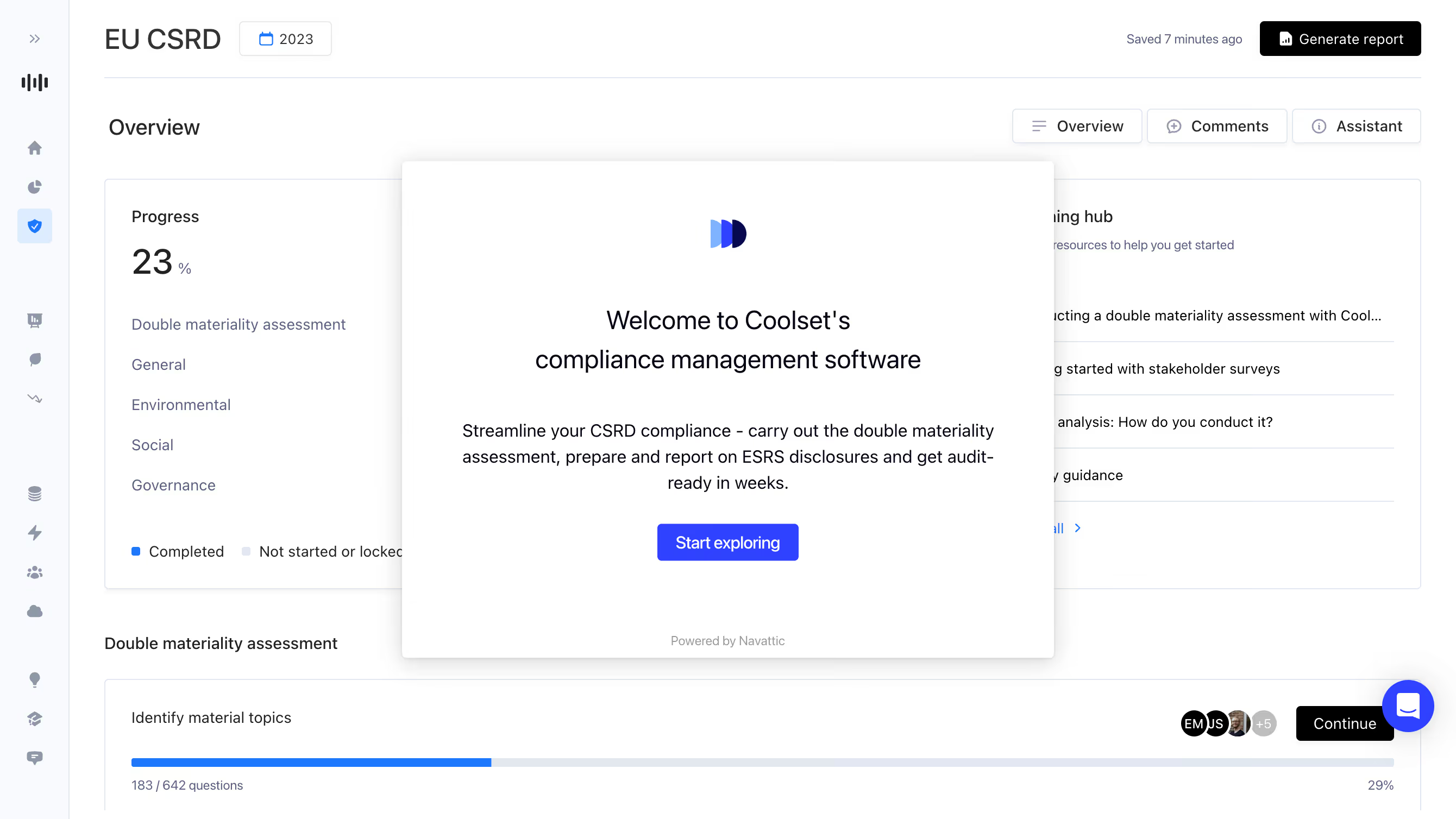
Coolset supports the full CSRD compliance sequence, from double materiality assessment through to audit-ready reporting.
The platform's DMA tool guides stakeholder engagement, generates materiality matrices aligned with ESRS requirements and produces documentation that supports auditor review. For ESRS disclosures, Coolset provides structured templates with smart autofill based on existing organisational data, along with task assignment and team collaboration across departments.
Every disclosure includes an audit trail: supporting documentation, data sources and decision records are linked directly to each data point. Reports export in PDF, Word and XBRL formats.
Coolset also supports data reuse across the Voluntary SME Standard (VSME), EU Taxonomy and the EU Deforestation Regulation (EUDR), so the work done for CSRD doesn't sit in isolation.
If you’d like to know more, set up a call with one of our experts to give you a breakdown of our DMA and ESRS software.
This free compliance checker scans your packaging documentation and maps it against mandatory PPWR data requirements, giving you a clear view of your compliance status. Get actionable insights on documentation gaps before they become compliance issues.
From double materiality to audit-ready ESRS disclosures - Coolset gives your team the tools to report with clarity, accuracy and confidence.

Based on customer case studies our team has developed a realistic timeline and planning for EUDR compliance. Access it here.