EU Omnibus Q&A: What businesses need to know in 2026



Disclaimer: New EUDR developments - December 2025
In November 2025, the European Parliament and Council backed key changes to the EU Deforestation Regulation (EUDR), including a 12‑month enforcement delay and simplified obligations based on company size and supply chain role.
Key changes proposed:
- New enforcement timeline: 30 December 2026 for large/medium operators, 30 June 2027 for small/micro operators
- Simplified DDS: One-time declarations for small and micro primary producers
- Narrowed scope: Most downstream actors and non‑SME traders would no longer need to submit DDSs
- New DDS requirement: Estimated annual quantity of regulated products must be included
These updates are not yet legally binding. A final text will be confirmed through trilogue negotiations and formal publication in the EU’s Official Journal. Until then, the current EUDR regulation and deadlines remain in force.
We continue to monitor developments and will update all guidance as the final law is adopted.
Key takeaways
- The Omnibus I Directive raises the CSRD scope threshold to 1,000 employees and EUR 450M turnover, reducing in-scope companies by roughly 85% and delaying Wave 2 reporting to FY2027.
- Companies no longer in mandatory scope can still report voluntarily under the CSRD or adopt the VSME standard as a lighter alternative.
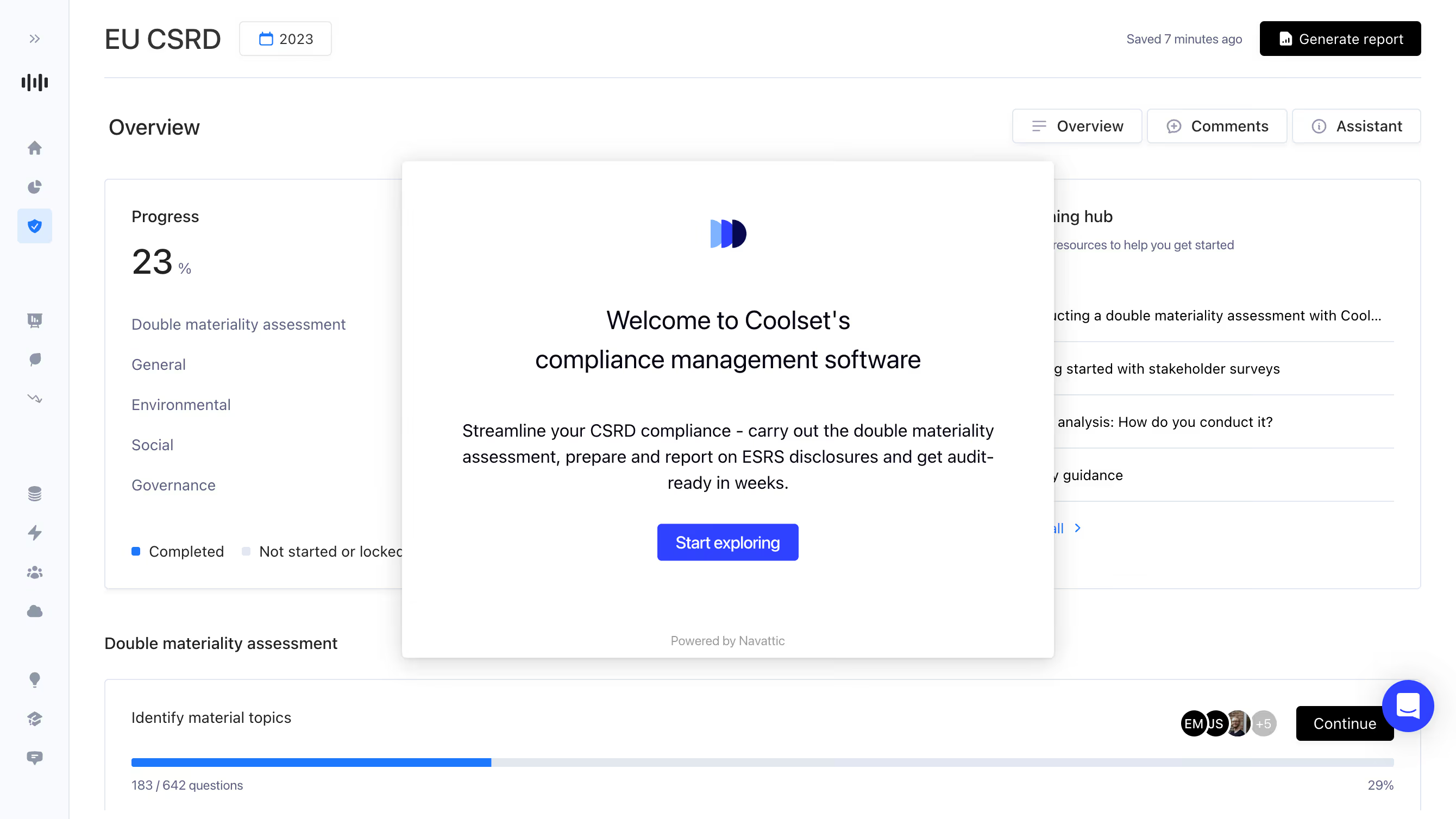
- Coolset's CSRD platform helps companies assess scope, run materiality assessments and build audit-ready reports under both CSRD and VSME.
The EU Omnibus Proposal has already reshaped the CSRD landscape in practice and more changes are coming. With the stop-the-clock delay now legally adopted, and the wider Omnibus I package moving through final publication and national implementation, many companies are reassessing what they need to do in 2026 and beyond.
The direction is clear: mandatory CSRD will apply to fewer companies, the timeline for Wave 2 has been pushed back, and the ESRS are being simplified, placing greater weight on materiality judgement and evidence quality.
To help you navigate these changes, we’ve compiled the most pressing questions companies are asking, from regulatory obligations and financial considerations to the future of ESG reporting.
CSRD scope and reporting obligations
What are the key changes to CSRD under the Omnibus Proposal?
Under the agreed Omnibus approach, CSRD scope is being narrowed significantly. The provisional agreement keeps companies in scope if they meet both:
- More than 1,000 employees, and
- More than €450m net turnover (for EU undertakings), with a similar €450m EU-turnover trigger for non-EU groups.
This is a major shift away from the earlier “250 employees + financial thresholds” model many mid-market companies were preparing for.
Does the 1,000-employee threshold apply to FTE or total headcount?
Companies can report using either FTE (full-time equivalents) or total headcount, but they must disclose their chosen methodology. This is outlined in ESRS S1, paragraph 50b and 50d.
Are contractors and temporary workers included in the 1,000-employee threshold?
No, the threshold only includes direct employees. Contractors, freelancers, and temporary workers are not counted toward the 1,000-employee limit.
Does the threshold apply to EU-based employees only, or does it include global employees?
For EU-based companies, the 1,000-employee threshold includes global employees, meaning multinational firms must count their entire workforce.
If my company meets the €450m net turnover threshold but not the 1,000-employee threshold, do I still have to report under CSRD?
No. Under the agreed approach, mandatory CSRD scope for EU undertakings requires both the employee threshold and the €450m net turnover threshold.
If a company falls below the CSRD threshold but later exceeds 1,000 employees, when does reporting begin?
Crossing the CSRD size thresholds does not automatically trigger reporting the following year. In most cases, a company or group must meet the relevant criteria for two consecutive years before being considered in scope, with reporting starting according to the applicable CSRD phase-in timeline.
If my country has already implemented CSRD into national law, what do I do now?
The stop-the-clock delay is already adopted, so Wave 2 timing is fixed at EU level. For the remaining Omnibus I changes companies remain subject to current national CSRD rules until updated national laws take effect following EU publication and transposition.
What are the risks of stopping with ESG reporting altogether?
Companies that stop ESG reporting risk major financial and operational setbacks. Banks and investors increasingly offer lower interest rates and better financing terms to businesses with strong ESG performance. Large clients and supply chain partners often require ESG disclosures, meaning companies without them risk losing major contracts. Furthermore, ESG reporting helps businesses assess climate and social-related risks (such as supply chain disruptions due to extreme weather or changing labor regulations), allowing them to implement mitigation strategies.
{{custom-cta}}
The Future of ESG reporting and the shift to VSME
What is VSME, and why was it introduced?
VSME (Voluntary Sustainability Reporting Standard for SMEs) was developed at the request of the European Commission for non-listed micro, small and medium enterprises and falls outside the CSRD reporting regime. Developed by EFRAG, the same organization responsible for the ESRS (European Sustainability Reporting Standards), VSME aligns closely with ESRS while offering a simplified approach. Its purpose is to help SMEs enhance transparency and demonstrate sustainability commitments without the complexity and administrative burden of full CSRD compliance.
Should I continue reporting on CSRD, or switch to VSME?
A practical rule of thumb in 2026:
- If you’re clearly in scope (or highly likely to be), stay on a CSRD track.
- If you’re likely out of scope under the new thresholds but still get ESG requests from customers/banks, VSME can be a strong “right-sized” baseline.
Why choose VSME over GRI or other voluntary reporting frameworks?
VSME is positioned as the EU’s preferred voluntary on-ramp, which may make it easier to respond to EU buyer and lender requests. If you operate globally or already use GRI, many companies choose a mapping approach (GRI for broad stakeholder reporting, combined with VSME- or ESRS-aligned disclosures for EU customer, lender, and procurement requests).
Is reporting under VSME more cost-effective?
Yes, reporting under VSME is significantly more cost-effective compared to mandatory CSRD reporting. One of the biggest savings comes from the exemption from the CSRD audit, which can cost between €50,000 and €150,000. Additionally, VSME requires less extensive data collection and reporting complexity, reducing the time commitment for internal teams and minimizing the need for external consulting services.
Will large companies still request ESG data from suppliers post-Omnibus?
Yes. Large companies will still need supplier data for risk management and reporting, but the expectation is that asks to SMEs should be more targeted and aligned to simplified approaches.
Compliance and financial considerations
How does financial consolidation affect CSRD obligations?
Mandatory CSRD reporting is typically assessed at group level. If a company is required to prepare consolidated financial statements and the group meets the CSRD thresholds, the group must publish a consolidated CSRD report, which can cover its subsidiaries.
For those reporting under CSRD, how does the Omnibus impact value chain reporting?
Companies in CSRD scope will be limited in what they can request from value-chain partners with up to 1,000 employees: those partners can refuse information requests that go beyond a voluntary standard expected to be based on VSME.
How does the Omnibus affect EU Taxonomy and CSDDD thresholds?
EU Taxonomy: The Omnibus package limits mandatory EU Taxonomy reporting to the largest companies (at least 1,000 employees and €450m net turnover) while allowing others to report voluntarily.
CSDDD: Mandatory CSDDD obligations are expected to apply only to very large companies, generally those with more than 5,000 employees and a net turnover exceeding €1.5 billion.
If a company is no longer in CSRD scope, does that mean it is also exempt from EU Taxonomy and CSDDD?
In most cases, yes. If you fall outside the narrowed CSRD scope, you are also unlikely to be in scope for mandatory EU Taxonomy reporting, and even less likely to be captured by CSDDD, which targets a smaller population of very large companies.
Omnibus timeline and next steps
When will the Omnibus Proposal be approved and take effect?
Some Omnibus changes are already in force. In particular, the “stop-the-clock” delay has been formally adopted, pushing back the first CSRD reporting date for Wave 2 companies to 2028 (covering FY2027).
The remaining Omnibus changes, including the narrowed CSRD scope and the Amended ESRS, have been politically agreed at EU level and are expected to enter into force following final legal adoption, publication, and national implementation.
What happens if the Omnibus Proposal is rejected?
A full reversal is extremely unlikely. The reporting delay is already law, and there is broad alignment between the European Commission, Parliament, and Council on narrowing scope and simplifying requirements.
Practical next steps for businesses
Should companies continue preparing for CSRD or wait for the Omnibus?
Companies should adjust preparation, not pause it:
- Companies clearly in scope should continue preparing for CSRD reporting.
- Companies likely to fall outside the narrowed scope should focus on materiality, core ESG data, and VSME-level disclosures, which are increasingly requested by customers, banks, and procurement.
When will Coolset support VSME reporting on its platform?
Coolset's VSME product is now ready. Please schedule a time with our team to discuss it.
Learn ow to run a ‘simplification-ready’ double materiality assessment that reduces rework and holds up to audit expectations

on mobile screens
to experience this demo.


↘ Check if your documentation meets PPWR requirements
This free compliance checker scans your packaging documentation and maps it against mandatory PPWR data requirements, giving you a clear view of your compliance status. Get actionable insights on documentation gaps before they become compliance issues.
Start reporting on VSME
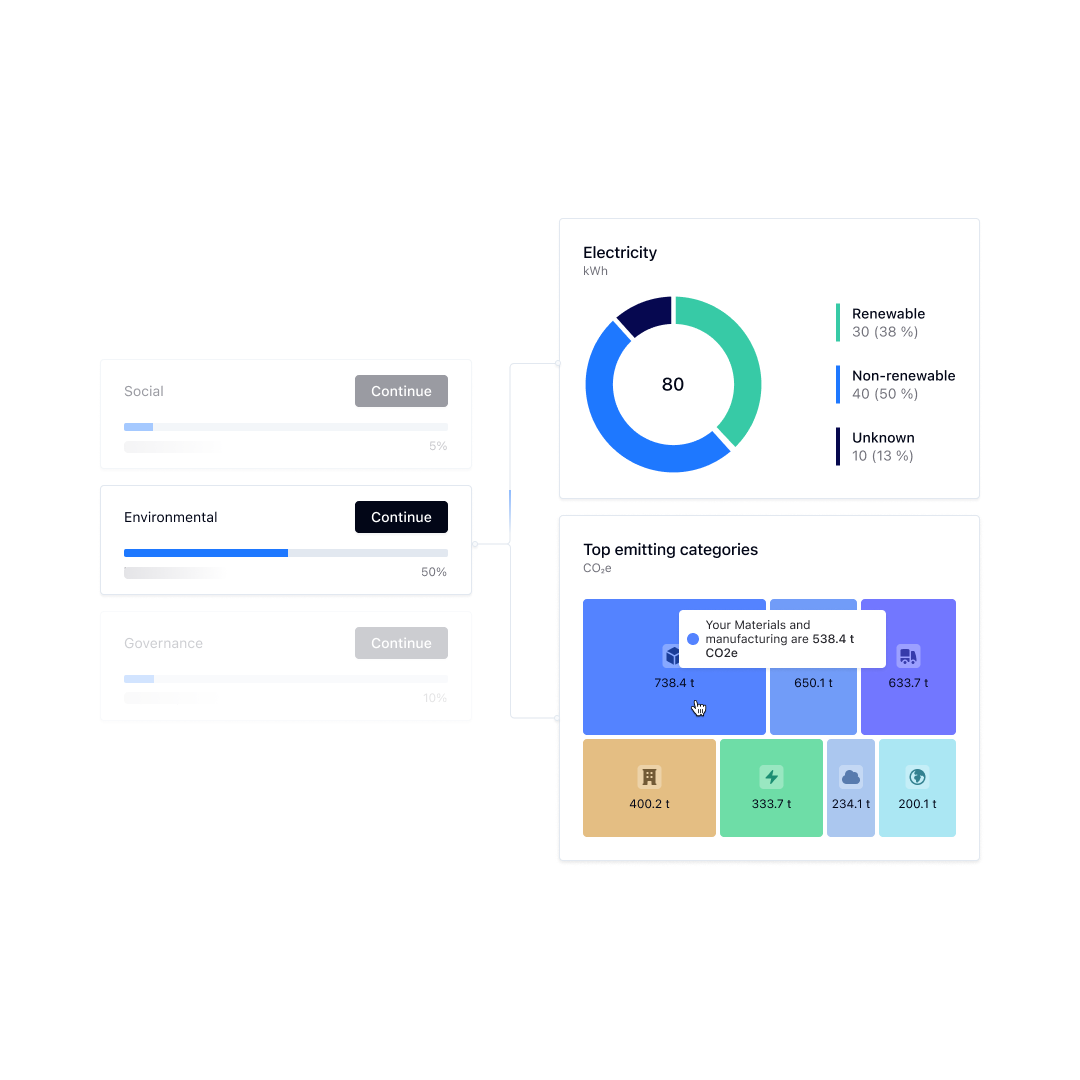
Collect ESG data, collaborate and create structured, automated reports with Coolset.

.webp)