PPWR substance restrictions: PFAS, heavy metals, and banned chemicals explained


Disclaimer: New EUDR developments - December 2025
In November 2025, the European Parliament and Council backed key changes to the EU Deforestation Regulation (EUDR), including a 12‑month enforcement delay and simplified obligations based on company size and supply chain role.
Key changes proposed:
- New enforcement timeline: 30 December 2026 for large/medium operators, 30 June 2027 for small/micro operators
- Simplified DDS: One-time declarations for small and micro primary producers
- Narrowed scope: Most downstream actors and non‑SME traders would no longer need to submit DDSs
- New DDS requirement: Estimated annual quantity of regulated products must be included
These updates are not yet legally binding. A final text will be confirmed through trilogue negotiations and formal publication in the EU’s Official Journal. Until then, the current EUDR regulation and deadlines remain in force.
We continue to monitor developments and will update all guidance as the final law is adopted.
Key takeaways
- The PPWR sets three substance requirements that all apply from 12 August 2026: a general duty to minimise substances of concern, a combined limit on four heavy metals, and concentration limits on PFAS in food-contact packaging.
- As a manufacturer, you self-declare conformity. The burden of proof sits in your own technical file, built on supplier data you mostly do not hold in one place today.
- Coolset helps manufacturers and importers check whether their packaging documentation meets PPWR requirements before the deadline.
Three substance rules, one deadline
Most of the conversation about the PPWR focuses on recyclability and recycled content, which roll out from 2030. The substance rules are different: they are among the first obligations to apply, and they apply on the general application date of 12 August 2026 with no grace period. After that date, packaging that does not meet them cannot lawfully be placed on the EU market, regardless of when it was produced.
For manufacturers, the regime breaks into three distinct requirements under Article 5 of the Regulation:
- A general obligation to minimise substances of concern in all packaging.
- A combined concentration limit on four heavy metals in all packaging.
- PFAS concentration limits that apply to food-contact packaging only.
The three requirements work together, and your conformity file should address all of them.
The PFAS restriction: scope and thresholds
The PPWR does not ban PFAS outright; it sets maximum concentration levels for food-contact packaging. PFAS (per- and polyfluoroalkyl substances) are the family of chemicals widely used as grease and water repellents on paper, board and moulded fibre, which is exactly why food-service packaging is one of the most exposed categories.
From 12 August 2026, food-contact packaging cannot be placed on the market if it contains PFAS at or above any of the limits outlined in Art. 5(5) of PPWR. The Commission recommends following the approach for verifying that your products comply with the food-contact PFAS limits:
- Total fluorine (TF) screening: How much fluorine does the sample contain?
If TF is below 50 ppm, the sample can be considered compliant. No further testing needed. - Distinction between organic and inorganic fluorine
If TF is above 50 ppm, fluorine is likely to be inorganic (not PFAS). Testing must be done to determine whether the sample contains organic (PFAS) or inorganic (not PFAS) fluorine. - Targeted analysis of any individual PFAS and sum of PFAS
Direct analysis has to be employed to determine the measurement of any individual PFAS and the sum of PFAS in the sample
Three practical points decide how much work this is for you:
- It covers intentional and unintentional PFAS alike. The Regulation makes no distinction. In practice, only packaging where PFAS were intentionally added tends to exceed the limits, but the obligation applies either way.
- The limit applies to the packaging unit as a whole. That includes the associated inks, varnishes, glues and adhesives placed on the market, not just the base substrate. A clean substrate paired with a non-compliant coating still fails.
- There is no published list of restricted PFAS. No CAS-number list will be issued. The limits apply to every substance falling within the Regulation's definition of PFAS, so you cannot screen against a fixed list.
A separate, horizontal PFAS restriction is moving through REACH on its own timeline. The two tracks run in parallel: the PPWR sets the packaging-specific perimeter that applies from August 2026, and the REACH route is a broader restriction whose final scope is still being defined. The Commission must review the PPWR PFAS limits by 12 August 2030 to assess any overlap and decide whether to amend or repeal them.
Heavy metal limits
The combined concentration of lead, cadmium, mercury and hexavalent chromium must not exceed 100 mg/kg across all packaging, not only food-contact. This limit carries forward from Directive 94/62/EC, which the PPWR repeals and replaces, so companies already meeting it mostly need to update their technical documentation to reference Regulation (EU) 2025/40.
Glass packaging has a defined derogation pathway where the exceedance results from recycled glass content and no heavy metal is intentionally introduced during manufacturing. Glass bottlers can rely on it, but they still need to be able to evidence that they qualify.
{{custom-cta}}
The substances of concern obligation
This is the part that most often gets underestimated. Alongside the named limits, Article 5(1) requires that all packaging be manufactured so that the presence and concentration of substances of concern is minimised in the material itself and in emissions and waste-management outcomes such as ash, leachate and secondary raw materials.
A substance counts as a substance of concern if it meets at least one of the criteria borrowed from the Ecodesign for Sustainable Products Regulation (Article 2(27)). The conditions are not cumulative, one is enough. In summary, a substance qualifies if it:
- is a Substance of Very High Concern under REACH;
- is classified under the CLP Regulation in a relevant hazard class (carcinogenicity, mutagenicity, reproductive toxicity, endocrine disruption, PBT/vPvB or PMT/vPvM properties, sensitisation, aquatic or ozone-layer hazard, or specific target organ toxicity);
- is regulated under the POPs Regulation (EU) 2019/1021; or
- negatively affects the reuse or recycling of the material it is in.
Two features make this different from the PFAS and heavy metal limits. First, there is no general concentration threshold. The duty is to minimise, with the underlying principle that human health and the environment are protected. Second, there is no closed list of substances. The Commission and ECHA must publish a report on substances of concern in packaging by 31 December 2026, which may eventually lead to new restrictions. The definition is already in force, and a manufacturer can identify qualifying substances today using the existing hazard classifications and the ECHA candidate list.
One crucial element that distinguishes the PPWR from the old EN 13428:2004 concerns the presumption of conformity for substances of concern. After 12 August 2026, the PPWR will no longer create such a presumption of conformity, because it addresses end-of-life emissions rather than the full life-cycle scope the PPWR now requires.
Key deadlines for manufacturers
12 August 2026: Substances of concern minimisation duty (all packaging), heavy metal limit (all packaging) and PFAS limits (food-contact packaging) all apply. EN 13428:2004 no longer creates a presumption of conformity for substances of concern.
31 December 2026: Commission and ECHA report on substances of concern in packaging is due, with possible follow-up restrictions.
12 August 2030: Commission review of the PPWR PFAS limits against REACH, the POPs Regulation and food-contact materials rules.
The headline date is 12 August 2026 but the work that proves compliance, including collecting supplier data, commissioning tests, reconciling it into a defensible file, has to be finished before the first non-compliant shipment would otherwise move.
%20Template%20-%20Split%20width%20-%201_1%20-%20Visual%20Right%20(2).webp)
What this means for your conformity evidence
The PPWR uses internal conformity assessment, not third-party certification. That puts the documentation burden squarely on you as the manufacturer, and it makes the quality of your evidence highly relevant.
A defensible compliance process has three layers:
- Substance-level test data. Each restricted substance must be shown to sit below the applicable threshold, tested at the material-layer level rather than on the finished pack. A single aggregate report can dilute a component-level failure below detection while still being non-compliant in use.
- A documented chain of custody for that data. If a supplier ran the test, you need their actual report, not a summary of it. Under Article 16, suppliers are obliged to give you the information needed to demonstrate conformity, and that obligation extends across pigments, inks, adhesives, coatings and recycled-content streams — anywhere a restricted substance could enter the packaging. Generic "PFAS-free" letterhead statements don't satisfy this; you need the underlying substance data behind the claim.
- A reasoned methodology that explains how you turned the test results and supplier evidence into a conformity decision for the packaging as placed on the market.
All of this feeds the technical documentation required under Annex VII and the EU Declaration of Conformity you issue from August 2026. Note the Article 21 rule: if your name or brand appears on the packaging, you are the manufacturer for PPWR purposes even if you did not produce it, and the declaration is yours to issue.
Non-compliance carries layered exposure: market surveillance authorities can demand corrective action, withdrawal or recall, and Member States can impose fines. Where a packaging type has already been the subject of a prohibition measure, customs can stop further shipments at the EU border on a risk basis. That combination is what turns substance compliance from a sustainability side project into a procurement and logistics priority.
What to do this week
- Pull the bill of materials for your highest-volume food-contact packaging SKUs and send each supplier a written request for substance test reports, per material layer, covering PFAS and the four heavy metals. Reference Regulation (EU) 2025/40 and the 12 August 2026 application date, and set a 30-day response deadline.
- Screen your full portfolio against the substances-of-concern criteria using the ECHA candidate list and CLP classifications, so you know which materials carry a minimisation and documentation duty even where they clear the numeric limits.
The pattern of supplier responses is your gap analysis. It tells you which materials, suppliers and SKUs need active intervention — reformulation, resourcing, or replacement — while there is still time to act before the Regulation applies.
Frequently asked questions
Does the PPWR ban PFAS? No. It sets maximum concentration limits for food-contact packaging, 25 ppb for any individual PFAS, 250 ppb for the sum, and 50 ppm including polymeric PFAS, rather than prohibiting the substances outright. A separate horizontal PFAS restriction is being developed under REACH on its own timeline.
Do the heavy metal limits apply to all packaging or only food-contact? All packaging. The combined limit of 100 mg/kg for lead, cadmium, mercury and hexavalent chromium applies regardless of contents. Only the PFAS limits are scoped to food-contact packaging.
Is there a list of substances of concern to check against? Not a definitive one. The Commission and ECHA report due by 31 December 2026 may list relevant substances, but the legal definition is already in force from August 2026. Manufacturers identify qualifying substances now using REACH SVHC status, CLP hazard classifications, POPs regulation coverage, and recyclability impact.
Who is responsible for demonstrating compliance? The manufacturer placing the packaging on the market. Suppliers must provide the underlying information under Article 16, but the conformity decision and technical documentation are the manufacturer's. If your name or brand is on the packaging, you are the manufacturer for PPWR purposes.
Do the PFAS limits cover inks and adhesives? Yes. The limits apply to the packaging unit as a whole, including associated inks, varnishes, glues and adhesives. Test at the material-layer level rather than relying on a single report for the finished pack.
The Packaging and Packaging Waste Regulation (PPWR) turns PFAS and heavy metals into a supplier documentation problem. Coolset helps compliance teams collect substance evidence across SKUs and suppliers, and keep it audit ready.
.webp)

on mobile screens
to experience this demo.
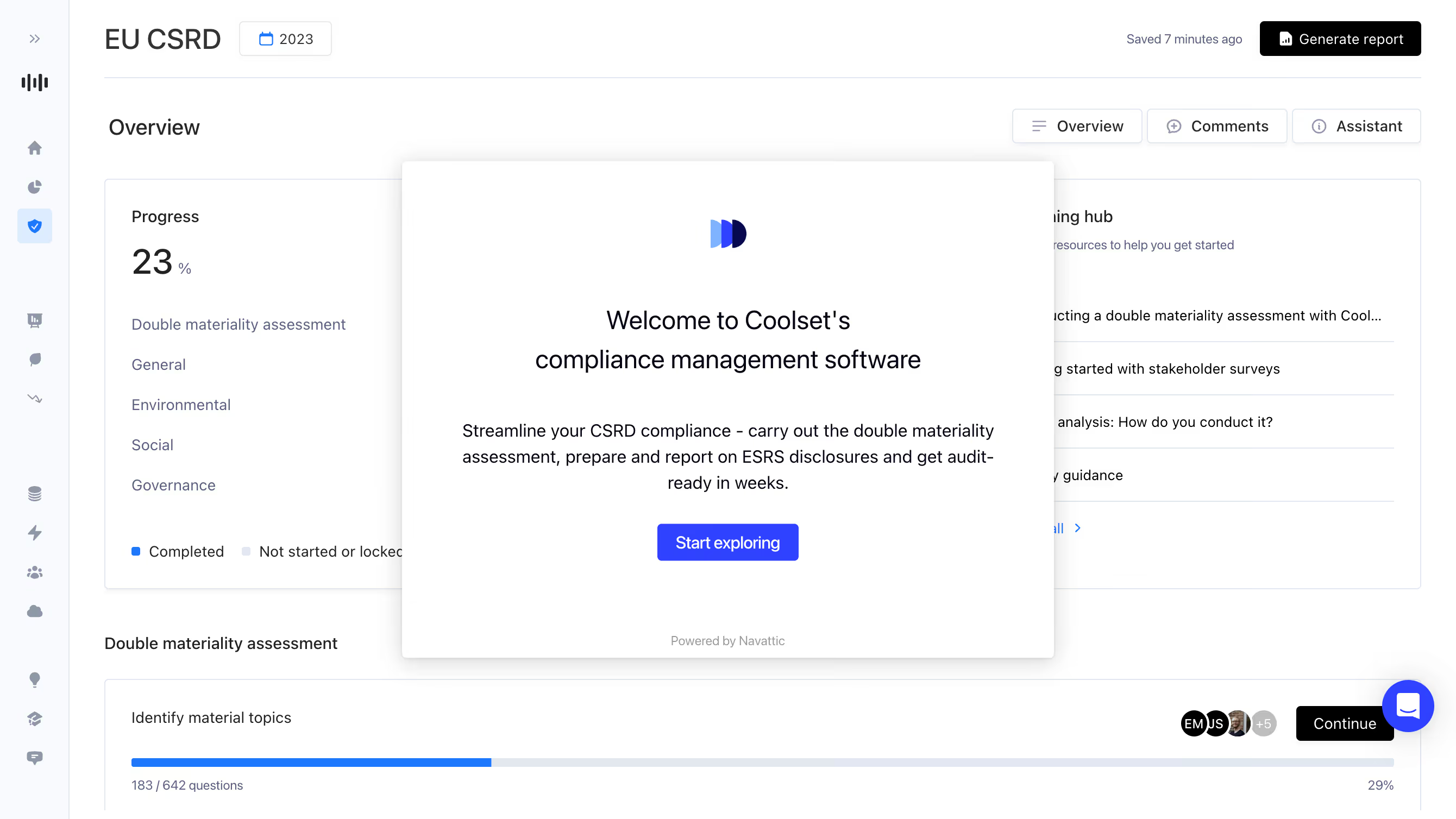
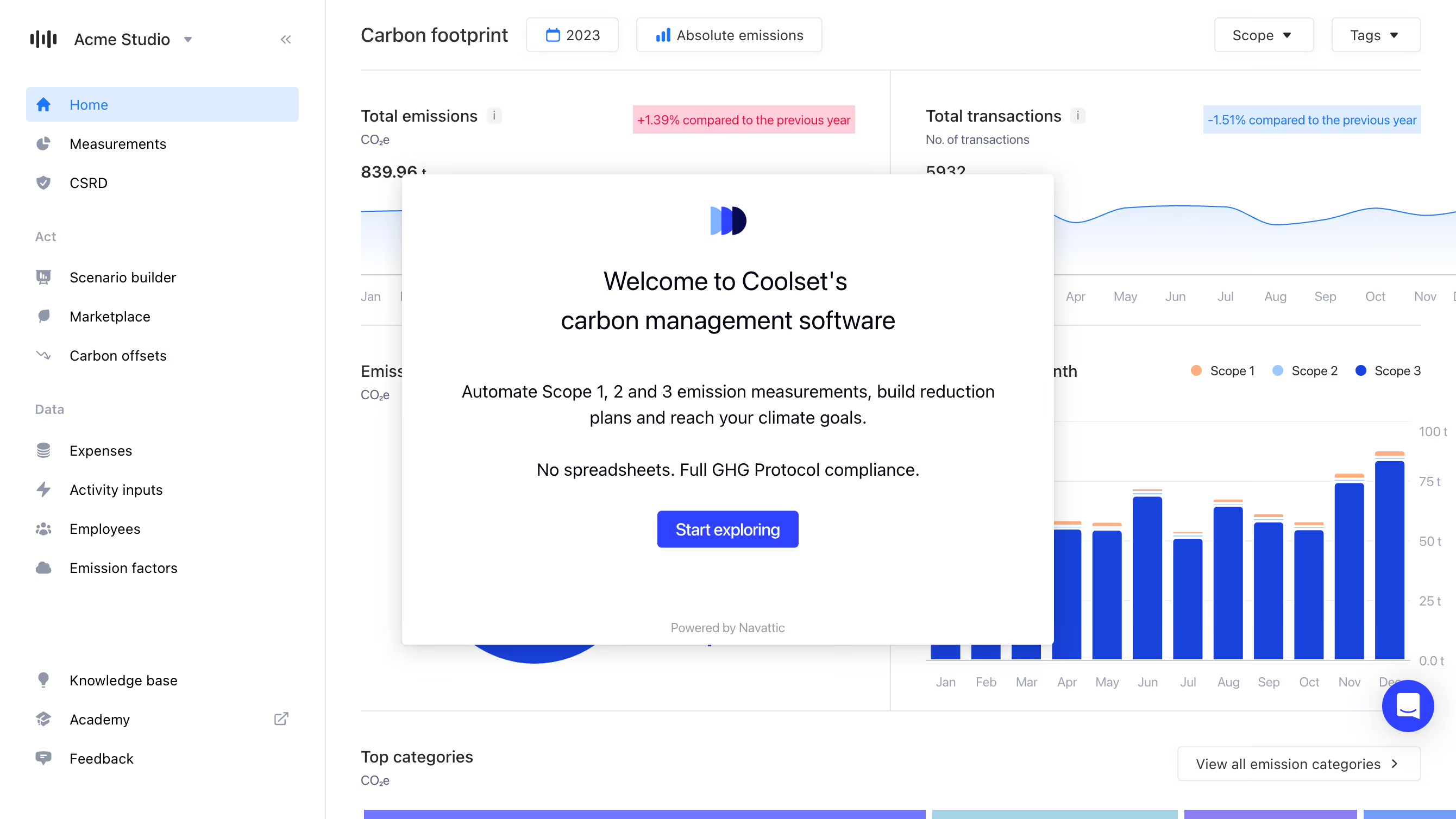
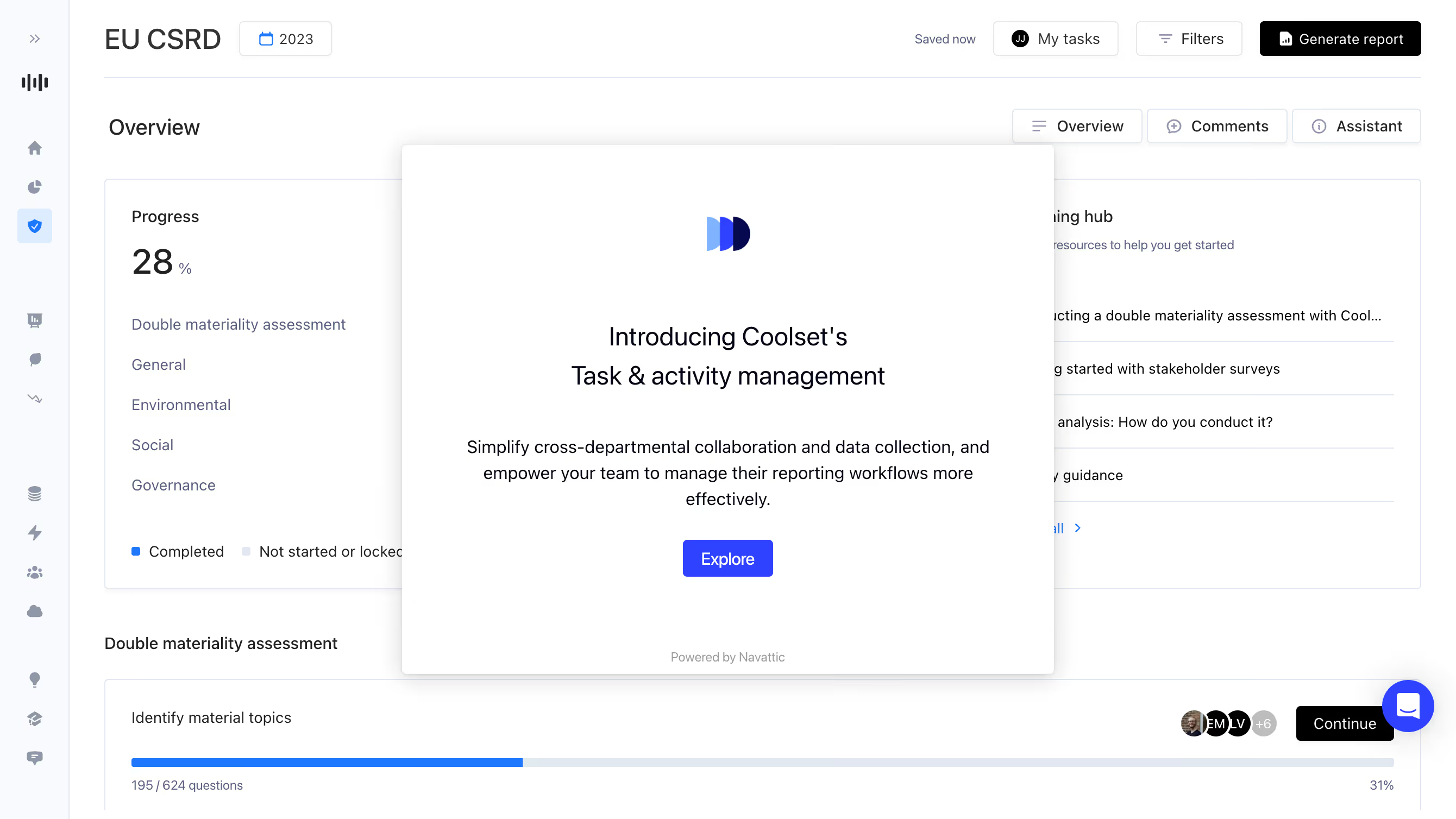


↘ Check if your documentation meets PPWR requirements
This free compliance checker scans your packaging documentation and maps it against mandatory PPWR data requirements, giving you a clear view of your compliance status. Get actionable insights on documentation gaps before they become compliance issues.

.webp)