EUDR delay 2025: What the EU Parliament vote means for importers and operators (Updated June 2026)
.webp)


Disclaimer: New EUDR developments - December 2025
In November 2025, the European Parliament and Council backed key changes to the EU Deforestation Regulation (EUDR), including a 12‑month enforcement delay and simplified obligations based on company size and supply chain role.
Key changes proposed:
- New enforcement timeline: 30 December 2026 for large/medium operators, 30 June 2027 for small/micro operators
- Simplified DDS: One-time declarations for small and micro primary producers
- Narrowed scope: Most downstream actors and non‑SME traders would no longer need to submit DDSs
- New DDS requirement: Estimated annual quantity of regulated products must be included
These updates are not yet legally binding. A final text will be confirmed through trilogue negotiations and formal publication in the EU’s Official Journal. Until then, the current EUDR regulation and deadlines remain in force.
We continue to monitor developments and will update all guidance as the final law is adopted.
Key takeaways
- Parliament backed a delay to 30 December 2026 for large operators, and 30 June 2027 for small and micro operators.
- New definitions clarify lighter requirements for small producers and downstream actors.
- The Commission must conduct a formal simplification review by April 2026.
- Legal enforcement dates remain unchanged until the revised law is formally adopted.
What did the European Parliament vote for on the 26 November?
On 26 November, a majority in the European Parliament voted in favour of a 12-month delay to the EU Deforestation Regulation (EUDR), and an additional review to propose more simplifications in April 2026. This position is supported by the European People’s Party (EPP) and far-right groups despite failed attempts by other political groups to reach a more moderate compromise.
The vote gives the Parliament an official negotiating position and clears the way for trilogue negotiations, the next step where the Parliament, Council, and Commission work toward agreeing on a final legal text.
No position becomes law until a compromise is reached, adopted, and published in the Official Journal of the EU. Until that final text is adopted and published, the current legal deadline of 30 December 2025 remains in force. However, with all three institutions now aligned in principle, both the delay and simplification review are highly likely to be included in the final outcome.
What has been accepted in the voting of the Parliament today?
On 26 November 2025, the European Parliament voted in favour of a package of amendments to the EUDR.
We break them down for you one-by-one:
New timeline put forward by Parliament, now aligned with Council position
- New application dates: 30 December 2026 for large and medium operators, 30 June 2027 for small and micro operators (for non-timber, in-scope products).
- No grace or testing period: the regulation will apply in full from the new dates once adopted.
New roles and responsibilities defined accepted by Parliament
- Introduction of a new category “small and micro primary operators’’
- Introduction of a new category “downstream operators”
- Non-SME traders do not have to create new DDSes for their orders
Additional changes to downstream operator/traders responsibilities
- Only the first downstream operator needs to record traceability and upstream DDS references
- Downstream operators that buy from downstream operators/traders are excluded from EUDR
- Downstream operators that export their products do not need to show a DDS during customs clearance
Additional changes to small and micro primary operator responsibilities
- Small and micro primary operators will need to create only a -one time- simplified declaration.
- Small and micro primary operators will have to update the simplified declaration only if -major- changes happen.
A new simplification review
- The Commission must assess the regulation’s administrative burden by 30 April 2026, with the option to propose further simplification or legislative changes.
Additional change to operator DDS information needed
- Operators must now include a one-off estimated annual quantity of the relevant products intended to be placed on the market or exported when submitting a DDS under Annex II.
Download our latest roles and responsibilities table here

What are the positions of the European Commission, Council and Parliament?
Throughout late 2025, EU institutions debated how to adjust the EUDR timeline and reduce administrative complexity, particularly for small and micro primary operators. While the Commission and Council agreed on the need for flexibility, they proposed different approaches.
Here is a more detailed breakdown of each position, including the Parliament’s role.
European Commission
On October 21 2025, the Commission proposed:
- Keeping the current enforcement date of 30 December 2025
- Introducing a grace period (January-June 2026) where enforcement would be supportive rather than punitive
- Extending the compliance deadline for small and micro operators to 30 December 2026
- Defining simplified obligations for micro and small primary operators
- Clarifying roles for downstream operators and non-SME traders
Council of the EU
On 17 November 2025, the Council published its official position:
- A full one-year delay, applying the EUDR from 30 December 2026 for medium and large operators, and from 30 June 2027 for micro and small operators
Due diligence responsibility placed exclusively on the first operator placing a product on the EU market - Downstream operators and traders would not submit separate DDSs, but must retain and pass on the reference number
- Micro and small primary operators would submit a one-time simplified declaration
The European Parliament has now voted to support a similar enforcement delay and simplification measures. Both institutions now agree on the core direction of change, allowing trilogue negotiations with the Commission to begin, where the final legal text will be negotiated.
European Parliament
On 26 November 2025, the Parliament:
- Voted in favour of the Council’s proposal for a full one-year delay
Supported the simplification review clause - Confirmed its position for trilogue negotiations with limited amendments
The legislative process will now move into trilogue discussions, aiming to finalise and adopt the revised EUDR before the end of 2025.
The table below summarises the current positions of the three key EU institutions involved in the EUDR revision process:

A brief history of EUDR changes and developments
The EUDR has evolved from a planned start in 2024, to a delay to 2025, followed by proposals for a grace period and simplified rules for smaller operators. On 26 November 2025, the European Parliament backed a full one-year delay and simplification review. Final details will now be decided in trilogue talks.
Here’s how the timeline has evolved:
- May 2023 - EUDR adopted
The EUDR was formally adopted with a planned enforcement date of 30 December 2024.
- October 2024 - First delay approved
Enforcement was postponed to 30 December 2025 due to Member State readiness concerns and technical delays with the EU’s TRACES information system.
- October 2025 - Commission proposes phased approach
The Commission suggested keeping the 2025 deadline but introducing a grace period and simplifications for small producers.
- November 2025 - Council backs full delay and review
The Council proposed a full 12-month delay and a simplification review by April 2026.
- November 2025 - Parliament supports delay
On 26 November, the Parliament voted to support the delay and review, effectively aligning with the Council’s position.
- Coming weeks - Parliament to head into trilogue negotiations and adopt a first reading
Parliament will agree on its official position and formally submit it as its first-reading text, triggering trilogue negotiations with the Council and Commission. Talks are expected to move quickly, as both Parliament and Council now support the delay and simplification review.
- December 2025 - Delay ensured
If the trilogue concludes successfully, the final legal text will be adopted and published in the EU’s Official Journal before the end of the year, formally confirming the new enforcement dates and obligations.
- April 2026 - Further review
The European Commission will deliver a formal review of the regulation’s administrative burden. This may result in a new legislative proposal, depending on the outcome.

Coolset are tracking the latest developments and the official EUDR timeline in this article.
Has the EUDR deadline officially changed?
Not yet. While the Parliament and Council now support the delay, the revised regulation will not become law until a final text is agreed in trilogue and formally adopted.
Trilogues are closed-door meetings where representatives from all three institutions work to agree on a single, final version of the law. This process involves:
- Comparing each institution’s position
- Proposing compromise wording
- Aligning on key changes (e.g. enforcement dates, roles, simplification)
Once a provisional agreement is reached, the text is sent back to both the Parliament and Council for formal approval. Only after this second approval is the law adopted and published in the Official Journal of the EU, at which point it becomes legally binding.
A one-year delay is likely, but not confirmed until the final law is adopted. Until that happens, the current legal deadline of 30 December 2025 remains in force.
{{custom-cta}}
What should importers and operators be doing now?
Companies should continue preparing for EUDR compliance focusing on traceability, supplier data, and due diligence documentation based on their role in the supply chain:
- Operators (not exempt): Continue full preparation for due diligence and TRACES submissions.
- Downstream operators/traders buying from operators: Set up systems to record traceability data and DDS references.
- Downstream operators/traders buying from other downstream actors: You are no longer in scope.
- Small and micro primary operators: Prepare to submit a one-time simplified declaration once the functionality is available in TRACES.
Even amid political uncertainty, companies should move forward with core EUDR readiness activities:
- Finalize traceability systems for in-scope products
- Collect geolocation data and land-use proof from suppliers
- Classify your operator/trader role under the EUDR
- Draft and test due diligence statements (DDS) in the TRACES test environment
- Update contracts and procurement templates with EUDR data-sharing clauses
See our checklist below:

How software supports compliance through uncertainty
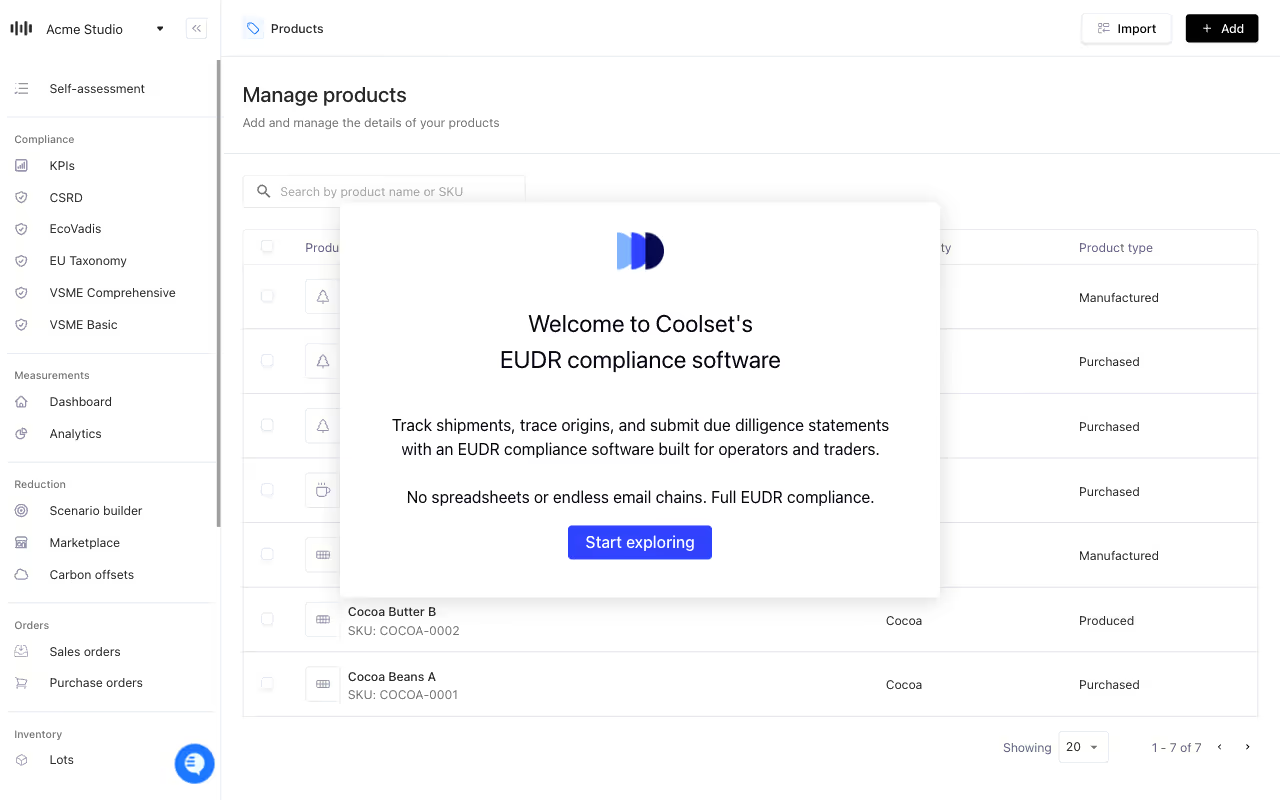
Software can reduce friction by connecting data from suppliers, documentation, and internal teams into one process, making it easier to stay aligned with regulatory expectations now and as trialogue discussions develop.
Software platforms such as Coolset help to
- Automate document and data collection across supply tiers
- Build auditable traceability chains, with or without benchmarking shortcuts
- Future-proof due diligence processes against regulatory changes
Centralizes supplier data and DDS files for easy TRACES submission
Download our EUDR due diligence guide or schedule a free call with our research team to learn more.
{{product-tour-injectable}}
FAQs - Frequently asked questions
Is the EUDR deadline officially delayed?
No. The EUDR deadline of 30 December 2025 remains legally binding. Although the European Parliament and Council now support a one-year delay, the change will only take effect once all three EU institutions agree on a final legal text and it is formally adopted and published in the Official Journal of the EU.
What did the EU Parliament vote for on EUDR?
The European Parliament voted on 26 November 2025 to support a one-year delay to EUDR enforcement, extending the deadline to 30 December 2026 for large operators and 30 June 2027 for small operators. It also backed a simplification review by April 2026, focused on reducing burdens for micro and small primary producers.
Can I pause EUDR preparations until there’s legal clarity?
No. Until a final legal text is adopted, the 2025 deadline remains in force. Delaying preparation risks non-compliance if negotiations stall or the amendment is not adopted in time. Companies should continue building traceability systems, collecting supplier data, and preparing due diligence documentation to stay ahead of potential enforcement.
What does simplification mean for downstream operators?
Under the new amendments, only downstream operators who buy directly from an operator are required to retain and pass on DDS reference numbers. Downstream operators who purchase from other downstream actors are now excluded from EUDR obligations entirely.
What’s happening with the country benchmarking system?
The Parliament previously rejected the Commission’s benchmarking framework. As of today, all countries remain under standard risk, meaning full due diligence is required for all imports.
4 live sessions (14 Oct – 4 Nov): supply chain mapping, data collection, risk assessment and DDS submission.


on mobile screens
to experience this demo.


Start preparing for EUDR
Get your systems ready for traceability, risk assessment and due diligence.


.webp)