Best 20 ESG reporting software tools compared (2026)
.webp)
Disclaimer: New EUDR developments - December 2025
In November 2025, the European Parliament and Council backed key changes to the EU Deforestation Regulation (EUDR), including a 12‑month enforcement delay and simplified obligations based on company size and supply chain role.
Key changes proposed:
- New enforcement timeline: 30 December 2026 for large/medium operators, 30 June 2027 for small/micro operators
- Simplified DDS: One-time declarations for small and micro primary producers
- Narrowed scope: Most downstream actors and non‑SME traders would no longer need to submit DDSs
- New DDS requirement: Estimated annual quantity of regulated products must be included
These updates are not yet legally binding. A final text will be confirmed through trilogue negotiations and formal publication in the EU’s Official Journal. Until then, the current EUDR regulation and deadlines remain in force.
We continue to monitor developments and will update all guidance as the final law is adopted.
Key takeaways
- ESG software automates data collection and audit prep as CSRD, EUDR, PPWR, CBAM and GHG Scope 1-3 reporting tighten.
- Top tools combine multi-framework coverage, AI data entry, cross-framework reuse and audit-ready outputs.
- Coolset covers CSRD, EU Taxonomy, VSME, EcoVadis, EUDR, PPWR and EUTR in one platform with guided workflows and AI autofills.
ESG reporting in 2026: what's changed
ESG reporting has entered a new phase. The Omnibus I package, approved by the European Parliament in December 2025, significantly narrowed the scope of the Corporate Sustainability Reporting Directive (CSRD), now limited to companies with more than 1,000 employees and turnover exceeding €450 million. Wave 2 and 3 reporting timelines have been pushed to 2028 and 2029 respectively, and the amended ESRS datapoints have been reduced from over 1,100 to an estimated 400–500, pending a delegated act expected mid-2026.
For many companies, this means more breathing room. But for those still in scope, the obligations remain complex, and the Omnibus changes don't make preparation optional. First reporting under the revised rules starts January 2027. That gives in-scope enterprises roughly a year to get their data infrastructure, materiality assessments and supplier engagement processes in order.
There's also an important nuance: companies above the CSRD threshold are almost always managing other overlapping ESG obligations at the same time: EU Taxonomy, GRI, CDP, EcoVadis. A tool that handles CSRD in isolation won't solve the broader challenge.
Meanwhile, regulations beyond CSRD are accelerating. The EU Deforestation Regulation (EUDR) is moving toward enforcement, the Packaging and Packaging Waste Regulation (PPWR) begins applying from August 2026, and the Carbon Border Adjustment Mechanism (CBAM) enters its definitive phase in 2026. Companies that need to comply with multiple frameworks at once are the ones who benefit most from integrated ESG software.
For a deeper look at how the Omnibus changes affect software selection specifically, see our CSRD software buyer's guide.
This article compares 20 of the leading ESG reporting tools available today. Here is what they do, who they're built for, and what to look for when making your decision.
Quick picks: ESG reporting software at a glance
Short on time? Here are the standout tools by use case:
Comparison table: 20 ESG reporting software tools
Why using ESG reporting software is worth the investment
When done manually, ESG data collection and reporting is a time-consuming, error-prone, and costly process. It also becomes increasingly complex to manage as your business grows. Without painstaking oversight, it can increase the risk of non-compliance with ESG reporting standards and regulations.
It can also restrict your ability to deeply analyze data and identify trends, making strategic decision-making more difficult. Additionally, it can lead to inconsistent reporting, affecting comparability over time.
ESG reporting software eliminates these inefficiencies by centralizing all data, automating repetitive tasks, and ensuring traceability across reporting cycles. The latest generation of tools goes a step further. They use AI to extract, validate and prefill ESG data, so teams can focus on review and strategy instead of manual input. AI-assisted ESG software now helps organizations interpret disclosures, detect data gaps, and even generate draft responses aligned with standards like ESRS or GRI.
- Streamlined data collection and higher accuracy
- Reduced manual work and faster reporting cycles
- Built-in compliance and audit-readiness
- Enhanced stakeholder communication
- Data-driven insights for performance improvement
- Better collaboration and stakeholder transparency
- Performance benchmarking and monitoring
- Signalling maturity and gaining competitive edge
Best 20 ESG reporting software solutions right now
Now, let's dive into the top 20 ESG reporting tools available on the market. We've organized them into four categories to help you find the right fit faster.
Multi-framework ESG compliance platforms
These tools are built for teams managing multiple regulatory obligations simultaneously: CSRD, EU Taxonomy, EUDR, PPWR, VSME, EcoVadis, GHG Scope 1-3 and CBAM.
1. Coolset

Coolset is an ESG management and supply chain compliance platform built for teams managing multiple regulatory obligations and carbon accounting at once. Where other tools focus on a single framework, Coolset covers CSRD, EU Taxonomy, VSME, EcoVadis, EUDR, EUTR and PPWR in one platform, and keeps each module updated as regulations evolve, so teams aren't left working with outdated requirements.
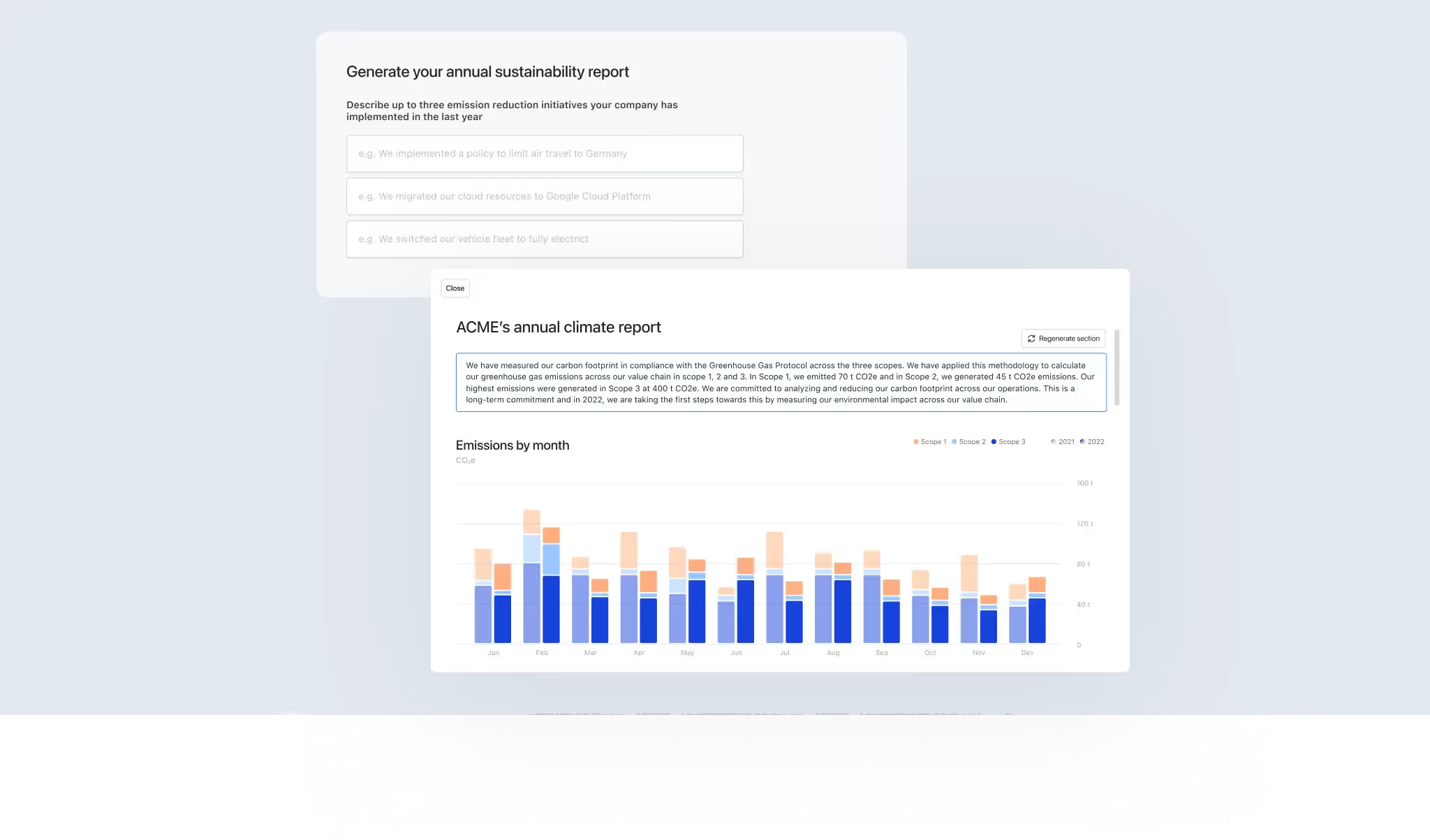
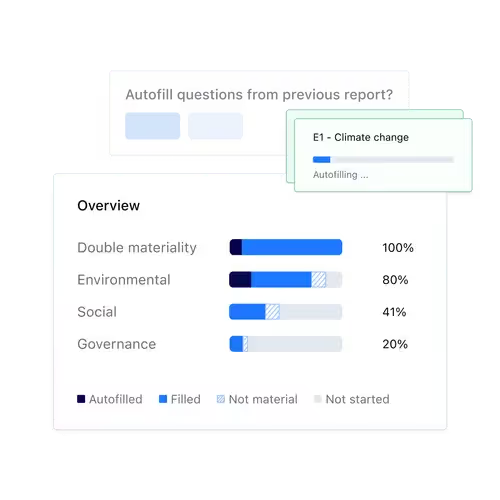
The platform is designed to make complex regulations genuinely manageable. Guided, step-by-step workflows break down dense regulatory requirements into clear tasks, leading to comprehensive, audit-ready reports without requiring deep regulatory expertise from every team member. Data collected for one framework can be reused across others, avoiding duplicate entry when managing overlapping obligations. AI-powered autofills, smart suggestions and linked evidence sources reduce manual input and keep disclosures traceable to their source.
Since the Omnibus changes, Coolset has updated its CSRD module to reflect the revised ESRS datapoints, one of the clearest indicators that a platform is keeping pace with the regulatory environment rather than lagging behind it.
- Best for: Mid-market and larger companies (500–5,000 employees) managing carbon accounting alongside multiple ESG compliance frameworks
- Frameworks: GHG Protocol (Scope 1, 2 and 3), CSRD, ESRS, EU Taxonomy, EUDR, PPWR, VSME, EcoVadis, EUTR
- Strengths: Widest framework coverage in a single platform, full Scope 1-2-3 carbon accounting, guided regulatory workflows, AI autofills, cross-framework data reuse, MCP integration for connecting ESG data to any AI environment
- Limitations: Primarily designed for compliance-driven teams, less suited for pure voluntary reporting without regulatory obligations
- Pricing: Available on request
- Website: www.coolset.com
{{product-tour-injectable}}
2. Sweep

Sweep is a sustainability data management platform that helps organizations centralize ESG and carbon emissions data across their operations and supply chain. The platform supports multi-framework reporting from a single dataset, making it a strong option for enterprises that need to report under several standards simultaneously.
- Best for: Enterprise and mid-market teams needing multi-framework reporting from a single dataset
- Frameworks: CSRD, GHG Protocol, ISSB, GRI, CDP, SFDR, TCFD, SASB
- Strengths: Centralized data collection, built-in validation and governance, real-time supplier data collection
- Limitations: Less focused on supply chain compliance regulations like EUDR or PPWR
- Pricing: Custom pricing on request
- Website: www.sweep.net
3. Position Green
Position Green is an integrated ESG platform connecting regulatory compliance, carbon management, supplier sustainability and performance insight. AI is embedded across the suite, supporting ESRS mapping, disclosure drafting, anomaly detection and benchmarking. The platform claims to automate over 30% of sustainability reporting through intelligent data mapping.
- Best for: Organizations wanting AI-powered ESG reporting with advisory support
- Frameworks: CSRD, ESRS, VSME, EU Taxonomy, CSDDD, GRI, CDP
- Strengths: Strong AI capabilities, enter-once data model, in-house advisor support, decarbonization modeling
- Limitations: Relatively newer to the market compared to established enterprise players
- Pricing: Custom pricing on request
- Website: www.positiongreen.com
Carbon accounting and emissions platforms
These tools specialize in measuring, reporting and reducing greenhouse gas emissions. These are ideal for companies where Scope 1, 2 and 3 emissions are the primary concern.
4. Watershed
Watershed is an enterprise sustainability platform used by 90+ Fortune 500 companies. It combines carbon measurement (500,000+ emissions factors), automated ESG reporting with AI drafting, and decarbonization pathways. The platform supports automated data collection with OCR, anomaly detection and supplier analysis.
- Best for: Large enterprises and financial institutions focused on carbon management and ESG reporting
- Frameworks: CSRD, CDP, SB 253/261, GHG Protocol
- Strengths: Enterprise scale, AI-powered report drafting, strong clean energy procurement capabilities
- Limitations: Primarily US-focused, less depth on European regulatory frameworks like EUDR or PPWR
- Pricing: On request
- Website: watershed.com
5. Persefoni

Persefoni is an AI-powered climate management and carbon accounting platform. It helps businesses measure their carbon footprint, create decarbonization plans, and comply with emissions reporting requirements like the SEC, CSRD, and more.
- Best for: Businesses and financial services focusing on carbon accounting and climate management
- Frameworks: CSRD, SEC, GHG Protocol, CDP, TCFD
- Strengths: AI-powered carbon measurement, strong financial services capabilities, Scope 3 supplier engagement
- Limitations: Narrower regulatory coverage beyond carbon and climate
- Pricing: Offers PRO, PRO+, and ADVANCED plans, with details available upon request
- Website: www.persefoni.com
6. Plan A
Plan A is a TÜV Rheinland-certified carbon accounting platform that helps businesses measure, report and reduce their carbon footprint. Its Gaia AI assistant helps teams navigate sustainability requirements, while the platform supports regulatory reporting across CSRD, ESRS, EU Taxonomy and more. Notable clients include BMW, Visa and KFC.
- Best for: Mid-market companies needing certified carbon accounting with regulatory reporting
- Frameworks: CSRD, ESRS, EU Taxonomy, GHG Protocol, SBTi, SEC, UK SDR
- Strengths: TÜV Rheinland certified, AI assistant (Gaia), strong decarbonization tools, B Corp certified
- Limitations: Carbon-first, less depth on non-climate ESG topics like social reporting
- Pricing: On request
- Website: plana.earth
7. Normative
Normative is a science-based carbon accounting engine with a strong focus on Scope 3 emissions and supply chain transparency. Every footprint is built to GHG Protocol standards, independently verified by TÜV SÜD, and fully traceable from source to output. Every account includes a named, GHG Protocol-certified Climate Strategy Advisor.
- Best for: Enterprises requiring scientifically validated carbon data and expert climate strategy support
- Frameworks: CSRD, CDP, SBTi, EcoVadis, GHG Protocol, SECR
- Strengths: TÜV SÜD verified, dedicated Climate Strategy Advisor per account, automated data ingestion and factor matching
- Limitations: Focused on carbon, does not cover broader ESG frameworks like EUDR or PPWR
- Pricing: On request
- Website: normative.io
8. Greenly

Greenly is a carbon accounting platform that helps businesses assess, manage, and reduce CO2 emissions. It allows you to measure greenhouse gas emissions, build customized decarbonization plans, participate in carbon offsetting programs, and produce reports to communicate your progress.
- Best for: SMEs and mid-market companies looking for accessible carbon management
- Frameworks: GHG Protocol, GRI, CDP
- Strengths: User-friendly interface, good for smaller teams, AI-powered carbon analysis
- Limitations: Limited regulatory framework coverage (no CSRD module, no EUDR/PPWR)
- Pricing: On request
- Website: greenly.earth
For more carbon-focused tools, see our comparison of the top 5 carbon accounting software tools and best Scope 3 reporting software.
Enterprise GRC and ESG platforms
These tools combine governance, risk management and compliance (GRC) with ESG capabilities, suited for large organizations that want ESG integrated into their existing enterprise infrastructure.
9. Workday

Workday is a cloud-based software provider that develops applications to help businesses manage payroll, benefits, HR, and employee data. Its data and analytics platform helps businesses stay on track with ESG initiatives and reporting by delivering critical sustainability insights to decision-makers.
- Best for: Medium to large businesses already using Workday for HR/finance
- Frameworks: GRI, SASB, CDP
- Strengths: No additional cost for Workday customers, integrated with HR and finance data, strong workforce reporting
- Limitations: Limited ESG depth compared to dedicated platforms, weak on EU-specific regulations
- Pricing: Included at no additional cost for Workday customers
- Website: www.workday.com
10. Diligent

Diligent's ESG reporting platform makes it easy to monitor, measure, and report on ESG matters. From centralized data collection and measurement to automated reporting it helps businesses to expertly manage evolving ESG considerations.
- Best for: Organizations looking for comprehensive governance, risk, compliance, and ESG management
- Frameworks: GRI, SASB, TCFD
- Strengths: Strong board and governance integration, centralized GRC + ESG platform, benchmarking capabilities
- Limitations: GRC-first approach, ESG functionality less deep than dedicated ESG tools
- Pricing: Custom pricing on request
- Website: www.diligent.com
11. Workiva

Workiva unifies financial reporting, ESG reporting, and auditing and risk management into one centralized hub. With pre-built ESG frameworks and standards to choose from, businesses can measure what's relevant for them to keep up with evolving regulations and stakeholder expectations.
- Best for: Companies looking for a comprehensive ESG, GRC, and financial reporting platform
- Frameworks: CSRD, ISSB, GRI, SEC, TCFD
- Strengths: End-to-end ESG + financial reporting, cross-team collaboration, pre-built framework templates, named a leader in the Green Quadrant
- Limitations: Can be complex to set up, more suited to US/global reporting than EU-specific supply chain regulations
- Pricing: Custom pricing based on the specific needs of the business
- Website: www.workiva.com
12. Sphera
Sphera is a long-established enterprise software provider specializing in EHS, sustainability and operational risk management. Named a leader in the 2025 Green Quadrant, it offers one of the broadest capability sets in the market, combining sustainability reporting with lifecycle assessment and supply chain risk monitoring. Its LCA database provides comprehensive, industry-specific Scope 3 emissions calculations.
- Best for: Large enterprises in industrial, asset-heavy sectors needing deep EHS + ESG integration
- Frameworks: CSRD, GRI, CDP, GHG Protocol, CSDDD
- Strengths: Industry-leading LCA database, highly configurable, advanced Scope 3 analytics, EHS integration
- Limitations: Complex implementation, better suited for very large organizations
- Pricing: Custom pricing on request
- Website: sphera.com
13. IBM Envizi ESG Suite

IBM's Envizi ESG Suite is a cloud-based ESG reporting software that helps enterprises capture and manage ESG data in a single platform. Its templates allow you to report in alignment with multiple frameworks.
- Best for: Enterprises needing to consolidate, manage, and report their ESG data efficiently
- Frameworks: CSRD, GRI, CDP, TCFD, GHG Protocol
- Strengths: Robust GHG calculations, streamlined reporting tools, decarbonization analytics
- Limitations: Enterprise pricing makes it less accessible for mid-market companies
- Pricing: Starting at an estimated price of €4,162 per month
- Website: ibm.com/products/envizi
14. AuditBoard

AuditBoard's ESG and sustainability management platform helps businesses to centralize their ESG program into a single platform. It streamlines data collection, automates manual tasks, simplifies reporting, and ensures data accuracy.
- Best for: Audit, risk, and compliance teams in various industries looking to streamline ESG program management
- Frameworks: GRI, SASB, TCFD
- Strengths: Centralizes ESG data and evidence collection, extends enterprise risk management to include ESG
- Limitations: More US-focused, limited EU regulatory coverage
- Pricing: Custom; schedule a demo for details
- Website: auditboard.com
Specialized and mid-market ESG tools
These platforms serve specific niches, whether it is financial + ESG integration, real-time monitoring, or tools designed for smaller teams.
15. Cority

Cority's sustainability and ESG solution helps businesses to measure and report their ESG performance. From streamlined data collection to configurable sustainability and CSR reporting templates, the tool is all about helping organizations ensure their ESG data is accurate and auditable.
- Best for: Organizations seeking sustainability and ESG data management solutions, trusted by 1,500+ organizations
- Frameworks: GRI, CDP, GHG Protocol
- Strengths: Centralized Sustainability Cloud, audit-ready data, strong EHS heritage
- Limitations: Focused on environmental data, less depth on governance or social metrics
- Pricing: Customized based on specific needs
- Website: cority.com
16. Benchmark Gensuite

Designed for enterprise leaders, Benchmark Gensuite's ESG reporting and management software helps businesses compile investor-grade ESG data and insights. It has four sustainability tools designed to help companies track emissions, assess resource utilization, build reduction plans, and prioritize ESG issues.
- Best for: Enterprise leaders needing investor-grade ESG data
- Frameworks: GRI, CDP, SASB
- Strengths: Powerful data mining and reporting, collaborative dashboards, desktop and mobile analytics
- Limitations: Limited EU regulatory framework support
- Pricing: Not listed; offers a demo and tailored solutions
- Website: benchmarkgensuite.com
17. LucaNet

LucaNet is an end-to-end ESG solution that collects and analyzes sustainability data and produces fully compliant reports. It helps businesses accelerate their reporting, improve data quality, identify risks, and comply with reporting obligations.
- Best for: Companies integrating ESG with financial reporting, emphasizing automated data collection
- Frameworks: EU Taxonomy, CSRD, GRI
- Strengths: Over 300 interfaces for data automation, central ESG data management, strong financial reporting integration
- Limitations: Primarily focused on financial consolidation, ESG is an add-on, not the core product
- Pricing: Available upon request
- Website: lucanet.com
18. Novisto

Novisto is an ESG data management and analytics platform that automates workflows to help businesses fast-track their sustainability journeys. It includes features for ESG data collection, reporting, benchmarking, collaboration, and risk management.
- Best for: Companies looking to streamline their ESG data management and reporting
- Frameworks: GRI, SASB, CDP, CSRD
- Strengths: Automated workflows, centralized audit-ready data, AI-powered data quality enhancements
- Limitations: Less focus on carbon accounting and emissions-specific features
- Pricing: On request
- Website: novisto.com
19. SustainIQ

SustainIQ helps businesses to measure, monitor, and report on sustainability and ESG data in real-time. It takes factors like waste management, social value, biodiversity, and more into consideration to provide a holistic view of ESG performance.
- Best for: Businesses aiming to centralize their sustainability and ESG data for real-time reporting and analysis
- Frameworks: GRI, CDP
- Strengths: Real-time monitoring, bulk data upload capabilities, holistic ESG view
- Limitations: Limited framework coverage compared to newer platforms
- Pricing: On request; demo available
- Website: sustainiq.com
20. KeyESG

KeyESG is an all-in-one ESG management software to manage, analyze, report on, and improve ESG performance. It helps businesses automate data collection, calculate and estimate emissions, measure and analyze data, and report in line with global standards.
- Best for: Businesses seeking efficient ESG management processes, including data collection, compliance, reporting, and improvement
- Frameworks: GRI, CDP, CSRD
- Strengths: Simplified data collection, intelligent reporting, target setting for ESG improvement
- Limitations: Less established than larger platforms, limited supply chain features
- Pricing: On request; demo available
- Website: keyesg.com
The role of AI in ESG reporting software
AI has moved from a marketing buzzword to a core differentiator in ESG software. According to market research, the AI-powered CSRD reporting software market alone is expected to grow at 26% CAGR through 2031.
The most impactful AI features in today's ESG tools include:
- Automated data extraction: OCR and natural language processing pull ESG data from invoices, supplier documents and internal systems, reducing manual entry by up to 90% in some cases
- Disclosure drafting: AI generates draft responses for ESRS datapoints and other standards, which teams can review and refine rather than writing from scratch
- Gap detection: Algorithms identify missing data points, inconsistencies and compliance gaps before auditors do
- Anomaly detection: AI flags unusual data patterns that could indicate errors or reporting risks
- Multi-framework mapping: Smart data models map a single piece of data to multiple frameworks automatically enter once, report across CSRD, GRI, CDP and more)
When evaluating AI claims, look for specificity: what exactly does the AI do, and where in the workflow? A platform that says "AI-powered" without explaining the mechanism is less trustworthy than one that specifies "AI autofills ESRS E1 datapoints using your uploaded emissions data."
Post-Omnibus: what to look for in ESG software
The Omnibus I package changed the ESG software landscape in several important ways:
- CSRD scope narrowed: companies below 1,000 employees may now fall under VSME instead of full CSRD. Your software should support both, since many companies still need voluntary ESRS alignment for supply chain requests even if they're not directly in scope
- ESRS datapoints reduced: tools that have already updated to reflect the amended ESRS demonstrate regulatory agility. Platforms still showing the old 1,100+ datapoints are a red flag
- Multi-framework pressure increased: with CSRD delayed for many, teams are refocusing on EUDR, PPWR, CBAM, and EcoVadis. A platform that only covers CSRD may have been enough in 2024, but in 2026, multi-regulation coverage is critical
- Voluntary reporting rising: many companies outside the revised scope are still reporting voluntarily to satisfy customer due diligence requirements, investor expectations, or upcoming supply chain regulations. Software that supports both mandatory and voluntary reporting pathways is more future-proof
How to choose ESG reporting software for your business
When selecting ESG reporting software for your business, consider these factors based on what matters most to your team:
- Framework coverage and regulatory depth: Does the platform support the regulations relevant to you? For EU-based companies, look for CSRD/ESRS, EU Taxonomy, EUDR, PPWR, and CBAM. For global companies, check ISSB, GRI, CDP and SEC coverage. The strongest tools cover both
- Regulatory update cadence: How quickly does the vendor update the platform when regulations change? After the Omnibus I package, many tools took months to reflect the new CSRD scope. Vendors that update within weeks show they have dedicated regulatory teams
- Supply chain emissions coverage: Make sure your ESG reporting software has the capabilities to track and report on Scope 1, 2, and 3 emissions. Understanding the full scope of your impact, including supply chain emissions, is critical for setting realistic targets
- AI capabilities: What does the AI actually do? Look for specifics: automated data extraction, disclosure drafting, gap detection, multi-framework mapping. Ask for a demo of the AI features, not just a slide
- Data reuse across frameworks: Can you enter data once and use it across CSRD, EU Taxonomy, EcoVadis, and other obligations? This is one of the biggest time-savers and accuracy improvements
- Customization and scalability: Choose a software that fits your current needs and is scalable to accommodate future growth. Confirm it can handle increased data volume or complexity without disrupting operations
- Audit readiness: Does the platform produce outputs that auditors can verify directly? Look for linked evidence trails, traceability to source documents, and ISSA 5000 alignment
- Actionable insights: Alongside tracking and reporting data, look for tools that give you actionable insights. From benchmarking against industry standards to identifying emission hotspots, this level of analysis helps you proactively improve sustainability performance
Streamline ESG reporting with Coolset
As you can see, there are plenty of ESG reporting tools out there to enhance your business's ESG data management. We hope this comparison helped you understand the different options available and which might be the best fit for your needs.
At Coolset, we specialize in helping mid-market companies streamline ESG data collection and focus their efforts on reducing and reporting impact in line with leading sustainability frameworks.
Discover the capabilities of our reporting platform by scheduling a free demo with an ESG expert today.
Related resources
- Top 7 CSRD software tools in 2026
- Top 5 carbon accounting software tools (2026)
- Best 12 Scope 3 reporting software tools in 2026
- Best 5 EU Taxonomy reporting software tools in 2026
- Top CBAM software tools for 2026
- Best 6 EUDR compliance tools for 2026
- Best 6 PPWR compliance tools for 2026
- Your CSRD software buyer's guide
- The amended ESRS: what has changed and what it means for 2026 CSRD reporting
- CSRD under Omnibus: updated scope, timelines and what companies should do in 2026
- Navigating the VSME: a practical guide for mid-market companies
- How to transition from CSRD to VSME
- EcoVadis: Your guide for a platinum score
- Which EU regulations affect your supply chain?
Try Coolset's ESG reporting software
Improve your ESG reporting today
Try Coolset's ESG reporting software

.webp)