PPWR and EUDR in 2026: how to build one integrated compliance strategy

Disclaimer: New EUDR developments - December 2025
In November 2025, the European Parliament and Council backed key changes to the EU Deforestation Regulation (EUDR), including a 12‑month enforcement delay and simplified obligations based on company size and supply chain role.
Key changes proposed:
- New enforcement timeline: 30 December 2026 for large/medium operators, 30 June 2027 for small/micro operators
- Simplified DDS: One-time declarations for small and micro primary producers
- Narrowed scope: Most downstream actors and non‑SME traders would no longer need to submit DDSs
- New DDS requirement: Estimated annual quantity of regulated products must be included
These updates are not yet legally binding. A final text will be confirmed through trilogue negotiations and formal publication in the EU’s Official Journal. Until then, the current EUDR regulation and deadlines remain in force.
We continue to monitor developments and will update all guidance as the final law is adopted.
Key takeaways
- PPWR and EUDR share the same compliance architecture: supplier evidence, formal declarations, and chain of responsibility. Running them separately is inefficient.
- The biggest bottleneck for both regulations is supplier data. One integrated supplier request covers both, reducing fatigue and speeding up responses.
- Coolset manages both PPWR and EUDR compliance in one place – one supplier engagement, one compliance file per product.
Most compliance teams managing both PPWR and EUDR treat them as separate workstreams: different teams, different supplier requests, different timelines. That approach made sense in 2024. In 2026, it is becoming a liability.
The same suppliers are receiving duplicate requests. The same data is being collected twice. And teams discover the same documentation gaps twice – once per regulation, often too late.
PPWR and EUDR regulate different things. One governs how packaging is designed, labelled, and disposed of. The other governs whether products containing specific commodities can be proven deforestation-free. But both were built on the same regulatory logic, and that shared architecture is the basis for a smarter approach.
What did the March 2026 EU Commission guidance confirm for PPWR?
On March 30, 2026, the European Commission published its first official guidance notice and FAQ document on PPWR, covering around 33 topics. Neither document is legally binding, but together they settle several questions that companies have been trying to resolve.
Four points are worth flagging. First, the manufacturer definition is now confirmed: if your brand name or trademark appears on the packaging, you are the manufacturer. Second, the PFAS deadline is a hard stop – there is no stock exhaustion period and no grace period. All products must comply from August 12, 2026. Third, recyclability conformity assessments are not yet required. The full design-for-recyclability criteria do not kick in until 2030, so packaging scoring grades A to C is not required until then. Fourth, the August 12, 2026 deadline has not moved and neither document mentions any delay.
For the full breakdown of what applies from August 2026 and what comes later, see PPWR compliance deadlines explained.
What does PPWR require and who does it apply to?
The Packaging and Packaging Waste Regulation (PPWR), Regulation (EU) 2025/40, covers all packaging and packaging waste on the European market – commercial, household, industrial, and transport. The regulation applies directly in every EU member state without national transposition, replacing the previous directive framework that required individual implementation in each country.
Obligations fall into two categories. On the design side: substance restrictions (PFAS and heavy metal limits apply from August 2026), recyclability standards applying from 2030, harmonised labelling from 2028, and packaging minimization requirements. On the administrative side: manufacturers must conduct conformity assessments, issue a Declaration of Conformity (DoC) per packaging type, and retain it for five years for single-use packaging or ten years for reusable. The DoC is signed once and remains valid until the packaging changes.
Three supply chain roles carry different burdens. The manufacturer – the company whose brand or trademark is on the packaging – carries full compliance responsibility. The importer is responsible for verifying the manufacturer has done a proper job. The distributor must not place non-compliant packaging on the market. For a complete walkthrough of who carries which obligations, see PPWR compliance for importers and distributors.
What does EUDR require and which products fall under it?
The EU Deforestation Regulation (EUDR) covers seven commodities and their derivatives: cattle, cocoa, coffee, palm oil, rubber, soy, and wood. Any land used to produce these commodities must not have been deforested after December 31, 2020.
Products sold in or exported from the EU market must meet three conditions: deforestation-free, produced in compliance with the relevant laws of the country of origin, and covered by a due diligence statement (DDS). Unlike the PPWR Declaration of Conformity – which is signed once and held until packaging changes – the DDS is required per shipment, making EUDR a rolling compliance obligation rather than a one-time declaration. For a detailed breakdown of which products are in scope, see the sector-by-sector overview.
Current enforcement deadlines are December 30, 2026 for large and medium operators, and June 30, 2027 for small and micro operators. The EUDR simplification review is due April 2026, but no significant changes are expected.
In November 2025, the European Parliament and Council backed changes including a 12-month enforcement delay and simplified obligations for small and micro primary producers. These updates are not yet legally binding. Until the final text is formally published in the EU Official Journal, the current regulation and deadlines of December 2026 and June 2027 remain in force.
How are PPWR and EUDR built the same way?
Both regulations require companies to prove compliance before placing products on the market, not after. The sequence is always the same: collect data from suppliers, assess it against requirements, document findings, declare compliance, retain the evidence, and repeat whenever anything changes. Both regulations make the declaring company legally liable for what they sign.
This is not a one-time project. It is compliance embedded into procurement and supplier management as a continuous operational process. Three structural features make the supply chain the common denominator for both regulations:
Mapping both regulations step by step shows where this infrastructure converges. Role identification requires a per-SKU assessment under both – manufacturer vs. importer vs. distributor for PPWR, operator vs. downstream operator vs. trader for EUDR. Product scoping requires a systematic inventory exercise for both. Supply chain mapping requires identifying tiers and building a supplier registry for both. The assessment methods differ – conformity check for PPWR, risk assessment for EUDR – but both follow an assess-act-document pattern. And both require ongoing monitoring: DoC updates whenever packaging changes, a new DDS for every shipment into the EU
The single biggest bottleneck in both regulations, and the biggest opportunity to consolidate, is supplier data collection. One supplier engagement process can serve two data streams. For a broader view of how PPWR and EUDR sit alongside other EU supply chain regulations, see which EU regulations affect your supply chain.
What compliance challenges do companies face running both programs separately?
Companies running PPWR and EUDR in parallel consistently encounter four structural problems.
Supplier fatigue: a single supplier may be receiving requests from procurement, sustainability, quality, and compliance teams within the same organization – each sending separate, uncoordinated requests in different formats. Without internal coordination, that supplier could receive five different requests in three formats from one company alone. The result is slow responses, incomplete submissions, and compliance gaps that trace back to the requesting company.
Data complexity: both regulations demand granular, structured data that most companies do not have available yet. The data lives deep in the supply chain and rarely exists in a format ready for compliance use. Substance test results for PFAS and heavy metals have testing lead times of six to twelve weeks. Geolocation data from commodity suppliers often requires tracing through multiple tiers to reach the plot level.
Organizational fragmentation: compliance responsibilities sit with logistics, procurement, quality, and sustainability teams simultaneously. Running them in silos means duplicated supplier outreach, separate systems, and no shared view of compliance status. For more on how to align internal ownership, see who really owns EUDR compliance.
Audit readiness: both regulations empower competent authorities to request documentation at short notice. Under PPWR, companies have ten days to provide evidence. Under EUDR, evidence must be available upon request. Gaps in one program are often gaps in the other, discovered at the same time.
How should companies structure supplier requests to cover both PPWR and EUDR?
Supplier data collection is the rate-limiting step for both regulations. The framework below consolidates both into one outreach process.
Step 1: Map your product portfolio against both regulations
Start with SKUs, not regulations. For each product, identify which packaging types fall under PPWR and which ingredients or raw materials fall under EUDR's seven commodities. A single product can trigger obligations under both regulations simultaneously.
Consider a food company selling chocolate bars, coffee pods, and olive oil across eight EU markets. The chocolate bar needs a DoC for its packaging under PPWR and a DDS for the cocoa under EUDR. The coffee pods need a DoC for packaging under PPWR and a DDS for the coffee under EUDR. The olive oil needs a DoC for packaging under PPWR only – olive oil is not an EUDR-scope commodity. This mapping exercise tells the company exactly what it needs before it contacts a single supplier.
Step 2: Determine who owes you what
Once product exposure is clear, map which suppliers carry which obligations. From a packaging converter under PPWR: material composition per packaging type, substance test results for PFAS limits and heavy metals, recyclability assessment data, and technical documentation per Annex VII. From a commodity supplier under EUDR: country and region of origin, plot-level geolocation coordinates, evidence of legal production, and a due diligence statement if one already exists.
Note that when importers take on the role of manufacturer under Article 21, documentation obligations shift significantly. Confirm your role per packaging type before issuing supplier requests.
Step 3: Design one integrated request
Combine both data needs into a single supplier outreach, framed as everything needed for EU market access in 2026. One email thread or platform request, one deadline, one contact. Provide pre-filled Declaration of Conformity templates referencing Regulation (EU) 2025/40, a one-pager explaining what data is required and why, and structured EUDR data templates for commodity suppliers. The more friction removed from the response process, the faster and more complete the submissions will be.
Resist the temptation to stagger requests by regulation deadline. Sending PPWR requests now and EUDR requests in autumn means suppliers handle two separate rounds of contact from the same company. Sending both together once reduces their burden and the risk of inconsistent or incomplete responses. For a detailed guide on EUDR data collection, see how to collect EUDR data from suppliers. For PPWR, see the PPWR Declaration of Conformity guide.
Step 4: Tier suppliers by risk
Not all suppliers carry the same risk. Tier 1 covers dual-exposure suppliers providing both EUDR-scope commodities and PPWR-scope branded packaging – these carry the highest combined risk and require the most documentation. A chocolate packaging supplier who also supplies the cocoa ingredient, for example, falls here. Tier 2 covers EUDR-only commodity suppliers – request origin and geolocation data. Tier 3 covers PPWR-only packaging suppliers – request DoC information and technical documentation.
Step 5: Reduce friction for suppliers
The bottleneck is often supplier understanding, not supplier willingness. Many suppliers – particularly those based outside the EU – are unfamiliar with either regulation. Pre-filled templates, clear instructions, and a short explanation of legal consequences for non-response consistently produce faster and more complete returns than open-ended requests. Geolocation under EUDR is a hard requirement: if a supplier cannot provide plot-level coordinates for the land where a regulated commodity was produced, that commodity cannot be legally imported into the EU. Making this consequence explicit often motivates responses where general requests have failed.
{{custom-cta}}
What does the 2026 compliance calendar look like for both regulations?
The remainder of 2026 has four distinct compliance phases. Three actions should happen this quarter regardless of where you are in the process.
First, run a joint portfolio scan: identify every product that falls under PPWR, every product that falls under EUDR, and every product that falls under both. This is the foundation for everything else. Second, consolidate your data requests: design one integrated supplier outreach covering both regulations, send it now, and prioritize dual-exposure suppliers first. Third, build a single compliance system: one place to store DoCs, DDS records, substance test results, and geolocation data – serving both authority inquiries from the same file.
How does Coolset help companies manage PPWR and EUDR compliance together?
Coolset's platform manages both PPWR and EUDR compliance for complex supply chains in one place – one supplier engagement, one compliance record, one audit-ready file per product.
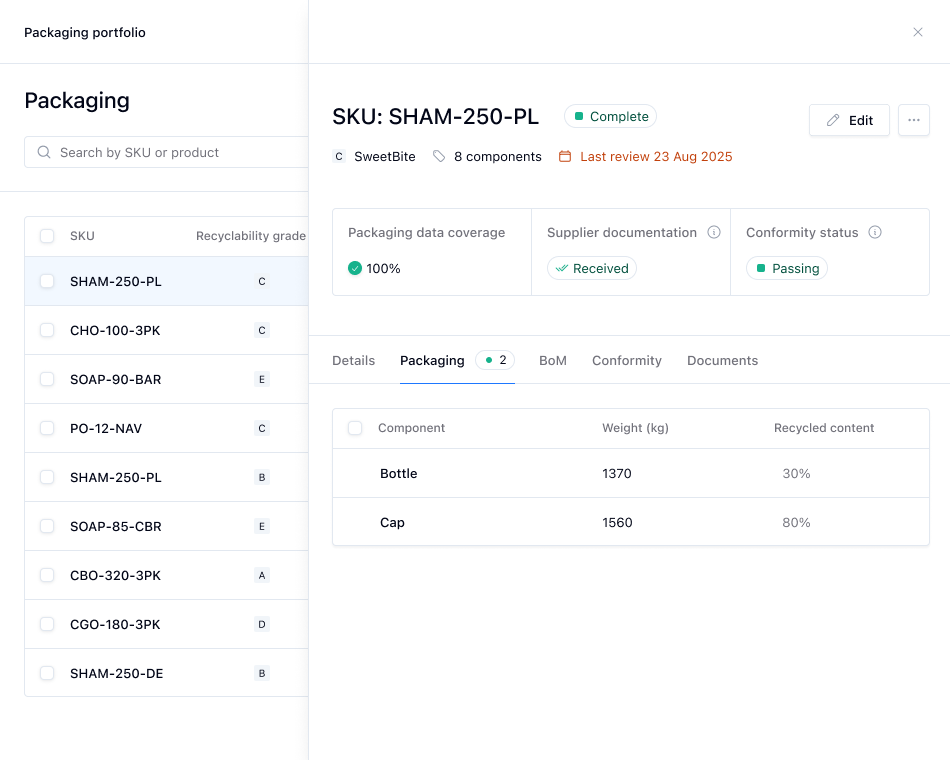
For PPWR, the platform maintains a complete packaging portfolio with bill of materials per SKU, generates and collects Declarations of Conformity, spots conformity risks before products reach the market, and stores all documents and data points with full traceability and version history for regulatory inquiries.
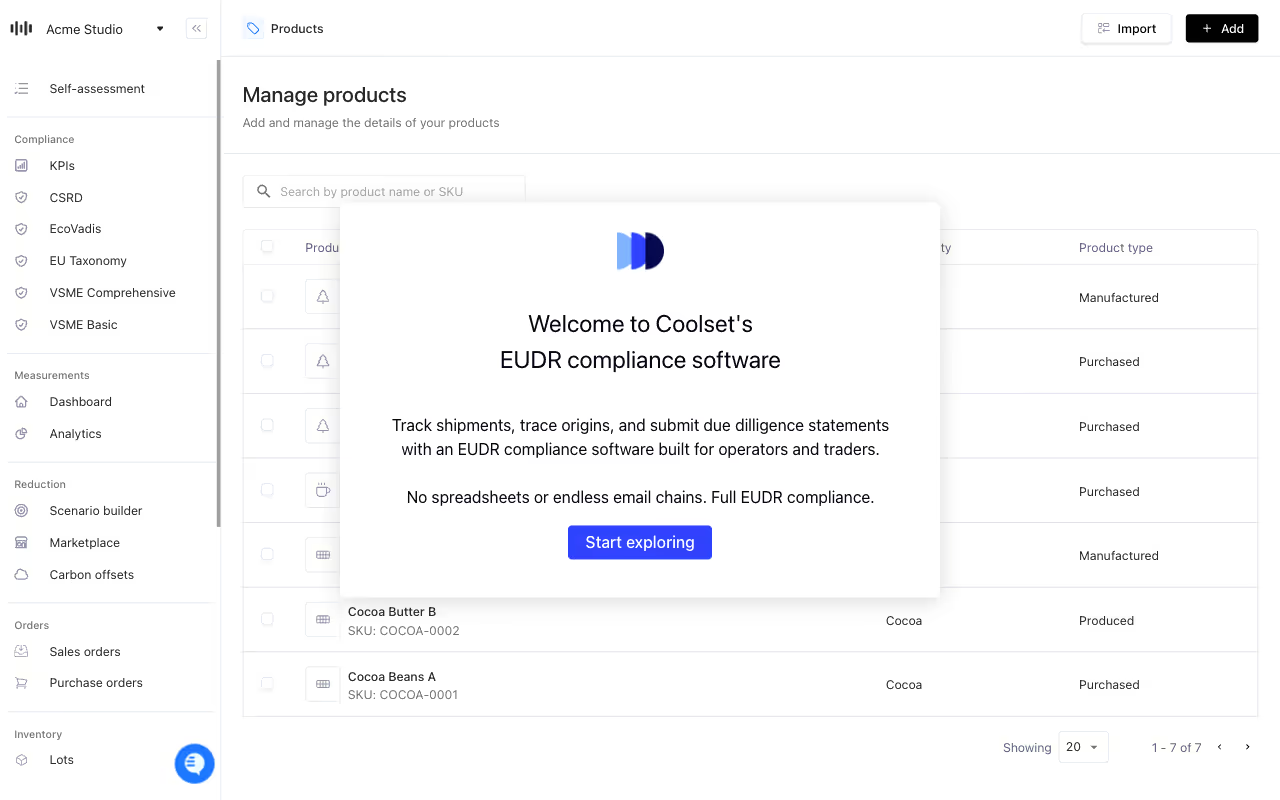
For EUDR, Coolset combines traceability, satellite-based risk screening, and DDS automation to manage the due diligence process end to end. Suppliers have their own workspace in the platform and submit information directly, which flows into your compliance file without manual handling.
Both modules share the same supplier registry and outreach infrastructure. Companies already managing EUDR supplier engagement can add PPWR packaging conformity tracking without duplicating effort. For companies evaluating compliance software, see 9 questions to ask before buying PPWR compliance software and the best EUDR compliance tools for 2026.
Frequently asked questions
Does the August 12, 2026 PPWR deadline apply to all packaging types?
The August 12, 2026 date activates PFAS restrictions on food-contact packaging and Declaration of Conformity obligations across all in-scope packaging. Recyclability conformity assessments are not required until 2030. EU Commission guidance published March 30, 2026 confirms there is no grace period and no stock exhaustion window for the PFAS ban.
Can we use the same supplier request for PPWR and EUDR?
Yes – and this is the recommended approach. One outreach collects PPWR packaging data (material composition, substance test results, DoC) and EUDR commodity data (geolocation coordinates, production dates, legality evidence) in the same document, framed as everything the supplier needs to provide for your EU market access in 2026.
Does PPWR apply to B2B packaging as well as consumer packaging?
Yes. PPWR covers all packaging placed on the EU market, including commercial, industrial, and transport formats. The obligations and timelines differ by packaging type, but scope is broad. See PPWR compliance for importers and distributors for a full breakdown.
What happens if a supplier cannot provide geolocation data under EUDR?
Geolocation is a hard requirement under EUDR. If a supplier cannot provide plot-level coordinates for the land where a regulated commodity was produced, that commodity cannot be legally imported into the EU. There is no risk-based workaround for missing geolocation. Engaging suppliers early and making the consequence explicit is the most effective way to get responses.
What are the penalties for EUDR non-compliance?
Authorities can impose fines of up to 4% of total annual EU turnover, confiscate goods, and apply temporary market exclusion. Under PPWR, non-compliant packaging is withdrawn from the market and corrective action is required. See EUDR compliance and enforcement for full details.
{{product-tour-injectable}}
Practical session on your responsibilities, the packaging data you need, the DoC and how to manage supplier requests

on mobile screens
to experience this demo.


↘ Check if your documentation meets PPWR requirements
This free compliance checker scans your packaging documentation and maps it against mandatory PPWR data requirements, giving you a clear view of your compliance status. Get actionable insights on documentation gaps before they become compliance issues.


