EUDR compliance: how to choose the right solution for your business



Disclaimer: New EUDR developments - December 2025
In November 2025, the European Parliament and Council backed key changes to the EU Deforestation Regulation (EUDR), including a 12‑month enforcement delay and simplified obligations based on company size and supply chain role.
Key changes proposed:
- New enforcement timeline: 30 December 2026 for large/medium operators, 30 June 2027 for small/micro operators
- Simplified DDS: One-time declarations for small and micro primary producers
- Narrowed scope: Most downstream actors and non‑SME traders would no longer need to submit DDSs
- New DDS requirement: Estimated annual quantity of regulated products must be included
These updates are not yet legally binding. A final text will be confirmed through trilogue negotiations and formal publication in the EU’s Official Journal. Until then, the current EUDR regulation and deadlines remain in force.
We continue to monitor developments and will update all guidance as the final law is adopted.
Key takeaways
- EUDR requires a Due Diligence Statement per order with plot-level geolocation, submitted through the EU Information System on TRACES.
- The Regulation applies from 30 December 2026 for all large and medium operators, and 30 June 2027 for micro and small operators.
- Coolset's EUDR compliance platform handles geolocation validation, risk assessment and TRACES submission in one workflow.
Under Regulation (EU) 2023/1115, operators must submit a Due Diligence Statement in the EU Information System for every order of cattle, cocoa, coffee, palm oil, rubber, soya, wood and derived products placed on the EU market. Following the targeted revision formally adopted by the Council on 18 December 2025, that obligation applies from 30 December 2026 for all large and medium operators, with an additional six-month cushion for micro and small operators until 30 June 2027.
The compliance question is no longer whether to act, but which tool can actually produce a legally valid statement. The right EUDR solution is the one that can generate a Due Diligence Statement at the geolocation-polygon level for every relevant commodity batch, not a generic ESG tracker repurposed for the occasion. Choosing it means testing vendors against the specific obligations of Regulation (EU) 2023/1115, not against vendor marketing.
Why generic ESG and procurement tools fall short on EUDR
EUDR is a transaction-level regulation. Each order placed on the EU market requires its own Due Diligence Statement with a unique reference number issued by the EU Information System built on the TRACES platform. That mechanic differs fundamentally from annual sustainability disclosure tools, which aggregate data at the entity level once a year. A platform that cannot issue and track DDS reference numbers per shipment is not an EUDR tool, regardless of its sustainability branding.
Geolocation is the data point that breaks most generic systems. The European Commission's guidance identifies geolocation, traceability, due diligence, the Information System, timelines and penalties as the practical areas covered by the regime. Standard procurement systems and supplier questionnaire platforms are not designed to ingest geographic geometry, validate it against forest-cover baselines, or persist it as evidence. Self-attested checkboxes in a supplier survey will not stand as the basis for a due diligence conclusion.
Operator liability is also non-transferable. Producers in non-EU countries do not carry the burden of obligations under EUDR unless they place product on the EU market, which means the EU-based operator is the entity competent authorities will audit. The tooling has to produce auditable evidence trails, with raw geolocation data, satellite analysis outputs and risk assessment rationale preserved in a form a competent authority can inspect.
For a broader view of how this fits into supply chain due diligence across regimes, the same underlying data should serve more than one purpose, which is the reverse of how generic ESG tools tend to silo it.
{{product-tour-injectable}}
The compliance obligations your solution has to execute
EUDR splits operator responsibilities into information collection, risk assessment and risk mitigation, and any credible tool has to execute all three. The DDS reference number sits at the end of that chain, and downstream operators and traders rely on it for their own statements.
Information collection covers the data set described in Regulation (EU) 2023/1115: HS codes from Annex I, quantity, country of production, geolocation of the plots of land where the commodities were produced, supplier and customer data, and evidence of deforestation-free status after the cut-off date of 31 December 2020. Producers outside the EU may be asked to supply production geolocations, without which you cannot import the goods into the EU. Operationally, that means your tool must run a structured outreach to upstream suppliers and store their responses as evidence.
Risk assessment and mitigation are the next gates. A risk assessment that returns a single opaque score will not survive an audit; competent authorities will expect to see how the conclusion was reached and what evidence supported it. Mitigation actions need to be logged with dates, responsible parties and outcomes, so that the record itself can be produced on inspection.
Records and DDS must be retained for at least five years. Regulation (EU) 2025/2650 confirms the five-year retention rule and introduces the downstream operator category, defined as a natural or legal person who places products on the market made from materials already covered by a due diligence statement or simplified declaration. Downstream operators and traders do not file declarations, but they must register in the Information System. Your platform needs to model both roles cleanly.
What "negligible risk" actually demands from your data layer
Negligible risk is the bar EUDR sets for placing product on the market, and the data layer behind it does the real work. Geolocation data must be precise enough to overlay against deforestation baselines for the cut-off date of 31 December 2020, which means geometry has to be validated against satellite reference data, not just stored as coordinates in a database. A tool that accepts a geolocation upload but cannot run a temporal forest-cover comparison is incomplete.
Country risk classification then changes the depth of due diligence. The Commission's benchmarking system assigns every country a level of risk (low, standard or high) based on the quantitative criteria in Article 29(3), using the FAO Global Forest Resources Assessment dataset. Sourcing from low-risk countries triggers simplified due diligence obligations. Your tool's workflow has to adapt to that distinction automatically, otherwise compliance teams will spend the same effort on low-risk Finnish spruce as on high-risk supply from a region with active deforestation pressure.
For commodity categories where certification schemes are often offered as a shortcut, FSC, RSPO and Rainforest Alliance do not substitute for due diligence. They can feed evidence into the assessment, but the operator still owns the conclusion.
Buyer's checklist: testing vendors against the regulation, not the marketing
The fastest way to separate EUDR tools from ESG tools wearing an EUDR badge is to test against the regulation's actual mechanics. Use this checklist when evaluating shortlisted vendors.
- Confirm the platform ingests polygon geometry for plot-level geolocation and validates it against forest-cover baselines for the 31 December 2020 cut-off.
- Verify native integration with the EU Information System for DDS submission and retrieval of reference numbers. A manual CSV export workflow is not integration.
- Require evidence of satellite-based deforestation analysis with traceable methodology. Ask which datasets the vendor uses, how recent imagery is processed and how false positives are handled.
- Test multi-tier supplier onboarding. The tool has to collect geolocation from smallholders and aggregators without forcing them into unfamiliar enterprise software, since most upstream suppliers will not use the same system as the operator.
- Check that risk assessment logic produces an auditable rationale per consignment, not a black-box score.
- Confirm that mitigation actions, evidence files and supplier communications are logged and retained for the full five-year statutory period.
- Validate handling of the downstream operator and trader categories introduced by Regulation (EU) 2025/2650, including registration in the Information System and citation of upstream DDS references.
- Ask for proof that the platform applies the simplified regime correctly when sourcing from low-risk countries under the Article 29 benchmarking system.
{{custom-cta}}
Where EUDR tooling has to plug into the rest of your compliance stack
EUDR data is operational data, and a defensible solution should reduce duplication of supplier outreach rather than create it. Geolocation, supplier master data and risk assessments collected for EUDR can be reused across other due diligence and reporting workflows in the same organization. Asking suppliers for overlapping information through multiple disconnected portals erodes cooperation and inflates onboarding costs.
ERP and procurement integration is the practical hinge. HS codes, supplier master data, consignment volumes and invoice references should flow into the EUDR tool automatically rather than be re-keyed per shipment. Re-keying is where errors enter audit files, and audit files are what competent authorities will inspect.
The May 2026 simplification package reinforces the point that the core obligations are stable. The European Commission's Guidance Document clarifies how the regime applies in practice, and the Commission has confirmed it will not reopen the core text, relying instead on guidance, FAQs and a delegated act on Annex I. The simplification package update walks through what changed in December 2025 and what did not.
Run a 30 December 2026 readiness test this week
The most efficient way to choose between vendors is a live mock submission. Pick one high-volume commodity SKU, ideally one with a complex upstream supply chain, and ask each shortlisted vendor to produce a complete mock Due Diligence Statement using your real supplier data. The deliverable should include polygon coordinates validated against the 31 December 2020 deforestation baseline, a risk assessment that walks through each criterion with cited evidence, documented mitigation actions where risk is not yet negligible, and a TRACES-format submission package ready for the EU Information System.
Set a one-week deadline. The vendors that complete the exercise on real data are the ones worth advancing to procurement. For supporting context on common questions during procurement, the EUDR FAQ is a useful reference to share with internal stakeholders.
Frequently asked questions
When does EUDR start to apply?
Following the targeted revision adopted by the Council on 18 December 2025, the EUDR applies from 30 December 2026 for all large and medium operators, with micro and small operators having an additional six-month cushion until 30 June 2027. The application date was postponed from the previous deadline of 30 December 2025.
What commodities are covered by EUDR?
The Regulation covers cattle, cocoa, coffee, palm oil, rubber, soya and wood, along with derived products listed in Annex I. The list of relevant products is identified by HS classification codes.
What is a Due Diligence Statement?
A Due Diligence Statement is the document operators submit through the EU Information System for each consignment of relevant products placed on the EU market or exported. The system returns a unique reference number that downstream operators and traders must cite in their own statements.
Does sourcing from a low-risk country exempt me from EUDR?
No. Sourcing from a low-risk country under the Article 29 benchmarking system triggers a simplified due diligence regime. Operators remain liable for the accuracy of the information and must still submit a statement.
Are micro and small operators in scope?
Yes, with a later start date. Regulation (EU) 2025/2650 postpones application to 30 June 2027 for natural persons and micro and small enterprises. Micro or small primary operators in low-risk countries submit a single simplified declaration in the Information System, the content of which is set out in Annex III.
Related: EUDR downstream operator: what the regulation means for your business in 2026
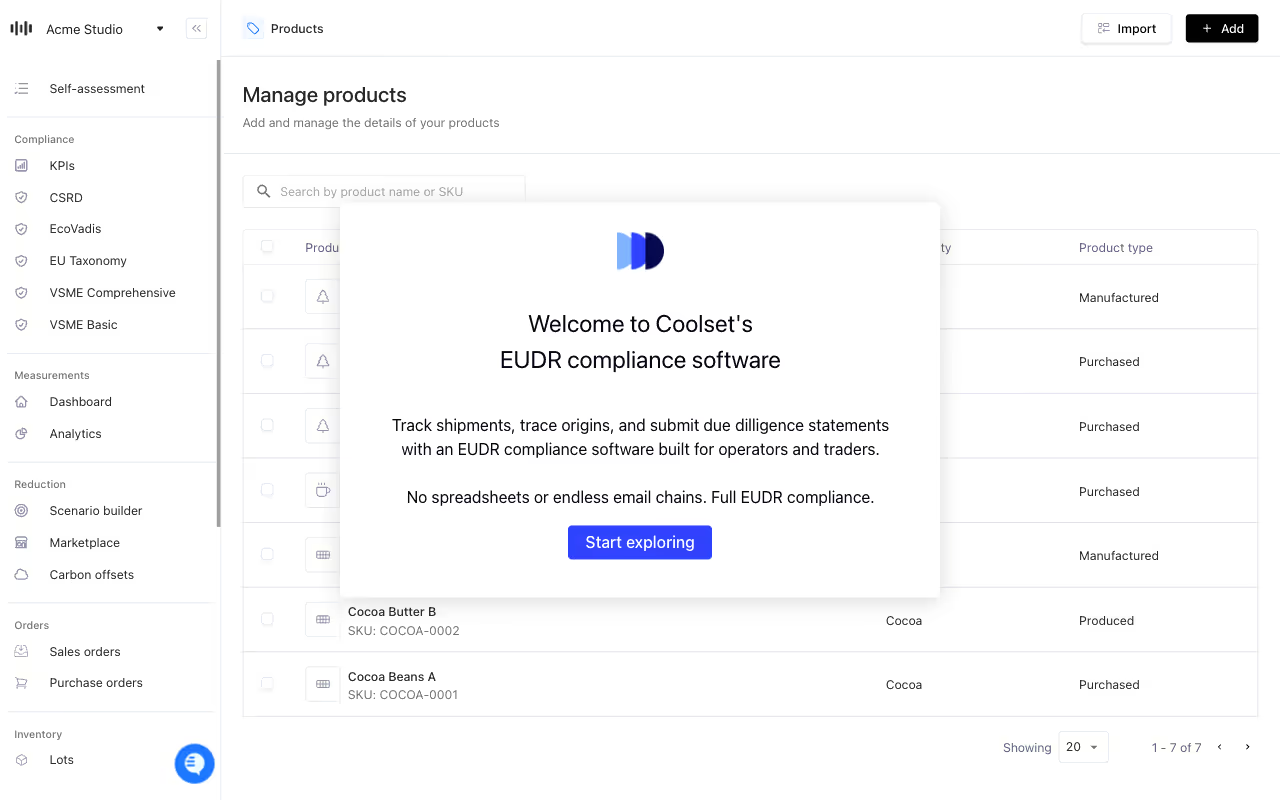
Coolset's EUDR module ingests polygon geolocation, runs risk assessments against the 31 December 2020 baseline and submits Due Diligence Statements to the EU Information System without manual exports.


on mobile screens
to experience this demo.


↘ Check if your documentation meets PPWR requirements
This free compliance checker scans your packaging documentation and maps it against mandatory PPWR data requirements, giving you a clear view of your compliance status. Get actionable insights on documentation gaps before they become compliance issues.

.webp)