Best 5 EUTR compliance tools in 2025

Disclaimer: Latest EUDR developments
On 21 October, the European Commission proposed targeted changes to the EU Deforestation Regulation (EUDR). These adjustments aim to make the rollout smoother without changing the regulation’s overall goals.
Key points from the proposal:
- The 30 December 2025 compliance deadline for large and medium operators remains unchanged.
- Small and micro primary producers (such as farmers and foresters) may receive an extension until 30 December 2026.
- A transition period from January to June 2026 is planned for large and medium companies, giving them time to adapt before formal checks and penalties begin.
- New, simplified obligations are introduced for two groups: small and micro primary producers, and downstream operators (e.g. manufacturers, retailers).
We're closely monitoring the development and will update our content accordingly. In the meantime, read the full explainer here.
Key takeaways:
- Manual EUTR workflows are difficult to sustain due to fragmented documentation, inconsistent risk scoring, and weak audit trails.
- Purpose-built tools reduce compliance risk by automating document collection, structuring supplier data, and enabling traceable due diligence.
- Choosing the right tool depends on supply chain complexity, internal capacity, and whether timber-only or broader ESG compliance is required.
- Coolset offers an end-to-end compliance platform that supports EUTR due diligence, document collection, supplier assessment, and audit-ready reporting.
Ensuring compliance with the EU Timber Regulation (EUTR) is harder than it looks. Many teams still rely on manual checks, supplier emails, and scattered documents. This may be workable for a small number of products, but unsustainable once supply chains grow or an auditor asks for evidence you can’t quickly produce.
And with up to an estimated 30% of global timber trade coming from illegal sources, regulators are increasingly scrutinising operators who can’t demonstrate proper due diligence.
The EUTR requires continuous proof of legal harvest, which means gathering the right documents, verifying supplier information, and keeping an up-to-date due diligence system at all times. For companies sourcing from multiple regions or intermediaries, this becomes a real operational risk.
That’s why dedicated EUTR compliance tools matter. They centralize documentation, streamline supplier data collection, automate checks, and keep your due diligence workflow audit-ready without constant manual effort.
This article covers the top EUTR tools in 2025 highlighting their strengths, limitations, and how to choose the right one based on your supply-chain complexity and internal capacity.
The tools we’ll cover are:
- Coolset
- RADIX Tree
- OriginsNext
- Control Union Certifications / Woodtrack
- DoubleHelix Tracking
What qualifies as an EUTR compliance tool in 2025?
An EUTR tool is any system that helps companies meet the regulation’s core obligations: due diligence, risk assessment, traceability, and audit-ready documentation.
Practically, it should collect supplier documents, verify key information, flag risks, and maintain a clear record of what was checked before products are placed on the EU market.
Why manual approaches fall short
Spreadsheets and email threads break quickly once you add more suppliers, species, or regions. Information gets lost, risk scoring becomes inconsistent, and there’s no reliable audit trail. Most enforcement issues under EUTR come from gaps in documentation, not from intentional non-compliance.
When a company actually needs a tool
A dedicated system becomes essential when:
- your supplier base or product list grows
- you work across multiple regions or intermediaries
- audits are slow, stressful, or hard to document
- several teams handle due-diligence tasks
At that point, software becomes the only sustainable way to keep EUTR workflows consistent, complete, and defensible.
Tool comparison – What EUTR compliance software is available today?
Now that we know how EUTR tools can help businesses meet their obligations, let’s take a look at 5 tools out there.
1. Coolset
As the authors of this comparison, we want to be transparent about listing Coolset first.
Based on our assessment of usability, coverage, and suitability for timber importers and operators, we genuinely believe Coolset is the strongest option for teams that need a clear, structured system to manage EUTR due diligence while simultaneously preparing for the upcoming transition to EUDR.
Coolset is an end-to-end compliance platform that supports EUTR due diligence, document collection, supplier assessment, and audit-ready reporting. It’s designed for companies needing a simple, centralized workflow rather than multiple tools.
Website: www.coolset.com/eutr
Best for: Timber importers and operators with several suppliers, mixed product lines, or limited internal compliance resources.
Key features:
- Document collection & storage
- Supplier & product-level due diligence
- Risk scoring & mitigation tracking
- Workflow management and audit history
- Support for EUTR, EUDR-aligned due diligence, FSC/PEFC documentation
Limitations:
- Not a specialist timber-only system
- Traceability depth depends on the quality of supplier inputs
2. RADIX Tree (By Global Traceability)
A long-standing supply-chain traceability and due-diligence system originally built for EUTR compliance. Widely used in the timber sector for structured documentation and supplier data exchange.
Website: www.global-traceability.com/en/radix-tree/
Best for: Companies with multi-tier timber supply chains requiring structured document flows and standardised risk evaluation.
Key features:
- EUTR due-diligence workflows
- Supplier data collection & chain-of-custody info
- Risk assessment templates
- Support for GTTN, FSC/PEFC documentation exchange
Limitations:
- Interface and workflows may feel dated
- Less flexible for companies sourcing non-timber commodities
3. OriginsNext
A platform offering a dedicated EUTR module focused on legality verification, supplier documentation, and digital traceability for timber products.
Website: www.originsnext.com
Best for: Importers and traders handling timber from multiple harvest regions who need a clear structure for collecting legality documents.
Key features:
- EUTR legality documentation management
- Supplier & product-level traceability
- Verification workflows
- Support for FSC/PEFC, legality certificates, species/country data
Limitations:
- Primarily built for timber; limited application outside wood products
- Less automation compared to newer compliance tools
4. Control Union Certifications / Woodtrack
A certification-body-run due diligence system that helps operators meet EUTR requirements through structured document checks and legality verification.
Website: www.controlunion.com
(Woodtrack is accessed through Control Union’s certification portal.)
Best for: Companies wanting a compliance tool backed by an established monitoring organization or third-party verifier.
Key features:
- EUTR due-diligence templates
- Legality evidence collection
- Risk assessment & mitigation tracking
- Integration with certification schemes (FSC/PEFC, legality verification)
Limitations:
- More rigid workflow; less adaptable to complex or fast-changing supply chains
- Focused on compliance rather than broader operational visibility
5. DoubleHelix Tracking
A timber-sector traceability and verification platform offering supply-chain mapping, risk evaluation, and scientific origin testing for higher-risk materials.
Website: www.doublehelixtracking.com
Best for: Companies sourcing from high-risk regions or needing stronger verification (e.g., species testing, origin confirmation).
Key features:
- Supply-chain mapping & documentation
- Legality risk assessment
- DNA/isotope testing for species/origin
- Support for EUTR, legality frameworks, FSC/PEFC evidence
Limitations:
- More specialised; often used alongside another compliance system
- Higher costs for forensic testing
How to choose the right EUTR compliance tool
When selecting an EUTR tool, it’s important that the system matches the way your organisation sources, evaluates, and documents timber products. Here are some key things to consider.
Define scope and internal roles
Start by clarifying what the tool actually needs to cover:
- Which products fall under EUTR?
- Who owns supplier contact, documentation checks, and risk assessments?
- Do procurement, sustainability, and compliance teams all contribute?
- How much internal time can you dedicate to ongoing due diligence?
A tool should fit your existing workflow, not force you into a new one you can’t maintain.
Assess supply-chain complexity and risk exposure
Different tools suit different sourcing realities:
- Low complexity: stable suppliers, low-risk countries, small product range → lightweight systems
- Medium complexity: mixed suppliers, intermediary traders, varied species → structured workflows
- High complexity: high-risk origins, multi-tier chains, multiple annual audits → robust traceability + verification
Understanding your risk profile helps narrow the field before comparing features.
Evaluate tools against a decision checklist
Regardless of size or sector, every EUTR tool should meet core operational needs:
- Origin data collection: Ability to capture country of harvest, species, and supporting legality documents.
- Supplier engagement: Simple ways to request documents, send reminders, and track responses.
- Risk rating logic: Clear, repeatable scoring aligned with EUTR expectations.
- Legal document storage: Centralized, version-controlled repository for certificates and evidence.
- Multi-supplier input support: Ability to manage complex chains involving traders, processors, or aggregators.
- Audit export / trace logs: Evidence trails showing what was checked, when, and by whom.
What features make a tool audit-ready?
EUTR audits focus on whether an operator can demonstrate complete, consistent, and verifiable due diligence. An audit-ready tool should make this process easy to follow and aligned with EU expectations.
Centralized documentation
A single location for legality evidence, certificates, supplier declarations, and risk assessments, with clear histories. This aligns with the EU’s requirement for structured, accessible due-diligence records outlined in the official guidance.
Real-time traceability
Up-to-date links between products, suppliers, species, and harvest origins, making it easy for auditors to trace timber back to source. This reflects best practices highlighted in EUTR/FLEGT traceability guidance.
Permissioned access for compliance reviewers
Role-based access controls so internal teams, external auditors, or monitoring organisations can review evidence without exposing unrelated or sensitive data.
Risk flagging and version control
Automatic alerts when documents are missing, expired, or inconsistent, plus visible version histories showing who changed what and when—critical for demonstrating a defensible due-diligence process during inspections.
How software helps streamline EUTR compliance
EUTR compliance is fundamentally a documentation and verification workflow. Good software reduces the manual effort behind these tasks and ensures nothing slips through the cracks.
What good tooling can automate
- Document requests: Automatically asks suppliers for legality documents and sends reminders.
- Tracking & completeness checks: Flags missing evidence, outdated certificates, or incomplete risk assessments.
- Version control: Keeps a record of changes to documents and assessments over time.
- Audit history: Maintains a clear trail of what was checked, when, and by whom.
- Supplier data organisation: Links suppliers, species, and harvest origins in a structured way.
These automations remove repetitive admin work and help teams maintain consistent due diligence across multiple product lines and sourcing regions.
Where EUTR overlaps with broader frameworks
EUTR often sits alongside other compliance obligations, especially for companies sourcing multiple commodities or reporting under emerging ESG frameworks. Many teams now manage EUTR alongside:
- EUDR (geolocation and deforestation-free requirements)
- CSRD (supply-chain transparency, risk disclosures)
- Voluntary schemes like FSC/PEFC
- Supplier ESG assessments and broader sustainability reporting
When these requirements overlap, maintaining separate systems quickly becomes inefficient.
Where Coolset fits
Coolset sits slightly apart from traditional timber-only systems. While those tools specialize in timber legality and traceability, Coolset provides a broader compliance stack that can support EUTR due diligence alongside EUDR preparation and wider ESG/supply-chain requirements.
This makes it a practical option for mid-market companies that want a single workflow for multiple compliance needs rather than managing separate tools for each regulation.
FAQs
What kind of software do I need for EUTR compliance?
You need a tool that can collect supplier documents, assess legality risks, store evidence in a structured way, and generate an audit trail. Anything without these core functions won’t meet EUTR’s due-diligence expectations.
What’s the difference between a due diligence system and a compliance tool?
A due diligence system is the process: collecting documents, assessing risk, and recording decisions.
A compliance tool is the software that supports this process by making it structured, consistent, and auditable. Good tools operationalise due diligence rather than replace it.
Can EUDR tools be used for EUTR timber?
Sometimes, especially if they include document management, supplier engagement, and risk scoring. But EUDR tools focused only on geolocation or deforestation-free checks may not cover the specific legality documentation required under EUTR. Coverage varies by tool.
Learn more about the differences and similarities between the EUDR and EUTR here.
What happens if my tool doesn’t cover multi-tier suppliers?
You risk gaps in traceability. EUTR requires operators to understand the full supply path, not just the last trader. If the tool only handles direct suppliers, you may miss critical legality evidence coming from upstream actors.
Is manual compliance enough for small timber traders?
It can be if volumes are low, supply chains are simple, and documentation is easy to obtain. But as soon as suppliers, species, or countries of harvest multiply, manual workflows typically break down and become higher risk during audits.

on mobile screens
to experience this demo.



Know your EUDR obligations
Answer a few quick questions to identify your role in the EUDR supply chain, your compliance deadline, and the exact steps you need to take. No e-mail required.
Your EUDR compliance status
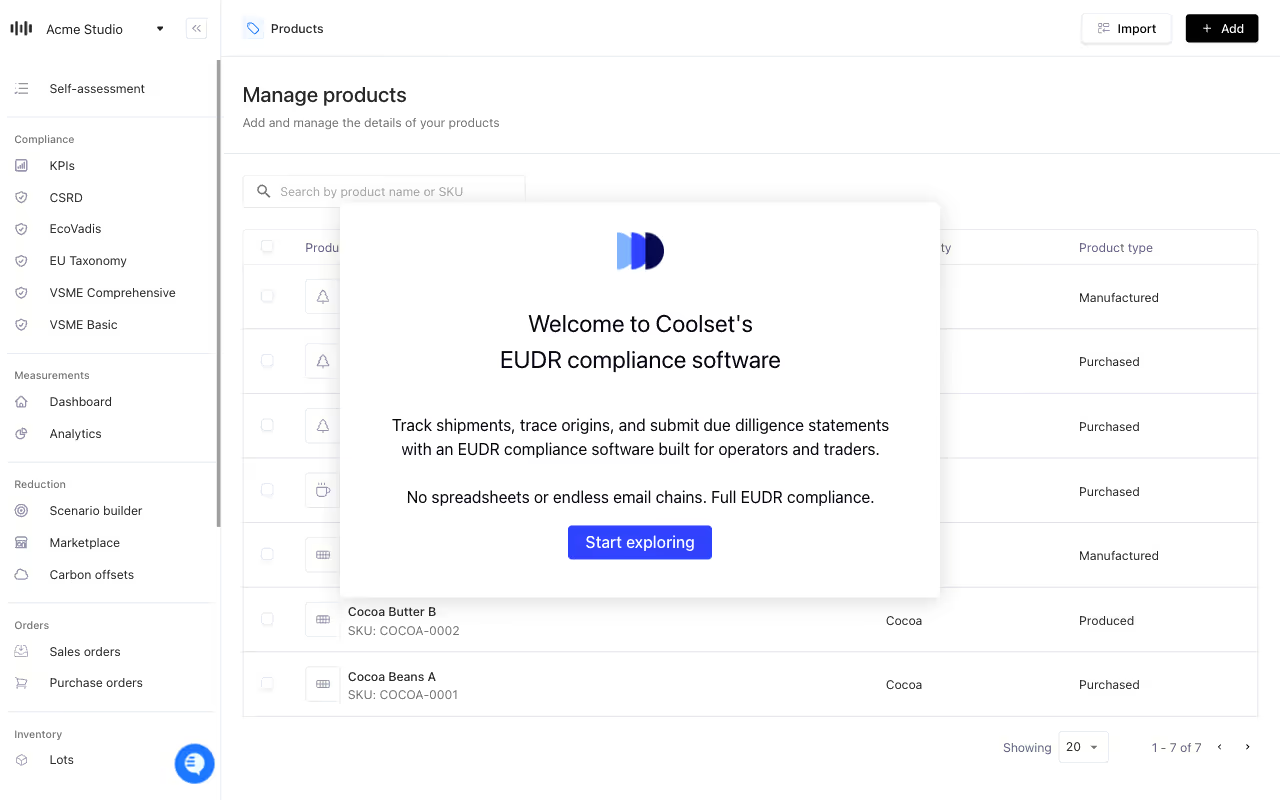
Get ready for EUTR
Trace your products, collect supplier documentation, run legality checks and generate complete, reliable audit trails in one platform.
.webp)


