PPWR compliance deadlines explained: what applies from August 2026 and what comes later


Disclaimer: New EUDR developments - December 2025
In November 2025, the European Parliament and Council backed key changes to the EU Deforestation Regulation (EUDR), including a 12‑month enforcement delay and simplified obligations based on company size and supply chain role.
Key changes proposed:
- New enforcement timeline: 30 December 2026 for large/medium operators, 30 June 2027 for small/micro operators
- Simplified DDS: One-time declarations for small and micro primary producers
- Narrowed scope: Most downstream actors and non‑SME traders would no longer need to submit DDSs
- New DDS requirement: Estimated annual quantity of regulated products must be included
These updates are not yet legally binding. A final text will be confirmed through trilogue negotiations and formal publication in the EU’s Official Journal. Until then, the current EUDR regulation and deadlines remain in force.
We continue to monitor developments and will update all guidance as the final law is adopted.
What compliance teams need to understand about PPWR timing
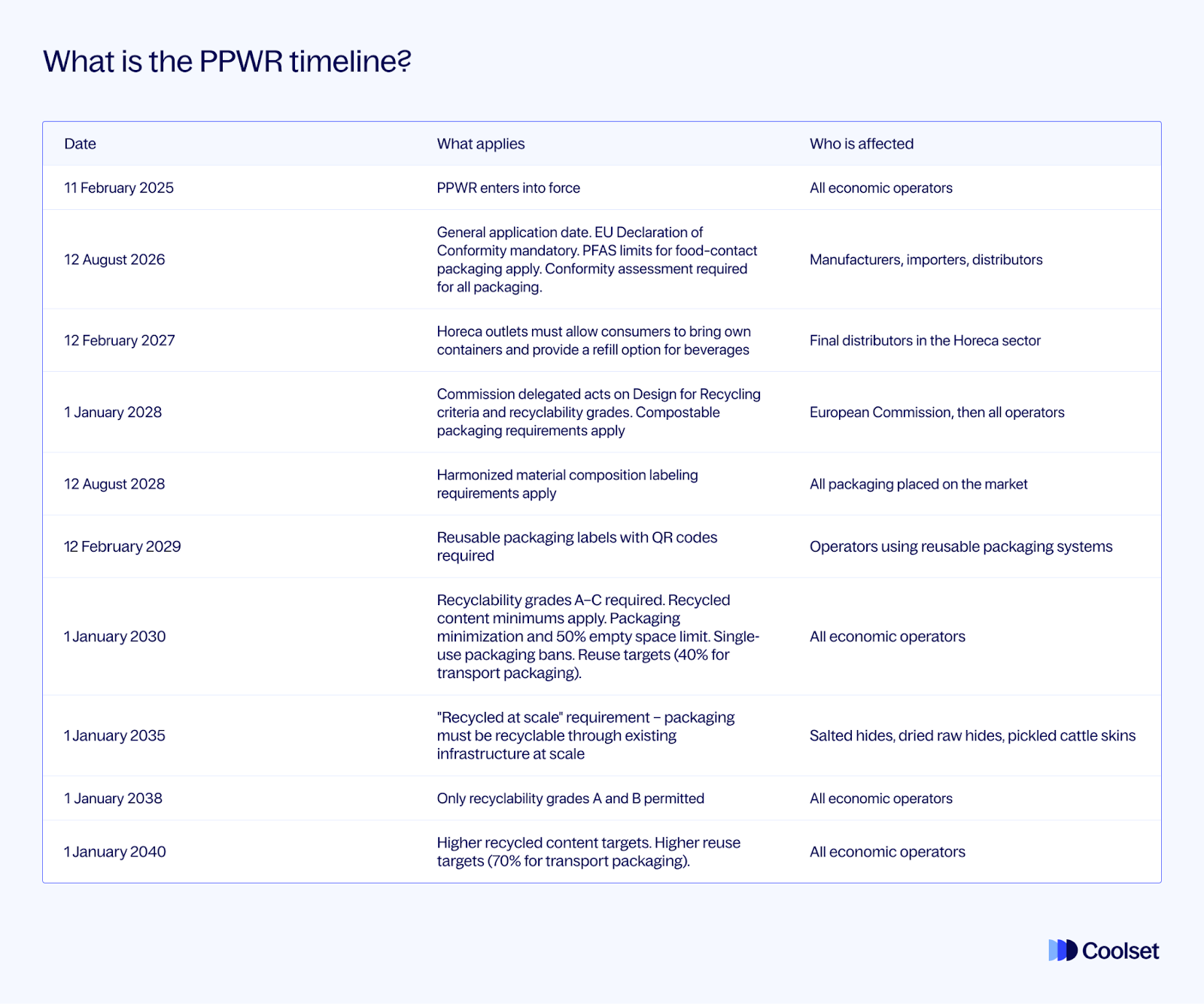
The PPWR has one headline date, August 12, 2026, but the compliance picture is more layered than that. Some obligations are active from day one. Others won't land until 2027, 2028 or 2030. Knowing which is which is going to be core in preparing for compliance later this year.
Upon its enforcement, PPWR is directly binding across all EU Member States with no need for national transposition and no grace period for new stock. If packaging enters the EU market after that date, it must comply. This article maps each compliance milestone, explains what it requires, and lays out how to sequence your preparation.
Who does PPWR apply to?
PPWR applies to any economic operator that places packaging or packaged goods on the EU market. The regulation defines four primary roles - manufacturer, importer, distributor and producer - and each carries distinct obligations.
Manufacturers bear the primary design and conformity responsibilities. Importers must collect and verify supplier documentation. Distributors carry verification duties. Producers, defined broadly to include brand owners, importers and distance sellers, must register with national extended producer responsibility (EPR) systems in every Member State where they operate.
Is August 2026 the only PPWR deadline?
No. August 12, 2026 is the primary enforcement date, but PPWR rolls out in distinct phases through 2040. Several obligations such as recyclability grade requirements, recycled content minimums, reuse infrastructure, require planning well before their enforcement dates.
August 12, 2026 - the general application date
August 12, 2026 is when the bulk of PPWR obligations become enforceable across all 27 EU member states. The date marks the end of the 18 month transition period the EU built-in for companies to prepare for compliance after the regulation came into force.
Unlike directives, PPWR is a regulation. That means no national transposition is required: the same rules apply simultaneously and identically across all EU markets on the same day. Companies that have historically managed packaging compliance market by market will need to treat August 12, 2026 as a single, unified deadline regardless of the geographies included.
From that date, packaging not meeting PPWR's sustainability, labeling and conformity requirements cannot be placed on the EU market. The main obligations that apply from August 12, 2026 are:
- PFAS and heavy metal limits for packaging
- EU Declaration of Conformity for every packaging type
- Manufacturer and importer identification on packaging
- EPR registration in each relevant Member State
- Active reuse systems for operators already using reusable packaging
Which requirements don't apply until after August 2026?
Recyclability grade requirements, where packaging must meet grade A, B or C to remain on the market, apply from January 1, 2030. Minimum recycled content targets for plastic packaging begin in 2030. Harmonized material composition labeling applies from August 12, 2028. Reusable packaging labels with QR codes become mandatory from February 12, 2029.
Planning for post-2026 requirements cannot wait until after 2026. Packaging redesigns and supply chain changes typically need 12-24 months of lead time. Work on recyclability assessments and reuse infrastructure must begin now.
Does existing stock get a grace period after August 2026?
No general grace period exists under PPWR. Non-compliant packaging cannot be placed on the EU market after August 12, 2026. Stock already in the supply chain before that date may generally be sold through, but sell-through rules vary by Member State. Companies should verify the position of each relevant national authority before the enforcement date.
{{custom-cta}}
What does PPWR require from August 12, 2026?
From August 12, 2026, the following obligations apply to all economic operators placing packaging on the EU market.
Substances of concern: PFAS and heavy metals
PPWR restricts two categories of substances in packaging from the general application date.
For PFAS, the restriction applies to food-contact packaging only. Three thresholds apply: 25 ppb for any individual PFAS (targeted analysis, polymeric PFAS excluded); 250 ppb for the sum of all PFAS by targeted analysis; and 50 ppm total fluorine. If total fluorine exceeds 50 mg/kg, the manufacturer or importer must be able to show, on request, whether that fluorine is PFAS or non-PFAS in origin. Manufacturers and importers should request PFAS test data from suppliers and verify results against all three thresholds before August 12, 2026.
For heavy metals, PPWR carries forward the limit on lead, cadmium, mercury and hexavalent chromium from Directive 94/62/EC, which PPWR repeals and replaces. The combined concentration of these four metals must not exceed 100 mg/kg across all packaging types - not only food-contact. Companies already meeting the Directive limit need to update their technical documentation to reference Regulation (EU) 2025/40.
EU Declaration of Conformity
Every packaging type placed on the EU market must carry an EU Declaration of Conformity (DoC) from August 12, 2026. The DoC is a formal written self-declaration, using the model in Annex VIII of Regulation (EU) 2025/40, confirming that a packaging type meets the sustainability requirements in Articles 5-12.
Manufacturers issue the DoC. Importers collect and verify DoCs from suppliers. If an importer's name or brand appears on the packaging, the importer becomes the manufacturer under Article 21 of PPWR and must issue the DoC themselves. Importers must retain the DoC for five years (single-use) or ten years (reusable) and produce it to authorities within ten days on request.
For a full breakdown of what the DoC must contain and how to request it from suppliers, see PPWR Declaration of Conformity: what it is, when you need it and how to get it from suppliers.
Identification and contact labeling
From August 12, 2026, every packaging unit must carry a traceable identifier: a type, batch or serial number, or include that information in an accompanying document where size or format makes direct labeling impractical (Article 15(5)). The manufacturer's name, trade name or trademark and postal address must also appear on the packaging or via a data carrier such as a QR code (Article 15(6)).
For importers, the same requirement applies to importer contact details under Article 18(3). Where the importer's name or brand already appears on the packaging under Article 21, the importer is the manufacturer for PPWR purposes and must meet Article 15(6) directly.
EPR registration
PPWR requires producers to register with national EPR systems in each EU Member State where they place packaged products on the market. For companies operating across multiple EU markets, that means parallel registrations with different national processes and lead times. Companies should begin assessing EPR exposure and initiating registrations now.
Reuse systems for operators using reusable packaging
From August 12, 2026, operators who already place reusable packaging on the market must have active reuse systems in place: collection, reconditioning and redistribution of reusable units. PPWR does not require a switch from single-use to reusable from this date.
What PPWR requirements come after 2026?
PPWR introduces additional obligations at regular intervals after the general application date.
February 12, 2027 - HORECA refill obligations
From February 12, 2027, final distributors in the Hotel, Restaurant and Catering (HORECA) sector must allow consumers to bring their own containers and offer a refill option for beverages. HORECA operators need to plan infrastructure changes, including refill stations, well in advance.
January 1, 2028 - recyclability criteria and compostable packaging
From January 1, 2028, the European Commission must publish delegated acts establishing the Design for Recycling criteria and recyclability performance grades. These acts define the grading framework binding from 2030. Compostable packaging requirements also begin applying from this date.
Grading each packaging type requires technical assessments that often need supplier input. Companies should start that work in 2027 at the latest.
August 12, 2028 - harmonized material composition labeling
From August 12, 2028, all packaging must carry standardized material composition information, enabling consumers to sort correctly for recycling. The exact format will come through implementing acts. Companies should begin tracking material composition data at SKU level before this deadline.
February 12, 2029 - reusable packaging labels with QR codes
From February 12, 2029, operators using reusable packaging systems must label units with QR codes containing specific environmental and operational data. Companies should assess their product data infrastructure early to avoid a full packaging redesign at the deadline.
January 1, 2030 - recyclability grades, recycled content, minimization and reuse targets
January 1, 2030 is the next major enforcement date. From that date, all economic operators must meet the following requirements:
- Only packaging in recyclability grades A, B or C may be placed on the EU market. Packaging below grade C is considered technically non-recyclable under PPWR and cannot remain on the market.
- Minimum recycled content targets apply to plastic packaging: 30% for contact-sensitive PET packaging, 10% for other contact-sensitive plastic packaging, and 30% for single-use plastic beverage bottles.
- Packaging weight and volume must meet the functional minimum criteria under Article 10 of PPWR, a stricter standard than the 2026 threshold.
- A 40% reuse target applies for transport packaging. Online sellers must offer a reusable shipping packaging option at checkout.
Additional requirements follow in 2035, 2038 and 2040: a "recycled at scale" criterion, a shift to recyclability grades A and B only, and a 70% reuse target for transport packaging.
How should compliance teams sequence PPWR preparation?
PPWR compliance runs across parallel workstreams with different deadlines and lead times. Sequencing work correctly avoids last-minute pressure on the most operationally demanding obligations.
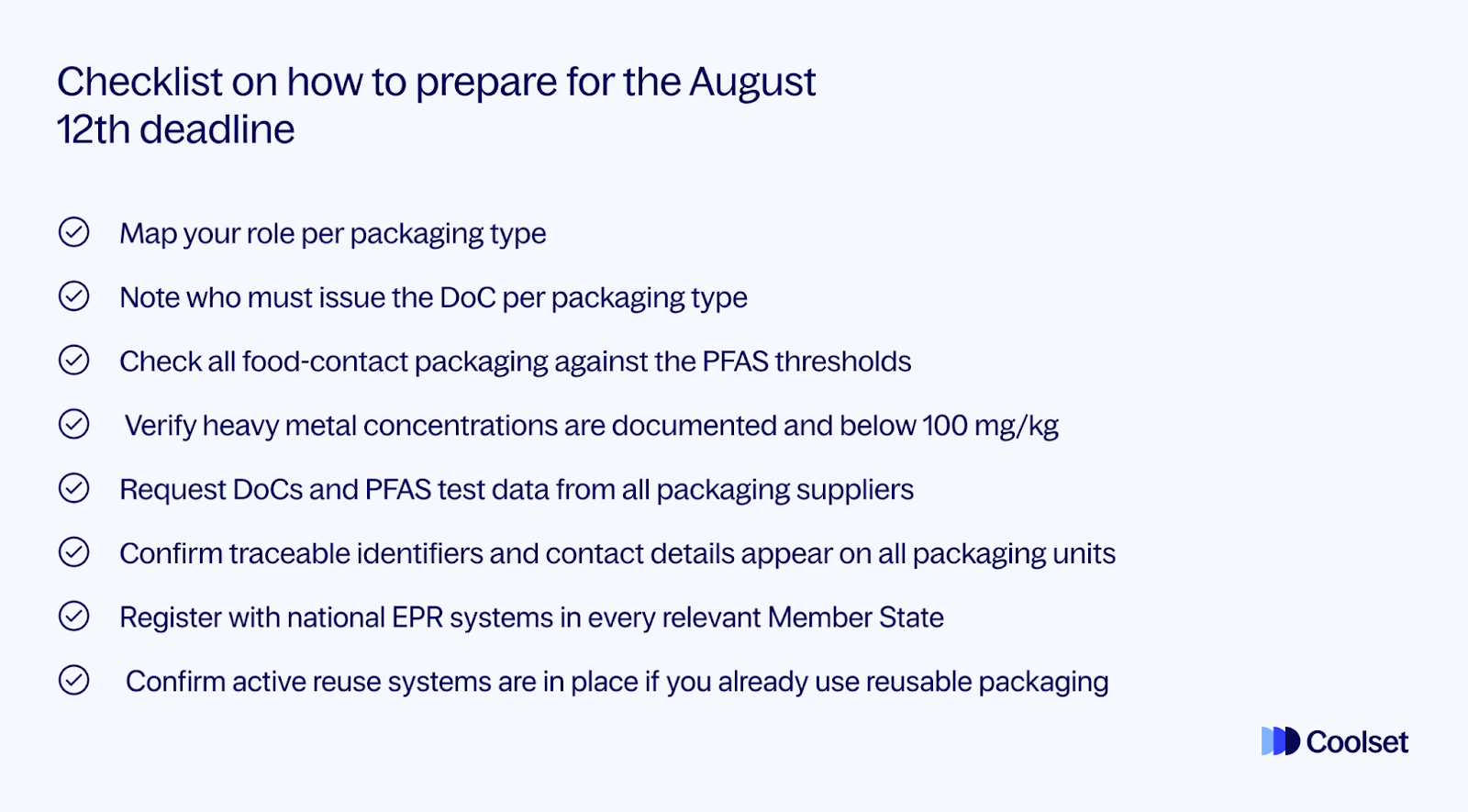
Now to August 2026: Documentation, design and registration
Three workstreams need to close before August 12, 2026.
- Role and scope mapping: Determine which economic operator role applies to your company for each packaging type. This drives every downstream decision: who issues the DoC, what documentation to hold and where EPR obligations sit. See the PPWR roles article for the decision framework.
- Documentation: Collect Declarations of Conformity from packaging suppliers for all packaging types in scope. If your name or brand appears on the packaging, you must issue the DoC yourself. For a step-by-step guide, see PPWR compliance for importers and distributors.
- EPR registration: Register with national EPR systems in each relevant Member State. Registration varies in complexity and lead time
- Also audit your packaging portfolio for PFAS content and substances of concern. Packaging that fails these requirements must be updated or replaced before August 12, 2026.
2026 - 2028: Digital labeling and reuse system planning
Companies with food service or takeaway packaging must begin planning for 2027 and 2028 obligations now. Reuse systems require infrastructure, supplier agreements, return logistics, container management.
Digital labeling with QR codes applies from February 2029. Companies should assess their product data infrastructure so they can accommodate digital identifiers without a full redesign at the deadline.
2028 and beyond: Recyclability assessment and packaging redesign
The 2030 recyclability grade requirements will require many companies to assess and reclassify their entire packaging portfolio. For packaging below grade C, a redesign or supplier change becomes necessary, work that should begin no later than 2027 to allow time for negotiations, testing and transition.
Recycled content targets will also drive supply chain changes for plastic packaging. Sourcing recycled materials in sufficient volumes is already constrained in some markets – making early supplier engagement important.
How does Coolset support PPWR compliance?
Coolset's PPWR module helps compliance teams manage obligations across multiple packaging types, supplier relationships and EU markets.
Key capabilities:
- Packaging portfolio management: track every SKU, its compliance status and upcoming deadline exposure in one place.
- Supplier data collection: request Declarations of Conformity and technical documentation from suppliers at scale, with automated reminders and status tracking.
- DoC management: store and organize Declarations of Conformity by packaging type, with audit-ready formatting and ten-year retention support.
- Conformity monitoring: track which packaging types meet the August 2026 deadline and flag those requiring action before later milestones.
Explore how Coolset helps compliance teams stay ahead of every PPWR deadline.
Frequently asked questions
What is the PPWR compliance deadline?
The primary deadline is August 12, 2026, when most PPWR obligations become enforceable across all EU member states. These include the PFAS ban, empty-space rules, the Declaration of Conformity requirement, EPR registration and reuse systems for reusable packaging. Additional requirements apply in phases from 2027 through 2030.
Is there a grace period after August 2026?
No. Non-compliant packaging cannot be placed on the EU market after August 12, 2026. Stock placed on the market before that date may generally be sold through, but sell-through rules vary by Member State. Companies should verify the position of national authorities in each relevant market rather than assuming a uniform window.
Does the PPWR apply to companies outside the EU?
Yes. Any company placing packaged goods on the EU market, regardless of where it is based, falls within PPWR scope. Non-EU companies must appoint an EU authorized representative to manage EPR registration and reporting, unless an EU importer contractually assumes those obligations.
What does the PPWR require from 2030?
From January 1, 2030, only packaging in recyclability grades A, B or C may be placed on the EU market. Packaging must meet minimum recycled content targets by material type, packaging weight and volume must meet the functional minimum, and online sellers must offer a reusable shipping option at checkout.
How do I know which PPWR obligations apply to my company?
Your obligations depend on which economic operator role applies to your company for each packaging type. Manufacturers, importers, producers and distributors each carry different documentation, EPR and conformity obligations. For a full breakdown, including the Article 21 rule that reclassifies importers as manufacturers, see the PPWR roles article.
{{ppwr-document-checker}}
A guided walkthrough of documentation requirements, Declaration of Conformity and supplier workflows that help you build effective and efficient PPWR compliance.
.webp)

auf mobilen Bildschirmen
um diese Demo zu erleben.


↘ Check if your documentation meets PPWR requirements
This free compliance checker scans your packaging documentation and maps it against mandatory PPWR data requirements, giving you a clear view of your compliance status. Get actionable insights on documentation gaps before they become compliance issues.
PPWR compliance for importers and distributors
Get control of PPWR conformity for the packaging import, distribute and use. Coolset gives importers and distributors the system to collect proof, track conformity and act on risks - across every SKU, supplier and packaging change.
.webp)


