Best 5 ESRS software tools (2026)

January 2, 2026
6
min read

Disclaimer: New EUDR developments - December 2025

In November 2025, the European Parliament and Council backed key changes to the EU Deforestation Regulation (EUDR), including a 12‑month enforcement delay and simplified obligations based on company size and supply chain role.

Key changes proposed:

  • New enforcement timeline: 30 December 2026 for large/medium operators, 30 June 2027 for small/micro operators
  • Simplified DDS: One-time declarations for small and micro primary producers
  • Narrowed scope: Most downstream actors and non‑SME traders would no longer need to submit DDSs
  • New DDS requirement: Estimated annual quantity of regulated products must be included

These updates are not yet legally binding. A final text will be confirmed through trilogue negotiations and formal publication in the EU’s Official Journal. Until then, the current EUDR regulation and deadlines remain in force.

We continue to monitor developments and will update all guidance as the final law is adopted.

Disclaimer: 2026 Omnibus changes to CSRD and ESRS

In December 2025, the European Parliament approved the Omnibus I package, introducing changes to CSRD scope, timelines and related reporting requirements.

As a result, parts of this article may no longer fully reflect the latest regulatory position. We are currently reviewing and updating our CSRD and ESRS content to align with the new rules.

Key changes include:

  • A narrowed CSRD scope, now limited to companies with 1,000+ employees and €450m turnover
  • Delays to CSRD reporting timelines, with wave 2 and 3 reports pushed to 2028/2029 in most cases
  • Simplification of ESRS datapoints

We continue to monitor regulatory developments closely and will update this article as further guidance and implementation details are confirmed.

If your business falls under scope of the Corporate Sustainability Reporting Directive (CSRD), understanding the European Sustainability Reporting Standards (ESRS) is a must. These are the mandatory guidelines your company must follow to comply with the new directive.

While the framework does wonders for standardizing sustainability reporting and improving transparency across Europe, it’s also extremely complex. With 10 topics, 37 subtopics, and 72 sub-sub-topics—adding up to over 1,100 potential data points to report—getting your head around the ESRS is a significant time investment.

Compliance isn't just time-consuming, it can be expensive too. Audit costs alone are estimated to range between 0.013% and 0.026% of revenue—roughly €13,000 to €26,000 annually for every €10 million in revenue. That, paired with penalties for non-compliance reaching up to €10 million in Germany, getting it right is crucial.

Despite the high stakes, 55% of finance executives still admit to relying on outdated methods like spreadsheets to manage environmental, social, and governance (ESG) data. But with data quality reportedly the biggest barrier to ESG investing, it's clear that legacy technology is failing to keep up with today’s stringent reporting requirements.

That’s why many forward-thinking businesses are turning to specialized ESRS software tools to take some of the burden off their shoulders. These platforms automate complex tasks, ensure compliance, and help to keep costs in check. 

In this article, we’ll explore the top five ESRS software tools currently available to help you determine the best fit for your business. You’ll get to know the ins and outs of:

  1. Coolset
  2. Sweep
  3. Position Green
  4. Emitwise
  5. SmartTrackers

Quick recap: what are the ESRS and why are they important?

The ESRS are the detailed guidelines companies in Europe must follow to comply with the CSRD. Developed by EFRAG, these standards help businesses report on ESG impacts in a standardized way, improving transparency and comparability. 

Covering a broad array of sustainability topics, the ESRS enables companies to provide comprehensive disclosures that are crucial for investors, customers, and regulators to make informed decisions.

Below is an overview of the ESRS’s ten topical standards covering ESG topics, as well as two cross-cutting standards covering general requirements and disclosures, applicable to all CSRD-affected companies.

Top 5 ESRS software tools in 2025

Now that we’ve got some background, let’s compare the top five ESRS software tools available right now to help you choose the one that’s right for your business.

1. Coolset

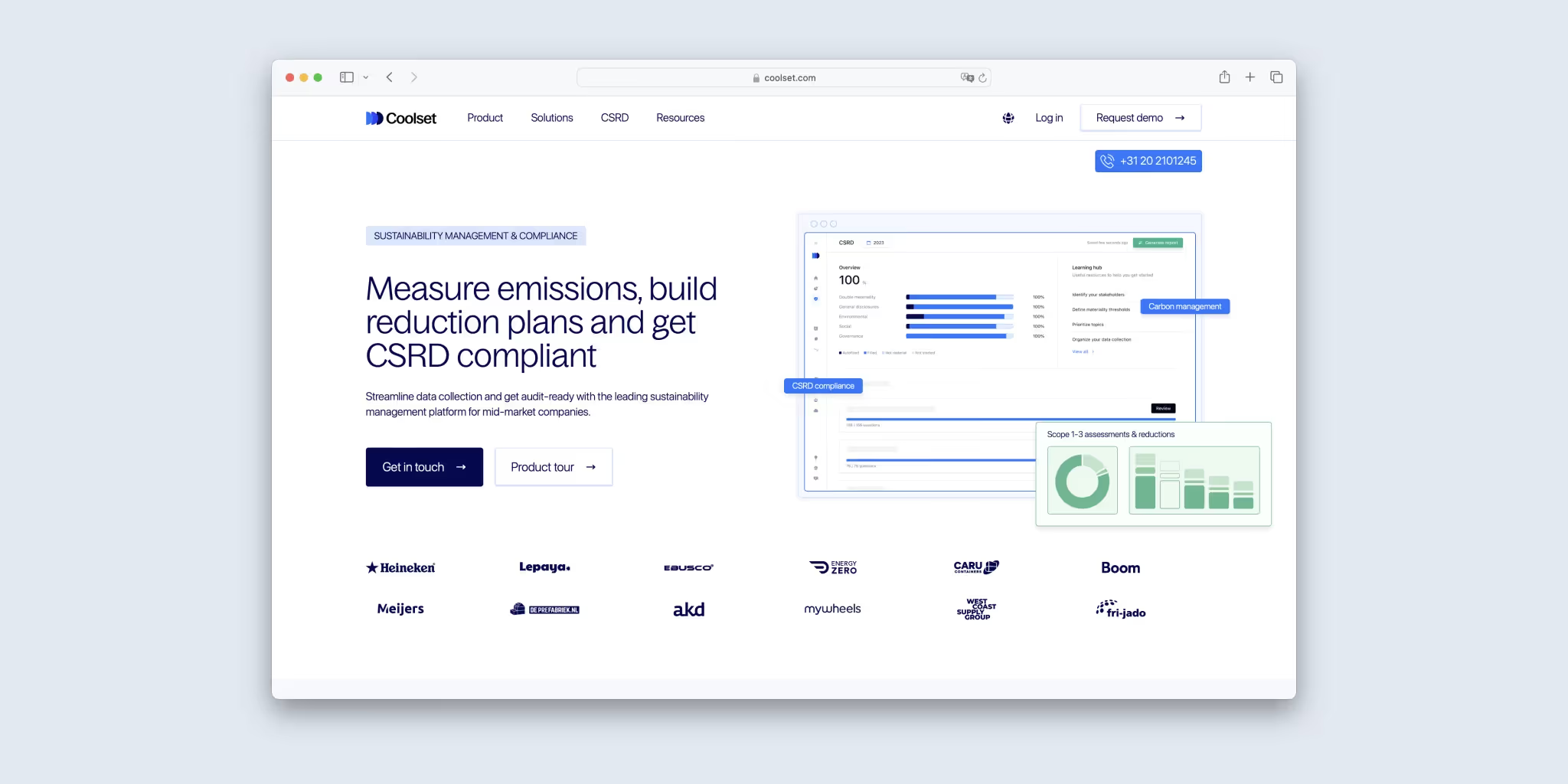
As the publishers of this comparison, we want to be transparent about including Coolset on this list. We believe our platform is a great option for mid-market companies looking for an all-in-one sustainability management and compliance solution.

Whether your focus is on carbon management or achieving ESRS and CSRD compliance, Coolset provides tools and support throughout your entire sustainability journey.

Website: www.coolset.com 

Ideal for: Mid-sized businesses

Key features

  • Scopes 1-3 emissions measurement 
  • Built-in ESRS and CSRD compliance
  • Double materiality assessment support
  • Audit-ready reporting
  • Easy data integration
  • Sustainable alternatives marketplace
  • Supporting evidence attachments

2. Sweep

Sweep is an ESG data management platform that helps large companies track, disclose, and act on their carbon emissions. Designed to streamline compliance with standards like the ESRS and CSRD, Sweep consolidates data from across the organization, reducing reporting time with automated controls and real-time progress tracking. 

Website: www.sweep.net 

Best for: Companies of all sizes

Key features:

  • Real-time ESG data monitoring
  • Integrated supply chain management
  • Compliance with multiple ESG standards
  • Simplified audit readiness
  • Comprehensive dashboards and AI-driven insights

3. Position Green

Position Green is an ESG management platform that supports global enterprises in tracking, reporting, and improving their sustainability performance. With built-in best practices and a focus on reducing manual tasks, it helps companies transform their ESG data into a competitive advantage.

Website: www.positiongreen.com 

Ideal for: Large enterprises across various sectors

Key features:

  • In-depth carbon accounting
  • CSRD and ESRS reporting support
  • Supplier assessment tools
  • ESG performance tracking, visualization, and forecasting
  • Data integration and analysis
  • Advisory services

4. Emitwise

Emitwise is a carbon management platform that helps businesses to measure, track, report, and reduce their environmental footprint, with a focus on Scope 3 emissions. From automating data processing to supporting smarter procurement decisions, Emitwise takes on the heavy lifting, allowing companies to focus on carbon reduction effectively.

Website: www.emitwise.com

Ideal for: Companies with complex supply chains or significant Scope 3 emissions
Key features
:

  • Detailed Scope 1-3 carbon accounting
  • CSRD-compliant reporting
  • Supplier management tools for decarbonization
  • Automated data validation and audit readiness
  • Financial-grade emissions accuracy

5. SmartTrackers

SmartTrackers is a versatile sustainability platform that enables businesses to measure their environmental impact, safety practices, and CO2 emissions. It provides clear insights to support accountability and compliance with industry standards and regulations. With a focus on customizability and flexible data entry, SmartTrackers adapts to various reporting needs.

Website: www.smarttrackers.nl 

Ideal for: Organizations of all sizes across various sectors

Key features:

  • Carbon tracking for Scopes 1-3
  • Customizable KPIs and reporting
  • Supplier engagement
  • Audit-ready documentation
  • CSRD compliance support
  • Real-time performance monitoring

How to choose the best ESRS software tool

Now that we’ve got an overview of the top tools on the market, let’s take a look at the key factors to keep in mind when selecting ESRS software:

1. Regulatory compliance

While it might sound obvious, it’s important that your software supports ESRS and CSRD compliance. Look for features like double materiality assessment support, adaptive ESRS disclosures, and audit-ready reporting in .XBRL format

2. Data collection and integration

Choose software that automates Scope 1, 2, and 3 data collection and validation. Make sure it integrates with your existing systems to reduce manual work and minimize errors.

3. Standards compliance

Look for adherence to standards like the Greenhouse Gas Protocol (GHGP) to ensure data reliability. You should also check if the software itself is certified. For example, Coolset’s carbon management methodology is TÜV Rheinland certified for Scope 1-3 measurements under the GHGP which can boost the credibility of your data.

4. Audit trails and documentation

Opt for ESRS software with built-in audit trails. Being able to track data changes and user actions can simplify the verification process and reduce audit costs.

5. Workflow efficiency and automation

Look for software that automates the most time consuming tasks like data collection and report generation.

6. Scalability and flexibility

Choose scalable software that adapts to your business growth and evolving regulations, with customizable reporting options.

7. Real-time monitoring

Look for tools that provide real-time data on key sustainability metrics, allowing continuous progress monitoring and informed decision-making.

8. System integration

Ensure the software integrates with your current systems (like energy management, supply chain, and finance) to unify data flow and enhance accuracy.

9. Cost and budget

Pick a solution that fits your budget, offering scalable features that can expand as your needs grow.

10. Support and resources

Choose platforms with solid support—blog posts, webinars, and a knowledgeable team—so you stay ahead of new requirements.

Why Coolset is the best choice for sustainability compliance

When it comes to complying with the EU’s new sustainability reporting standards, using the right ESRS software is crucial. We hope this guide has given you the insights you need to choose the best tool for your business.

Coolset’s ESRS software offers all of the essential features discussed above, from automating data collection to producing audit-ready reports, making ESRS compliance simpler and faster while minimizing the chance of errors.

Want to see how it works? Check out our interactive demo below or request a personalized walkthrough to see how Coolset can help you stay ahead of ESRS requirements and keep your sustainability efforts on track.

{{product-tour-injectable}}

See Coolset in action
Explore Coolset's top features and use cases.
Demo is not supported
on mobile screens
Please come back on a larger screen
to experience this demo.
This is a preview window. Click below to see the demo in a larger view.
See product tour
See product tour
See product tour
See product tour
See product tour
See product tour

↘ Instantly calculate your CBAM cost impact

Use the free calculator to estimate your Carbon Border Adjustment Mechanism costs for any imported goods. Select your product type, volume and country of origin to see projected CBAM charges and understand how upcoming EU rules will shape your import costs and savings through 2034.

The leading ESG platform for mid-market enterprises