Was ist die EU-Holzhandelsverordnung und wer muss sie befolgen?

December 16, 2025
10
min. Lesezeit

Disclaimer: New EUDR developments - December 2025

In November 2025, the European Parliament and Council backed key changes to the EU Deforestation Regulation (EUDR), including a 12‑month enforcement delay and simplified obligations based on company size and supply chain role.

Key changes proposed:

  • New enforcement timeline: 30 December 2026 for large/medium operators, 30 June 2027 for small/micro operators
  • Simplified DDS: One-time declarations for small and micro primary producers
  • Narrowed scope: Most downstream actors and non‑SME traders would no longer need to submit DDSs
  • New DDS requirement: Estimated annual quantity of regulated products must be included

These updates are not yet legally binding. A final text will be confirmed through trilogue negotiations and formal publication in the EU’s Official Journal. Until then, the current EUDR regulation and deadlines remain in force.

We continue to monitor developments and will update all guidance as the final law is adopted.

Wichtige Erkenntnisse:
  • EUTR gilt pro Transaktion; Unternehmen können je nach Beschaffung als Betreiber oder Händler agieren
  • Betreiber müssen ein Sorgfaltspflichtsystem betreiben, das Legitimationsprüfungen, Risikobewertungen und -minderungen umfasst
  • Händler konzentrieren sich auf Rückverfolgbarkeit und führen Lieferanten- und Kundenaufzeichnungen für Inspektionen
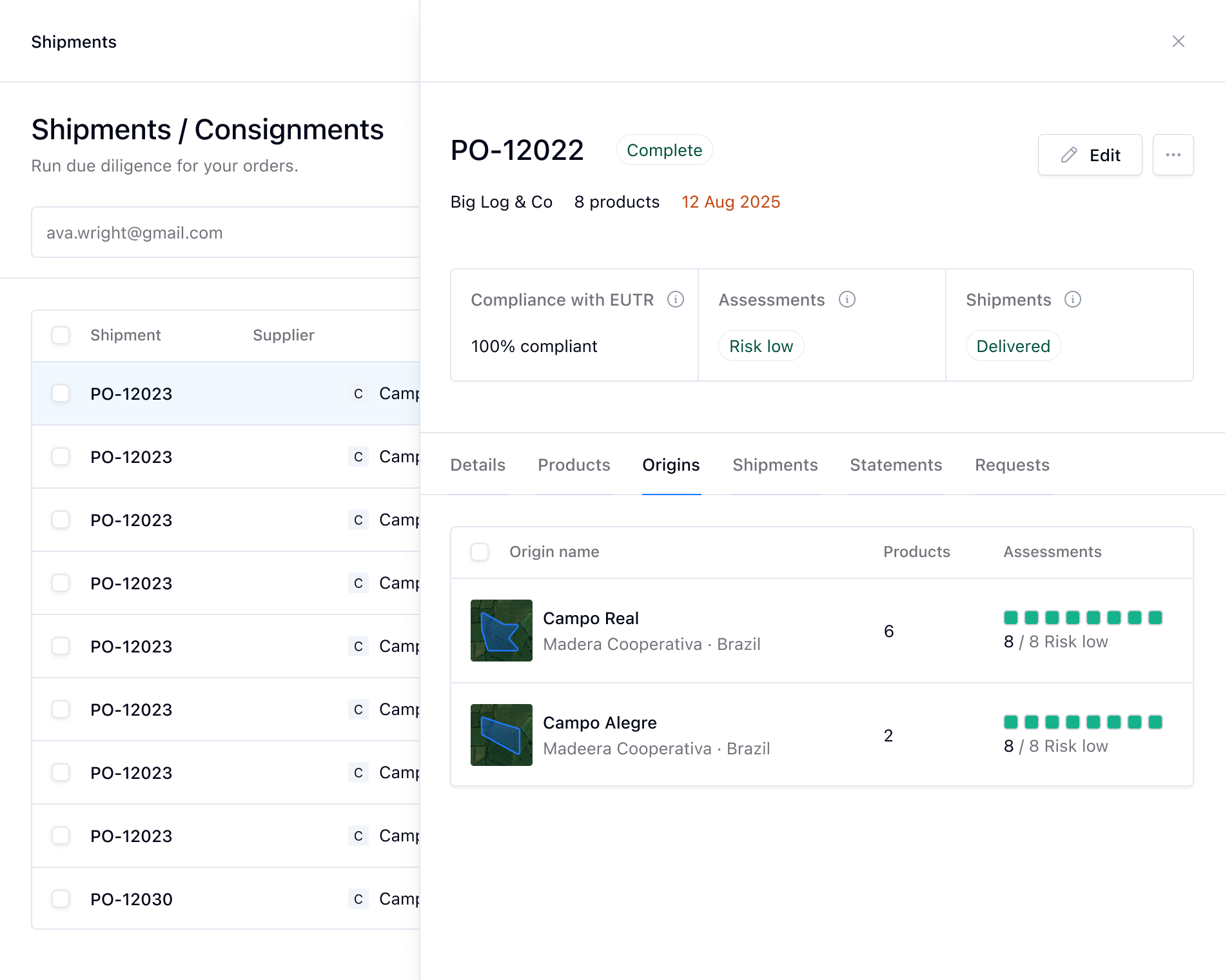
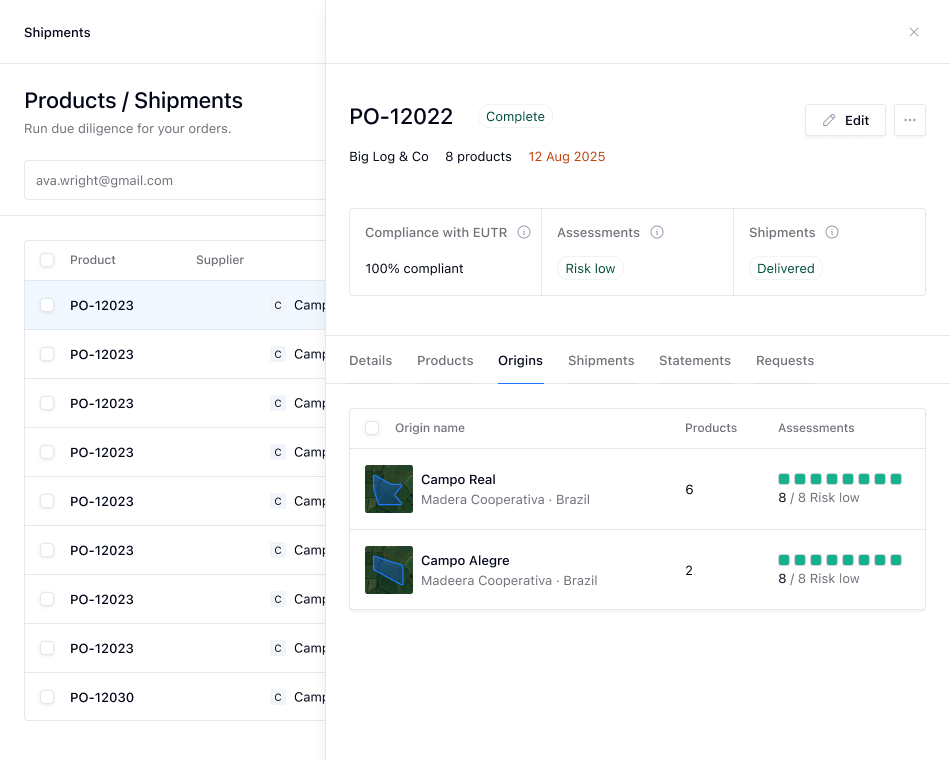
  • Coolset zentralisiert EUTR-Compliance, verwaltet Sorgfaltspflicht und bereitet Teams auf EUDR in einem System vor

The EU Timber Regulation (EUTR) aims to counter illegal logging and trading of timber products in member states of the European Union, and developed out of the EU’s Forest Law Enforcement, Governance and Trade (FLEGT) action plan. It was adopted in December 2010, and entered into force on 3 March 2013. 

The regulation applies to both ‘operators’ and ‘traders’; the former referring to companies who first place timber or wood products on the EU market, the latter those who trade goods already placed on the market.

In short, any business placing in-scope timber on the EU market must follow the EUTR. Any trader handling these products must maintain and pass on records.

Who is considered an operator under EUTR?

An operator under EUTR refers to any natural or legal person that places timber or timber products on the EU market for the first time.

Examples of operators include:  

  • A Dutch importer placing birch plywood from Asia into the EU market
  • A French forestry company harvesting logs domestically and selling to a sawmill
  • A manufacturer sourcing wood pulp from outside the EU to make packaging sold in the EU

Who is considered a trader under EUTR?

Traders under EUTR are natural or legal persons who buy or sell timber or timber products that have already been placed on the EU market. For example, wholesalers reselling sawn wood within the EU, or furniture retailers operating only within the EU.

Examples of traders include:

  • A wholesaler buying sawn pine from an EU operator and reselling it
  • A retailer selling imported furniture already placed on the market by an operator

What timber products are covered by the EU Timber Regulation

The EUTR applies to product categories listed in the Annex of Regulation (EU) 995/2010, covering timber and timber-related products. The annex determines products by Combined Nomenclature (CN) code, and includes logs, sawn wood, plywood, densified wood and barrels. 

However, the regulation recognises the importance of encouraging the use of recycled products, and excludes products that have completed their lifecycle from the scope of the regulation. Therefore, recycled timber and timber products are excluded from the scope of EUTR.

Companies should verify CN codes against Annex I when determining whether products and legacy stock are subject to EUTR.

What are the responsibilities of operators and traders under the EUTR

The EUTR has differentiating responsibilities for operators and traders, and it is important to understand your role for each order. Companies can be both operators and traders, with the responsibilities varying on order level. 

For example, a furniture company based in France would have operator obligations for any timber it imported from outside of the EU and first placed on the internal market, but trader responsibilities if that timber came from Germany for example. 

Operators

The obligations of operators are more comprehensive than that of traders. Operators should refrain from placing illegally harvested timber and timber products on the market, and must conduct due diligence when first placing products on the EU market. 

Operators must:

  • Establish and maintain a due diligence system
  • Collect information on species, quantity, supplier, and country/region of harvest
  • Obtain and verify documentation proving legality
  • Conduct a risk assessment to determine risk of illegal harvesting
  • Map the supply chain of the timber or timber products
  • Apply risk mitigation measures where risk is not negligible
  • Keep records of due diligence activities for at least five years
  • Cooperate with competent authorities during inspections

Operators are required to use a framework of procedures and measures, a ‘due diligence system’, to exercise due diligence on relevant products. To get step-by-step guidance how to prepare for the transition between EUTR and EUDR, download our free guide.

{{custom-cta}}

Traders

Traders are any companies who buy or sell relevant products that have already been placed on the internal market. Their responsibilities emphasise traceability, ensuring that they record and maintain records of the names and addresses of those who supplied them with products, and those they supplied the products to. 

Traders must:

  • Record from whom timber products were purchased and to whom they were sold.
  • Retain these records for at least five years to ensure traceability.
  • Transmit information to competent authorities upon request.

A single company can act as both operator and trader depending on the transaction. This distinction determines which EUTR obligations apply.

Who holds responsibility for EUTR compliance inside companies

EUTR responsibilities vary between roles under the regulation. Traders are required to simply hold onto and pass on records, whilst operators must establish and maintain a Due Diligence System. Where responsibility for EUTR compliance is held within companies often depends on your due diligence requirements under the regulation. 

If your company is a trader, the EUTR responsibilities are limited. Therefore, it is likely that EUTR responsibilities will fall with operations or logistics. They will be responsible for collecting and maintaining -  for each order - the names and addresses of both the operators who supplied the timber (products), and the traders to whom they have supplied the timber (products). This information will likely be easily retrievable from existing data used in everyday business operations. 

Those who have operator responsibilities may choose to divide the responsibilities between teams. This is particularly common for large corporations who are dealing with many orders of timber or timber products, occasionally a timber compliance lead may be appointed. Assigning clear ownership across teams is important to ensure compliance and audit-readiness, whilst not sacrificing on efficiency.

Typical internal responsibilities may be structured as follows. Procurement are responsible for collecting legality documents and supplier evidence. Sustainability or ESG teams maintain the Due Diligence System (DDS), conduct risk assessments and align with broader frameworks such as the Corporate Sustainability Reporting Directive (CSRD). Teams from legal and compliance may be drawn in to review contracts, update supplier terms and support with audit responses, whilst logistics track shipments and ensure documentation matches material flows. 

Diversifying responsibility across a company can be effective in reducing the burden of reporting, but it also runs the risk of information being dispersed and incoherent. Using a software platform can centralise your data, and allow multiple stakeholders to work on ensuring EUTR compliance synchronously.   

What does an EU Timber Regulation due diligence system require

Due diligence under EUTR is built on three steps: information gathering (Article 6a), risk assessment (Article 6b), and risk mitigation (Article 6c). The system must be documented and updated regularly, or operators can use a due diligence system established by a monitoring organisation. 

What information must companies collect

For every transaction, operators must provide general information identifying their timber products, alongside evidence to prove the timber was legally harvested. 

The required information includes:

  • Country of harvest (sub-national region / concession if applicable)
  • Harvesting permits and land rights documentation
  • Species and commercial description
  • Quantity
  • Names and details of suppliers in the chain
  • Supplier and customer details
  • Evidence demonstrating compliance with national legislation on harvest rights, fees, environmental protections, and labor laws

How to assess and document risk

For timber and timber products subject to the EUTR, a risk assessment must be conducted to evaluate whether there is a risk that the timber may have been harvested illegally. A negligible risk conclusion must be justified before placing products on the internal market. 

The exception to this rule is if the product is accompanied by a valid FLEGT or CITES certificate. If so, the timber or timber product is considered to have been legally harvested, and no further risk assessment is required under EUTR. 

The risk assessment should account for information collected in Article 6a, such as legality documents, as well as assessing:

  • Prevalence of illegal logging in the region
  • Corruption level and governance indicators
  • Prevalence of armed conflict
  • Sanctions imposed by the UN Security Council or Council of EU on timber
  • Complexity of supply chain and number of intermediaries
  • Any inconsistencies or gaps in supplier documentation
  • Third-party assessments or certification claims

Only if all risks are considered negligible can products be placed upon the market. If any risk is identified as non-negligible, risk mitigation measures should be taken.

What risk mitigation measures can companies use

Mitigation measures should be taken to ensure that no illegally harvested timber is placed upon the market. The mitigation procedures should be adequate and proportionate to effectively minimise the risk, and may include:

  • Requesting supplementary information from suppliers
  • Conducting independent audits
  • Providing further documentation to evidence legality
  • Excluding high-risk suppliers
  • Using third-party verification schemes

Once the risk of illegal harvesting has been mitigated adequately, products may be placed on the market. 

How to maintain records and prepare for audits

EUTR requires companies to maintain relevant records for a minimum of five years. For traders, the documentation to maintain is limited to supplier and customer records for each order - which should be provided to competent authorities on request. For operators, the records to be maintained include:

  • All due diligence documentation
  • Risk assessments and mitigation evidence
  • Supplier communications
  • Results from third-party audits or verifications
  • Contracts referencing legality requirements

Clear documentation supports oversight by Member State authorities during inspections.

How often should I apply the due diligence system

Following the EUTR Amendments 607/2012, the due diligence requirement should be applied to each specific type of timber or timber product supplied by a particular supplier, within every 12 months. This assumes that the tree species and the country or concession of harvest remain the same during this 12 month period. Therefore, whilst the due diligence does not have to be performed on every transaction, the amendments do require the information details (Article 6a) to be provided for each order. Practically, this means ensuring that the relevant information outlined above can be accessed for every order. 

How is the EU Timber Regulation enforced and what are the penalties

Enforcement of the EU Timber Regulation is carried out by national competent authorities through risk-based checks on both operators and monitoring organisations. Authorities verify whether operators comply with Articles 4 and 6 by reviewing their due diligence systems, assessing risk analysis and mitigation procedures, examining supporting documentation, and conducting spot checks or field audits. 

Checks follow a documented inspection plan and may also be triggered by relevant information or substantiated concerns raised by third parties. Operators must provide full access to premises, documentation, and records. Typical checks include:

  • Examining legality documentation
  • Verifying harvest permits and supply chain records
  • Reviewing risk assessments
  • Conducting visits to operators or traders
  • Cross-checking evidence with third-country authorities

When shortcomings are identified, authorities may issue remedial action notices and, where necessary, impose interim measures such as seizing timber or prohibiting products from being placed on the market. Typical penalties may include:

  • Monetary fines
  • Confiscation of timber
  • Temporary prohibition from placing timber on the market
  • Corrective action orders requiring improved due diligence

In parallel, authorities must also inspect recognised monitoring organisations at least once every two years, as required by the amended legislation. These checks occur more frequently where issues have been detected in operators’ use of a monitoring organisation’s due diligence system.

EUTR enforcement continues until the regulation sunsets in 2028. 

What are the challenges of EUTR compliance

Companies complying with EUTR may face several challenges, including incomplete legality documentation from upstream suppliers, limited visibility into early-stage harvesting operations, and confusion created by the overlap between EUTR and EUDR requirements. Manual documentation processes make audit preparation difficult, and many legacy certificates do not meet today’s due diligence expectations. Standardized document requests, centralized evidence storage, and integrated traceability workflows can help companies address these gaps while building systems that also support future EUDR compliance.

What is the difference between the EUTR and the EUDR

The EUTR focuses on legality of timber harvesting. The EUDR expands the legislation, and  introduces deforestation-free requirements, geolocation data, plot-level traceability, and a broader product scope. 

Key differences

The EUTR’s narrower focus and lower data requirements mean companies transitioning to EUDR must expand their traceability systems, adopt geolocation-based workflows, and prepare for stricter evidence standards.

What applies now: EUTR vs EUDR timelines explained

The implementation of EUDR formally replaces and repeals EUTR. The current implementation date for EUDR is 30 December 2025, however this is under debate, and likely subject to a one year delay. Using this time to prepare for the transition to EUDR is valuable, as the complexity and requirements significantly increase. 

EUTR to EUDR transition timeline

  • EUTR ends on 30 December 2025, when EUDR comes into force, but
  • Lives on until 31 December 2027 for old timber (harvested before 29 June 2023)
  • From 31 December 2027, all timber on the EU market must meet EUDR’s deforestation-free rules

Overlap scenarios that could occur include. A company may handle:

  • EUTR-regulated legacy timber requiring legality due diligence
  • EUDR-regulated new timber requiring geolocation, plot-level traceability, and DDS submission

This overlap requires dual systems and clear product classification.

How to comply with the EU Timber Regulation in 2025

Companies must maintain an effective DDS for all EUTR-regulated goods and prepare teams for the shift to EUDR data requirements.

1. Confirm whether products fall under EUTR

  • Match CN codes to Annex I.

2. Determine your role

  • Operator or trader per transaction.

3. Update your due diligence system

  • Collect legality documentation.
  • Record country, region, species, and harvesting rights.
  • Document your risk assessment.

4. Strengthen risk mitigation

  • Use independent verification where needed.
  • Address documentation gaps.
  • Update supplier terms to reflect EUTR obligations.

5. Prepare for inspections

  • Maintain records for five years.
  • Store documents centrally and ensure accessibility.
  • Train internal teams on evidence requirements.

6. Build transition workflows for EUDR

  • Begin mapping geolocation requirements for timber harvested after 2020.
  • Assess the feasibility of supplier data collection.
  • Extend your due diligence system to allow for deforestation risk assessments and further due diligence.

FAQ

Is there an official EUTR certificate?
No. Compliance is demonstrated through a due diligence system and records, not a certificate issued by authorities.

Who must comply with the EUTR in 2025
Any operator placing timber on the EU market and any trader handling those goods.

Is the EUTR still valid?
Yes. It remains valid until the EUDR formally repeals it, and for legacy timber until 31 December 2028.

How does EUTR differ from EUDR?
EUTR focuses on legality. EUDR adds deforestation-free requirements, geolocation data, mandatory due diligence statements, and a broader product list.

Do traders need to conduct due diligence under EUTR?
No. Traders must maintain and pass on records but do not perform full due diligence.

Download our EUTR to EUDR downloadable

How to prepare your data, systems and processes for the transition

See Coolset in action
Explore Coolset's top features and use cases.
Demo wird nicht unterstützt
auf mobilen Bildschirmen
Bitte kommen Sie auf einem größeren Bildschirm zurück
um diese Demo zu erleben.
This is a preview window. Click below to see the demo in a larger view.
See product tour
See product tour
See product tour
See product tour
See product tour
See product tour

↘ Instantly calculate your CBAM cost impact

Use the free calculator to estimate your Carbon Border Adjustment Mechanism costs for any imported goods. Select your product type, volume and country of origin to see projected CBAM charges and understand how upcoming EU rules will shape your import costs and savings through 2034.

EUDR Compliance Checker
EUDR Checker Icon

Know your EUDR obligations

Answer a few quick questions to identify your role in the EUDR supply chain, your compliance deadline, and the exact steps you need to take. No e-mail required.

Your EUDR compliance status

Comply with EUTR and EUDR in one platform

Trace your products, collect supplier documentation, run legality checks and generate complete, reliable audit trails in one platform.
Das leading Plattform für Nachhaltigkeitsmanagement für mittelständische Enterprises